COPPER

A PS Audio Publication

Issue 166 • Free Online Magazine

Issue 166 Speaker Stories

A Loudspeaker Company Grows in Brooklyn

A Loudspeaker Company Grows in Brooklyn

It’s been a while since someone from Copper last visited DeVore Fidelity in New York City. By the time Bill Leebens went out to Brooklyn Navy Yard in 2016, John DeVore had already been building speakers for 16 years and was well regarded for his reviewer-darlings, the Gibbon Series. While I have nothing against these tall narrow towers, my aesthetic leans towards the boxier Orangutans. Leebens’ article (in Issue 19) mentions an “Uber-Orangutan” being in the works, and when I recently trekked to the former shipyards on the East River, I was expecting to audition the final result of a fully-tweaked top-of-the-line Orangutan Reference system, which I had previewed at the Rocky Mountain Audio Fest in 2018.

The four-piece O/Ref costs $88,900 and comprises nearly 500-pounds of wood, bronze, brass, and hardware spread across a pair of three-way speakers, each with a tweeter, super tweeter, and 10-inch woofer, plus two “Bassmachines” (subwoofers), both loaded with a 700-watt amp, 11-inch woofer, and 11-inch passive radiator. A massive array like that would definitely be installed in an acoustically perfect audio salon with equally expensive and esoteric amps, or so I thought.

There was no such showroom. DeVore Fidelity is a fully-functioning production facility stacked high with planks, drivers, raw cabinets from Box Furniture Company next door, and works in progress like an O/93 ($8,825/pair) on which employees Jenny and Dahlia were clamping a freshly-polyurethaned baffle. At the other end of the workshop is the “Monkeyhaus,” an office for John, but for a fellow audio geek, it’s nirvana in a 14- by 26-foot room with 10-foot ceilings, hardwood floors, and simple sheathing panels for walls. It’s also an encouraging sight for anyone thinking they can’t carve out their own slice of heaven in a loft, basement, or spare room with a few throw rugs and acoustic panels.

Aside from a computer workstation and lots of prime gear on racks from Box Furniture Co., the space is a mecca of music, with about 10,000 LPs, 45s, and 78s; tapes, both reels and cassettes; plus terabytes of digital files. At the far end, against a short wall, stood the famous O/96, DeVore’s bestselling two-way work of art with simple lines, a 10-inch woofer, and many layers of lacquer applied by hand over customizable veneers. The price of the O/96 starts at $13,200, and they’re back-ordered well into 2023. Unfortunately, there was no trace of the Bassmachines.
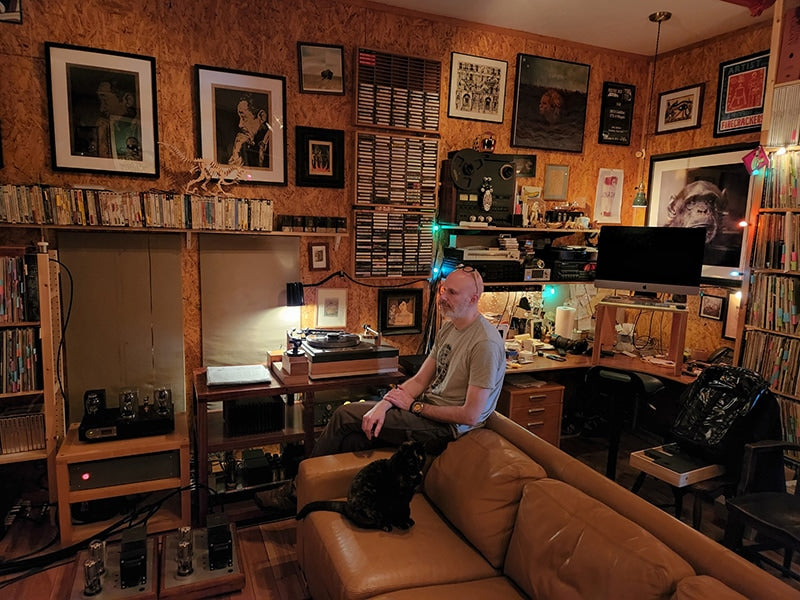
 

John DeVore. Courtesy of Tom Methans.

John DeVore. Courtesy of Tom Methans.


What John had set up for that day was the O/baby. Instead of continuing along the grand scale, he went smaller – as small as the micr/O, a 10 by 10 by 10-inch ($3,950) cube for shelves and near-field desktop listening. I think a hot-rodded six-cabinet set would be so fantastic, but I should defer to John regarding design and marketing: he built his first speakers while studying at the Rhode Island School of Design in the 1980s and was also a salesman at two landmark stores in Manhattan, Stereo Exchange and Sound by Singer. On top of that, John is a musician and a voracious consumer of all kinds of music.

The O/babys are 14.75 inches wide x 9.75 inches deep by 35 inches high and weigh less than 40 lbs. each. The height includes 12-inch oak stands – DeVore’s are optional at $995, but any wooden stand will do. I had no doubt the speaker would sound good, especially when I learned it was a junior version of the O/96. Priced at $5,700, O/baby is a minimalist speaker with a 0.75-inch thick baffle of birch ply under a blond oak veneer, creating a nice contrast to the dark gray cabinet. The drivers, built to DeVore specifications, are a 0.75-inch Vifa Danish textile-dome horn-loaded tweeter and a 7-inch SEAS paper woofer from Norway. Positioned closely together at the top of the speaker, both drivers fire directly at your ears.


O/baby. Courtesy of DeVore Fidelity.

O/baby. Courtesy of DeVore Fidelity.


As I sat on the couch snuggled with my new best friend, Roxy, the internet-famous cat, John spun the James Gang’s “Funk #49” (1970) on his homemade three-tonearm turntable. The track has a pronounced left/right channel separation and sounded like Joe Walsh’s gritty guitar amp was crunching its way into the room through the right speaker, but at 2:12 minutes, the song turned holographic with an avalanche of drums. O/baby played this classic rock James Gang cut with ease, and I’m sure they can even deliver Limp Bizkit if you wanted, but I wouldn’t use them as blasters. O/baby speaks a warmer, more emotive language, as evidenced by the jazz fusion cut from “The Dawn” (1998) by Erik Truffaz on Blue Note records. Expression and imaging increased as the musical landscape opened up with a better recording. Whereas “Funk #49” sounded like it was a final mix coming at me from an engineer’s booth, “The Dawn” made me feel like I was in-studio, live with the musicians, enveloped by the sweetness of a moody trumpet, funky keyboards, velvety bass, and the tight sizzle-thump of percussion.
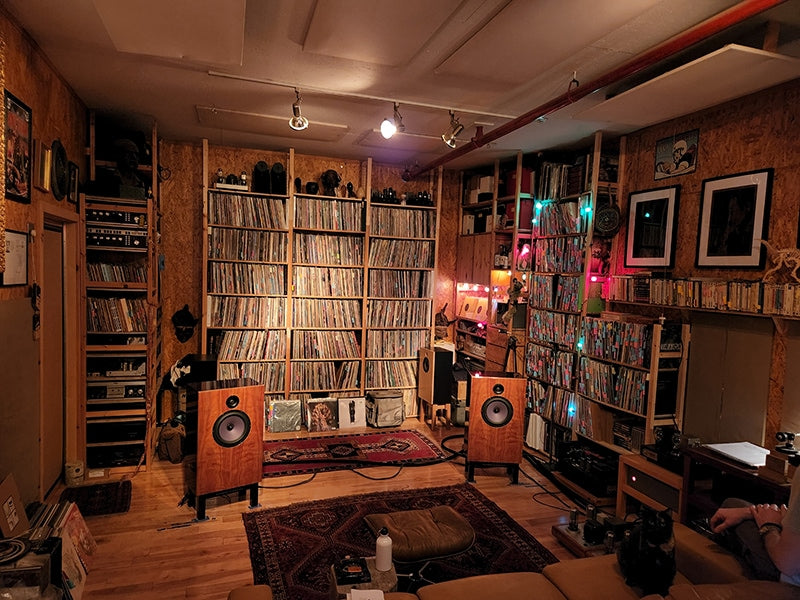
 

O/96 speakers in the listening room. Courtesy of Tom Methans.

O/96 speakers in the listening room. Courtesy of Tom Methans.


Driving the Babys was a vintage set of 55-watt per channel Komuro Push-Pull 845 monoblock amps worth around $15,000 per pair – but that’s in 1990s dollars! Wasn’t that overkill for those little speakers? I still remember a stereo salesman’s advice from my youth: buy the most expensive speakers you can afford, spend half that amount on the receiver, and finally, a quarter amount each on a tape deck and turntable. DeVore customers, on the other hand, are likely to fall in love with a particular model and then spend many times more on amplification, but you don’t have to. O/baby is meant to pair with almost anything, including tubes, solid-state, Class A, Class D, affordable, lavish, and even those compact desktop integrated amp/DAC combos. Nevertheless, I could have listened to the Komuro monoblocks and O/babys for hours while discovering new records from the Monkeyhaus library.

Despite my adoration of mega speakers, I thought about the performance, practicality, and magic of expertly crafted smaller ones. In fact, one of my all-time favorites, a pair of diminutive Spica TC-50s, which I had for 20 years, were two-way wedges with 6.5-inch woofers, and they were perfectly suited to my different apartments, equipment, and listening habits. The O/baby is in a different class and at the opposite extreme of price range (the TC-50 sold for $450 per pair in 1984), but DeVore’s design, craftsmanship, and flexibility with amplifiers should certainly keep audiophiles happy for many years through multiple equipment upgrades and any changes in musical preferences.
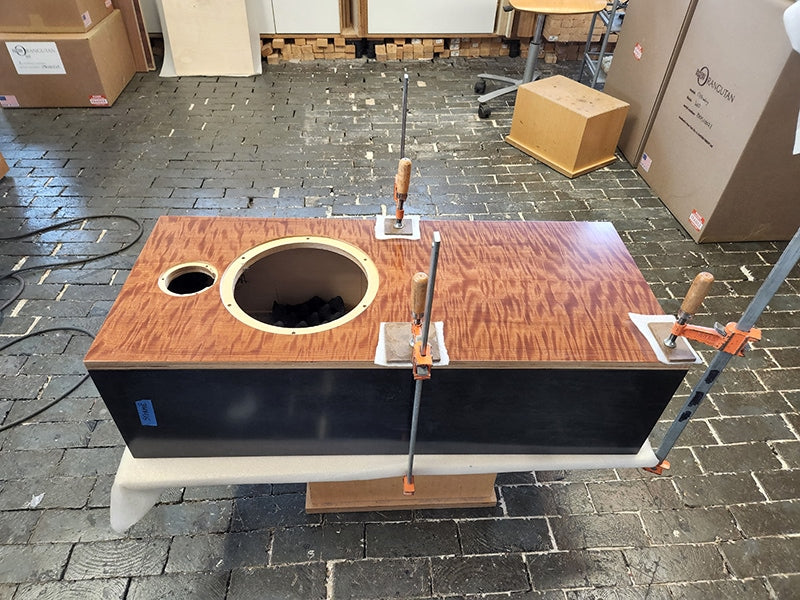
 

An O/93 being built. Courtesy of Tom Methans.

An O/93 being built. Courtesy of Tom Methans.


I will repeat and answer Bill Leebens’ question from many years ago, “So, what does the future hold for DeVore Fidelity?” Well, in the short term, the 6-watt Komuro K300S SET amplifier priced at $20,000. Yes, DeVore will make amplifiers in Brooklyn under the brand name Komuro Amplifier Company. In addition to being long-time friends, John considers engineer Nori Komuro as one of the greatest tube amp makers. So, John purchased Komuro’s circuit designs and is almost ready to ship the handmade K300S, housed in a birch ply chassis sandwiched between aluminum and steel plates. It features custom transformers, and hard-wiring, with not a single printed circuit board or capacitor to stand between the source and speaker. Beyond that, single-ended 845 monoblocks and push-pull 845 monoblocks are planned to follow. Also, as impressive as the three-arm turntable is, John insists he has no interest in entering the turntable business. However, designers live to design, and I can’t wait to see what he does next.

While I never heard the O/Ref system that day, I got a better sense of the brand after examining and listening to the other pieces. And I can’t help but think there’s something else – something intangibly special about DeVore Fidelity. It feels like John and his crew imbue each build with genuine heart, soul, and a Brooklyn elan that transcends its physical qualities. It’s quite possible I was intoxicated by carpenter’s glue, polyurethane, and shiny veneers. I can’t be sure, so that’s why everyone should make a point to audition DeVore equipment for themselves.

DeVore Fidelity
63 Flushing Ave., Unit 259
Building 280, Suite 510
Brooklyn, NY 11205
(718) 855-9999
info@devorefidelity.com

Header image: DeVore O/baby loudspeaker. Courtesy of DeVore Fidelity.

More from Issue 166

View All Articles in Issue 166

Search Copper Magazine

#230 Camaraderie by B. Jan Montana May 04, 2026 #230 AXPONA 2026: A Family Gathering by Paul McGowan May 04, 2026 #230 Pianist Ryan Benthall Explores Jazz Realms and Far Beyond With Divine Sky by Frank Doris May 04, 2026 #230 The Vinyl Beat in AXPONA-Land by Rudy Radelic May 04, 2026 #230 Teddy Thompson’s Musical Growth Deepens With Never Be the Same by Ray Chelstowski May 04, 2026 #230 More Fun in the Sun: Florida Audio Expo, Part Two by Frank Doris May 04, 2026 #230 CanJam NYC 2026 Show Report: Heady Sound, Part Two by Frank Doris and Harris Fogel May 04, 2026 #230 Sonic Youth On Murray Street by Wayne Robins May 04, 2026 #230 Graffeo Coffee: A Symphony of Sensory Experience by Joe Caplan May 04, 2026 #230 The Saul Authority: The Story of Hi-Fi Pioneer Saul Marantz by Olivier Meunier-Plante May 04, 2026 #230 How to Play in a Rock Band, 23: Encounters With Famous Musicians, Part Two by Frank Doris May 04, 2026 #230 An Outlier in the Rack: A Vintage BIC Beam Box by The Staff at Just Audio May 04, 2026 #230 PS Audio in the News by PS Audio Staff May 04, 2026 #230 A Cautionary Tale by Rich Isaacs May 04, 2026 #230 Reel-to-Reel Roots, Part 33 (Revised): Ken Kessler Reports On the 2026 (British) AudioJumble by Ken Kessler May 04, 2026 #230 Text Messaging by Frank Doris May 04, 2026 #230 The Audiophile Rat Race by Peter Xeni May 04, 2026 #230 On the Rocks by Rich Isaacs May 04, 2026 #229 The Earliest Stars of Country Music, Part Three by Jeff Weiner Apr 06, 2026 #229 The Healing Power of Music and Sound at the Omega Institute by Joe Caplan Apr 06, 2026 #229 CanJam NYC 2026 Show Report: Heady Sound, Part One by Frank Doris Apr 06, 2026 #229 Florida Audio Expo 2026: Warming Up to High-End Audio, Part One by Frank Doris Apr 06, 2026 #229 Quick Takes: Anne Bisson, Sam Morrison, The Velvet Underground, and the Stooges by Frank Doris Apr 06, 2026 #229 The Vinyl Beat: New Arrivals, and Old Audio Show Demo Scores to Settle by Rudy Radelic Apr 06, 2026 #229 Harvard Gets a High-End Audio Education by Frank Doris Apr 06, 2026 #229 No Country for Old Knees by B. Jan Montana Apr 06, 2026 #229 How To Play in A Rock Band, 22: Encounters With Famous Musicians, Part 1 by Frank Doris Apr 06, 2026 #229 The Soulful Grooves of Guinea-Bissau by Steve Kindig Apr 06, 2026 #229 Four-Hand Piano Performance at Its Finest by Stephan Haberthür Apr 06, 2026 #229 The People Who Make Audio Happen: Supreme Acoustics Systems’ Las Vegas Grand Opening by Harris Fogel Apr 06, 2026 #229 Blue Öyster Cult: Tyranny and Expectations by Wayne Robins Apr 06, 2026 #229 Guitarist Rick Vito’s Cinematic New Album, Slidemaster by Ray Chelstowski Apr 06, 2026 #229 Measurements and Observational Listening by Paul McGowan Apr 06, 2026 #229 PS Audio in the News by PS Audio Staff Apr 06, 2026 #229 Back to My Reel-to-Reel Roots, Part 28: The Cassette Strikes Back by Ken Kessler Apr 06, 2026 #229 Are You Receiving Me? by Frank Doris Apr 06, 2026 #229 Hospitality by Peter Xeni Apr 06, 2026 #229 Cantina Gateway by James Schrimpf Apr 06, 2026 #228 Serita’s Black Rose Duo Shakes Your Soul With a Blend of Funk, Rock, Blues and a Whole Lot More by Frank Doris Mar 02, 2026 #228 Vinyl, A Love Story by Wayne Robins Mar 02, 2026 #228 Thrill Seeker by B. Jan Montana Mar 02, 2026 #228 The Vinyl Beat: Donald Byrd, Bill Evans, Wes Montgomery, Eddie Palmieri and Frank Sinatra by Rudy Radelic Mar 02, 2026 #228 Listening to Prestige: The History of a Vitally Important Jazz Record Label by Frank Doris Mar 02, 2026 #228 How to Play in a Rock Band, 21: Touring With James Lee Stanley by Frank Doris Mar 02, 2026 #228 The NAMM 2026 Show: The Music Industry’s Premier Event by John Volanski Mar 02, 2026 #228 The Earliest Stars of Country Music, Part Two by Jeff Weiner Mar 02, 2026 #228 From The Audiophile's Guide: A Brief History of Stereophonic Sound by Paul McGowan Mar 02, 2026

A Loudspeaker Company Grows in Brooklyn

A Loudspeaker Company Grows in Brooklyn

It’s been a while since someone from Copper last visited DeVore Fidelity in New York City. By the time Bill Leebens went out to Brooklyn Navy Yard in 2016, John DeVore had already been building speakers for 16 years and was well regarded for his reviewer-darlings, the Gibbon Series. While I have nothing against these tall narrow towers, my aesthetic leans towards the boxier Orangutans. Leebens’ article (in Issue 19) mentions an “Uber-Orangutan” being in the works, and when I recently trekked to the former shipyards on the East River, I was expecting to audition the final result of a fully-tweaked top-of-the-line Orangutan Reference system, which I had previewed at the Rocky Mountain Audio Fest in 2018.

The four-piece O/Ref costs $88,900 and comprises nearly 500-pounds of wood, bronze, brass, and hardware spread across a pair of three-way speakers, each with a tweeter, super tweeter, and 10-inch woofer, plus two “Bassmachines” (subwoofers), both loaded with a 700-watt amp, 11-inch woofer, and 11-inch passive radiator. A massive array like that would definitely be installed in an acoustically perfect audio salon with equally expensive and esoteric amps, or so I thought.

There was no such showroom. DeVore Fidelity is a fully-functioning production facility stacked high with planks, drivers, raw cabinets from Box Furniture Company next door, and works in progress like an O/93 ($8,825/pair) on which employees Jenny and Dahlia were clamping a freshly-polyurethaned baffle. At the other end of the workshop is the “Monkeyhaus,” an office for John, but for a fellow audio geek, it’s nirvana in a 14- by 26-foot room with 10-foot ceilings, hardwood floors, and simple sheathing panels for walls. It’s also an encouraging sight for anyone thinking they can’t carve out their own slice of heaven in a loft, basement, or spare room with a few throw rugs and acoustic panels.

Aside from a computer workstation and lots of prime gear on racks from Box Furniture Co., the space is a mecca of music, with about 10,000 LPs, 45s, and 78s; tapes, both reels and cassettes; plus terabytes of digital files. At the far end, against a short wall, stood the famous O/96, DeVore’s bestselling two-way work of art with simple lines, a 10-inch woofer, and many layers of lacquer applied by hand over customizable veneers. The price of the O/96 starts at $13,200, and they’re back-ordered well into 2023. Unfortunately, there was no trace of the Bassmachines.


John DeVore. Courtesy of Tom Methans.

John DeVore. Courtesy of Tom Methans.


What John had set up for that day was the O/baby. Instead of continuing along the grand scale, he went smaller – as small as the micr/O, a 10 by 10 by 10-inch ($3,950) cube for shelves and near-field desktop listening. I think a hot-rodded six-cabinet set would be so fantastic, but I should defer to John regarding design and marketing: he built his first speakers while studying at the Rhode Island School of Design in the 1980s and was also a salesman at two landmark stores in Manhattan, Stereo Exchange and Sound by Singer. On top of that, John is a musician and a voracious consumer of all kinds of music.

The O/babys are 14.75 inches wide x 9.75 inches deep by 35 inches high and weigh less than 40 lbs. each. The height includes 12-inch oak stands – DeVore’s are optional at $995, but any wooden stand will do. I had no doubt the speaker would sound good, especially when I learned it was a junior version of the O/96. Priced at $5,700, O/baby is a minimalist speaker with a 0.75-inch thick baffle of birch ply under a blond oak veneer, creating a nice contrast to the dark gray cabinet. The drivers, built to DeVore specifications, are a 0.75-inch Vifa Danish textile-dome horn-loaded tweeter and a 7-inch SEAS paper woofer from Norway. Positioned closely together at the top of the speaker, both drivers fire directly at your ears.


O/baby. Courtesy of DeVore Fidelity.

O/baby. Courtesy of DeVore Fidelity.


As I sat on the couch snuggled with my new best friend, Roxy, the internet-famous cat, John spun the James Gang’s “Funk #49” (1970) on his homemade three-tonearm turntable. The track has a pronounced left/right channel separation and sounded like Joe Walsh’s gritty guitar amp was crunching its way into the room through the right speaker, but at 2:12 minutes, the song turned holographic with an avalanche of drums. O/baby played this classic rock James Gang cut with ease, and I’m sure they can even deliver Limp Bizkit if you wanted, but I wouldn’t use them as blasters. O/baby speaks a warmer, more emotive language, as evidenced by the jazz fusion cut from “The Dawn” (1998) by Erik Truffaz on Blue Note records. Expression and imaging increased as the musical landscape opened up with a better recording. Whereas “Funk #49” sounded like it was a final mix coming at me from an engineer’s booth, “The Dawn” made me feel like I was in-studio, live with the musicians, enveloped by the sweetness of a moody trumpet, funky keyboards, velvety bass, and the tight sizzle-thump of percussion.


O/96 speakers in the listening room. Courtesy of Tom Methans.

O/96 speakers in the listening room. Courtesy of Tom Methans.


Driving the Babys was a vintage set of 55-watt per channel Komuro Push-Pull 845 monoblock amps worth around $15,000 per pair – but that’s in 1990s dollars! Wasn’t that overkill for those little speakers? I still remember a stereo salesman’s advice from my youth: buy the most expensive speakers you can afford, spend half that amount on the receiver, and finally, a quarter amount each on a tape deck and turntable. DeVore customers, on the other hand, are likely to fall in love with a particular model and then spend many times more on amplification, but you don’t have to. O/baby is meant to pair with almost anything, including tubes, solid-state, Class A, Class D, affordable, lavish, and even those compact desktop integrated amp/DAC combos. Nevertheless, I could have listened to the Komuro monoblocks and O/babys for hours while discovering new records from the Monkeyhaus library.

Despite my adoration of mega speakers, I thought about the performance, practicality, and magic of expertly crafted smaller ones. In fact, one of my all-time favorites, a pair of diminutive Spica TC-50s, which I had for 20 years, were two-way wedges with 6.5-inch woofers, and they were perfectly suited to my different apartments, equipment, and listening habits. The O/baby is in a different class and at the opposite extreme of price range (the TC-50 sold for $450 per pair in 1984), but DeVore’s design, craftsmanship, and flexibility with amplifiers should certainly keep audiophiles happy for many years through multiple equipment upgrades and any changes in musical preferences.


An O/93 being built. Courtesy of Tom Methans.

An O/93 being built. Courtesy of Tom Methans.


I will repeat and answer Bill Leebens’ question from many years ago, “So, what does the future hold for DeVore Fidelity?” Well, in the short term, the 6-watt Komuro K300S SET amplifier priced at $20,000. Yes, DeVore will make amplifiers in Brooklyn under the brand name Komuro Amplifier Company. In addition to being long-time friends, John considers engineer Nori Komuro as one of the greatest tube amp makers. So, John purchased Komuro’s circuit designs and is almost ready to ship the handmade K300S, housed in a birch ply chassis sandwiched between aluminum and steel plates. It features custom transformers, and hard-wiring, with not a single printed circuit board or capacitor to stand between the source and speaker. Beyond that, single-ended 845 monoblocks and push-pull 845 monoblocks are planned to follow. Also, as impressive as the three-arm turntable is, John insists he has no interest in entering the turntable business. However, designers live to design, and I can’t wait to see what he does next.

While I never heard the O/Ref system that day, I got a better sense of the brand after examining and listening to the other pieces. And I can’t help but think there’s something else – something intangibly special about DeVore Fidelity. It feels like John and his crew imbue each build with genuine heart, soul, and a Brooklyn elan that transcends its physical qualities. It’s quite possible I was intoxicated by carpenter’s glue, polyurethane, and shiny veneers. I can’t be sure, so that’s why everyone should make a point to audition DeVore equipment for themselves.

DeVore Fidelity
63 Flushing Ave., Unit 259
Building 280, Suite 510
Brooklyn, NY 11205
(718) 855-9999
info@devorefidelity.com

Header image: DeVore O/baby loudspeaker. Courtesy of DeVore Fidelity.

0 comments

Leave a comment

0 Comments

Your avatar

Loading comments...

🗑️ Delete Comment

Enter moderator password to delete this comment:

✏️ Edit Comment

Enter your email to verify ownership: