COPPER

A PS Audio Publication

Issue 91 • Free Online Magazine

Issue 91 IN MY ROOM

A Turntable of my Own, Part 2

A Turntable of my Own, Part 2

Copper #90---Ed.>

Here we see the finished laminated fiberglass plinth sitting atop the 1 ½” thick machined aluminum sub-plate. You will notice the ¾” thick grey MDF pieces sitting between the main plinth and the tone arms. They are mockups of parts that will be machined from aluminum. You will notice Dinavector, Triplainer, and Kuzma Air Line tonearms in the picture. Since that time, I have chosen to use a pair of Kumza Air Lines and a Kuzma Four Point tonearm instead.

Here we see machined aluminum pieces that will be fastened to the main plinth. You will note mounting holes machined for specific arms to be used on this table.

This is an underside view of the 1 ½” thick aluminum pieces that will serve as a support for the 3 VPI double motor – flywheel drive units. The cored-out part viewed will later be filled with a matrix of epoxy resin and #9 lead shot. This will be used to increase the mass of the aluminum part.

Since the fiberglass shell for the main plinth will be filled with the same epoxy/lead matrix to increase the mass that will be necessary to make provisions for adjustment tools and signal cables from the tonearms to pass through the plinth. There will be 280 pounds of epoxy/lead matrix filling this plinth.

Here we see the main plinth and the 3 sub-bases for the VPI motors. Beneath that you will see the top large 1” thick aluminum plate that will be used as a support for all of the upper parts of the turntable. The bottom plate will become the top of the stand, yet to be constructed for the entire turntable. In between the two will be a Minus K vibration isolation device.

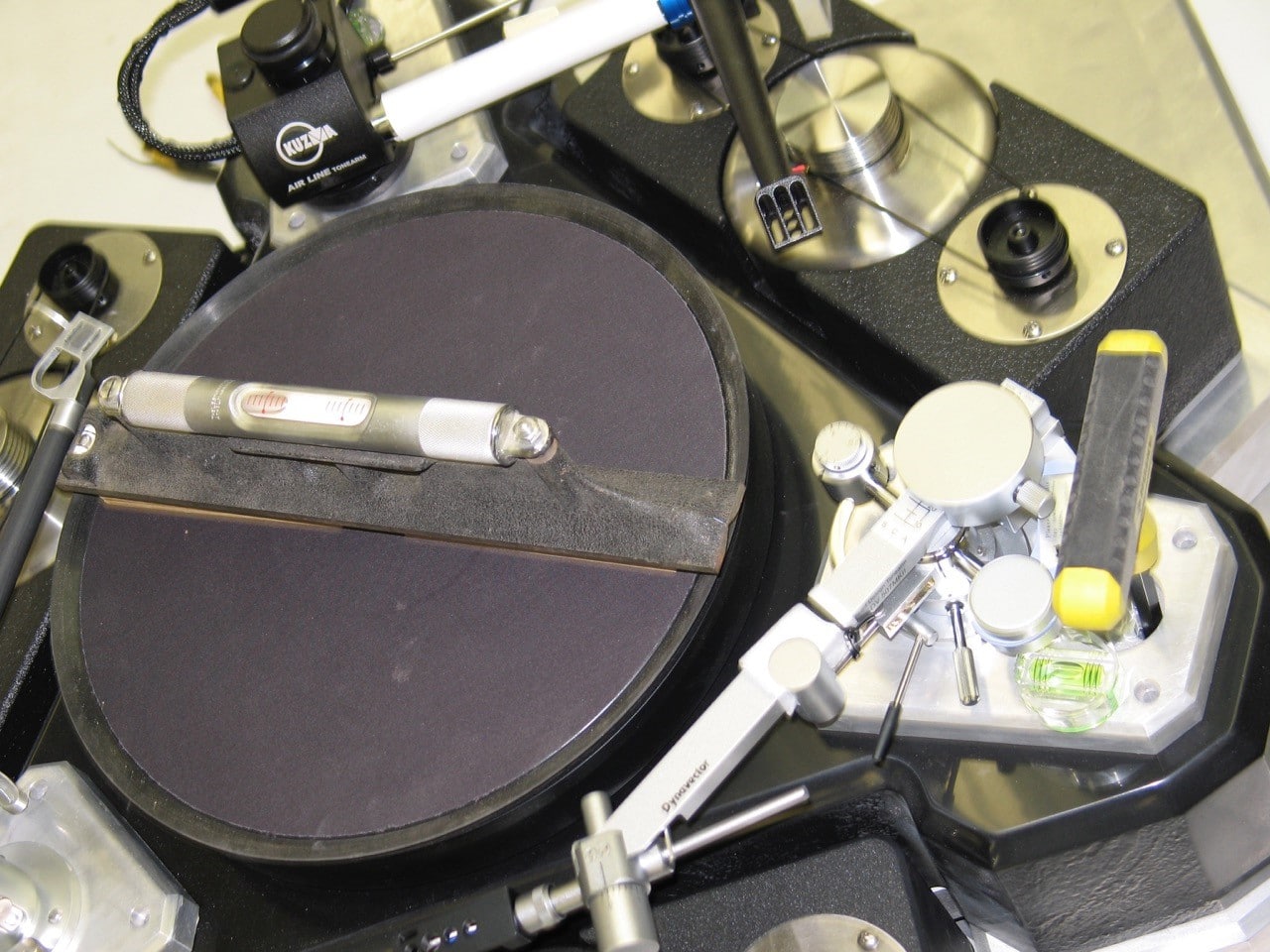
This is a closeup view of the machined aluminum plate to which the arms will be mounted. You will notice a bubble level which, in reality, is only there to cover an adjustment hole used to properly level the entire turntable. I am using a highly accurate German bubble level for looks only…..it adds a nice visual touch.

Here we see the platter with a 12” Starret machinist level atop. On the right side, you will notice a T-handle allen wrench going through the plinth down to the brass adjustment point that is used to level the table. The Starret machinist level has graduations equal to 1/1000th of an inch per foot. Pictured are the aluminum pieces I designed to hold the inverted bearing for the Sota vacuum platter I will be using. Here we see the anodized bearing cup supports installed on the fiberglass plinth. A steel mold was fabricated for casting the 1” thick lead disc that will be bonded to the top of a standard Sota vacuum platter. This steel mold was sent to a supplier in Ohio that casts lead parts for the medical industry. Two of these platters were poured, rather than just one, in case I thought some day I might make a second turntable. Yeah right.
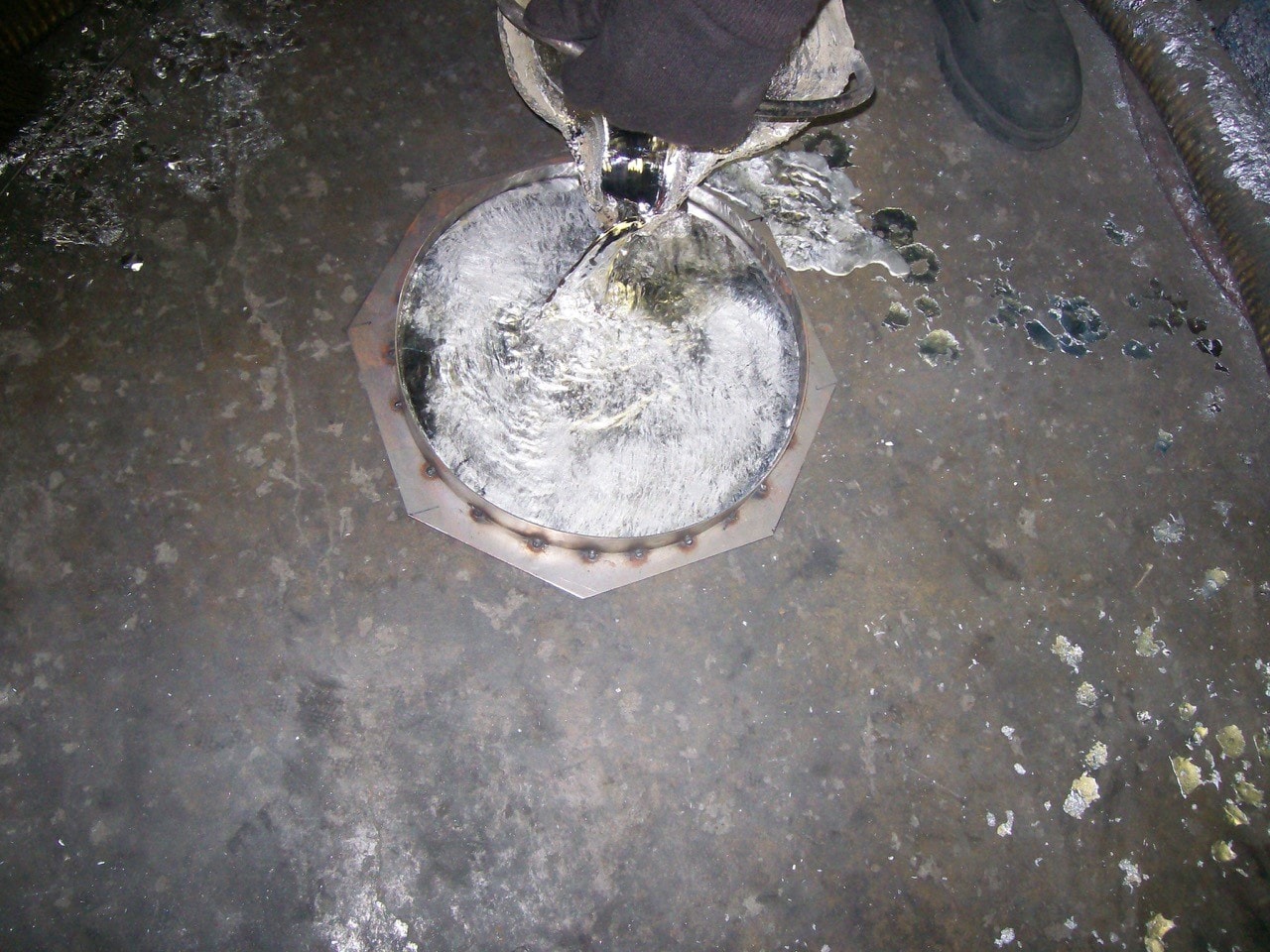
Here we have a good friend of mine, an expert machinist, finishing out the lead discs. A closeup view of the machining operation. After the two lead discs are machined, they were sent to Sota Industries so that they could bond this plate to the top of the Sota sub-platter. After that process was completed, the acrylic/rubber vacuum disc was then bonded to the top of the lead disc.

Depicted here is one of the two completed platters that came back from Sota. They bonded and finished the edges of the platter in the same manner they finished their standard Sota platters. This lead disc added approximately 85 pounds to the weight of the existing Sota vacuum platter. Before I decided to implement an extra lead disc, I conferred with Kirk and Donna at Sota regarding the weight capacity of the ball in their inverted bearing system. They told me that David Fletcher, who was instrumental in the design and weight capacity of their inverted bearing system, designed it for a weight capacity of 150 pounds. After the platter was installed, a dial indicator was used to measure the runout of the lead platter. It was immeasurable, as was the runout on the Sota platter to which it was bonded.

[We will continue with Part 3 in the next issue—Ed.]

More from Issue 91

View All Articles in Issue 91

Search Copper Magazine

#226 JJ Murphy’s Sleep Paralysis is a Genre-Bending Musical Journey Through Jazz, Fusion and More by Frank Doris Jan 05, 2026 #226 Stewardship by Consent by B. Jan Montana Jan 05, 2026 #226 Food, Music, and Sensory Experience: An Interview With Professor Jonathan Zearfoss of the Culinary Institute of America by Joe Caplan Jan 05, 2026 #226 Studio Confidential: A Who’s Who of Recording Engineers Tell Their Stories by Frank Doris Jan 05, 2026 #226 Pilot Radio is Reborn, 50 Years Later: Talking With CEO Barak Epstein by Frank Doris Jan 05, 2026 #226 The Vinyl Beat Goes Down to Tijuana (By Way of Los Angeles), Part One by Rudy Radelic Jan 05, 2026 #226 Capital Audiofest 2025: Must-See Stereo, Part Two by Frank Doris Jan 05, 2026 #226 My Morning Jacket’s Carl Broemel and Tyler Ramsey Collaborate on Their Acoustic Guitar Album, Celestun by Ray Chelstowski Jan 05, 2026 #226 The People Who Make Audio Happen: CanJam SoCal 2025, Part Two by Harris Fogel Jan 05, 2026 #226 How to Play in a Rock Band, 19: Touring Can Make You Crazy, Part One by Frank Doris Jan 05, 2026 #226 Linda Ronstadt Goes Bigger by Wayne Robins Jan 05, 2026 #226 From The Audiophile’s Guide: Active Room Correction and Digital Signal Processing by Paul McGowan Jan 05, 2026 #226 PS Audio in the News by Frank Doris Jan 05, 2026 #226 Back to My Reel-to-Reel Roots, Part 25: Half-Full, Not Empty by Ken Kessler Jan 05, 2026 #226 Happy New Year! by Frank Doris Jan 05, 2026 #226 Turn It Down! by Peter Xeni Jan 05, 2026 #226 Ghost Riders by James Schrimpf Jan 05, 2026 #226 A Factory Tour of Audio Manufacturer German Physiks by Markus "Marsu" Manthey Jan 04, 2026 #225 Capital Audiofest 2025: Must-See Stereo, Part One by Frank Doris Dec 01, 2025 #225 Otis Taylor and the Electrics Delivers a Powerful Set of Hypnotic Modern Blues by Frank Doris Dec 01, 2025 #225 A Christmas Miracle by B. Jan Montana Dec 01, 2025 #225 T.H.E. Show New York 2025, Part Two: Plenty to See, Hear, and Enjoy by Frank Doris Dec 01, 2025 #225 Underappreciated Artists, Part One: Martin Briley by Rich Isaacs Dec 01, 2025 #225 Rock and Roll is Here to Stay by Wayne Robins Dec 01, 2025 #225 A Lifetime of Holiday Record (and CD) Listening by Rudy Radelic Dec 01, 2025 #225 Little Feat: Not Saying Goodbye, Not Yet by Ray Chelstowski Dec 01, 2025 #225 How to Play in a Rock Band, Part 18: Dealing With Burnout by Frank Doris Dec 01, 2025 #225 The People Who Make Audio Happen: CanJam SoCal 2025 by Harris Fogel Dec 01, 2025 #225 Chicago’s Sonic Sanctuaries: Four Hi‑Fi Listening Bars Channeling the Jazz‑Kissa Spirit by Olivier Meunier-Plante Dec 01, 2025 #225 From The Audiophile’s Guide: Controlling Bass Frequencies Through Membrane Absorbers (and How to Build Your Own) by Paul McGowan Dec 01, 2025 #225 Your Editor’s Tips for Attending Audio Shows by Frank Doris Dec 01, 2025 #225 PS Audio in the News by Frank Doris Dec 01, 2025 #225 Back to My Reel-to-Reel Roots, Part 24 by Ken Kessler Dec 01, 2025 #225 Holiday Music by Frank Doris Dec 01, 2025 #225 Puppy Prognostication by Peter Xeni Dec 01, 2025 #225 How to Post Comments on Copper by Frank Doris Dec 01, 2025 #225 Living Color by Rudy Radelic Dec 01, 2025 #224 T.H.E. Show New York 2025, Part One: A New Beginning by Frank Doris Nov 03, 2025 #224 Fool’s Leap of Faith is the Extraordinary Octave Records Debut from Singer/Songwriter Tyler Burba and Visit by Frank Doris Nov 03, 2025 #224 The Beatles’ “Aeolian Cadences.” What? by Wayne Robins Nov 03, 2025 #224 Persona Non Grata by B. Jan Montana Nov 03, 2025 #224 Talking With Recording Engineer Barry Diament of Soundkeeper Recordings, Part Two by Frank Doris Nov 03, 2025 #224 B Sides, B Movies, and Beware of Zombies by Rudy Radelic Nov 03, 2025 #224 The Burn-In Chronicles: 1,000 Hours to Sonic Salvation by Olivier Meunier-Plante Nov 03, 2025 #224 A Conversation With Mat Weisfeld of VPI Industries by Joe Caplan Nov 03, 2025 #224 Blues-Rocker Kenny Wayne Shepherd Celebrates 30 Years of Ledbetter Heights by Ray Chelstowski Nov 03, 2025 #224 Playing in a Rock Band, 17: When Good Gigs Go Bad, Part Two by Frank Doris Nov 03, 2025

A Turntable of my Own, Part 2

A Turntable of my Own, Part 2

Copper #90---Ed.>

Here we see the finished laminated fiberglass plinth sitting atop the 1 ½” thick machined aluminum sub-plate. You will notice the ¾” thick grey MDF pieces sitting between the main plinth and the tone arms. They are mockups of parts that will be machined from aluminum. You will notice Dinavector, Triplainer, and Kuzma Air Line tonearms in the picture. Since that time, I have chosen to use a pair of Kumza Air Lines and a Kuzma Four Point tonearm instead.

Here we see machined aluminum pieces that will be fastened to the main plinth. You will note mounting holes machined for specific arms to be used on this table.

This is an underside view of the 1 ½” thick aluminum pieces that will serve as a support for the 3 VPI double motor – flywheel drive units. The cored-out part viewed will later be filled with a matrix of epoxy resin and #9 lead shot. This will be used to increase the mass of the aluminum part.

Since the fiberglass shell for the main plinth will be filled with the same epoxy/lead matrix to increase the mass that will be necessary to make provisions for adjustment tools and signal cables from the tonearms to pass through the plinth. There will be 280 pounds of epoxy/lead matrix filling this plinth.

Here we see the main plinth and the 3 sub-bases for the VPI motors. Beneath that you will see the top large 1” thick aluminum plate that will be used as a support for all of the upper parts of the turntable. The bottom plate will become the top of the stand, yet to be constructed for the entire turntable. In between the two will be a Minus K vibration isolation device.

This is a closeup view of the machined aluminum plate to which the arms will be mounted. You will notice a bubble level which, in reality, is only there to cover an adjustment hole used to properly level the entire turntable. I am using a highly accurate German bubble level for looks only…..it adds a nice visual touch.

Here we see the platter with a 12” Starret machinist level atop. On the right side, you will notice a T-handle allen wrench going through the plinth down to the brass adjustment point that is used to level the table. The Starret machinist level has graduations equal to 1/1000th of an inch per foot. Pictured are the aluminum pieces I designed to hold the inverted bearing for the Sota vacuum platter I will be using. Here we see the anodized bearing cup supports installed on the fiberglass plinth. A steel mold was fabricated for casting the 1” thick lead disc that will be bonded to the top of a standard Sota vacuum platter. This steel mold was sent to a supplier in Ohio that casts lead parts for the medical industry. Two of these platters were poured, rather than just one, in case I thought some day I might make a second turntable. Yeah right.

Here we have a good friend of mine, an expert machinist, finishing out the lead discs. A closeup view of the machining operation. After the two lead discs are machined, they were sent to Sota Industries so that they could bond this plate to the top of the Sota sub-platter. After that process was completed, the acrylic/rubber vacuum disc was then bonded to the top of the lead disc.

Depicted here is one of the two completed platters that came back from Sota. They bonded and finished the edges of the platter in the same manner they finished their standard Sota platters. This lead disc added approximately 85 pounds to the weight of the existing Sota vacuum platter. Before I decided to implement an extra lead disc, I conferred with Kirk and Donna at Sota regarding the weight capacity of the ball in their inverted bearing system. They told me that David Fletcher, who was instrumental in the design and weight capacity of their inverted bearing system, designed it for a weight capacity of 150 pounds. After the platter was installed, a dial indicator was used to measure the runout of the lead platter. It was immeasurable, as was the runout on the Sota platter to which it was bonded.

[We will continue with Part 3 in the next issue—Ed.]

0 comments

Leave a comment

0 Comments

Your avatar

Loading comments...

🗑️ Delete Comment

Enter moderator password to delete this comment: