COPPER

A PS Audio Publication

Issue 158 • Free Online Magazine

Issue 158 Wayne's Words

Sometimes I Sit and Listen to Courtney Barnett

Sometimes I Sit and Listen to Courtney Barnett

Courtney Barnett had me the first time I heard “Pedestrian at Best,” from her 2015 debut album, Sometimes I Sit and Think, Sometimes I Just Sit, which, if you spend any time with her music, is a kind of quintessential Barnettism.

What I like so much about “Pedestrian at Best” is that is a pure rock critic phrase. It sounds like an entire Christgau’s Consumer Guide review of a very average band from the 1970s: “Very Average Band”: Pedestrian at best. B minus.” So, there is something self-knowing about the way I’m guessing Barnett, who lives in Melbourne, Australia, approaches music. And she’s anything from average, so very not pedestrian.

“Pedestrian at Best” is the most energetic and hard rocking song I’ve heard her do. It’s guitar-based classicism has the adrenalin of “You Really Got Me,” “Wild Thing,” and “Sweet Jane,” the closest Barnett has gotten to rocking on all cylinders. She likes to hold back.


I’m sure she’s done quite a few interviews, but the facts and details of her life are of little interest to me. She is 35 years old, though you might peg her for up to ten years younger. (Maybe I’ve been watching a lot of old videos.) I read one short profile for The Guardian, Nov. 5, 2021, by Andrew Stafford. It is brief and basic, but he gets quite a bit from what appears to be a not very long Zoom interview, where she spoke “from a spartan room that offers no clues.” The article ran in advance of her latest album, Things Take Time, Take Time, which was released November 12. This album title is also a quintessential Barnettism, in which she repeats a phrase, as if she is thinking to herself whether she has said what she needs to say, or whether some elaboration is required. (In between Sometimes and Things Take was another album, Tell Me How You Really Feel, about which, for whatever reason, I remained resolutely neutral except for the brilliant song that may explain everything about that record, “Crippling Self-Doubt and a General Lack of Confidence.”)

The newer album is relentlessly mid-tempo: There are no rollicking rockers like “Pedestrian at Best,” and though many of the songs contain moments about loneliness, neediness, or sadness, there are no dreary ballads, either. “Here’s the Thing” takes you through her day, her thoughts. Sometimes she’s a little happy, sometimes she’s a little sad. But as I said, steady in tempo, steady in mood. She’s not a weeper, no drama, but a keen observer of both herself and the rest of the world, wherever her eyes land. It feels very self-consoling.
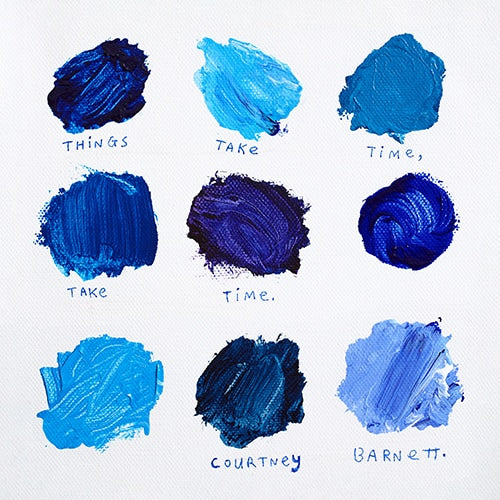
 

Courtney Barnett, Things Take Time, Take Time album cover.


Consider “Rae Street,” which appears to be the first single from Things Take Time, Take Time, which does raise the rock quotient a bit. The first few times I heard it, I figured it was about some hipster thoroughfare in Melbourne, congested with bars, clubs, and people watching. Then I watched the video, and there is plenty of people-watching: In fact, almost all of the people are played by Barnett, who is looking out the window of a suburban house, and she sees the sanitation worker, a person pouring cement, a food delivery, a mom teaching her daughter how to ride a bike with training wheels, a person mowing a lawn, climbing a ladder, painting a house: It’s about nothing, and everything, absorbing the details of everyday life under pandemic isolation.


The structure of the songs is interesting: Following along on https://courtneybarnett.com.au/, most of the lyrics are not verses and choruses, but sentences and paragraphs. She is renewing the spirit of letter writing in an age of brief, unpunctuated, misspelled e-mail. From “Rae Street”: “I might change my sheets today.” A little further:

“The pair across the street; one’s up the ladder and one’s on their knees, painting the faded brick. What’s the point, it looks fine from up here.”

This letter-writing, so foreign to most of us these days, is a way that I teach writing music criticism. Avoid fancy phrases, needless adverbs, excessive adjectives: avoid calling a song “amazing.” Instead, find words to describe why a song is “amazing.” Then make believe you’re writing a letter to a close friend, or a relative you like. Tell them about the song, the performance, like you are speaking to them. Songs as letters to a friend: That’s what Things Take Time, Take Time feels like.

Barnett likes old-school mail so much she uses postcards, or at least, digital replicas. She has a song called “Write a List of Things to Look Forward to.” On her website, there is an e-postcard to fill out, with five things to look forward to, which I filled out and sent to her. When you hit Send, there is a picture of Courtney, reading a postcard. The stamp is one of the blue paint smudges that are both the album cover and the visual theme for this latest project.


What was on my list of things I’m looking forward to? That I was looking forward to my college students returning from spring break who, for the first time in two years, will be mask-free, and I will be able to see their faces; that I was looking forward to my 73rd birthday, or a grandchild, whichever comes first; that I wanted to interview Barnett for my Substack, to talk about songwriting and both of us being left-handed; that I was looking forward to finishing this Copper article; and that I wanted to hear her cover a Bob Dylan song, but not “Forever Young,” but rather “Queen Jane Approximately” or better, “Just Like Tom Thumb’s Blues.”

Dylan is important as a distant backdrop for Barnett. She gets some of her words-forward phrasing from him, although more so Lou Reed, who is kind of her vocal doppelganger, and Leonard Cohen, whose “So Long, Marianne,” from Barnett’s 2019 MTV Unplugged Melbourne session is one of the best Cohen covers I’ve heard in a while. The older Barnett semi-classic “Avant Gardener” has a video about a doubles-tennis match, an asthma attack, and a riotous ending over a missed call by the young referee, who looks like kind of 1980s Dylan. The song itself? It sort of really is about gardening. Barnett is the rock poet laureate of mundane Mondays.


But what’s striking about the singing is the degree that the Lou Reed voice of aloof affect, is natural to her. Another cover from the Barnett archives is the single “I’ll Be Your Mirror,” from the Velvet Underground repertory. There’s irony here, since “I’ll Be Your Mirror” was a showcase for the Velvet’s model-singer Nico. Barnett sings it in her organic Lou voice, which is almost like a gift to him.

Barnett has mastered the casual intonation that marks the work of not a singer-songwriter, but a songwriter-singer. Barnett is definitely a woman, but her voice is neither masculine nor feminine, which perhaps makes her so appealing to a millennial generation that appreciates, even strives for, gender fluidity. Barnett’s own look is seriously normative: a pretty, nicely layered brunette with slightly long bangs, no tattoos, no piercings. She doesn’t align visually with any tribe. If she was an American, you could cast her in a commercial for an insurance company, or car manufacturer.

Her “now I sing, now I talk at the same time” voice is made for collaboration with other musicians such as guitarist Kurt Vile, whose 2017 album with Barnett, Lotta Sea Lice, may be one of my favorite Barnett projects. Vile (rhymes with Kurt Weill) was a member of The War on Drugs. He and Barnett knocked out an album in Australia together that seems effortless and pleasurable because it rejects the high-stakes of old music biz album making, in which the pressure to make an album for a predetermined release date is followed by pressure to tour. The go-to song here is “Continental Breakfast,” which sounds like a conversation across continents, and features them trading verses in a shaggy dog story with lines like “I walk like a bruised ego alone shorefront property, un-owned to me.”

Barnett has her own label, Milk! Records, that she started in 2012 with Jen Cloher, a guitar-playing songwriter-singer herself; formerly a couple, they remain business partners, according to the Guardian. Milk! distributed Sleater-Kinney’s Path of Wellness album in Australia. Cloher’s own music is much worth seeking out, and her early work sounds much like Barnett’s. I’ve just been looking around randomly, but her 2013 Milk! EP In Blood Memory (with Burnett also on guitar) has a great rocker, “Toothless Tiger,” and a sort of alt-country tune called “David Bowie Eyes” that can be found on Bandcamp if you want to check them out. That EP is dedicated to the inspiration of Patti Smith, Television, the Velvet Underground, and Neil Young and Crazy Horse. I’d love to hear Barnett and Cloher cover Television’s “Marquee Moon,” if they can still play together.


For more from Wayne Robins, see Critical Conditions at http://waynerobins49.substack.com.

Header image courtesy of Mia Mala McDonald.

More from Issue 158

View All Articles in Issue 158

Search Copper Magazine

#226 JJ Murphy’s Sleep Paralysis is a Genre-Bending Musical Journey Through Jazz, Fusion and More by Frank Doris Jan 05, 2026 #226 Stewardship by Consent by B. Jan Montana Jan 05, 2026 #226 Food, Music, and Sensory Experience: An Interview With Professor Jonathan Zearfoss of the Culinary Institute of America by Joe Caplan Jan 05, 2026 #226 Studio Confidential: A Who’s Who of Recording Engineers Tell Their Stories by Frank Doris Jan 05, 2026 #226 Pilot Radio is Reborn, 50 Years Later: Talking With CEO Barak Epstein by Frank Doris Jan 05, 2026 #226 The Vinyl Beat Goes Down to Tijuana (By Way of Los Angeles), Part One by Rudy Radelic Jan 05, 2026 #226 Capital Audiofest 2025: Must-See Stereo, Part Two by Frank Doris Jan 05, 2026 #226 My Morning Jacket’s Carl Broemel and Tyler Ramsey Collaborate on Their Acoustic Guitar Album, Celestun by Ray Chelstowski Jan 05, 2026 #226 The People Who Make Audio Happen: CanJam SoCal 2025, Part Two by Harris Fogel Jan 05, 2026 #226 How to Play in a Rock Band, 19: Touring Can Make You Crazy, Part One by Frank Doris Jan 05, 2026 #226 Linda Ronstadt Goes Bigger by Wayne Robins Jan 05, 2026 #226 From The Audiophile’s Guide: Active Room Correction and Digital Signal Processing by Paul McGowan Jan 05, 2026 #226 PS Audio in the News by Frank Doris Jan 05, 2026 #226 Back to My Reel-to-Reel Roots, Part 25: Half-Full, Not Empty by Ken Kessler Jan 05, 2026 #226 Happy New Year! by Frank Doris Jan 05, 2026 #226 Turn It Down! by Peter Xeni Jan 05, 2026 #226 Ghost Riders by James Schrimpf Jan 05, 2026 #226 A Factory Tour of Audio Manufacturer German Physiks by Markus "Marsu" Manthey Jan 04, 2026 #225 Capital Audiofest 2025: Must-See Stereo, Part One by Frank Doris Dec 01, 2025 #225 Otis Taylor and the Electrics Delivers a Powerful Set of Hypnotic Modern Blues by Frank Doris Dec 01, 2025 #225 A Christmas Miracle by B. Jan Montana Dec 01, 2025 #225 T.H.E. Show New York 2025, Part Two: Plenty to See, Hear, and Enjoy by Frank Doris Dec 01, 2025 #225 Underappreciated Artists, Part One: Martin Briley by Rich Isaacs Dec 01, 2025 #225 Rock and Roll is Here to Stay by Wayne Robins Dec 01, 2025 #225 A Lifetime of Holiday Record (and CD) Listening by Rudy Radelic Dec 01, 2025 #225 Little Feat: Not Saying Goodbye, Not Yet by Ray Chelstowski Dec 01, 2025 #225 How to Play in a Rock Band, Part 18: Dealing With Burnout by Frank Doris Dec 01, 2025 #225 The People Who Make Audio Happen: CanJam SoCal 2025 by Harris Fogel Dec 01, 2025 #225 Chicago’s Sonic Sanctuaries: Four Hi‑Fi Listening Bars Channeling the Jazz‑Kissa Spirit by Olivier Meunier-Plante Dec 01, 2025 #225 From The Audiophile’s Guide: Controlling Bass Frequencies Through Membrane Absorbers (and How to Build Your Own) by Paul McGowan Dec 01, 2025 #225 Your Editor’s Tips for Attending Audio Shows by Frank Doris Dec 01, 2025 #225 PS Audio in the News by Frank Doris Dec 01, 2025 #225 Back to My Reel-to-Reel Roots, Part 24 by Ken Kessler Dec 01, 2025 #225 Holiday Music by Frank Doris Dec 01, 2025 #225 Puppy Prognostication by Peter Xeni Dec 01, 2025 #225 How to Post Comments on Copper by Frank Doris Dec 01, 2025 #225 Living Color by Rudy Radelic Dec 01, 2025 #224 T.H.E. Show New York 2025, Part One: A New Beginning by Frank Doris Nov 03, 2025 #224 Fool’s Leap of Faith is the Extraordinary Octave Records Debut from Singer/Songwriter Tyler Burba and Visit by Frank Doris Nov 03, 2025 #224 The Beatles’ “Aeolian Cadences.” What? by Wayne Robins Nov 03, 2025 #224 Persona Non Grata by B. Jan Montana Nov 03, 2025 #224 Talking With Recording Engineer Barry Diament of Soundkeeper Recordings, Part Two by Frank Doris Nov 03, 2025 #224 B Sides, B Movies, and Beware of Zombies by Rudy Radelic Nov 03, 2025 #224 The Burn-In Chronicles: 1,000 Hours to Sonic Salvation by Olivier Meunier-Plante Nov 03, 2025 #224 A Conversation With Mat Weisfeld of VPI Industries by Joe Caplan Nov 03, 2025 #224 Blues-Rocker Kenny Wayne Shepherd Celebrates 30 Years of Ledbetter Heights by Ray Chelstowski Nov 03, 2025 #224 Playing in a Rock Band, 17: When Good Gigs Go Bad, Part Two by Frank Doris Nov 03, 2025

Sometimes I Sit and Listen to Courtney Barnett

Sometimes I Sit and Listen to Courtney Barnett

Courtney Barnett had me the first time I heard “Pedestrian at Best,” from her 2015 debut album, Sometimes I Sit and Think, Sometimes I Just Sit, which, if you spend any time with her music, is a kind of quintessential Barnettism.

What I like so much about “Pedestrian at Best” is that is a pure rock critic phrase. It sounds like an entire Christgau’s Consumer Guide review of a very average band from the 1970s: “Very Average Band”: Pedestrian at best. B minus.” So, there is something self-knowing about the way I’m guessing Barnett, who lives in Melbourne, Australia, approaches music. And she’s anything from average, so very not pedestrian.

“Pedestrian at Best” is the most energetic and hard rocking song I’ve heard her do. It’s guitar-based classicism has the adrenalin of “You Really Got Me,” “Wild Thing,” and “Sweet Jane,” the closest Barnett has gotten to rocking on all cylinders. She likes to hold back.


I’m sure she’s done quite a few interviews, but the facts and details of her life are of little interest to me. She is 35 years old, though you might peg her for up to ten years younger. (Maybe I’ve been watching a lot of old videos.) I read one short profile for The Guardian, Nov. 5, 2021, by Andrew Stafford. It is brief and basic, but he gets quite a bit from what appears to be a not very long Zoom interview, where she spoke “from a spartan room that offers no clues.” The article ran in advance of her latest album, Things Take Time, Take Time, which was released November 12. This album title is also a quintessential Barnettism, in which she repeats a phrase, as if she is thinking to herself whether she has said what she needs to say, or whether some elaboration is required. (In between Sometimes and Things Take was another album, Tell Me How You Really Feel, about which, for whatever reason, I remained resolutely neutral except for the brilliant song that may explain everything about that record, “Crippling Self-Doubt and a General Lack of Confidence.”)

The newer album is relentlessly mid-tempo: There are no rollicking rockers like “Pedestrian at Best,” and though many of the songs contain moments about loneliness, neediness, or sadness, there are no dreary ballads, either. “Here’s the Thing” takes you through her day, her thoughts. Sometimes she’s a little happy, sometimes she’s a little sad. But as I said, steady in tempo, steady in mood. She’s not a weeper, no drama, but a keen observer of both herself and the rest of the world, wherever her eyes land. It feels very self-consoling.


Courtney Barnett, Things Take Time, Take Time album cover.


Consider “Rae Street,” which appears to be the first single from Things Take Time, Take Time, which does raise the rock quotient a bit. The first few times I heard it, I figured it was about some hipster thoroughfare in Melbourne, congested with bars, clubs, and people watching. Then I watched the video, and there is plenty of people-watching: In fact, almost all of the people are played by Barnett, who is looking out the window of a suburban house, and she sees the sanitation worker, a person pouring cement, a food delivery, a mom teaching her daughter how to ride a bike with training wheels, a person mowing a lawn, climbing a ladder, painting a house: It’s about nothing, and everything, absorbing the details of everyday life under pandemic isolation.


The structure of the songs is interesting: Following along on https://courtneybarnett.com.au/, most of the lyrics are not verses and choruses, but sentences and paragraphs. She is renewing the spirit of letter writing in an age of brief, unpunctuated, misspelled e-mail. From “Rae Street”: “I might change my sheets today.” A little further:

“The pair across the street; one’s up the ladder and one’s on their knees, painting the faded brick. What’s the point, it looks fine from up here.”

This letter-writing, so foreign to most of us these days, is a way that I teach writing music criticism. Avoid fancy phrases, needless adverbs, excessive adjectives: avoid calling a song “amazing.” Instead, find words to describe why a song is “amazing.” Then make believe you’re writing a letter to a close friend, or a relative you like. Tell them about the song, the performance, like you are speaking to them. Songs as letters to a friend: That’s what Things Take Time, Take Time feels like.

Barnett likes old-school mail so much she uses postcards, or at least, digital replicas. She has a song called “Write a List of Things to Look Forward to.” On her website, there is an e-postcard to fill out, with five things to look forward to, which I filled out and sent to her. When you hit Send, there is a picture of Courtney, reading a postcard. The stamp is one of the blue paint smudges that are both the album cover and the visual theme for this latest project.


What was on my list of things I’m looking forward to? That I was looking forward to my college students returning from spring break who, for the first time in two years, will be mask-free, and I will be able to see their faces; that I was looking forward to my 73rd birthday, or a grandchild, whichever comes first; that I wanted to interview Barnett for my Substack, to talk about songwriting and both of us being left-handed; that I was looking forward to finishing this Copper article; and that I wanted to hear her cover a Bob Dylan song, but not “Forever Young,” but rather “Queen Jane Approximately” or better, “Just Like Tom Thumb’s Blues.”

Dylan is important as a distant backdrop for Barnett. She gets some of her words-forward phrasing from him, although more so Lou Reed, who is kind of her vocal doppelganger, and Leonard Cohen, whose “So Long, Marianne,” from Barnett’s 2019 MTV Unplugged Melbourne session is one of the best Cohen covers I’ve heard in a while. The older Barnett semi-classic “Avant Gardener” has a video about a doubles-tennis match, an asthma attack, and a riotous ending over a missed call by the young referee, who looks like kind of 1980s Dylan. The song itself? It sort of really is about gardening. Barnett is the rock poet laureate of mundane Mondays.


But what’s striking about the singing is the degree that the Lou Reed voice of aloof affect, is natural to her. Another cover from the Barnett archives is the single “I’ll Be Your Mirror,” from the Velvet Underground repertory. There’s irony here, since “I’ll Be Your Mirror” was a showcase for the Velvet’s model-singer Nico. Barnett sings it in her organic Lou voice, which is almost like a gift to him.

Barnett has mastered the casual intonation that marks the work of not a singer-songwriter, but a songwriter-singer. Barnett is definitely a woman, but her voice is neither masculine nor feminine, which perhaps makes her so appealing to a millennial generation that appreciates, even strives for, gender fluidity. Barnett’s own look is seriously normative: a pretty, nicely layered brunette with slightly long bangs, no tattoos, no piercings. She doesn’t align visually with any tribe. If she was an American, you could cast her in a commercial for an insurance company, or car manufacturer.

Her “now I sing, now I talk at the same time” voice is made for collaboration with other musicians such as guitarist Kurt Vile, whose 2017 album with Barnett, Lotta Sea Lice, may be one of my favorite Barnett projects. Vile (rhymes with Kurt Weill) was a member of The War on Drugs. He and Barnett knocked out an album in Australia together that seems effortless and pleasurable because it rejects the high-stakes of old music biz album making, in which the pressure to make an album for a predetermined release date is followed by pressure to tour. The go-to song here is “Continental Breakfast,” which sounds like a conversation across continents, and features them trading verses in a shaggy dog story with lines like “I walk like a bruised ego alone shorefront property, un-owned to me.”

Barnett has her own label, Milk! Records, that she started in 2012 with Jen Cloher, a guitar-playing songwriter-singer herself; formerly a couple, they remain business partners, according to the Guardian. Milk! distributed Sleater-Kinney’s Path of Wellness album in Australia. Cloher’s own music is much worth seeking out, and her early work sounds much like Barnett’s. I’ve just been looking around randomly, but her 2013 Milk! EP In Blood Memory (with Burnett also on guitar) has a great rocker, “Toothless Tiger,” and a sort of alt-country tune called “David Bowie Eyes” that can be found on Bandcamp if you want to check them out. That EP is dedicated to the inspiration of Patti Smith, Television, the Velvet Underground, and Neil Young and Crazy Horse. I’d love to hear Barnett and Cloher cover Television’s “Marquee Moon,” if they can still play together.


For more from Wayne Robins, see Critical Conditions at http://waynerobins49.substack.com.

Header image courtesy of Mia Mala McDonald.

0 comments

Leave a comment

0 Comments

Your avatar

Loading comments...

🗑️ Delete Comment

Enter moderator password to delete this comment: