COPPER

A PS Audio Publication

Issue 174 • Free Online Magazine

Issue 174 Music'al Notes

Neighbors

Neighbors

Bukhara.

It was the razor wire that really got my attention. The concrete paving of the back garden and installation of a 10-foot perimeter fence was bewildering, but the addition of razor wire seemed excessive.

My wife and I lived in Israel in the early seventies. We rented one half of a two-family home in Ra’anana, a small town (at that time) northeast of Tel Aviv.

The house was very simple but it had everything a young couple needed. Only 700 square feet, it had two bedrooms, a kitchen, a living room and a shower with a separate toilet. (Most Israeli homes have the toilet separate from the bathroom.)

The bonus was the garden. Small as the house was, it sported a front, side and back garden and, just to sweeten the pot, it backed onto an agricultural field, bordered by poplar trees and in the distance, orange groves. In spring the perfume of the orange blossom so permeated the air that it almost made you high.

We created a garden and I planted two poplar trees in front of our door. At that time, I had no idea how tall they could grow. Last time I visited, the current owner had removed one. But the remaining one, almost 50 years old, was still proudly standing at least 60 feet in the air.

The early seventies were also a time of Soviet immigration to Israel. Most anyone who could prove a Jewish relative was given an exit visa and routed, mainly through Vienna, to Israel. Many immigrants came to the US instead, but a fair proportion came to Israel, and quite a few settled near us.

Our new neighbors were from Bukhara, a city in Uzbekistan. The history of Bukharin Jews under the Soviets and before that, the Tsars, was always difficult and in a recent reevaluation of the facts, it justified the razor wire and fence.

But not knowing this at the time, it seemed paranoid and really ugly.

The family consisted of a father, mother and two teenage daughters. Most communication was done through the girls as they spoke Hebrew as well as Russian and a local Bukharin dialect. Both daughters were sweet and friendly, likewise their mother. But the father was small, wizened, scary-looking and constantly suspicious. As much as I tried to befriend him, he had no interest in me or mine.

I would bump into him from time to time but he never even acknowledged my existence.

Sometimes, he would invite friends over and they would spend the night singing what sounded to us like dirges. Long and sonorous, they would last until the wee small hours and often, as the dividing wall between our houses was thin, the noise would drive us crazy.

The mother, (I never knew her name) would often prepare food in the back garden, and one day I watched in awe as she carefully removed the skin of a chicken, tied off the holes for the legs and wings, and stuffed it so well with a mixture of meat and vegetables that it looked just like a whole chicken again.

A few weeks before Passover, a lamb appeared in the yard. It was frisky and fluffy. Every morning one of the girls would feed the lamb and over the weeks it grew bigger and fatter.

The day before Passover, the father tied the hind legs of the lamb, hoisted it on a gallows-like structure, and after saying a prayer, slaughtered the beast with a long-curved knife. I am not squeamish and have seen animals killed this way before but somehow, the quick demise of this sweet little lamb touched a chord in my heart. Nevertheless, the aromas from their kitchen the following night were so wonderful that I wished they would have invited us to their Seder.

A few houses down from us, by pure coincidence, lived a couple I had known in Scotland from my days in Habonim, a Jewish Zionist youth movement.

Ella and Frank were from London and we became fast friends. The majority of the people we met in Israel at that time were immigrants, thus friendships blossomed quickly as families and old friends were far away. (To this day, I am still in touch with many of the people I befriended there.)

Ella and Frank had a dog called Snoozer, a misnomer as he was medium-sized, black and hyper-active. He was a street dog. This was common in those days and dogs were free to roam hither and thither.

One day I heard barking and I saw Snoozer yapping at the heels of one of our neighbor’s daughters. She looked scared and scampered up the steps into her house. A moment later, our neighbor, wearing long johns, emerged. On his head was a Red Army military cap and in his right hand was the same long-curved blade he had used on the hapless lamb. With a frenzied look in his eyes, he lunged at Snoozer, who scampered off as fast as he could to avoid being cut to pieces. As hard as he tried, he never caught the dog but I am sure the incident didn’t help endear him to his new country.

Samir.

The man standing in the vestibule of my front door was young, tall and mannerly. In accented Hebrew, he asked if he could cut my lawn and for emphasis, pointed to a bicycle with a wooden platform at the front. Sitting on top of it was a lawnmower.

Samir, as I later discovered, lived in a nearby Arab town called Qalqilya. In those days there was no separation barrier between the West Bank and Israel. Travel to and from the West Bank was common for both Israelis and Palestinians. Qalqilya was about 10 miles from where we lived and I often visited the outdoor market to buy chickens and vegetables.
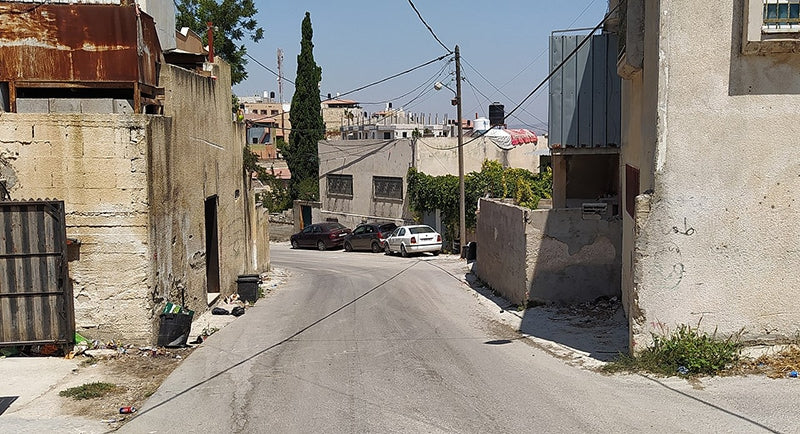
 

Qalqilya. Courtesy of Wikimedia Commons/أمين.

Qalqilya. Courtesy of Wikimedia Commons/أمين.


He looked like he needed the work so I said yes, and he started coming each week to tend the garden and cut the grass. He was newly married and within a year was the father of a boy. I congratulated him and bought a gift for the baby. He asked if my wife was pregnant and when I told him no, he told me that Allah would provide. The next year, Allah blessed him with another son. I noticed that he had acquired a young man to help him. The following year he had yet another son, and instead of a bicycle, a van plus another helper. Samir was doing well. After work we would hang out on the patio at the back of my house. We drank sodas. Samir was devout and never touched alcohol. We would talk about the political situation (which was never good); he commiserated with me that I had not yet fathered a child. I never had the courage to tell him that we had decided to wait a while before trying.

He kept inviting me to his home. He told me that I was welcome any Saturday and all I had to do was go to the marketplace and ask anyone for Samir’s house.

One day we did go.

We had asked our Israeli friends Margalit and Ze’ev to join us. They had both been in the army during the various wars that Israel had with their neighbors, and Margalit was uncomfortable with the idea of visiting Qalqilya and socializing with an Arab family. But I persisted and she agreed to join us.

True to form we asked a vendor at the market where Samir lived, and a small boy, followed by an entourage of children, escorted us to Samir’s home.

Samir was delighted to see us. He lived in a one-room house and I noticed that, neat as it was, there were mattresses on the floor.

He spoke to his wife who gathered up the children who were scattered about the yard. He then ushered us onto his patio. His garden was full of fruit trees. I recognized guava, Surinam cherry, fig, lemon, orange and avocado trees. His patio was covered by a grape arbor with clusters of black grapes hanging above our heads. He served an array of soft drinks: Coca Cola and Fanta, a jug of pomegranate juice, and also Laban Ayran, which is a yogurt-based drink.

After some small talk he invited us into his house, which had been transformed into a living room. The children were spotless and wearing their best clothes. Samir’s wife was wearing a long loose-fitting dark green robe called a thobe which was beautifully decorated with a red crossed -stitching called tatreez. I later found out that the different stitching and robe colors varied from area to area in the West Bank.

On the table I recognized baklava, kanafeh (a sweet cheese pastry), and balah el sham, a deep-fried dough with powdered sugar on it similar to an Italian zeppole. We were served Turkish coffee with hel (cardamom) floating in it. Everything was delicious but as the visit progressed, our friend Margalit became more and more anxious. She kept hinting that we leave but decorum forced me to stay a little longer.

When finally, we departed, Samir, ever-gracious, thanked me for coming and told me that our visit had honored his home.

On the way home, Margalit was a wreck. The proximity of the “enemy” was too much for her and as we drove home, she sobbed and told us that quite a few of her friends had died in the wars so her enmity for Arabs was very real.

Soon after, the Yom Kippur War broke out. Although it lasted less than three weeks, attitudes, including mine, changed and normal travel to the West Bank ceased.

After the War, I realized I would never visit him again.


Header image: Bukhara, courtesy of Wikimedia Commons/Adam Jones.

More from Issue 174

View All Articles in Issue 174

Search Copper Magazine

#226 JJ Murphy’s Sleep Paralysis is a Genre-Bending Musical Journey Through Jazz, Fusion and More by Frank Doris Jan 05, 2026 #226 Stewardship by Consent by B. Jan Montana Jan 05, 2026 #226 Food, Music, and Sensory Experience: An Interview With Professor Jonathan Zearfoss of the Culinary Institute of America by Joe Caplan Jan 05, 2026 #226 Studio Confidential: A Who’s Who of Recording Engineers Tell Their Stories by Frank Doris Jan 05, 2026 #226 Pilot Radio is Reborn, 50 Years Later: Talking With CEO Barak Epstein by Frank Doris Jan 05, 2026 #226 The Vinyl Beat Goes Down to Tijuana (By Way of Los Angeles), Part One by Rudy Radelic Jan 05, 2026 #226 Capital Audiofest 2025: Must-See Stereo, Part Two by Frank Doris Jan 05, 2026 #226 My Morning Jacket’s Carl Broemel and Tyler Ramsey Collaborate on Their Acoustic Guitar Album, Celestun by Ray Chelstowski Jan 05, 2026 #226 The People Who Make Audio Happen: CanJam SoCal 2025, Part Two by Harris Fogel Jan 05, 2026 #226 How to Play in a Rock Band, 19: Touring Can Make You Crazy, Part One by Frank Doris Jan 05, 2026 #226 Linda Ronstadt Goes Bigger by Wayne Robins Jan 05, 2026 #226 From The Audiophile’s Guide: Active Room Correction and Digital Signal Processing by Paul McGowan Jan 05, 2026 #226 PS Audio in the News by Frank Doris Jan 05, 2026 #226 Back to My Reel-to-Reel Roots, Part 25: Half-Full, Not Empty by Ken Kessler Jan 05, 2026 #226 Happy New Year! by Frank Doris Jan 05, 2026 #226 Turn It Down! by Peter Xeni Jan 05, 2026 #226 Ghost Riders by James Schrimpf Jan 05, 2026 #226 A Factory Tour of Audio Manufacturer German Physiks by Markus "Marsu" Manthey Jan 04, 2026 #225 Capital Audiofest 2025: Must-See Stereo, Part One by Frank Doris Dec 01, 2025 #225 Otis Taylor and the Electrics Delivers a Powerful Set of Hypnotic Modern Blues by Frank Doris Dec 01, 2025 #225 A Christmas Miracle by B. Jan Montana Dec 01, 2025 #225 T.H.E. Show New York 2025, Part Two: Plenty to See, Hear, and Enjoy by Frank Doris Dec 01, 2025 #225 Underappreciated Artists, Part One: Martin Briley by Rich Isaacs Dec 01, 2025 #225 Rock and Roll is Here to Stay by Wayne Robins Dec 01, 2025 #225 A Lifetime of Holiday Record (and CD) Listening by Rudy Radelic Dec 01, 2025 #225 Little Feat: Not Saying Goodbye, Not Yet by Ray Chelstowski Dec 01, 2025 #225 How to Play in a Rock Band, Part 18: Dealing With Burnout by Frank Doris Dec 01, 2025 #225 The People Who Make Audio Happen: CanJam SoCal 2025 by Harris Fogel Dec 01, 2025 #225 Chicago’s Sonic Sanctuaries: Four Hi‑Fi Listening Bars Channeling the Jazz‑Kissa Spirit by Olivier Meunier-Plante Dec 01, 2025 #225 From The Audiophile’s Guide: Controlling Bass Frequencies Through Membrane Absorbers (and How to Build Your Own) by Paul McGowan Dec 01, 2025 #225 Your Editor’s Tips for Attending Audio Shows by Frank Doris Dec 01, 2025 #225 PS Audio in the News by Frank Doris Dec 01, 2025 #225 Back to My Reel-to-Reel Roots, Part 24 by Ken Kessler Dec 01, 2025 #225 Holiday Music by Frank Doris Dec 01, 2025 #225 Puppy Prognostication by Peter Xeni Dec 01, 2025 #225 How to Post Comments on Copper by Frank Doris Dec 01, 2025 #225 Living Color by Rudy Radelic Dec 01, 2025 #224 T.H.E. Show New York 2025, Part One: A New Beginning by Frank Doris Nov 03, 2025 #224 Fool’s Leap of Faith is the Extraordinary Octave Records Debut from Singer/Songwriter Tyler Burba and Visit by Frank Doris Nov 03, 2025 #224 The Beatles’ “Aeolian Cadences.” What? by Wayne Robins Nov 03, 2025 #224 Persona Non Grata by B. Jan Montana Nov 03, 2025 #224 Talking With Recording Engineer Barry Diament of Soundkeeper Recordings, Part Two by Frank Doris Nov 03, 2025 #224 B Sides, B Movies, and Beware of Zombies by Rudy Radelic Nov 03, 2025 #224 The Burn-In Chronicles: 1,000 Hours to Sonic Salvation by Olivier Meunier-Plante Nov 03, 2025 #224 A Conversation With Mat Weisfeld of VPI Industries by Joe Caplan Nov 03, 2025 #224 Blues-Rocker Kenny Wayne Shepherd Celebrates 30 Years of Ledbetter Heights by Ray Chelstowski Nov 03, 2025 #224 Playing in a Rock Band, 17: When Good Gigs Go Bad, Part Two by Frank Doris Nov 03, 2025

Neighbors

Neighbors

Bukhara.

It was the razor wire that really got my attention. The concrete paving of the back garden and installation of a 10-foot perimeter fence was bewildering, but the addition of razor wire seemed excessive.

My wife and I lived in Israel in the early seventies. We rented one half of a two-family home in Ra’anana, a small town (at that time) northeast of Tel Aviv.

The house was very simple but it had everything a young couple needed. Only 700 square feet, it had two bedrooms, a kitchen, a living room and a shower with a separate toilet. (Most Israeli homes have the toilet separate from the bathroom.)

The bonus was the garden. Small as the house was, it sported a front, side and back garden and, just to sweeten the pot, it backed onto an agricultural field, bordered by poplar trees and in the distance, orange groves. In spring the perfume of the orange blossom so permeated the air that it almost made you high.

We created a garden and I planted two poplar trees in front of our door. At that time, I had no idea how tall they could grow. Last time I visited, the current owner had removed one. But the remaining one, almost 50 years old, was still proudly standing at least 60 feet in the air.

The early seventies were also a time of Soviet immigration to Israel. Most anyone who could prove a Jewish relative was given an exit visa and routed, mainly through Vienna, to Israel. Many immigrants came to the US instead, but a fair proportion came to Israel, and quite a few settled near us.

Our new neighbors were from Bukhara, a city in Uzbekistan. The history of Bukharin Jews under the Soviets and before that, the Tsars, was always difficult and in a recent reevaluation of the facts, it justified the razor wire and fence.

But not knowing this at the time, it seemed paranoid and really ugly.

The family consisted of a father, mother and two teenage daughters. Most communication was done through the girls as they spoke Hebrew as well as Russian and a local Bukharin dialect. Both daughters were sweet and friendly, likewise their mother. But the father was small, wizened, scary-looking and constantly suspicious. As much as I tried to befriend him, he had no interest in me or mine.

I would bump into him from time to time but he never even acknowledged my existence.

Sometimes, he would invite friends over and they would spend the night singing what sounded to us like dirges. Long and sonorous, they would last until the wee small hours and often, as the dividing wall between our houses was thin, the noise would drive us crazy.

The mother, (I never knew her name) would often prepare food in the back garden, and one day I watched in awe as she carefully removed the skin of a chicken, tied off the holes for the legs and wings, and stuffed it so well with a mixture of meat and vegetables that it looked just like a whole chicken again.

A few weeks before Passover, a lamb appeared in the yard. It was frisky and fluffy. Every morning one of the girls would feed the lamb and over the weeks it grew bigger and fatter.

The day before Passover, the father tied the hind legs of the lamb, hoisted it on a gallows-like structure, and after saying a prayer, slaughtered the beast with a long-curved knife. I am not squeamish and have seen animals killed this way before but somehow, the quick demise of this sweet little lamb touched a chord in my heart. Nevertheless, the aromas from their kitchen the following night were so wonderful that I wished they would have invited us to their Seder.

A few houses down from us, by pure coincidence, lived a couple I had known in Scotland from my days in Habonim, a Jewish Zionist youth movement.

Ella and Frank were from London and we became fast friends. The majority of the people we met in Israel at that time were immigrants, thus friendships blossomed quickly as families and old friends were far away. (To this day, I am still in touch with many of the people I befriended there.)

Ella and Frank had a dog called Snoozer, a misnomer as he was medium-sized, black and hyper-active. He was a street dog. This was common in those days and dogs were free to roam hither and thither.

One day I heard barking and I saw Snoozer yapping at the heels of one of our neighbor’s daughters. She looked scared and scampered up the steps into her house. A moment later, our neighbor, wearing long johns, emerged. On his head was a Red Army military cap and in his right hand was the same long-curved blade he had used on the hapless lamb. With a frenzied look in his eyes, he lunged at Snoozer, who scampered off as fast as he could to avoid being cut to pieces. As hard as he tried, he never caught the dog but I am sure the incident didn’t help endear him to his new country.

Samir.

The man standing in the vestibule of my front door was young, tall and mannerly. In accented Hebrew, he asked if he could cut my lawn and for emphasis, pointed to a bicycle with a wooden platform at the front. Sitting on top of it was a lawnmower.

Samir, as I later discovered, lived in a nearby Arab town called Qalqilya. In those days there was no separation barrier between the West Bank and Israel. Travel to and from the West Bank was common for both Israelis and Palestinians. Qalqilya was about 10 miles from where we lived and I often visited the outdoor market to buy chickens and vegetables.


Qalqilya. Courtesy of Wikimedia Commons/أمين.

Qalqilya. Courtesy of Wikimedia Commons/أمين.


He looked like he needed the work so I said yes, and he started coming each week to tend the garden and cut the grass. He was newly married and within a year was the father of a boy. I congratulated him and bought a gift for the baby. He asked if my wife was pregnant and when I told him no, he told me that Allah would provide. The next year, Allah blessed him with another son. I noticed that he had acquired a young man to help him. The following year he had yet another son, and instead of a bicycle, a van plus another helper. Samir was doing well. After work we would hang out on the patio at the back of my house. We drank sodas. Samir was devout and never touched alcohol. We would talk about the political situation (which was never good); he commiserated with me that I had not yet fathered a child. I never had the courage to tell him that we had decided to wait a while before trying.

He kept inviting me to his home. He told me that I was welcome any Saturday and all I had to do was go to the marketplace and ask anyone for Samir’s house.

One day we did go.

We had asked our Israeli friends Margalit and Ze’ev to join us. They had both been in the army during the various wars that Israel had with their neighbors, and Margalit was uncomfortable with the idea of visiting Qalqilya and socializing with an Arab family. But I persisted and she agreed to join us.

True to form we asked a vendor at the market where Samir lived, and a small boy, followed by an entourage of children, escorted us to Samir’s home.

Samir was delighted to see us. He lived in a one-room house and I noticed that, neat as it was, there were mattresses on the floor.

He spoke to his wife who gathered up the children who were scattered about the yard. He then ushered us onto his patio. His garden was full of fruit trees. I recognized guava, Surinam cherry, fig, lemon, orange and avocado trees. His patio was covered by a grape arbor with clusters of black grapes hanging above our heads. He served an array of soft drinks: Coca Cola and Fanta, a jug of pomegranate juice, and also Laban Ayran, which is a yogurt-based drink.

After some small talk he invited us into his house, which had been transformed into a living room. The children were spotless and wearing their best clothes. Samir’s wife was wearing a long loose-fitting dark green robe called a thobe which was beautifully decorated with a red crossed -stitching called tatreez. I later found out that the different stitching and robe colors varied from area to area in the West Bank.

On the table I recognized baklava, kanafeh (a sweet cheese pastry), and balah el sham, a deep-fried dough with powdered sugar on it similar to an Italian zeppole. We were served Turkish coffee with hel (cardamom) floating in it. Everything was delicious but as the visit progressed, our friend Margalit became more and more anxious. She kept hinting that we leave but decorum forced me to stay a little longer.

When finally, we departed, Samir, ever-gracious, thanked me for coming and told me that our visit had honored his home.

On the way home, Margalit was a wreck. The proximity of the “enemy” was too much for her and as we drove home, she sobbed and told us that quite a few of her friends had died in the wars so her enmity for Arabs was very real.

Soon after, the Yom Kippur War broke out. Although it lasted less than three weeks, attitudes, including mine, changed and normal travel to the West Bank ceased.

After the War, I realized I would never visit him again.


Header image: Bukhara, courtesy of Wikimedia Commons/Adam Jones.

0 comments

Leave a comment

0 Comments

Your avatar

Loading comments...

🗑️ Delete Comment

Enter moderator password to delete this comment: