COPPER

A PS Audio Publication

Issue 180 • Free Online Magazine

Issue 180 From the Sweet Spot

Lounging with In-Ear Monitors, Part One

Lounging with In-Ear Monitors, Part One

If one of the greatest limitations to getting good stereo sound is the dominating effect of your room’s sonic and tonal personality, then what might be a better way of tailoring your own personal preferred listening experience than to eliminate the room altogether – and hone your listening skills at the same time. What am I talking about? I am referring to headphones, and more specifically, in-ear monitors (IEMs). Often referred to as earbuds, earphones, or in-ear headphones, I’ll go with the term in-ear monitors, as they are typically called in the world of pro audio.

It occurs to me that with such a global demand for in-ears, albeit that they may primarily be used for plugging into mobile phones and portable devices (which is not a crime in and of itself), two things really stand out:

One, there is a phenomenal global demand. Second, that there exists such fierce competition in the IEM space that it is driving some recent improvements in sound and manufacturing quality of very inexpensive IEMs. Some brands are tuning their devices so well that a low purchase price is perhaps less-indicative of lesser sonic quality than ever before. Increasingly, as more and more people care more about the preferred tonal “personality” traits and sonic reproduction of their favorite tunes, it seems to me they are becoming more demanding and well-informed about what sounds good.

Yet it is true that there is an absolute plethora of IEMs on the market that sound anywhere from downright mediocre to shockingly harsh, brittle and thin. There are models with massively exaggerated bass response, and others with a deep V-shaped midrange scoop.

Of course, listener preferences can be subjective, but we do have a benchmark to steer by – that of the “Harman curve.” It’s a frequency response curve derived from research by Harman International. This curve has been deemed by Harman to be pleasing to a majority of listeners, offering sufficient bass, clean non-muddied mids, good vocal representation and adequate detail in the treble response without being fatiguing and wearing as you listen to your favorite drum parts, cymbal hits and hi-hat rides. The fact that so may manufacturers plot their frequency responses for their IEMs makes it a relatively easy thing to make visual comparative analyses of sonic characteristics. Although looking at frequency response curves is not a bulletproof method for comparing apples to apples, (or Samsungs to Samsungs) it can certainly set you off in a good direction. (For more about the Harman curve, click here.)
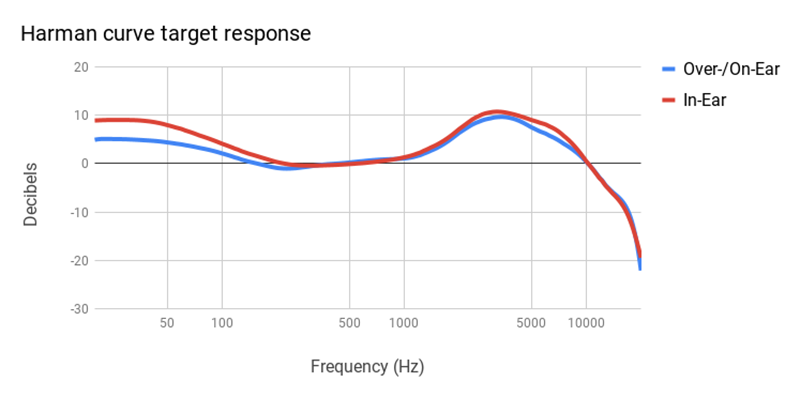
The Harman curve, a target frequency response curve for headphones. Courtesy of Jazz Times magazine. The Harman curve, a target frequency response curve for headphones. Courtesy of Jazz Times magazine.

How well the IEMs fit in your ears is a significant factor that should not be overlooked, especially when doing critical listening. A bad fit will affect how the headphones sound, particularly in the bass. A poorly-fitting seal in your ear canal entrance is just not going to cut it if you do anything other than sit rigidly still when listening, and that alone probably negates the experience for the joggers, athletes, gym-goers, walkers and others among us. I haven’t had a lot of luck with the Apple EarPods; although their cleverly-designed contoured earpiece tries to provide a tapered one size fits all solution, in my experience, it just means that the EarPods habitually fall out and don’t work like a proper IEM. (The sound quality is what could perhaps be generously described as forgivably functional and passable.)

Let’s return, though, to considering if quality has improved at lower price points. What factors go into the cost of a well-made IEM? Apart from the obvious point of the build quality and longevity of the components used, do the earphones come with a selection of different sized ear buds for an optimal fit? Usually, a respectable brand will give you at least three sizes, and some will include Comply or other memory foam eartips. Here’s something to consider: the size of each of your ears may not be the same, and you may find that using two different sizes may work best for your ears.

If you are unaware of these and want a very-good-sounding product that comes with a set of earbuds which on their own might cost around half the price of the IEM itself, check out the Linsoul Audio Moondrop Chu. At under $25 these IEMs (along with a select peer group in their price range), are ridiculously well-balanced and tuned and I have to say compete with some products more than ten times their price. It’s borderline insanity that such quality is available in today’s marketplace. But then, look at the technology in our mobile phones, and that contextualizes where and perhaps why these advancements are breaking new ground in price-to-performance ratios. Perhaps surprisingly the Moondrop Chu earpieces are indeed made of metal, not plastic, and even feature an attractive and detailed logo. The packaging is also excellent, featuring one of Moondrop’s stylized Manga-esque characters.

Other things to consider when looking at (and listening to) IEMs: are the cables detachable from the earpieces so that if caught, they don’t snag, stretch or break? If this might be an issue and you also might want to be able to detach your cables for tidy storage, look at the 7HZ Salnotes Zero, also from Linsoul. These in-ears feature a subtly-improved treble response over the Chu, and the price difference is negligible. Do they sound good? No, they sound very good. If you want to invest more money in excellent performing IEMs from Moondrop, perhaps consider the Blessing 2 and Moondrop Variations models (US$319.99 and US$520 respectively), both of which have their devotees, primarily due to their natural-sounding presentation and better-balanced top end. Of course, there are also plenty of high-quality models from manufacturers including Periodic Audio, Shure, Cardas, Audio-Technica, Jerry Harvey Audio, Shure, Bose, Sennheiser, HIFIMAN, Audeze and numerous others.
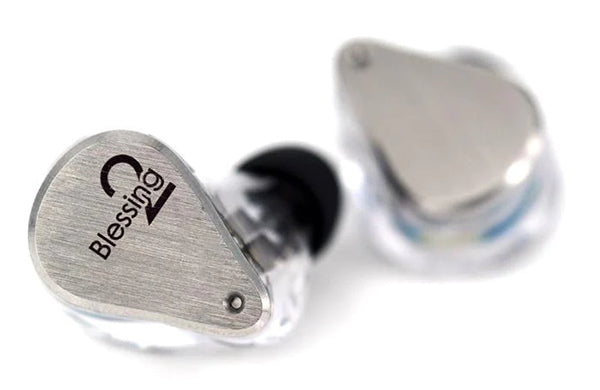
Moondrop Blessing 2 in-ear headphones.

Another thing to consider is whether the IEM has single or multiple drivers and crossovers – yes, that is also a thing in the IEM space. Also, IEMs can use either dynamic drivers (like miniature loudspeakers), or balanced armature drivers, where a voice coil is wrapped around an armature that is suspended between two magnets. The conventional wisdom is that dynamic drivers have a stronger low-end response, while balanced armature designs deliver better midrange and high-frequency response, but as always, the implementation can be as or more important than the technology. Some models incorporate a hybrid of both designs.

Check out the Truthear Zero in-ears from Shenzhen Audio (not to be confused with any other units named Zero from other brands) which utilizes both a 10 mm and a 7.8 mm dynamic driver and a crossover. There are even IEMs with planar-magnetic drivers, like the AAW Nightingale or the more affordable Linsoul Audio 7HZ Timeless.
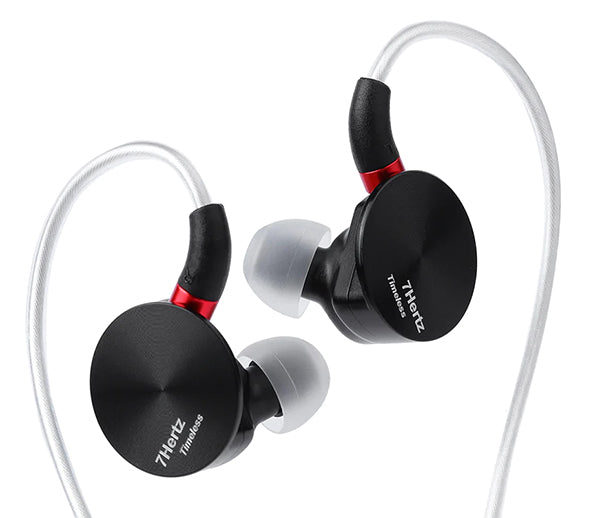
Linsoul Audio 7Hz Timeless in-ear headphones.
Linsoul Audio 7HZ Timeless in-ear headphones.

I have been blown away by the sound quality of some modern IEMs. You do have to sift out a lot of junk. To that end, I have recently tried many different models to replace a beloved set of IEMs that I owned. I don’t wish to name and shame the brand, but I was…disappointed that there was no offer to repair them from the unspoken of and undivulged company. What had me really bothered, however, was that when after gently removing the earbud, the entire driver unit came away from its ceramic housing, taking with it the super-fine-gauge voice coil wire which could simply not be reattached. I wouldn’t have minded, but they had a retail price of almost $200. One may typically expect these kinds of issues from something that cost $25. The upside however, is that so much advancement has been made in IEMs in recent years that equivalent and indeed better-sounding products are more readily available than ever.

In our next installment we will look more deeply into in-ear monitor technology and how you may improve your own listening experience. I’ll also discuss noise-cancellation and its advantages and limitations.

Header image courtesy of Pexels.com/Shazard R.

More from Issue 180

View All Articles in Issue 180

Search Copper Magazine

#226 JJ Murphy’s Sleep Paralysis is a Genre-Bending Musical Journey Through Jazz, Fusion and More by Frank Doris Jan 05, 2026 #226 Stewardship by Consent by B. Jan Montana Jan 05, 2026 #226 Food, Music, and Sensory Experience: An Interview With Professor Jonathan Zearfoss of the Culinary Institute of America by Joe Caplan Jan 05, 2026 #226 Studio Confidential: A Who’s Who of Recording Engineers Tell Their Stories by Frank Doris Jan 05, 2026 #226 Pilot Radio is Reborn, 50 Years Later: Talking With CEO Barak Epstein by Frank Doris Jan 05, 2026 #226 The Vinyl Beat Goes Down to Tijuana (By Way of Los Angeles), Part One by Rudy Radelic Jan 05, 2026 #226 Capital Audiofest 2025: Must-See Stereo, Part Two by Frank Doris Jan 05, 2026 #226 My Morning Jacket’s Carl Broemel and Tyler Ramsey Collaborate on Their Acoustic Guitar Album, Celestun by Ray Chelstowski Jan 05, 2026 #226 The People Who Make Audio Happen: CanJam SoCal 2025, Part Two by Harris Fogel Jan 05, 2026 #226 How to Play in a Rock Band, 19: Touring Can Make You Crazy, Part One by Frank Doris Jan 05, 2026 #226 Linda Ronstadt Goes Bigger by Wayne Robins Jan 05, 2026 #226 From The Audiophile’s Guide: Active Room Correction and Digital Signal Processing by Paul McGowan Jan 05, 2026 #226 PS Audio in the News by Frank Doris Jan 05, 2026 #226 Back to My Reel-to-Reel Roots, Part 25: Half-Full, Not Empty by Ken Kessler Jan 05, 2026 #226 Happy New Year! by Frank Doris Jan 05, 2026 #226 Turn It Down! by Peter Xeni Jan 05, 2026 #226 Ghost Riders by James Schrimpf Jan 05, 2026 #226 A Factory Tour of Audio Manufacturer German Physiks by Markus "Marsu" Manthey Jan 04, 2026 #225 Capital Audiofest 2025: Must-See Stereo, Part One by Frank Doris Dec 01, 2025 #225 Otis Taylor and the Electrics Delivers a Powerful Set of Hypnotic Modern Blues by Frank Doris Dec 01, 2025 #225 A Christmas Miracle by B. Jan Montana Dec 01, 2025 #225 T.H.E. Show New York 2025, Part Two: Plenty to See, Hear, and Enjoy by Frank Doris Dec 01, 2025 #225 Underappreciated Artists, Part One: Martin Briley by Rich Isaacs Dec 01, 2025 #225 Rock and Roll is Here to Stay by Wayne Robins Dec 01, 2025 #225 A Lifetime of Holiday Record (and CD) Listening by Rudy Radelic Dec 01, 2025 #225 Little Feat: Not Saying Goodbye, Not Yet by Ray Chelstowski Dec 01, 2025 #225 How to Play in a Rock Band, Part 18: Dealing With Burnout by Frank Doris Dec 01, 2025 #225 The People Who Make Audio Happen: CanJam SoCal 2025 by Harris Fogel Dec 01, 2025 #225 Chicago’s Sonic Sanctuaries: Four Hi‑Fi Listening Bars Channeling the Jazz‑Kissa Spirit by Olivier Meunier-Plante Dec 01, 2025 #225 From The Audiophile’s Guide: Controlling Bass Frequencies Through Membrane Absorbers (and How to Build Your Own) by Paul McGowan Dec 01, 2025 #225 Your Editor’s Tips for Attending Audio Shows by Frank Doris Dec 01, 2025 #225 PS Audio in the News by Frank Doris Dec 01, 2025 #225 Back to My Reel-to-Reel Roots, Part 24 by Ken Kessler Dec 01, 2025 #225 Holiday Music by Frank Doris Dec 01, 2025 #225 Puppy Prognostication by Peter Xeni Dec 01, 2025 #225 How to Post Comments on Copper by Frank Doris Dec 01, 2025 #225 Living Color by Rudy Radelic Dec 01, 2025 #224 T.H.E. Show New York 2025, Part One: A New Beginning by Frank Doris Nov 03, 2025 #224 Fool’s Leap of Faith is the Extraordinary Octave Records Debut from Singer/Songwriter Tyler Burba and Visit by Frank Doris Nov 03, 2025 #224 The Beatles’ “Aeolian Cadences.” What? by Wayne Robins Nov 03, 2025 #224 Persona Non Grata by B. Jan Montana Nov 03, 2025 #224 Talking With Recording Engineer Barry Diament of Soundkeeper Recordings, Part Two by Frank Doris Nov 03, 2025 #224 B Sides, B Movies, and Beware of Zombies by Rudy Radelic Nov 03, 2025 #224 The Burn-In Chronicles: 1,000 Hours to Sonic Salvation by Olivier Meunier-Plante Nov 03, 2025 #224 A Conversation With Mat Weisfeld of VPI Industries by Joe Caplan Nov 03, 2025 #224 Blues-Rocker Kenny Wayne Shepherd Celebrates 30 Years of Ledbetter Heights by Ray Chelstowski Nov 03, 2025 #224 Playing in a Rock Band, 17: When Good Gigs Go Bad, Part Two by Frank Doris Nov 03, 2025

Lounging with In-Ear Monitors, Part One

Lounging with In-Ear Monitors, Part One

If one of the greatest limitations to getting good stereo sound is the dominating effect of your room’s sonic and tonal personality, then what might be a better way of tailoring your own personal preferred listening experience than to eliminate the room altogether – and hone your listening skills at the same time. What am I talking about? I am referring to headphones, and more specifically, in-ear monitors (IEMs). Often referred to as earbuds, earphones, or in-ear headphones, I’ll go with the term in-ear monitors, as they are typically called in the world of pro audio.

It occurs to me that with such a global demand for in-ears, albeit that they may primarily be used for plugging into mobile phones and portable devices (which is not a crime in and of itself), two things really stand out:

One, there is a phenomenal global demand. Second, that there exists such fierce competition in the IEM space that it is driving some recent improvements in sound and manufacturing quality of very inexpensive IEMs. Some brands are tuning their devices so well that a low purchase price is perhaps less-indicative of lesser sonic quality than ever before. Increasingly, as more and more people care more about the preferred tonal “personality” traits and sonic reproduction of their favorite tunes, it seems to me they are becoming more demanding and well-informed about what sounds good.

Yet it is true that there is an absolute plethora of IEMs on the market that sound anywhere from downright mediocre to shockingly harsh, brittle and thin. There are models with massively exaggerated bass response, and others with a deep V-shaped midrange scoop.

Of course, listener preferences can be subjective, but we do have a benchmark to steer by – that of the “Harman curve.” It’s a frequency response curve derived from research by Harman International. This curve has been deemed by Harman to be pleasing to a majority of listeners, offering sufficient bass, clean non-muddied mids, good vocal representation and adequate detail in the treble response without being fatiguing and wearing as you listen to your favorite drum parts, cymbal hits and hi-hat rides. The fact that so may manufacturers plot their frequency responses for their IEMs makes it a relatively easy thing to make visual comparative analyses of sonic characteristics. Although looking at frequency response curves is not a bulletproof method for comparing apples to apples, (or Samsungs to Samsungs) it can certainly set you off in a good direction. (For more about the Harman curve, click here.)

The Harman curve, a target frequency response curve for headphones. Courtesy of Jazz Times magazine. The Harman curve, a target frequency response curve for headphones. Courtesy of Jazz Times magazine.

How well the IEMs fit in your ears is a significant factor that should not be overlooked, especially when doing critical listening. A bad fit will affect how the headphones sound, particularly in the bass. A poorly-fitting seal in your ear canal entrance is just not going to cut it if you do anything other than sit rigidly still when listening, and that alone probably negates the experience for the joggers, athletes, gym-goers, walkers and others among us. I haven’t had a lot of luck with the Apple EarPods; although their cleverly-designed contoured earpiece tries to provide a tapered one size fits all solution, in my experience, it just means that the EarPods habitually fall out and don’t work like a proper IEM. (The sound quality is what could perhaps be generously described as forgivably functional and passable.)

Let’s return, though, to considering if quality has improved at lower price points. What factors go into the cost of a well-made IEM? Apart from the obvious point of the build quality and longevity of the components used, do the earphones come with a selection of different sized ear buds for an optimal fit? Usually, a respectable brand will give you at least three sizes, and some will include Comply or other memory foam eartips. Here’s something to consider: the size of each of your ears may not be the same, and you may find that using two different sizes may work best for your ears.

If you are unaware of these and want a very-good-sounding product that comes with a set of earbuds which on their own might cost around half the price of the IEM itself, check out the Linsoul Audio Moondrop Chu. At under $25 these IEMs (along with a select peer group in their price range), are ridiculously well-balanced and tuned and I have to say compete with some products more than ten times their price. It’s borderline insanity that such quality is available in today’s marketplace. But then, look at the technology in our mobile phones, and that contextualizes where and perhaps why these advancements are breaking new ground in price-to-performance ratios. Perhaps surprisingly the Moondrop Chu earpieces are indeed made of metal, not plastic, and even feature an attractive and detailed logo. The packaging is also excellent, featuring one of Moondrop’s stylized Manga-esque characters.

Other things to consider when looking at (and listening to) IEMs: are the cables detachable from the earpieces so that if caught, they don’t snag, stretch or break? If this might be an issue and you also might want to be able to detach your cables for tidy storage, look at the 7HZ Salnotes Zero, also from Linsoul. These in-ears feature a subtly-improved treble response over the Chu, and the price difference is negligible. Do they sound good? No, they sound very good. If you want to invest more money in excellent performing IEMs from Moondrop, perhaps consider the Blessing 2 and Moondrop Variations models (US$319.99 and US$520 respectively), both of which have their devotees, primarily due to their natural-sounding presentation and better-balanced top end. Of course, there are also plenty of high-quality models from manufacturers including Periodic Audio, Shure, Cardas, Audio-Technica, Jerry Harvey Audio, Shure, Bose, Sennheiser, HIFIMAN, Audeze and numerous others.

Moondrop Blessing 2 in-ear headphones.

Another thing to consider is whether the IEM has single or multiple drivers and crossovers – yes, that is also a thing in the IEM space. Also, IEMs can use either dynamic drivers (like miniature loudspeakers), or balanced armature drivers, where a voice coil is wrapped around an armature that is suspended between two magnets. The conventional wisdom is that dynamic drivers have a stronger low-end response, while balanced armature designs deliver better midrange and high-frequency response, but as always, the implementation can be as or more important than the technology. Some models incorporate a hybrid of both designs.

Check out the Truthear Zero in-ears from Shenzhen Audio (not to be confused with any other units named Zero from other brands) which utilizes both a 10 mm and a 7.8 mm dynamic driver and a crossover. There are even IEMs with planar-magnetic drivers, like the AAW Nightingale or the more affordable Linsoul Audio 7HZ Timeless.

Linsoul Audio 7Hz Timeless in-ear headphones.
Linsoul Audio 7HZ Timeless in-ear headphones.

I have been blown away by the sound quality of some modern IEMs. You do have to sift out a lot of junk. To that end, I have recently tried many different models to replace a beloved set of IEMs that I owned. I don’t wish to name and shame the brand, but I was…disappointed that there was no offer to repair them from the unspoken of and undivulged company. What had me really bothered, however, was that when after gently removing the earbud, the entire driver unit came away from its ceramic housing, taking with it the super-fine-gauge voice coil wire which could simply not be reattached. I wouldn’t have minded, but they had a retail price of almost $200. One may typically expect these kinds of issues from something that cost $25. The upside however, is that so much advancement has been made in IEMs in recent years that equivalent and indeed better-sounding products are more readily available than ever.

In our next installment we will look more deeply into in-ear monitor technology and how you may improve your own listening experience. I’ll also discuss noise-cancellation and its advantages and limitations.

Header image courtesy of Pexels.com/Shazard R.

0 comments

Leave a comment

0 Comments

Your avatar

Loading comments...

🗑️ Delete Comment

Enter moderator password to delete this comment: