COPPER

A PS Audio Publication

Issue 179 • Free Online Magazine

Issue 179 Revolutions Per Minute

Around the World In 80 Lathes, Part 29

Around the World In 80 Lathes, Part 29

The Cost of Everything and the Value of Nothing

During the period from 1992 until 2002, Peter Copeland, employed by the British Library, wrote the Manual of Analogue Sound Restoration Techniques. Peter passed away in 2006, before the publication of his work, which was to take a couple more years.

A section of this outstanding compilation of knowledge is devoted to a historic overview of the cost of the various recording media available around the world. It begins with cylinders and progresses to wax blanks, lacquer disks, shellac and vinyl pressings, magnetic tape, and cassette tape, and concludes with the CD. He wrote, “As I write this, music distribution via The Internet is beginning to conquer conventional retail sales" (we are now at least 20 years down the line). After warning readers who would prefer a happy ending to read no further, he confides that “sound recording is no longer a ‘sexy’ industry. It shows every sign of becoming like the water industry – you just turn a tap, and there it is."

His final conclusion has stayed with me, and I have often quoted him: "It'll take a major shortage to remind people about the cost of everything and the value of nothing." Ever so relevant, I can think of many situations in a few of the industries I have an active interest in where this phrase would be painfully appropriate.

However, at present, vinyl record sales are still on the rise with the disk medium having experienced a massive resurgence over the past few years, while many lower-cost options for listening to music (such as the CD) are on a steep decline. Yet, there is no shortage of people who will take every opportunity to publicly state that they find records grossly overpriced nowadays, while they usually admit that they still buy them anyway. At the same time, the “race to the bottom" mentality is not proving very successful for the record labels that have been engaging in such practices. The lower-priced product is, more often than not, not the one with the highest sales figures, or turnover. Conversely, it is actually the better-quality, more elaborately packaged, mid-priced records that have been selling the highest numbers of copies over the last five years. But is selling more copies always more profitable?

We are living through a time of great change in every aspect of our lives. Many have been experimenting with different business models for sound recordings. The lowest-priced records are usually inadequate in terms of overall product quality to satisfy the market for this particular medium, in the digital age, where alternatives are plentiful and omnipresent for those who do not place quality particularly high on their priority list. As a consequence, they usually neither sell many copies, nor generate much profit in the vinyl domain. However, it doesn't seem like the high volume of sales associated with a carefully-created album is the most profitable avenue either. In fact, it is highly questionable whether there is any direct correlation between quality and profitability anymore.

So, what is the most highly desirable aspect of a product consisting of a carrier of recorded sound? What will make people splash out, when they are already complaining about the cost of a $19.99 record retail price?

A few episodes back, in Issues 147, 148, 149 and 150, we looked at the work of Stockfisch Records and their release of the DMM Dubplate Vol. 1, cut straight onto a copper-plated disk which you can play back on a regular turntable with outstanding sonic results. The disc also features superb packaging and presentation. The retail price far exceeds that of ordinary records and is high enough to not need to end in .99, as it won't make a difference, at least to anyone serious enough about sound quality and audio in general as to be willing to invest in something like that.
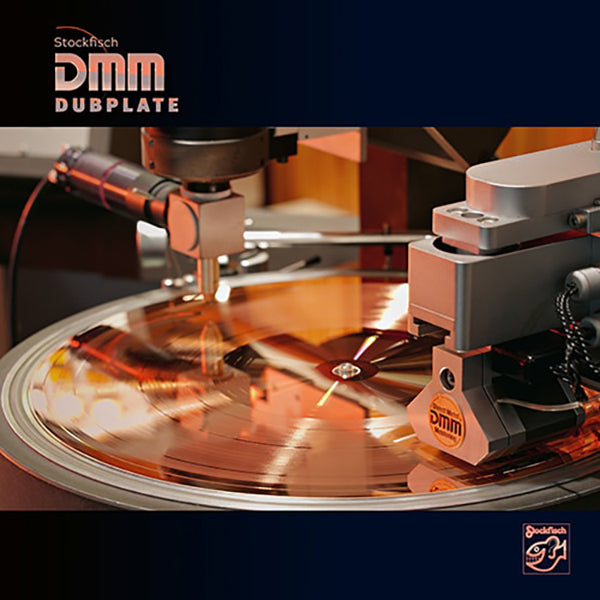
Stockfisch Records' DMM Dubplate, Vol. 1.

Similarly, Pete Hutchinson of the Electric Recording Company started a business offering exquisite reissues of outstanding recordings, cut from the original master tapes, using some of the finest vacuum tube mastering electronics ever made, along with a collection of excellent disk mastering lathes. ERC goes as far as using letterpress printing for a faithful and truly authentic reproduction of the original artwork. Their prices are also far beyond the $.99 range, but as with the DMM Dubplate, once the actual materials and processes used are taken into consideration, they merely account for the economics of producing something of genuinely high quality. There is not much left in the form of an enormous profit margin. It is a labor of love. If the motivation would have been the profit, there are certainly much easier ways of making money.

Both the Electric Recording Co. and Stockfisch Records are successful ventures. Both are certainly outside the ordinary. Both sell very limited-edition products and neither are likely to become tough competition for the individuals on the Forbes Real-Time Billionaires List.

Pete Hutchinson of The Electric Recording Co., with his Lyrec lathe. Courtesy of The Electric Recording Company. Pete Hutchinson of The Electric Recording Co., with his Lyrec lathe. Courtesy of The Electric Recording Company.

Back in 1953, using a modest Presto 6N disk recording lathe, Sam Phillips recorded Elvis Presley performing two songs for his mom, as a one-off record that was not intended as a commercial product. Elvis went on to make quite a bit of money, selling plenty of records. So did Jack White, beginning with the White Stripes and by now involved in a variety of musical projects and business ventures.

But, in 2015, Jack White purchased that one-off acetate of the very first recording of Elvis, for $300,000! It was a rather primitive recording of a man who up until that point was sustaining himself by hauling goods as a truck driver. It wasn't the highest sound quality ever captured in the universe, and it wasn't exquisitely packaged either. It wasn't even a commercial product. What it did have was scarcity, even if originally unintentional. As a one-off direct-to-disk recording, there was only one copy of it. And, it wasn't anywhere near the most expensive record ever sold!

Here's a video about how the disc was transferred to digital for preservation:

At around the same time in 2015, the very first pressed copy of the “White Album” by the Beatles (The Beatles), owned by Ringo Starr, was auctioned for $790,000. But that was peanuts. After all, it was just a mere copy of a record manufactured by the millions. OK, the first copy. I bet the press wasn't even fully warmed up!

More recently, T-Bone Burnett came up with a two-fold concept. One part of the concept was artificial scarcity and the other half was using a process of ionic deposition of a protective layer on a recorded lacquer master disk, so that it can be played back without damage, using a regular turntable. He called his concept Ionic Originals. As for the scarcity part, the idea was to make only one copy and see how much it sells for. For his first release, he got Bob Dylan to record a new version of "Blowin' In The Wind". It was a digital recording, recorded and mixed by Mike Piersante, pre-mastered for vinyl by Gavin Lurssen and cut to disk by Jeff Powell. It sold at auction for $1,769,508 in July 2022.

The reason I call this “artificial scarcity” is that, being a digital recording, there is no technically imposed limitation to how many copies could be generated, in various media. There was no particular reason why only a single record could be made, other than preference due to the business model.

It would make a fitting end to this story if the most expensive sound carrier in history was a one-off ionically-protected dubplate, containing a classic hit by Bob Dylan. But it wasn't. It wasn't even a record.

It was a measly little CD. Yes, that little piece of cheap plastic containing digital data, that costs a few cents to make. In 2015, Wu Tang Clan released on CD a single copy of an album they had reportedly spent six years recording. That copy sold for $2,400,000. The lucky buyer, Martin Shkreli, wasn’t that lucky after all and he was arrested, convicted and imprisoned shortly thereafter. The CD was confiscated by the Department of Justice and subsequently sold again in 2021 to PleasrDAO (a decentralized autonomous organization) for $4,000,000. For a CD.

Just let that sink in for a little bit.

Rewind: the cost of everything and the value of nothing...

Header image: The presentation case for the Wu-Tang Clan Once Upon a Time in Shaolin CD, the most expensive audio carrier in the world. Courtesy of Wikimedia Commons/Wutangcashew. Pete Hutchinson of Electric Recording Co., with his Lyrec lathe. Courtesy of The Electric Recording Company.

More from Issue 179

View All Articles in Issue 179

Search Copper Magazine

#226 JJ Murphy’s Sleep Paralysis is a Genre-Bending Musical Journey Through Jazz, Fusion and More by Frank Doris Jan 05, 2026 #226 Stewardship by Consent by B. Jan Montana Jan 05, 2026 #226 Food, Music, and Sensory Experience: An Interview With Professor Jonathan Zearfoss of the Culinary Institute of America by Joe Caplan Jan 05, 2026 #226 Studio Confidential: A Who’s Who of Recording Engineers Tell Their Stories by Frank Doris Jan 05, 2026 #226 Pilot Radio is Reborn, 50 Years Later: Talking With CEO Barak Epstein by Frank Doris Jan 05, 2026 #226 The Vinyl Beat Goes Down to Tijuana (By Way of Los Angeles), Part One by Rudy Radelic Jan 05, 2026 #226 Capital Audiofest 2025: Must-See Stereo, Part Two by Frank Doris Jan 05, 2026 #226 My Morning Jacket’s Carl Broemel and Tyler Ramsey Collaborate on Their Acoustic Guitar Album, Celestun by Ray Chelstowski Jan 05, 2026 #226 The People Who Make Audio Happen: CanJam SoCal 2025, Part Two by Harris Fogel Jan 05, 2026 #226 How to Play in a Rock Band, 19: Touring Can Make You Crazy, Part One by Frank Doris Jan 05, 2026 #226 Linda Ronstadt Goes Bigger by Wayne Robins Jan 05, 2026 #226 From The Audiophile’s Guide: Active Room Correction and Digital Signal Processing by Paul McGowan Jan 05, 2026 #226 PS Audio in the News by Frank Doris Jan 05, 2026 #226 Back to My Reel-to-Reel Roots, Part 25: Half-Full, Not Empty by Ken Kessler Jan 05, 2026 #226 Happy New Year! by Frank Doris Jan 05, 2026 #226 Turn It Down! by Peter Xeni Jan 05, 2026 #226 Ghost Riders by James Schrimpf Jan 05, 2026 #226 A Factory Tour of Audio Manufacturer German Physiks by Markus "Marsu" Manthey Jan 04, 2026 #225 Capital Audiofest 2025: Must-See Stereo, Part One by Frank Doris Dec 01, 2025 #225 Otis Taylor and the Electrics Delivers a Powerful Set of Hypnotic Modern Blues by Frank Doris Dec 01, 2025 #225 A Christmas Miracle by B. Jan Montana Dec 01, 2025 #225 T.H.E. Show New York 2025, Part Two: Plenty to See, Hear, and Enjoy by Frank Doris Dec 01, 2025 #225 Underappreciated Artists, Part One: Martin Briley by Rich Isaacs Dec 01, 2025 #225 Rock and Roll is Here to Stay by Wayne Robins Dec 01, 2025 #225 A Lifetime of Holiday Record (and CD) Listening by Rudy Radelic Dec 01, 2025 #225 Little Feat: Not Saying Goodbye, Not Yet by Ray Chelstowski Dec 01, 2025 #225 How to Play in a Rock Band, Part 18: Dealing With Burnout by Frank Doris Dec 01, 2025 #225 The People Who Make Audio Happen: CanJam SoCal 2025 by Harris Fogel Dec 01, 2025 #225 Chicago’s Sonic Sanctuaries: Four Hi‑Fi Listening Bars Channeling the Jazz‑Kissa Spirit by Olivier Meunier-Plante Dec 01, 2025 #225 From The Audiophile’s Guide: Controlling Bass Frequencies Through Membrane Absorbers (and How to Build Your Own) by Paul McGowan Dec 01, 2025 #225 Your Editor’s Tips for Attending Audio Shows by Frank Doris Dec 01, 2025 #225 PS Audio in the News by Frank Doris Dec 01, 2025 #225 Back to My Reel-to-Reel Roots, Part 24 by Ken Kessler Dec 01, 2025 #225 Holiday Music by Frank Doris Dec 01, 2025 #225 Puppy Prognostication by Peter Xeni Dec 01, 2025 #225 How to Post Comments on Copper by Frank Doris Dec 01, 2025 #225 Living Color by Rudy Radelic Dec 01, 2025 #224 T.H.E. Show New York 2025, Part One: A New Beginning by Frank Doris Nov 03, 2025 #224 Fool’s Leap of Faith is the Extraordinary Octave Records Debut from Singer/Songwriter Tyler Burba and Visit by Frank Doris Nov 03, 2025 #224 The Beatles’ “Aeolian Cadences.” What? by Wayne Robins Nov 03, 2025 #224 Persona Non Grata by B. Jan Montana Nov 03, 2025 #224 Talking With Recording Engineer Barry Diament of Soundkeeper Recordings, Part Two by Frank Doris Nov 03, 2025 #224 B Sides, B Movies, and Beware of Zombies by Rudy Radelic Nov 03, 2025 #224 The Burn-In Chronicles: 1,000 Hours to Sonic Salvation by Olivier Meunier-Plante Nov 03, 2025 #224 A Conversation With Mat Weisfeld of VPI Industries by Joe Caplan Nov 03, 2025 #224 Blues-Rocker Kenny Wayne Shepherd Celebrates 30 Years of Ledbetter Heights by Ray Chelstowski Nov 03, 2025 #224 Playing in a Rock Band, 17: When Good Gigs Go Bad, Part Two by Frank Doris Nov 03, 2025

Around the World In 80 Lathes, Part 29

Around the World In 80 Lathes, Part 29

The Cost of Everything and the Value of Nothing

During the period from 1992 until 2002, Peter Copeland, employed by the British Library, wrote the Manual of Analogue Sound Restoration Techniques. Peter passed away in 2006, before the publication of his work, which was to take a couple more years.

A section of this outstanding compilation of knowledge is devoted to a historic overview of the cost of the various recording media available around the world. It begins with cylinders and progresses to wax blanks, lacquer disks, shellac and vinyl pressings, magnetic tape, and cassette tape, and concludes with the CD. He wrote, “As I write this, music distribution via The Internet is beginning to conquer conventional retail sales" (we are now at least 20 years down the line). After warning readers who would prefer a happy ending to read no further, he confides that “sound recording is no longer a ‘sexy’ industry. It shows every sign of becoming like the water industry – you just turn a tap, and there it is."

His final conclusion has stayed with me, and I have often quoted him: "It'll take a major shortage to remind people about the cost of everything and the value of nothing." Ever so relevant, I can think of many situations in a few of the industries I have an active interest in where this phrase would be painfully appropriate.

However, at present, vinyl record sales are still on the rise with the disk medium having experienced a massive resurgence over the past few years, while many lower-cost options for listening to music (such as the CD) are on a steep decline. Yet, there is no shortage of people who will take every opportunity to publicly state that they find records grossly overpriced nowadays, while they usually admit that they still buy them anyway. At the same time, the “race to the bottom" mentality is not proving very successful for the record labels that have been engaging in such practices. The lower-priced product is, more often than not, not the one with the highest sales figures, or turnover. Conversely, it is actually the better-quality, more elaborately packaged, mid-priced records that have been selling the highest numbers of copies over the last five years. But is selling more copies always more profitable?

We are living through a time of great change in every aspect of our lives. Many have been experimenting with different business models for sound recordings. The lowest-priced records are usually inadequate in terms of overall product quality to satisfy the market for this particular medium, in the digital age, where alternatives are plentiful and omnipresent for those who do not place quality particularly high on their priority list. As a consequence, they usually neither sell many copies, nor generate much profit in the vinyl domain. However, it doesn't seem like the high volume of sales associated with a carefully-created album is the most profitable avenue either. In fact, it is highly questionable whether there is any direct correlation between quality and profitability anymore.

So, what is the most highly desirable aspect of a product consisting of a carrier of recorded sound? What will make people splash out, when they are already complaining about the cost of a $19.99 record retail price?

A few episodes back, in Issues 147, 148, 149 and 150, we looked at the work of Stockfisch Records and their release of the DMM Dubplate Vol. 1, cut straight onto a copper-plated disk which you can play back on a regular turntable with outstanding sonic results. The disc also features superb packaging and presentation. The retail price far exceeds that of ordinary records and is high enough to not need to end in .99, as it won't make a difference, at least to anyone serious enough about sound quality and audio in general as to be willing to invest in something like that.

Stockfisch Records' DMM Dubplate, Vol. 1.

Similarly, Pete Hutchinson of the Electric Recording Company started a business offering exquisite reissues of outstanding recordings, cut from the original master tapes, using some of the finest vacuum tube mastering electronics ever made, along with a collection of excellent disk mastering lathes. ERC goes as far as using letterpress printing for a faithful and truly authentic reproduction of the original artwork. Their prices are also far beyond the $.99 range, but as with the DMM Dubplate, once the actual materials and processes used are taken into consideration, they merely account for the economics of producing something of genuinely high quality. There is not much left in the form of an enormous profit margin. It is a labor of love. If the motivation would have been the profit, there are certainly much easier ways of making money.

Both the Electric Recording Co. and Stockfisch Records are successful ventures. Both are certainly outside the ordinary. Both sell very limited-edition products and neither are likely to become tough competition for the individuals on the Forbes Real-Time Billionaires List.

Pete Hutchinson of The Electric Recording Co., with his Lyrec lathe. Courtesy of The Electric Recording Company. Pete Hutchinson of The Electric Recording Co., with his Lyrec lathe. Courtesy of The Electric Recording Company.

Back in 1953, using a modest Presto 6N disk recording lathe, Sam Phillips recorded Elvis Presley performing two songs for his mom, as a one-off record that was not intended as a commercial product. Elvis went on to make quite a bit of money, selling plenty of records. So did Jack White, beginning with the White Stripes and by now involved in a variety of musical projects and business ventures.

But, in 2015, Jack White purchased that one-off acetate of the very first recording of Elvis, for $300,000! It was a rather primitive recording of a man who up until that point was sustaining himself by hauling goods as a truck driver. It wasn't the highest sound quality ever captured in the universe, and it wasn't exquisitely packaged either. It wasn't even a commercial product. What it did have was scarcity, even if originally unintentional. As a one-off direct-to-disk recording, there was only one copy of it. And, it wasn't anywhere near the most expensive record ever sold!

Here's a video about how the disc was transferred to digital for preservation:

At around the same time in 2015, the very first pressed copy of the “White Album” by the Beatles (The Beatles), owned by Ringo Starr, was auctioned for $790,000. But that was peanuts. After all, it was just a mere copy of a record manufactured by the millions. OK, the first copy. I bet the press wasn't even fully warmed up!

More recently, T-Bone Burnett came up with a two-fold concept. One part of the concept was artificial scarcity and the other half was using a process of ionic deposition of a protective layer on a recorded lacquer master disk, so that it can be played back without damage, using a regular turntable. He called his concept Ionic Originals. As for the scarcity part, the idea was to make only one copy and see how much it sells for. For his first release, he got Bob Dylan to record a new version of "Blowin' In The Wind". It was a digital recording, recorded and mixed by Mike Piersante, pre-mastered for vinyl by Gavin Lurssen and cut to disk by Jeff Powell. It sold at auction for $1,769,508 in July 2022.

The reason I call this “artificial scarcity” is that, being a digital recording, there is no technically imposed limitation to how many copies could be generated, in various media. There was no particular reason why only a single record could be made, other than preference due to the business model.

It would make a fitting end to this story if the most expensive sound carrier in history was a one-off ionically-protected dubplate, containing a classic hit by Bob Dylan. But it wasn't. It wasn't even a record.

It was a measly little CD. Yes, that little piece of cheap plastic containing digital data, that costs a few cents to make. In 2015, Wu Tang Clan released on CD a single copy of an album they had reportedly spent six years recording. That copy sold for $2,400,000. The lucky buyer, Martin Shkreli, wasn’t that lucky after all and he was arrested, convicted and imprisoned shortly thereafter. The CD was confiscated by the Department of Justice and subsequently sold again in 2021 to PleasrDAO (a decentralized autonomous organization) for $4,000,000. For a CD.

Just let that sink in for a little bit.

Rewind: the cost of everything and the value of nothing...

Header image: The presentation case for the Wu-Tang Clan Once Upon a Time in Shaolin CD, the most expensive audio carrier in the world. Courtesy of Wikimedia Commons/Wutangcashew. Pete Hutchinson of Electric Recording Co., with his Lyrec lathe. Courtesy of The Electric Recording Company.

0 comments

Leave a comment

0 Comments

Your avatar

Loading comments...

🗑️ Delete Comment

Enter moderator password to delete this comment: