

Copper

DSD – Is It PCM, Or Isn’t It?
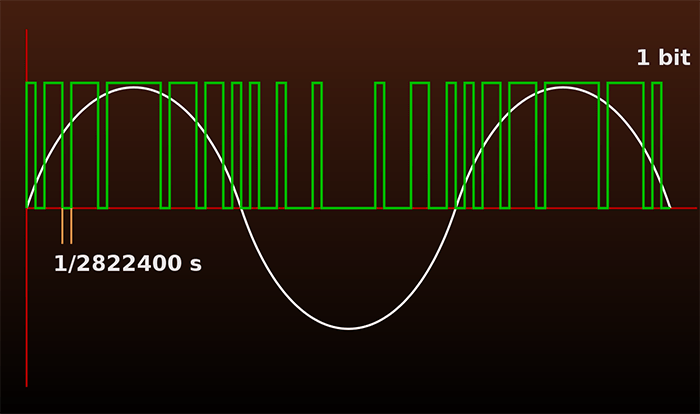
A few weeks back, a prominent person in the audio community shared with me their opinion that DSD is a different thing entirely from PCM, and was surprised to hear... Read more...
Contemplating Eternity
When I first started writing for Copper, my mandate was to write about digital audio. Frankly, I wasn’t sure how long Copper was going to last, but it seemed pretty... Read more...
The Lion and Albert
From the 1920’s through the 1950’s, one of the most popular English entertainers was Stanley Holloway, who carved out a niche for himself reciting comical poetic monologues in a northern working class accent, one of the last hurrahs of the old ‘Vaudeville’ music hall tradition.  He went on to star in films and television on both sides of the Atlantic, as well as on the stage.  Most of his famous monologues were written for him by the poet Marriott Edgar, who had worked with Holloway in a 1920’s stage revue... Read more...
A Survey of Recordings of Shostakovich Symphony No. 4
Back in Copper #39 I wrote a piece on the unsung 4th Symphony of the great 20th Century Russian composer Dmitri Shostakovich, and I hadn’t managed to cover a selection of the available recordings, or make a recommendation. So I decided to return to the subject for this column and finish the job. I have confined myself to those recordings I have in my personal Library, which means I have by necessity had to omit some highly regarded and notable performances, such as the original recordings by Kondrashin with the Moscow Philharmonic. But there are... Read more...
Going to Hong Kong
British Land Forces, Hong Kong29th August, 1949 Hello Jock, Trying to keep a promise. I thought now would be as good a time as ever. Firstly because we are just about half way to Hong Kong, and secondly there’s bags of time to write. Now, I don’t suppose for a moment you’ll be worried about the reasons, and the why’s and wherefore’s, so I’ll just get down to it and let you know how things are going…and how. Right! We left Woking on Tuesday night at about 7pm for London. When... Read more...
Ancestry
A while back, I started messing about researching into my ancestry. I can’t say I was particularly drawn to the subject, but my daughter Lorna subscribed to ancestry.co.uk and wanted me to fill her in on as much of the Murison family background as I could muster. She had already started on my wife’s family, as my wife’s mother, now in her nineties, is a total treasure trove of old family information. In relatively quick order she had managed to assemble a pretty comprehensive picture of the Quarmby family background. However, the Murison... Read more...
The Sound Of Music
The entirety of the field of Philosophy arises from two fundamental questions – the Adam and Eve of Philosophy if you like. Adam asks “What is real?”, while Eve asks “What do we do about it?” Adam’s question appears to be fundamentally concerned with rationality, and seems to demand clear, black and white answers. On the other hand, Eve’s question is far more nuanced, and leads one down a much more difficult and tortuous path. Adam’s descendants split off, to a large degree, and became the sciences. And to this... Read more...
Sounds Good to Me
What attributes should an item of equipment in a sound reproduction chain possess in order to meet the objectives of high-end audio playback? One attribute we tend to think of as important is flatness of frequency response. If a piece of equipment either boosts or attenuates a particular band of frequencies we tend to consider that a big no-no. Departures from a nominally flat frequency response – sometimes even subtle departures – can often be correlated with some sort of perceived tonal coloration in the resultant sound output. So flat... Read more...
30 Years
I am an ex-Pat Brit, living in Canada for the last 30+ years. During that time I have been back to the UK many times, but this year I spent a very solid and busy month on Albion’s shores, and spent a lot of that time reminiscing with some of my (literally) oldest friends. So I thought it might be interesting to note down – in a mostly random fashion – some of the observations that have crossed my mind. I spent a lot of that time driving, as you might... Read more...
To Sleep. Perchance to Dream.
What do we do, as a society, when we are obliged to face uncomfortable realities that require us to make major changes to things we have grown to think of as fundamental? It is a problem we face on a global scale with the emergence of Climate Change, for example. On a personal level, there is absolutely nothing that you or I could do that would make one iota of a difference. Instead, we must look to our leadership at a governmental level. But what we demand of them is... Read more...
20th Century Classical Music – the “Navel Gazing” Era?
In the world of Classical Music, the end of the 19th Century brought with it the end of the “Romantic Era”, which had followed on from the “Classical Period” after the death of Beethoven. Although these are somewhat arbitrary distinctions, they do serve to provide a pair of pretty useful designations that conveniently distinguish the majority of the music composed in those periods. They also represent boundaries between periods of reasonably consistent thinking about how composers would set about composing music. Composers – from a 30,000 foot viewpoint – are always... Read more...
Everest
This year, so far at least, eleven people have died on Mount Everest, and most of us have seen the photograph of the ridiculous “traffic jam” of climbers in a long, long line snaking up to the summit. And all for the single reason that Everest is the tallest mountain on earth. Everest has only been known for about 150 years. Although the peak itself was noted by a Chinese survey in 1715, it was not until the British “Great Trigonometric Survey of India” that measurements were made that would... Read more...
Does Science Have to Make Sense?
The origins of science, and the scientific method, have to do with attempting to understand the world around us. Why things fall when we drop them. How to throw a rock so that it hits a target. Why some things float and others don’t. Why ice forms and why it melts. How to transform base metal into gold. The original purpose of science was to make sense of the world. It was more than just curiosity. If we wanted to build a tall building, would it be possible to determine... Read more...
A Murder of Symmetry
Ronnie McGill received a note, mysteriously signed “Michael Schumacher”, which offered him a friendly warning. “Vinny Spadina is figuring to rub you out”. This, naturally, was worrisome. Ever since he had... Read more...
21st Century Schizoid LP
It was all the way back in the 1980’s that consumer digital audio suddenly took root in the form of the CD, and before you knew what had hit you the good old vinyl LP was being consigned to the junk pile of history – what my father-in-law used to call a GROBA (Gleaming Relic Of A Bygone Age), except that he was generally referring to his cars. But vinyl has steadfastly refused to go gentle into that good night. Here we are in 2019, and not only has the... Read more...
Lasers
Ever wondered how lasers work?…Wondered what it is that gives them the interesting properties they exhibit?…You have?….Good! This column’s for you. Lasers are all about electrons. Atoms are composed of a nucleus surrounded by several electrons, one for each proton in the nucleus. The number of protons in the nucleus determines which element the atom comprises. A nucleus with one proton will be that of a Hydrogen atom; with two protons a Helium atom; with 8 protons, an Oxygen atom, and so forth. The number of electrons which surround the nucleus... Read more...
Great Opera
Here’s what I wrote back in Copper 72: “Many people can’t stand opera, and to be fair, you can see where they’re coming from. Hour after hour of tedious recitative, all in Italian, interspersed with the occasional aria, and all sung by strangled and warbling voices seemingly intent on shattering glass. But oh, those arias!” If opera arias are all so wonderful, and if the recitative is so deadly dull, why does a typical opera apparently comprise something like 20% arias and 80% recitative, rather than the other way around? And what’s... Read more...
Monty Python's 3rd Symphony
“He’s done something no other composer has attempted. He’s placed himself at the center of his work. He gives us a glimpse into his soul. I expect that’s why it’s so … noisy. But it is quite, quite new – the artist as hero. Everything is different from today.” Monty Python was a legendary composer who in many ways set the table for all of Western music for the last two hundred years. Ask virtually anybody who they think the most famous composer of all time was, and the chances... Read more...
The Mikado
Our great Mikado, virtuous man,when he to rule our land beganresolved to try a planwhereby young men might best be steadied.So he decreed in words succinctthat all who flirted, leered, or winked,unless connubially linked,should forthwith be beheaded.And I am right, as you’ll agreethat he was right to so decree. Sir William Schwenck Gilbert and Sir Arthur Seymour Sullivan were first introduced when John Hollingshead, proprietor of London’s Gaiety theatre, commissioned them to write a burlesque comic opera “Thespis” to run over the Christmas season of 1871. Their collaboration proved to... Read more...
Audiophile Science
There is one consistent misconception that non-scientists have about science, and that is the Albert Einstein problem – the idea that major scientific problems can be solved by a lone genius who sweeps away decades of dead-end sawdust and comes up with a miraculous total solution. That stuff only ever happens in the movies, and even then the genius scientist either uses his new invention to take over the world, or becomes indentured in the service of a mad megalomaniac with the same idea. I don’t recall off-hand a movie... Read more...
Page 1 of 5