COPPER

A PS Audio Publication

Issue 174 • Free Online Magazine

Issue 174 Revolutions Per Minute

Around the World In 80 Lathes, Part 24

Around the World In 80 Lathes, Part 24

J.I. began his overview of Danish-made Lyrec record cutting lathes in Issue 173.

All Lyrec disk recording lathes, from the SV-2 to the SV-10, had similar features. They were all direct-driven by Lyrec’s own synchronous AC motors and featured massively heavy brass vacuum platters. They had a characteristic console shape, with an overhead carriage (located above the platter, instead of below, as was the case with Neumann and Scully lathes). The carriage was guided by a linear shaft system, with a leadscrew taking care of advancing the cutter head in the usual manner.

The cutter head suspension system was built into the carriage and featured a miniature vise clamp for holding the cutter head, which would come with a rectangular bar at the back that was designed to fit into the vise jaws. Although in the stereophonic era this would typically be an Ortofon cutter head, other cutter heads could also be fitted to a Lyrec lathe by using a suitable, custom-machined rectangular bar. However, the overhead design did not allow as much clearance and flexibility as with the Neumann and Scully lathes, since the space above the platter was limited by the presence of the overhead mechanism. As a result, massive heads such as those made by Westrex would not be able to be mounted with the correct geometry on the Lyrec suspension unit, even if a custom adapter was made.


The Lyrec SV-12 suspension unit, with the vise clamp cutter head mounting system. Courtesy of Electric Mastering.
The Lyrec SV-12 suspension unit, with the vise clamp cutter head mounting system. Courtesy of Electric Mastering.


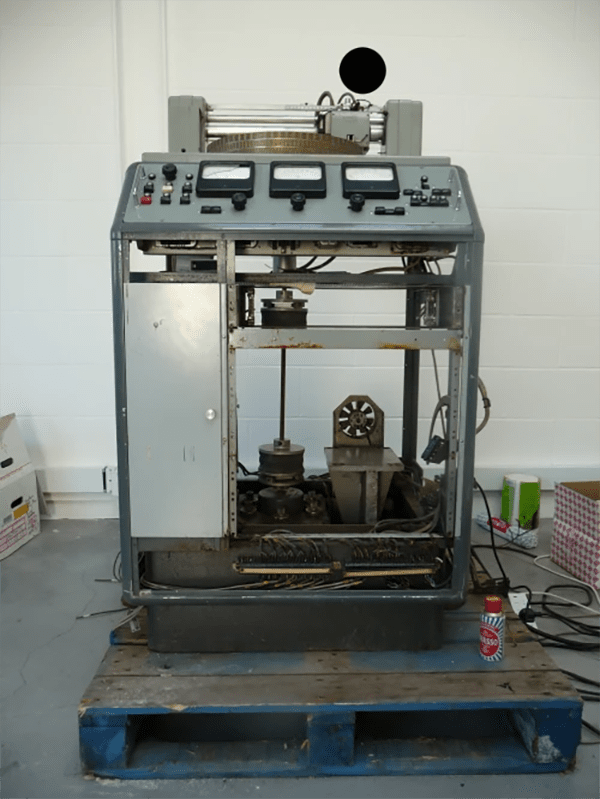
Lyrec lathe with the covers removed, making visible the drive shaft and motor below the platter. Courtesy of Electric Mastering.

Lyrec lathe with the covers removed, making visible the drive shaft and motor below the platter. Courtesy of Electric Mastering.


While the linear-shaft guide rod overhead system design was most probably first introduced by Fairchild (see Bill Leebens’ article in Issue 89 for an example of an early 1930s Fairchild Aerial Camera Corporation disk recording lathe, predating a nearly identical unit made in much greater numbers by the Fairchild Recording Equipment Corporation) and also used by RCA (Model 73 and 73B) and Presto (Model 8D, 8DG and 14B) in a very similar configuration, a very similar concept had previously found application in ruling machines, and more importantly, in ruling engines used to manufacture diffraction gratings used in spectroscopy. In fact, in the industrial world the ruling engine is the machine with the highest degree of similarity in scope and scale to the disk recording lathe. Compared to the Fairchild (Model 199, 539, 523 and 740), Presto, and RCA incarnations of the guide- rod overhead mechanism, the Lyrec design was absolutely massive, and grew massive over time in later iterations. It was supported by two large cast pillars on either side of the platter and looked elegant and symmetrical.

The slanted front of the cabinet that the lathe sits on, contain all the electronic controls for the cutting parameters, along with large, distinctive meters – two meters in the earlier models and three in the later ones. The audio electronics, in the form of the cutting amplifier rack, were of course separate, as with all large lathes intended for professional use.
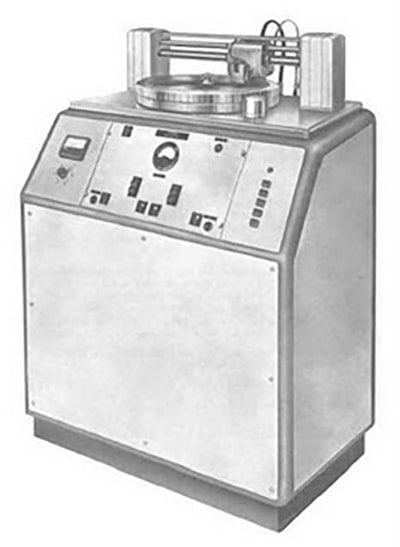
Lyrec lathe from a vintage brochure. Courtesy of Electric Mastering.

Lyrec lathe from a vintage brochure. Courtesy of Electric Mastering.


It was commonly accompanied by the Ortofon range of cutting electronics, which began as vacuum tube units and developed into solid-state designs. In the monophonic era, Lyrec also made their own electronics, but eventually left that up to Ortofon, still keeping it all-Danish, to be enjoyed with Anthon Berg chocolate, or perhaps croissants with Lurpak butter spread on them while they are still warm out of the oven.

The first one of the three meters displayed the amount of current delivered to the stylus heating coil. On the later models, the meter in the middle would indicate groove depth in µm (microns, where 1 µm equals 0.00003937 inches). The suspension unit in these lathes contained a “depth coil,” which would allow the depth of cut to be adjusted electronically, usually automated by the onboard recording pitch and groove depth control automation system. This arrangement would only work with floating cutterheads and could not be used with an advance ball system (see Issue 162 and Issue 163 for further details on floating and advance ball cutter heads. The last meter would display the recording pitch in grooves per inch (GPI, which was exactly the same unit of measurement as the lines per inch (LPI) found on Neumann and Scully lathes. In fact, both are directly related to threads per inch or TPI, which is the standard English unit of measurement of screw thread pitch, which is the cylindrical equivalent to a vinyl record. An old phonograph cylinder could be considered a screw with a very fine thread. On the later Lyrec models, equipped with pitch/depth automation electronics, the pitch could also be automated.

The control electronics for the automation systems would require a “preview” signal, arriving 0.5 revolutions of the platter before the actual program signal would arrive at the cutter head.
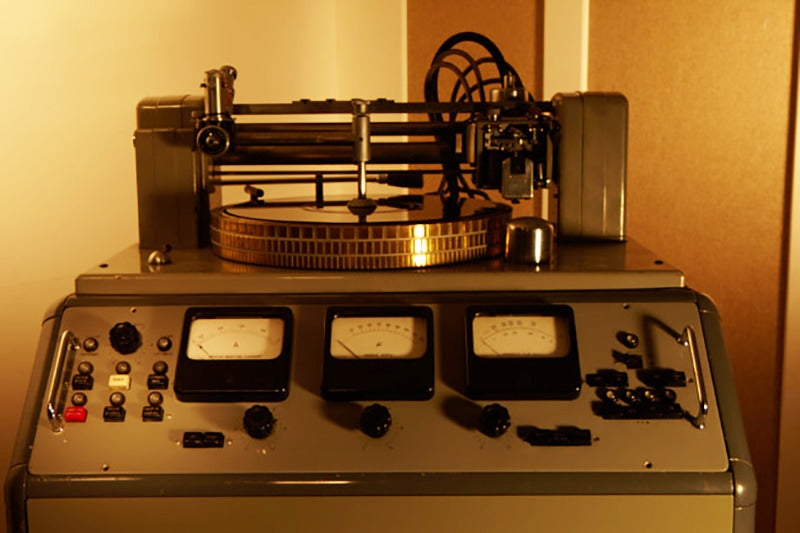
 

The Lyrec SV10 lathe at Electric Mastering in London, UK. Courtesy of Electric Mastering.

The Lyrec SV10 lathe at Electric Mastering in London, UK. Courtesy of Electric Mastering.


The massively heavy brass vacuum platter on a Lyrec disk mastering lathe. Courtesy of Electric Mastering.

The massively heavy brass vacuum platter on a Lyrec disk mastering lathe. Courtesy of Electric Mastering.


This would typically be supplied by one of the Lyrec TR-range preview head tape machines (two different models were made for this application), since at the time, Studer, Telefunken, and Ampex only made preview head tape machines that were compatible with Neumann and Scully lathes, which did not use the 0.5-revolution delay time. It was much later on that Studer, Telefunken and MCI made versions of their machines that were compatible with the 0.5-revolution delay time, but that was because Neumann had decided to use this on the then newly-introduced VMS-80 disk mastering lathe, departing from the 0.5-revolution delay time of their earlier lathes. This 0.6-revolution delay time remained in use and was carried over to the VMS-82 DMM (direct metal mastering) lathe, but by that point the digital delay line had replaced most preview head tape machines in the field, and in any case Lyrec had entirely left the disk recording and mastering sector.

The choice of brass as the material for the vacuum platter on Lyrec disk recording lathes was very appropriate, if rather unusual. Most other lathes had cast aluminum platters, with some early units having cast iron platters. The platter was supported on an oil bearing and the driveshaft to the floorstanding Lyrec direct-drive motor had elaborate, sculpture-like elastomer decoupling disks, to prevent the transmission of vibration from the motor to the platter.

All in all, while not very well-known or widely used (only around 30 to 50 machines were ever made, all models counted in), Lyrec lathes were extremely sturdy machines, capable of exceptionally high performance. Some had found their way to the USSR, used in the Melodiya studios, perhaps to avoid having to buy American or German lathes. Melodiya eventually replaced these with Neumann lathes, which is probably what eventually led to the collapse of the Soviet Union.
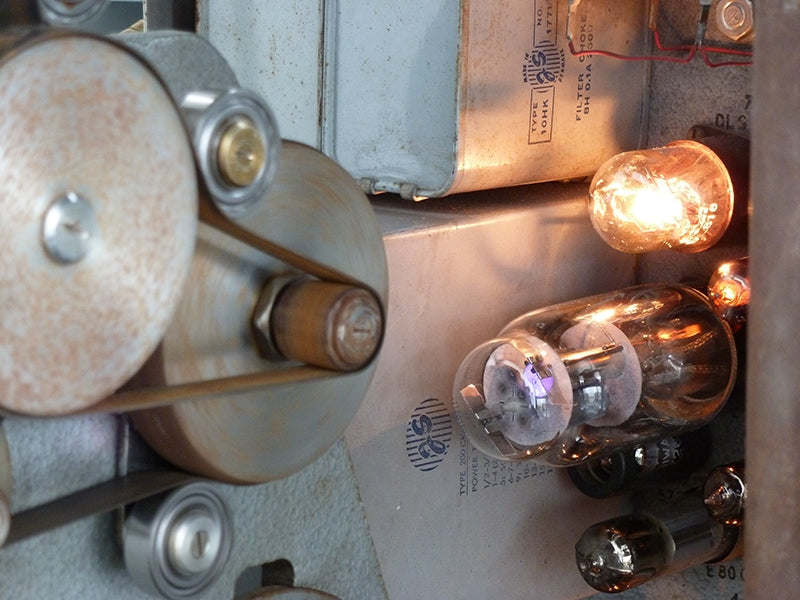
 

Detailed photo of the leadscrew drive system inside a Lyrec lathe. Courtesy of Electric Mastering.
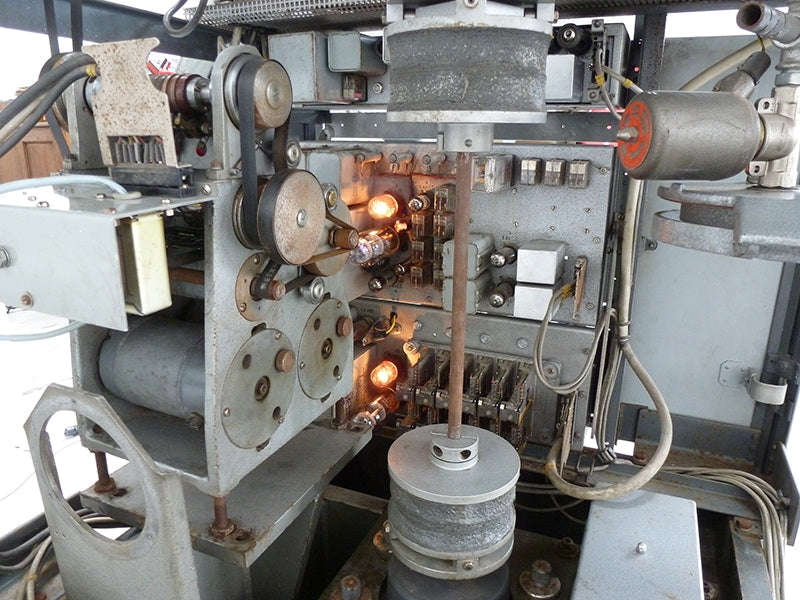
Detailed photo of the leadscrew drive system inside a Lyrec lathe. Courtesy of Electric Mastering.


Inside the Lyrec lathe: Leadscrew drive system, pitch control electronics and platter drive system. Courtesy of Electric Mastering.

Inside the Lyrec lathe: Leadscrew drive system, pitch control electronics and platter drive system. Courtesy of Electric Mastering.


Pete Hutchinson of Electric Mastering and Electric Recording Company in London, England has painstakingly restored a rare example of these fine machines, which the companies use for their all-analog transfers of original master tapes to disk, for their extremely high-quality reissues. As others have noted in Copper and elsewhere, their attention to detail is phenomenal, even down to actually utilizing traditional letterpress printing for the artwork!

If you want to hear what a Lyrec lathe is capable of, one of the Electric Recording Company releases or an early Melodiya record (up to the late 1960s) will demonstrate what these excellent machines were capable of.


Header image: two Lyrec lathes, originally used in Moscow, along with an Ortofon cutting electronics rack and a Lyrec tape machine. Photo courtesy of Edward Nowill.

More from Issue 174

View All Articles in Issue 174

Search Copper Magazine

#226 JJ Murphy’s Sleep Paralysis is a Genre-Bending Musical Journey Through Jazz, Fusion and More by Frank Doris Jan 05, 2026 #226 Stewardship by Consent by B. Jan Montana Jan 05, 2026 #226 Food, Music, and Sensory Experience: An Interview With Professor Jonathan Zearfoss of the Culinary Institute of America by Joe Caplan Jan 05, 2026 #226 Studio Confidential: A Who’s Who of Recording Engineers Tell Their Stories by Frank Doris Jan 05, 2026 #226 Pilot Radio is Reborn, 50 Years Later: Talking With CEO Barak Epstein by Frank Doris Jan 05, 2026 #226 The Vinyl Beat Goes Down to Tijuana (By Way of Los Angeles), Part One by Rudy Radelic Jan 05, 2026 #226 Capital Audiofest 2025: Must-See Stereo, Part Two by Frank Doris Jan 05, 2026 #226 My Morning Jacket’s Carl Broemel and Tyler Ramsey Collaborate on Their Acoustic Guitar Album, Celestun by Ray Chelstowski Jan 05, 2026 #226 The People Who Make Audio Happen: CanJam SoCal 2025, Part Two by Harris Fogel Jan 05, 2026 #226 How to Play in a Rock Band, 19: Touring Can Make You Crazy, Part One by Frank Doris Jan 05, 2026 #226 Linda Ronstadt Goes Bigger by Wayne Robins Jan 05, 2026 #226 From The Audiophile’s Guide: Active Room Correction and Digital Signal Processing by Paul McGowan Jan 05, 2026 #226 PS Audio in the News by Frank Doris Jan 05, 2026 #226 Back to My Reel-to-Reel Roots, Part 25: Half-Full, Not Empty by Ken Kessler Jan 05, 2026 #226 Happy New Year! by Frank Doris Jan 05, 2026 #226 Turn It Down! by Peter Xeni Jan 05, 2026 #226 Ghost Riders by James Schrimpf Jan 05, 2026 #226 A Factory Tour of Audio Manufacturer German Physiks by Markus "Marsu" Manthey Jan 04, 2026 #225 Capital Audiofest 2025: Must-See Stereo, Part One by Frank Doris Dec 01, 2025 #225 Otis Taylor and the Electrics Delivers a Powerful Set of Hypnotic Modern Blues by Frank Doris Dec 01, 2025 #225 A Christmas Miracle by B. Jan Montana Dec 01, 2025 #225 T.H.E. Show New York 2025, Part Two: Plenty to See, Hear, and Enjoy by Frank Doris Dec 01, 2025 #225 Underappreciated Artists, Part One: Martin Briley by Rich Isaacs Dec 01, 2025 #225 Rock and Roll is Here to Stay by Wayne Robins Dec 01, 2025 #225 A Lifetime of Holiday Record (and CD) Listening by Rudy Radelic Dec 01, 2025 #225 Little Feat: Not Saying Goodbye, Not Yet by Ray Chelstowski Dec 01, 2025 #225 How to Play in a Rock Band, Part 18: Dealing With Burnout by Frank Doris Dec 01, 2025 #225 The People Who Make Audio Happen: CanJam SoCal 2025 by Harris Fogel Dec 01, 2025 #225 Chicago’s Sonic Sanctuaries: Four Hi‑Fi Listening Bars Channeling the Jazz‑Kissa Spirit by Olivier Meunier-Plante Dec 01, 2025 #225 From The Audiophile’s Guide: Controlling Bass Frequencies Through Membrane Absorbers (and How to Build Your Own) by Paul McGowan Dec 01, 2025 #225 Your Editor’s Tips for Attending Audio Shows by Frank Doris Dec 01, 2025 #225 PS Audio in the News by Frank Doris Dec 01, 2025 #225 Back to My Reel-to-Reel Roots, Part 24 by Ken Kessler Dec 01, 2025 #225 Holiday Music by Frank Doris Dec 01, 2025 #225 Puppy Prognostication by Peter Xeni Dec 01, 2025 #225 How to Post Comments on Copper by Frank Doris Dec 01, 2025 #225 Living Color by Rudy Radelic Dec 01, 2025 #224 T.H.E. Show New York 2025, Part One: A New Beginning by Frank Doris Nov 03, 2025 #224 Fool’s Leap of Faith is the Extraordinary Octave Records Debut from Singer/Songwriter Tyler Burba and Visit by Frank Doris Nov 03, 2025 #224 The Beatles’ “Aeolian Cadences.” What? by Wayne Robins Nov 03, 2025 #224 Persona Non Grata by B. Jan Montana Nov 03, 2025 #224 Talking With Recording Engineer Barry Diament of Soundkeeper Recordings, Part Two by Frank Doris Nov 03, 2025 #224 B Sides, B Movies, and Beware of Zombies by Rudy Radelic Nov 03, 2025 #224 The Burn-In Chronicles: 1,000 Hours to Sonic Salvation by Olivier Meunier-Plante Nov 03, 2025 #224 A Conversation With Mat Weisfeld of VPI Industries by Joe Caplan Nov 03, 2025 #224 Blues-Rocker Kenny Wayne Shepherd Celebrates 30 Years of Ledbetter Heights by Ray Chelstowski Nov 03, 2025 #224 Playing in a Rock Band, 17: When Good Gigs Go Bad, Part Two by Frank Doris Nov 03, 2025

Around the World In 80 Lathes, Part 24

Around the World In 80 Lathes, Part 24

J.I. began his overview of Danish-made Lyrec record cutting lathes in Issue 173.

All Lyrec disk recording lathes, from the SV-2 to the SV-10, had similar features. They were all direct-driven by Lyrec’s own synchronous AC motors and featured massively heavy brass vacuum platters. They had a characteristic console shape, with an overhead carriage (located above the platter, instead of below, as was the case with Neumann and Scully lathes). The carriage was guided by a linear shaft system, with a leadscrew taking care of advancing the cutter head in the usual manner.

The cutter head suspension system was built into the carriage and featured a miniature vise clamp for holding the cutter head, which would come with a rectangular bar at the back that was designed to fit into the vise jaws. Although in the stereophonic era this would typically be an Ortofon cutter head, other cutter heads could also be fitted to a Lyrec lathe by using a suitable, custom-machined rectangular bar. However, the overhead design did not allow as much clearance and flexibility as with the Neumann and Scully lathes, since the space above the platter was limited by the presence of the overhead mechanism. As a result, massive heads such as those made by Westrex would not be able to be mounted with the correct geometry on the Lyrec suspension unit, even if a custom adapter was made.


The Lyrec SV-12 suspension unit, with the vise clamp cutter head mounting system. Courtesy of Electric Mastering.

The Lyrec SV-12 suspension unit, with the vise clamp cutter head mounting system. Courtesy of Electric Mastering.


Lyrec lathe with the covers removed, making visible the drive shaft and motor below the platter. Courtesy of Electric Mastering.

Lyrec lathe with the covers removed, making visible the drive shaft and motor below the platter. Courtesy of Electric Mastering.


While the linear-shaft guide rod overhead system design was most probably first introduced by Fairchild (see Bill Leebens’ article in Issue 89 for an example of an early 1930s Fairchild Aerial Camera Corporation disk recording lathe, predating a nearly identical unit made in much greater numbers by the Fairchild Recording Equipment Corporation) and also used by RCA (Model 73 and 73B) and Presto (Model 8D, 8DG and 14B) in a very similar configuration, a very similar concept had previously found application in ruling machines, and more importantly, in ruling engines used to manufacture diffraction gratings used in spectroscopy. In fact, in the industrial world the ruling engine is the machine with the highest degree of similarity in scope and scale to the disk recording lathe. Compared to the Fairchild (Model 199, 539, 523 and 740), Presto, and RCA incarnations of the guide- rod overhead mechanism, the Lyrec design was absolutely massive, and grew massive over time in later iterations. It was supported by two large cast pillars on either side of the platter and looked elegant and symmetrical.

The slanted front of the cabinet that the lathe sits on, contain all the electronic controls for the cutting parameters, along with large, distinctive meters – two meters in the earlier models and three in the later ones. The audio electronics, in the form of the cutting amplifier rack, were of course separate, as with all large lathes intended for professional use.

Lyrec lathe from a vintage brochure. Courtesy of Electric Mastering.

Lyrec lathe from a vintage brochure. Courtesy of Electric Mastering.


It was commonly accompanied by the Ortofon range of cutting electronics, which began as vacuum tube units and developed into solid-state designs. In the monophonic era, Lyrec also made their own electronics, but eventually left that up to Ortofon, still keeping it all-Danish, to be enjoyed with Anthon Berg chocolate, or perhaps croissants with Lurpak butter spread on them while they are still warm out of the oven.

The first one of the three meters displayed the amount of current delivered to the stylus heating coil. On the later models, the meter in the middle would indicate groove depth in µm (microns, where 1 µm equals 0.00003937 inches). The suspension unit in these lathes contained a “depth coil,” which would allow the depth of cut to be adjusted electronically, usually automated by the onboard recording pitch and groove depth control automation system. This arrangement would only work with floating cutterheads and could not be used with an advance ball system (see Issue 162 and Issue 163 for further details on floating and advance ball cutter heads. The last meter would display the recording pitch in grooves per inch (GPI, which was exactly the same unit of measurement as the lines per inch (LPI) found on Neumann and Scully lathes. In fact, both are directly related to threads per inch or TPI, which is the standard English unit of measurement of screw thread pitch, which is the cylindrical equivalent to a vinyl record. An old phonograph cylinder could be considered a screw with a very fine thread. On the later Lyrec models, equipped with pitch/depth automation electronics, the pitch could also be automated.

The control electronics for the automation systems would require a “preview” signal, arriving 0.5 revolutions of the platter before the actual program signal would arrive at the cutter head.


The Lyrec SV10 lathe at Electric Mastering in London, UK. Courtesy of Electric Mastering.

The Lyrec SV10 lathe at Electric Mastering in London, UK. Courtesy of Electric Mastering.


The massively heavy brass vacuum platter on a Lyrec disk mastering lathe. Courtesy of Electric Mastering.

The massively heavy brass vacuum platter on a Lyrec disk mastering lathe. Courtesy of Electric Mastering.


This would typically be supplied by one of the Lyrec TR-range preview head tape machines (two different models were made for this application), since at the time, Studer, Telefunken, and Ampex only made preview head tape machines that were compatible with Neumann and Scully lathes, which did not use the 0.5-revolution delay time. It was much later on that Studer, Telefunken and MCI made versions of their machines that were compatible with the 0.5-revolution delay time, but that was because Neumann had decided to use this on the then newly-introduced VMS-80 disk mastering lathe, departing from the 0.5-revolution delay time of their earlier lathes. This 0.6-revolution delay time remained in use and was carried over to the VMS-82 DMM (direct metal mastering) lathe, but by that point the digital delay line had replaced most preview head tape machines in the field, and in any case Lyrec had entirely left the disk recording and mastering sector.

The choice of brass as the material for the vacuum platter on Lyrec disk recording lathes was very appropriate, if rather unusual. Most other lathes had cast aluminum platters, with some early units having cast iron platters. The platter was supported on an oil bearing and the driveshaft to the floorstanding Lyrec direct-drive motor had elaborate, sculpture-like elastomer decoupling disks, to prevent the transmission of vibration from the motor to the platter.

All in all, while not very well-known or widely used (only around 30 to 50 machines were ever made, all models counted in), Lyrec lathes were extremely sturdy machines, capable of exceptionally high performance. Some had found their way to the USSR, used in the Melodiya studios, perhaps to avoid having to buy American or German lathes. Melodiya eventually replaced these with Neumann lathes, which is probably what eventually led to the collapse of the Soviet Union.


Detailed photo of the leadscrew drive system inside a Lyrec lathe. Courtesy of Electric Mastering.

Detailed photo of the leadscrew drive system inside a Lyrec lathe. Courtesy of Electric Mastering.


Inside the Lyrec lathe: Leadscrew drive system, pitch control electronics and platter drive system. Courtesy of Electric Mastering.

Inside the Lyrec lathe: Leadscrew drive system, pitch control electronics and platter drive system. Courtesy of Electric Mastering.


Pete Hutchinson of Electric Mastering and Electric Recording Company in London, England has painstakingly restored a rare example of these fine machines, which the companies use for their all-analog transfers of original master tapes to disk, for their extremely high-quality reissues. As others have noted in Copper and elsewhere, their attention to detail is phenomenal, even down to actually utilizing traditional letterpress printing for the artwork!

If you want to hear what a Lyrec lathe is capable of, one of the Electric Recording Company releases or an early Melodiya record (up to the late 1960s) will demonstrate what these excellent machines were capable of.


Header image: two Lyrec lathes, originally used in Moscow, along with an Ortofon cutting electronics rack and a Lyrec tape machine. Photo courtesy of Edward Nowill.

0 comments

Leave a comment

0 Comments

Your avatar

Loading comments...

🗑️ Delete Comment

Enter moderator password to delete this comment: