COPPER

A PS Audio Publication

Issue 103 • Free Online Magazine

Issue 103 REVOLUTIONS PER MINUTE

Vacuum Tubes: A Brief History

Vacuum Tubes: A Brief History

Vacuum tubes, also known as thermionic valves, or just valves in the UK, are electronic devices whose operation is based on thermionic emission. This is defined as the emission of electrons from the surface of a solid, in proportion to temperature. The physics of this process concerns the relationship of the thermal energy of the electron with the work function of the material, but in fear of my excitement escalating into a detailed explanation of electron orbits around atomic nuclei, I will skip straight to the plain English account, sparing my readers the lecture.

A heated electrode, called a thermionic cathode, that is placed inside an evacuated glass bulb (a bulb in which the air inside has been removed to create a vacuum) emits plenty of electrons. The number of emitted electrons increases with temperature. The heated cathode then becomes surrounded by a cloud of electrons (a space charge). When a positive potential is applied to a second electrode called the anode within the same glass envelope, the electrons are attracted by the positive potential at the anode and current flows.

(Header image: vacuum tubes glowing in the dark. The glow is produced by the heaters which provide the thermal energy necessary for thermionic emission. Photo courtesy of Agnew Analog Reference Instruments.)

This type of device, containing two elements, the anode and the cathode, functions as a diode. It allows current to flow in one direction only. This type of tube can be used as a rectifier – a device that takes the AC (alternating current) from the wall and converts into the DC (direct current) needed by an audio circuit.

Things get much more interesting if we add another element inside the glass envelope. A grid can be placed between anode and cathode. The electron flow can then be controlled by the grid potential. A negative grid potential with respect to the cathode potential will repel electrons. If it is made sufficiently negative, it will cut off the electron flow. Modulating the grid potential will modulate the electron flow and hence the current through the tube.

In a typical simple tube circuit, a small audio signal fed to the grid of a three-element tube, known as a triode, will modulate the current through the tube (between the anode and the cathode) in proportion to the audio signal. Current flowing through the load connected to the tube will result in a voltage across the load. A small signal voltage at the grid will modulate the current flowing through the load and, given a sufficiently high DC supply to the circuit, the modulation-dependent signal voltage across the load will be much larger than the signal voltage at the grid. A small signal voltage has essentially been converted into a large signal voltage, resulting in amplification!

A vintage soviet military tube tester, restored by the author, along with some fine examples of vacuum tubes including an RCA 56 triode.

Unlike the simple diode, tubes with (control) grids like the triode and other tube types (such as tetrodes and those with even more internal elements) are capable of amplification. This development, occurring in 1906 with the invention of the Audion by Lee de Forest, has had a massive impact on our technological progress.

The vacuum tube provided the necessary infrastructure for electrical sound recording and reproduction, the telephone, radio, television and the entire modern era in telecommunications, radar, industrial control and automation systems, medical imaging, computers and all subsequent developments in amplification devices – which form the backbone of pretty much everything we take for granted nowadays.

Early vacuum tubes had very low amplification factors. Gain was at a premium, so if a tube was designed for an application demanding linearity, the tube itself had to be capable of linear operation! These early low-gain vacuum tubes were impractical for use in negative feedback circuits, which sacrifice amplifier gain for error correction. (Without getting too technical, in a negative feedback amplifier part of the circuit’s amplification capability (gain) is used to reduce distortion in the output.

Up until the 1930s some incredibly linear tubes had been created. But they were not cheap, they were not easy to manufacture and they were not exactly energy-efficient.

The tetrode, the pentode and the beam power tube improved on efficiency and manufacturability, but not on linearity. Later triode tubes mostly developed along the same lines. Much higher amplification was becoming available and negative feedback became popular, to electronically compensate for the lack of linearity. This resulted in more complex circuits with a higher component count, but the overall cost was lower as the less-linear tubes were easier to make. (Indeed.)

Then came the transistor (invented in 1947), followed by the solid state operational amplifier (or “op-amp”), housed in a tiny integrated circuit package. Each new invention made things smaller, cheaper and easier to manufacture, with the devices producing less heat and operating more efficiently on lower voltages. Transistors and op-amps ushered in the era of affordable (and disposable) consumer electronics, but were not more linear as devices. (Sound familiar?) Circuits became much more complex, large amounts of negative feedback became the norm in audio circuits and prices went down despite the massive increase in component count in the average audio circuit.

Yet, the 1930s directly-heated triode tubes still remain the most inherently linear devices ever made.

Triodes are inherently linear devices, some types more so than others. The 45 was popular for low power applications. The 2A3 offered a bit more power and the legendary 300B even more, with a single-ended amplifier using one 300B tube producing around 7 W of power at best! This was considered a lot at the time, especially when the 45 triode in a similar single-tube configuration was only capable of a few milliwatts! More power could be obtained with multiple output tubes in parallel single-ended or push-pull configurations, but high-power applications usually required the use of large and expensive transmitting triodes, such as the 211 and the 845, which operated with power supply voltages in the kilovolt range! All of these tube types allow incredibly simple, minimalist circuit configurations, with no need for feedback.

They sound good.

But, as with all the fine pleasures in life, they come at a cost. Having said that, anyone who has ever attempted to wind a grid structure with ultra-fine wire to the level of accuracy and repeatability required in vacuum tube manufacture will never again complain about tube prices.

In fact, once glass blowing, precision machining, exotic materials processing, assembly and all the manufacturing and testing equipment required are all factored in, tubes are pretty reasonably priced. I wouldn’t want to have to make them myself for the prices we can buy them for, in all honesty.

Here’s a video about manufacturing vacuum tubes, from the How It’s Made TV show:


But I also wouldn’t want to have to live without tubes, so I am glad that they are still being manufactured. In fact, some of the 1930s triodes are still being made today and are still being used, both as replacement parts for vintage equipment as well as for new designs! How many other products can really boast continued relevance and desirability over a period of 90 years?

Yes, they are big, heavy, inefficient, produce a lot of heat, require shockingly high voltages, and no university nowadays will teach students how to make them or use them. But they still find applications in a wide range of fields:

There are the audiophiles, who feel that their tube amplifier simply sounds more realistic than anything else. (There are subsets of tube aficionados – those who prefer minimalist designs among them.) I often find myself in agreement, given a well-designed and properly implemented unit.

There are the musicians, especially electric guitar and bass players, who find that nothing else will give them the dynamics and tone of a vintage tube amplifier. It should be noted that the requirements for musical instrument amplifiers are different than for high-fidelity audio systems. The emphasis is not necessarily on linearity, but in the behavior outside the linear region. When tubes are pushed outside their linear region of operation (overdriven), they tend to produce mainly lower-order harmonics, musically and dynamically related to the signal, which tend to sound pleasant. Second harmonic distortion is an octave above the fundamental and third harmonic distortion is a musical fifth above. By comparison, the fifth harmonic is a musical third, but it won’t ask you if you’re playing on a major or minor scale!

Vacuum tubes inside a Marshall guitar amplifier, one of countless tube amplifiers modified by the author. Photo courtesy of Agnew Analog Reference Instruments.

Tubes tend to produce mainly second and third harmonic distortion, depending on the circuit configuration and operating level, with higher-order harmonics fading into insignificance. Other amplification devices tend to exhibit the opposite picture: Low second and third harmonics, but predominantly higher-order harmonics. Moreover, tubes have a very gradual transition from “clean” to “distorted” sound.

Tube amps can provide a wide tonal palette, responding to the dynamics of the performer’s playing style. With electric guitar and bass, the tube amplifier is very much an integral part of the instrument, which is why it is customary to record these instruments with a microphone placed near the amplifier’s loudspeaker. Vacuum tube musical instrument amplifiers, both vintage and modern, are sought after by professional musicians and are a regular feature in the world’s most highly regarded recording studios.

An Orange tube amplifier for electric bass guitar, with a Lem speaker cabinet, in the studio during a recording session. Photo courtesy of Magnetic Fidelity.

There are the recording and mastering engineers, many of whom love the sound of vacuum tube microphone preamplifiers, tube equalizers, tube compressors, and so on. Some of the finest, most transparent and most highly sought after studio equipment is based on vacuum tube electronics. Once again, the very gradual transition from “clean” to “dirty” on a well-designed tube mic preamp works wonders in naturally representing the impressive dynamics of a live performance, where it is generally desired to remain within the linear range. Tubes can offer a huge amount of headroom along with low noise, when carefully selected, resulting in an impressive dynamic range. More “realistic” dynamics result from the very gradual transition from clean to dirty, the predominantly low order harmonics and their “natural” relation to the signal level. This is what makes them sound good in all kinds of signal processing equipment as well. Being known for designing and using all-tube signal paths in the studio, I am obviously in agreement here.

Manley Variable Mu Limiter Compressor: A classic tube compressor, containing eight tubes, often seen in world-class mastering facilities. Photo courtesy of Magnetic Fidelity.


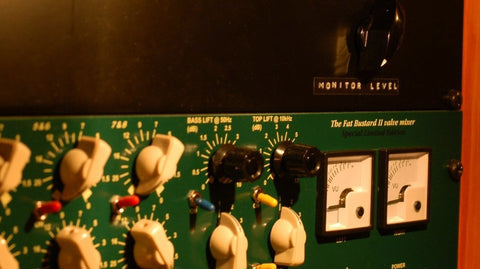
The Thermionic Culture Custom Green Fat Bustard at Magnetic Fidelity is a one-of-a-kind tube mixer, built for the author to his specifications, with an external power supply unit, special NOS tubes, audiophile-grade capacitors and other circuit modifications. Photo courtesy of Magnetic Fidelity.

A less obvious but hugely influential supporter of vacuum tube electronics is the military and defense sector. Tubes would survive an EMP (electro-magnetic pulse), whether naturally occurring (such as from lightning, an electrostatic discharge or a solar storm) or as part of an intentional attack. Solid state devices are very sensitive to EMPs and often do not survive such incidents. Mission-critical vacuum tube equipment is therefore still maintained, just in case.

While the military and defense sectors are known for funding and embracing new technologies, they are also famously reluctant to let go of proven, time and field-tested technologies. They also need a regular supply of tubes to keep their old faithful gear going. Considering the circumstances under which military equipment must remain operational, this gives a few hints regarding the reliability and ruggedness potential of a well-made vacuum tube!

Finally, there are medical imaging, transmitter, certain instrumentation and countless other obscure applications, uses and abuses for vacuum tubes in the present day. The vacuum tube manufacturing industry is certainly not what it once used to be. But it is still active, thanks to continued demand. In the recording industry, I have been observing a steadily growing interest in vacuum tubes in recent years. As far as music production, recording and reproduction are concerned, I believe that vacuum tubes will always have their place, regardless of technological developments in other areas.

Less is often more when it comes to sound. At the highest levels of sound quality, things don’t need to be practical or easy. They just need to sound good. As long as vacuum tubes keep on sounding good, they will stay.
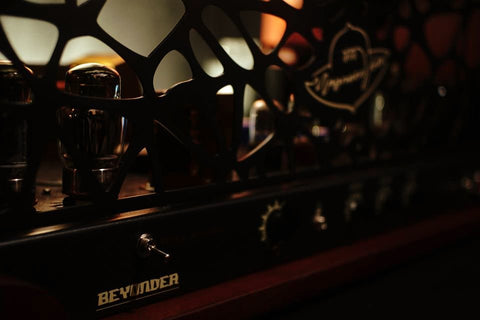
The Magnetovolt Beyonder is a custom 200W tube amplifier, featuring a novel circuit design by the author. It weighs around 140 lbs. and sounds like it! Photo courtesy of Magnetic Fidelity.


An internal view of the Magnetovolt Beyonder 200W tube amplifier in action, during a live concert of the rock group Naxatras. Photo courtesy of Dionisis Partheniadis.

More from Issue 103

View All Articles in Issue 103

Search Copper Magazine

#226 JJ Murphy’s Sleep Paralysis is a Genre-Bending Musical Journey Through Jazz, Fusion and More by Frank Doris Jan 05, 2026 #226 Stewardship by Consent by B. Jan Montana Jan 05, 2026 #226 Food, Music, and Sensory Experience: An Interview With Professor Jonathan Zearfoss of the Culinary Institute of America by Joe Caplan Jan 05, 2026 #226 Studio Confidential: A Who’s Who of Recording Engineers Tell Their Stories by Frank Doris Jan 05, 2026 #226 Pilot Radio is Reborn, 50 Years Later: Talking With CEO Barak Epstein by Frank Doris Jan 05, 2026 #226 The Vinyl Beat Goes Down to Tijuana (By Way of Los Angeles), Part One by Rudy Radelic Jan 05, 2026 #226 Capital Audiofest 2025: Must-See Stereo, Part Two by Frank Doris Jan 05, 2026 #226 My Morning Jacket’s Carl Broemel and Tyler Ramsey Collaborate on Their Acoustic Guitar Album, Celestun by Ray Chelstowski Jan 05, 2026 #226 The People Who Make Audio Happen: CanJam SoCal 2025, Part Two by Harris Fogel Jan 05, 2026 #226 How to Play in a Rock Band, 19: Touring Can Make You Crazy, Part One by Frank Doris Jan 05, 2026 #226 Linda Ronstadt Goes Bigger by Wayne Robins Jan 05, 2026 #226 From The Audiophile’s Guide: Active Room Correction and Digital Signal Processing by Paul McGowan Jan 05, 2026 #226 PS Audio in the News by Frank Doris Jan 05, 2026 #226 Back to My Reel-to-Reel Roots, Part 25: Half-Full, Not Empty by Ken Kessler Jan 05, 2026 #226 Happy New Year! by Frank Doris Jan 05, 2026 #226 Turn It Down! by Peter Xeni Jan 05, 2026 #226 Ghost Riders by James Schrimpf Jan 05, 2026 #226 A Factory Tour of Audio Manufacturer German Physiks by Markus "Marsu" Manthey Jan 04, 2026 #225 Capital Audiofest 2025: Must-See Stereo, Part One by Frank Doris Dec 01, 2025 #225 Otis Taylor and the Electrics Delivers a Powerful Set of Hypnotic Modern Blues by Frank Doris Dec 01, 2025 #225 A Christmas Miracle by B. Jan Montana Dec 01, 2025 #225 T.H.E. Show New York 2025, Part Two: Plenty to See, Hear, and Enjoy by Frank Doris Dec 01, 2025 #225 Underappreciated Artists, Part One: Martin Briley by Rich Isaacs Dec 01, 2025 #225 Rock and Roll is Here to Stay by Wayne Robins Dec 01, 2025 #225 A Lifetime of Holiday Record (and CD) Listening by Rudy Radelic Dec 01, 2025 #225 Little Feat: Not Saying Goodbye, Not Yet by Ray Chelstowski Dec 01, 2025 #225 How to Play in a Rock Band, Part 18: Dealing With Burnout by Frank Doris Dec 01, 2025 #225 The People Who Make Audio Happen: CanJam SoCal 2025 by Harris Fogel Dec 01, 2025 #225 Chicago’s Sonic Sanctuaries: Four Hi‑Fi Listening Bars Channeling the Jazz‑Kissa Spirit by Olivier Meunier-Plante Dec 01, 2025 #225 From The Audiophile’s Guide: Controlling Bass Frequencies Through Membrane Absorbers (and How to Build Your Own) by Paul McGowan Dec 01, 2025 #225 Your Editor’s Tips for Attending Audio Shows by Frank Doris Dec 01, 2025 #225 PS Audio in the News by Frank Doris Dec 01, 2025 #225 Back to My Reel-to-Reel Roots, Part 24 by Ken Kessler Dec 01, 2025 #225 Holiday Music by Frank Doris Dec 01, 2025 #225 Puppy Prognostication by Peter Xeni Dec 01, 2025 #225 How to Post Comments on Copper by Frank Doris Dec 01, 2025 #225 Living Color by Rudy Radelic Dec 01, 2025 #224 T.H.E. Show New York 2025, Part One: A New Beginning by Frank Doris Nov 03, 2025 #224 Fool’s Leap of Faith is the Extraordinary Octave Records Debut from Singer/Songwriter Tyler Burba and Visit by Frank Doris Nov 03, 2025 #224 The Beatles’ “Aeolian Cadences.” What? by Wayne Robins Nov 03, 2025 #224 Persona Non Grata by B. Jan Montana Nov 03, 2025 #224 Talking With Recording Engineer Barry Diament of Soundkeeper Recordings, Part Two by Frank Doris Nov 03, 2025 #224 B Sides, B Movies, and Beware of Zombies by Rudy Radelic Nov 03, 2025 #224 The Burn-In Chronicles: 1,000 Hours to Sonic Salvation by Olivier Meunier-Plante Nov 03, 2025 #224 A Conversation With Mat Weisfeld of VPI Industries by Joe Caplan Nov 03, 2025 #224 Blues-Rocker Kenny Wayne Shepherd Celebrates 30 Years of Ledbetter Heights by Ray Chelstowski Nov 03, 2025 #224 Playing in a Rock Band, 17: When Good Gigs Go Bad, Part Two by Frank Doris Nov 03, 2025

Vacuum Tubes: A Brief History

Vacuum Tubes: A Brief History

Vacuum tubes, also known as thermionic valves, or just valves in the UK, are electronic devices whose operation is based on thermionic emission. This is defined as the emission of electrons from the surface of a solid, in proportion to temperature. The physics of this process concerns the relationship of the thermal energy of the electron with the work function of the material, but in fear of my excitement escalating into a detailed explanation of electron orbits around atomic nuclei, I will skip straight to the plain English account, sparing my readers the lecture.

A heated electrode, called a thermionic cathode, that is placed inside an evacuated glass bulb (a bulb in which the air inside has been removed to create a vacuum) emits plenty of electrons. The number of emitted electrons increases with temperature. The heated cathode then becomes surrounded by a cloud of electrons (a space charge). When a positive potential is applied to a second electrode called the anode within the same glass envelope, the electrons are attracted by the positive potential at the anode and current flows.

(Header image: vacuum tubes glowing in the dark. The glow is produced by the heaters which provide the thermal energy necessary for thermionic emission. Photo courtesy of Agnew Analog Reference Instruments.)

This type of device, containing two elements, the anode and the cathode, functions as a diode. It allows current to flow in one direction only. This type of tube can be used as a rectifier – a device that takes the AC (alternating current) from the wall and converts into the DC (direct current) needed by an audio circuit.

Things get much more interesting if we add another element inside the glass envelope. A grid can be placed between anode and cathode. The electron flow can then be controlled by the grid potential. A negative grid potential with respect to the cathode potential will repel electrons. If it is made sufficiently negative, it will cut off the electron flow. Modulating the grid potential will modulate the electron flow and hence the current through the tube.

In a typical simple tube circuit, a small audio signal fed to the grid of a three-element tube, known as a triode, will modulate the current through the tube (between the anode and the cathode) in proportion to the audio signal. Current flowing through the load connected to the tube will result in a voltage across the load. A small signal voltage at the grid will modulate the current flowing through the load and, given a sufficiently high DC supply to the circuit, the modulation-dependent signal voltage across the load will be much larger than the signal voltage at the grid. A small signal voltage has essentially been converted into a large signal voltage, resulting in amplification!

A vintage soviet military tube tester, restored by the author, along with some fine examples of vacuum tubes including an RCA 56 triode.

Unlike the simple diode, tubes with (control) grids like the triode and other tube types (such as tetrodes and those with even more internal elements) are capable of amplification. This development, occurring in 1906 with the invention of the Audion by Lee de Forest, has had a massive impact on our technological progress.

The vacuum tube provided the necessary infrastructure for electrical sound recording and reproduction, the telephone, radio, television and the entire modern era in telecommunications, radar, industrial control and automation systems, medical imaging, computers and all subsequent developments in amplification devices – which form the backbone of pretty much everything we take for granted nowadays.

Early vacuum tubes had very low amplification factors. Gain was at a premium, so if a tube was designed for an application demanding linearity, the tube itself had to be capable of linear operation! These early low-gain vacuum tubes were impractical for use in negative feedback circuits, which sacrifice amplifier gain for error correction. (Without getting too technical, in a negative feedback amplifier part of the circuit’s amplification capability (gain) is used to reduce distortion in the output.

Up until the 1930s some incredibly linear tubes had been created. But they were not cheap, they were not easy to manufacture and they were not exactly energy-efficient.

The tetrode, the pentode and the beam power tube improved on efficiency and manufacturability, but not on linearity. Later triode tubes mostly developed along the same lines. Much higher amplification was becoming available and negative feedback became popular, to electronically compensate for the lack of linearity. This resulted in more complex circuits with a higher component count, but the overall cost was lower as the less-linear tubes were easier to make. (Indeed.)

Then came the transistor (invented in 1947), followed by the solid state operational amplifier (or “op-amp”), housed in a tiny integrated circuit package. Each new invention made things smaller, cheaper and easier to manufacture, with the devices producing less heat and operating more efficiently on lower voltages. Transistors and op-amps ushered in the era of affordable (and disposable) consumer electronics, but were not more linear as devices. (Sound familiar?) Circuits became much more complex, large amounts of negative feedback became the norm in audio circuits and prices went down despite the massive increase in component count in the average audio circuit.

Yet, the 1930s directly-heated triode tubes still remain the most inherently linear devices ever made.

Triodes are inherently linear devices, some types more so than others. The 45 was popular for low power applications. The 2A3 offered a bit more power and the legendary 300B even more, with a single-ended amplifier using one 300B tube producing around 7 W of power at best! This was considered a lot at the time, especially when the 45 triode in a similar single-tube configuration was only capable of a few milliwatts! More power could be obtained with multiple output tubes in parallel single-ended or push-pull configurations, but high-power applications usually required the use of large and expensive transmitting triodes, such as the 211 and the 845, which operated with power supply voltages in the kilovolt range! All of these tube types allow incredibly simple, minimalist circuit configurations, with no need for feedback.

They sound good.

But, as with all the fine pleasures in life, they come at a cost. Having said that, anyone who has ever attempted to wind a grid structure with ultra-fine wire to the level of accuracy and repeatability required in vacuum tube manufacture will never again complain about tube prices.

In fact, once glass blowing, precision machining, exotic materials processing, assembly and all the manufacturing and testing equipment required are all factored in, tubes are pretty reasonably priced. I wouldn’t want to have to make them myself for the prices we can buy them for, in all honesty.

Here’s a video about manufacturing vacuum tubes, from the How It’s Made TV show:


But I also wouldn’t want to have to live without tubes, so I am glad that they are still being manufactured. In fact, some of the 1930s triodes are still being made today and are still being used, both as replacement parts for vintage equipment as well as for new designs! How many other products can really boast continued relevance and desirability over a period of 90 years?

Yes, they are big, heavy, inefficient, produce a lot of heat, require shockingly high voltages, and no university nowadays will teach students how to make them or use them. But they still find applications in a wide range of fields:

There are the audiophiles, who feel that their tube amplifier simply sounds more realistic than anything else. (There are subsets of tube aficionados – those who prefer minimalist designs among them.) I often find myself in agreement, given a well-designed and properly implemented unit.

There are the musicians, especially electric guitar and bass players, who find that nothing else will give them the dynamics and tone of a vintage tube amplifier. It should be noted that the requirements for musical instrument amplifiers are different than for high-fidelity audio systems. The emphasis is not necessarily on linearity, but in the behavior outside the linear region. When tubes are pushed outside their linear region of operation (overdriven), they tend to produce mainly lower-order harmonics, musically and dynamically related to the signal, which tend to sound pleasant. Second harmonic distortion is an octave above the fundamental and third harmonic distortion is a musical fifth above. By comparison, the fifth harmonic is a musical third, but it won’t ask you if you’re playing on a major or minor scale!

Vacuum tubes inside a Marshall guitar amplifier, one of countless tube amplifiers modified by the author. Photo courtesy of Agnew Analog Reference Instruments.

Tubes tend to produce mainly second and third harmonic distortion, depending on the circuit configuration and operating level, with higher-order harmonics fading into insignificance. Other amplification devices tend to exhibit the opposite picture: Low second and third harmonics, but predominantly higher-order harmonics. Moreover, tubes have a very gradual transition from “clean” to “distorted” sound.

Tube amps can provide a wide tonal palette, responding to the dynamics of the performer’s playing style. With electric guitar and bass, the tube amplifier is very much an integral part of the instrument, which is why it is customary to record these instruments with a microphone placed near the amplifier’s loudspeaker. Vacuum tube musical instrument amplifiers, both vintage and modern, are sought after by professional musicians and are a regular feature in the world’s most highly regarded recording studios.

An Orange tube amplifier for electric bass guitar, with a Lem speaker cabinet, in the studio during a recording session. Photo courtesy of Magnetic Fidelity.

There are the recording and mastering engineers, many of whom love the sound of vacuum tube microphone preamplifiers, tube equalizers, tube compressors, and so on. Some of the finest, most transparent and most highly sought after studio equipment is based on vacuum tube electronics. Once again, the very gradual transition from “clean” to “dirty” on a well-designed tube mic preamp works wonders in naturally representing the impressive dynamics of a live performance, where it is generally desired to remain within the linear range. Tubes can offer a huge amount of headroom along with low noise, when carefully selected, resulting in an impressive dynamic range. More “realistic” dynamics result from the very gradual transition from clean to dirty, the predominantly low order harmonics and their “natural” relation to the signal level. This is what makes them sound good in all kinds of signal processing equipment as well. Being known for designing and using all-tube signal paths in the studio, I am obviously in agreement here.

Manley Variable Mu Limiter Compressor: A classic tube compressor, containing eight tubes, often seen in world-class mastering facilities. Photo courtesy of Magnetic Fidelity.


The Thermionic Culture Custom Green Fat Bustard at Magnetic Fidelity is a one-of-a-kind tube mixer, built for the author to his specifications, with an external power supply unit, special NOS tubes, audiophile-grade capacitors and other circuit modifications. Photo courtesy of Magnetic Fidelity.

A less obvious but hugely influential supporter of vacuum tube electronics is the military and defense sector. Tubes would survive an EMP (electro-magnetic pulse), whether naturally occurring (such as from lightning, an electrostatic discharge or a solar storm) or as part of an intentional attack. Solid state devices are very sensitive to EMPs and often do not survive such incidents. Mission-critical vacuum tube equipment is therefore still maintained, just in case.

While the military and defense sectors are known for funding and embracing new technologies, they are also famously reluctant to let go of proven, time and field-tested technologies. They also need a regular supply of tubes to keep their old faithful gear going. Considering the circumstances under which military equipment must remain operational, this gives a few hints regarding the reliability and ruggedness potential of a well-made vacuum tube!

Finally, there are medical imaging, transmitter, certain instrumentation and countless other obscure applications, uses and abuses for vacuum tubes in the present day. The vacuum tube manufacturing industry is certainly not what it once used to be. But it is still active, thanks to continued demand. In the recording industry, I have been observing a steadily growing interest in vacuum tubes in recent years. As far as music production, recording and reproduction are concerned, I believe that vacuum tubes will always have their place, regardless of technological developments in other areas.

Less is often more when it comes to sound. At the highest levels of sound quality, things don’t need to be practical or easy. They just need to sound good. As long as vacuum tubes keep on sounding good, they will stay.

The Magnetovolt Beyonder is a custom 200W tube amplifier, featuring a novel circuit design by the author. It weighs around 140 lbs. and sounds like it! Photo courtesy of Magnetic Fidelity.


An internal view of the Magnetovolt Beyonder 200W tube amplifier in action, during a live concert of the rock group Naxatras. Photo courtesy of Dionisis Partheniadis.

0 comments

Leave a comment

0 Comments

Your avatar

Loading comments...

🗑️ Delete Comment

Enter moderator password to delete this comment: