COPPER

A PS Audio Publication

Issue 32 • Free Online Magazine

Issue 32 VINTAGE WHINE

Horns!

If there’s a more contentious topic in audio than that of horn loudspeakers, I don’t know what it is.—Okay, that’s not quite true: cables are a more contentious topic. I’m just not going there.

We’ve spent a lot of space in this column exploring the history of moving-coil loudspeakers from their creation by Jensen through their development at Bell Labs/Western Electric, the development of the acoustic suspension enclosure and dome drivers at AR, with detours through Weathers, Stan White, and Spica. We’ve also looked at electrostatic speakers from Quad and Acoustat, and those funky plasma drivers. It’s only fair that we take a look at horns through the years—and that will require revisiting Western Electric and its offspring.

Writing about the history of any field is a feat of genealogy in which family branches mysteriously break off, enlivened with a sprinkling of illegitimate offspring. Audio is like this, only ever so much so more so. Paths will cross and re-cross; familiar names will pop up again and again.

In order to understand horn loudspeakers, a little knowledge of their antecedents may be helpful. Going way back, the first horns used for sounding or making noise—I would hesitate to call them musical instruments—were formed from animal horns. The  “trumpets” mentioned in the Torah, the Old Testament, and the Quran were not the brass, valved instruments of modern times, but likely a shofar or something similar.  Generally made from a ram’s horn, a  shofar is more like a bugle, really, as it is valveless and the player’s embouchure is the only control of the horn’s pitch.

The word “bugle”, interestingly enough, is derived from “buculus”, which is Latin for a castrated bullock—so the origins of bugles are clear. Like a bugle, a shofar has a conical bore, meaning that the inner sound-chamber is shaped like a cone, whereas flutes and trumpets (among others) have a cylindrical bore.

The first horns most of us encounter in  life are also of conical bore: megaphones, including the rolled-up-paper versions often made in grade school. And of course horns can be used both ways—the hearing horn dating back t0 who-knows-when was essentially a megaphone in reverse.

The seventeenth century saw a number of polymaths appear in the worlds of science and engineering, and two in particular focused their attention on horns: Athanasius Kircher was a German Jesuit scholar who seemed to have studied almost everything, including microbes under a microscope. Kircher supposedly built “speaking trumpets” and proposed the use of room-sized horns to amplify the sound of musicians—although it’s not known if such giant horns were ever built.

The "speaking trumpet", shown in a drawing supposedly made by Athanasius Kircher.
 

A proposal by Kircher for use of a horn to “broadcast” the sound of musicians playing.

Kircher’s English counterpart was Sir Samuel Morland, who created a series of large speaking horns used by church choirs or orchestras. One such horn, known as the “Harrington Vamping Horn” (p. 154, right hand column) was said to be fully five feet in length, and still exists at its original church. Two other examples were said to be five and a half and six feet in length.  Morland also worked in hydraulics and developed mechanical calculators and cryptographic machines.

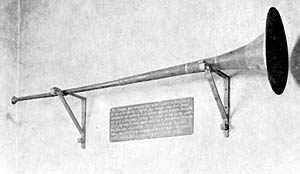
A similar tin horn, possibly not made by Morland, is still on display at East Leake church in Nottinghampshire. Eight feet long, it is clearly not of conical section, but is roughly exponential. It was supposedly in use by the church choir until 1855.
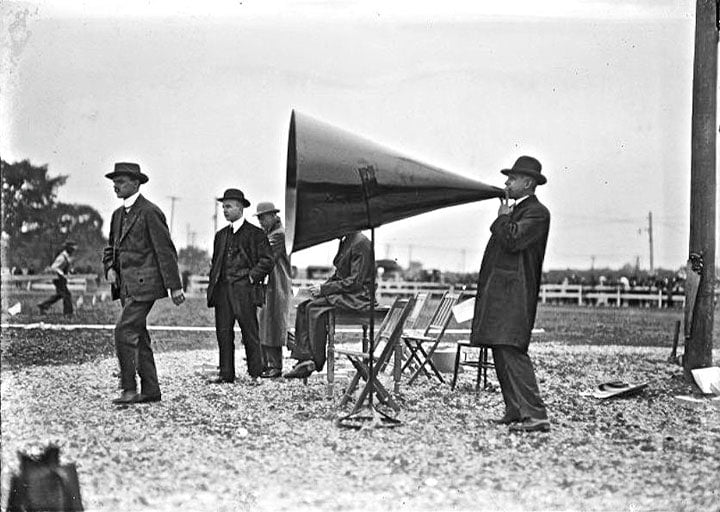
In the eighteenth century, theoretical work by Lagrange, Bernoulli, and Euler described the propagation of sound waves through horns, but contributed little to the development of practical devices. The nineteenth and early twentieth century saw conical megaphones used to amplify voices in public gatherings and in the military; such devices were usually of simple conical section.The term “megaphone” apparently was first associated with a device created by Thomas Edison around 1878.Edison was partially deaf and combined two hearing-horns with a central speaking horn in a single, cumbersome device. In the decades that followed, we saw the beginnings of horns associated with phonographic playback, with recording, and with playback by loudspeakers, as in the Western Electric horn shown in the construction plan atop this page. We’ll continue our discussion of horns in the next issue of Copper.

More from Issue 32

View All Articles in Issue 32

Search Copper Magazine

#226 JJ Murphy’s Sleep Paralysis is a Genre-Bending Musical Journey Through Jazz, Fusion and More by Frank Doris Jan 05, 2026 #226 Stewardship by Consent by B. Jan Montana Jan 05, 2026 #226 Food, Music, and Sensory Experience: An Interview With Professor Jonathan Zearfoss of the Culinary Institute of America by Joe Caplan Jan 05, 2026 #226 Studio Confidential: A Who’s Who of Recording Engineers Tell Their Stories by Frank Doris Jan 05, 2026 #226 Pilot Radio is Reborn, 50 Years Later: Talking With CEO Barak Epstein by Frank Doris Jan 05, 2026 #226 The Vinyl Beat Goes Down to Tijuana (By Way of Los Angeles), Part One by Rudy Radelic Jan 05, 2026 #226 Capital Audiofest 2025: Must-See Stereo, Part Two by Frank Doris Jan 05, 2026 #226 My Morning Jacket’s Carl Broemel and Tyler Ramsey Collaborate on Their Acoustic Guitar Album, Celestun by Ray Chelstowski Jan 05, 2026 #226 The People Who Make Audio Happen: CanJam SoCal 2025, Part Two by Harris Fogel Jan 05, 2026 #226 How to Play in a Rock Band, 19: Touring Can Make You Crazy, Part One by Frank Doris Jan 05, 2026 #226 Linda Ronstadt Goes Bigger by Wayne Robins Jan 05, 2026 #226 From The Audiophile’s Guide: Active Room Correction and Digital Signal Processing by Paul McGowan Jan 05, 2026 #226 PS Audio in the News by Frank Doris Jan 05, 2026 #226 Back to My Reel-to-Reel Roots, Part 25: Half-Full, Not Empty by Ken Kessler Jan 05, 2026 #226 Happy New Year! by Frank Doris Jan 05, 2026 #226 Turn It Down! by Peter Xeni Jan 05, 2026 #226 Ghost Riders by James Schrimpf Jan 05, 2026 #226 A Factory Tour of Audio Manufacturer German Physiks by Markus "Marsu" Manthey Jan 04, 2026 #225 Capital Audiofest 2025: Must-See Stereo, Part One by Frank Doris Dec 01, 2025 #225 Otis Taylor and the Electrics Delivers a Powerful Set of Hypnotic Modern Blues by Frank Doris Dec 01, 2025 #225 A Christmas Miracle by B. Jan Montana Dec 01, 2025 #225 T.H.E. Show New York 2025, Part Two: Plenty to See, Hear, and Enjoy by Frank Doris Dec 01, 2025 #225 Underappreciated Artists, Part One: Martin Briley by Rich Isaacs Dec 01, 2025 #225 Rock and Roll is Here to Stay by Wayne Robins Dec 01, 2025 #225 A Lifetime of Holiday Record (and CD) Listening by Rudy Radelic Dec 01, 2025 #225 Little Feat: Not Saying Goodbye, Not Yet by Ray Chelstowski Dec 01, 2025 #225 How to Play in a Rock Band, Part 18: Dealing With Burnout by Frank Doris Dec 01, 2025 #225 The People Who Make Audio Happen: CanJam SoCal 2025 by Harris Fogel Dec 01, 2025 #225 Chicago’s Sonic Sanctuaries: Four Hi‑Fi Listening Bars Channeling the Jazz‑Kissa Spirit by Olivier Meunier-Plante Dec 01, 2025 #225 From The Audiophile’s Guide: Controlling Bass Frequencies Through Membrane Absorbers (and How to Build Your Own) by Paul McGowan Dec 01, 2025 #225 Your Editor’s Tips for Attending Audio Shows by Frank Doris Dec 01, 2025 #225 PS Audio in the News by Frank Doris Dec 01, 2025 #225 Back to My Reel-to-Reel Roots, Part 24 by Ken Kessler Dec 01, 2025 #225 Holiday Music by Frank Doris Dec 01, 2025 #225 Puppy Prognostication by Peter Xeni Dec 01, 2025 #225 How to Post Comments on Copper by Frank Doris Dec 01, 2025 #225 Living Color by Rudy Radelic Dec 01, 2025 #224 T.H.E. Show New York 2025, Part One: A New Beginning by Frank Doris Nov 03, 2025 #224 Fool’s Leap of Faith is the Extraordinary Octave Records Debut from Singer/Songwriter Tyler Burba and Visit by Frank Doris Nov 03, 2025 #224 The Beatles’ “Aeolian Cadences.” What? by Wayne Robins Nov 03, 2025 #224 Persona Non Grata by B. Jan Montana Nov 03, 2025 #224 Talking With Recording Engineer Barry Diament of Soundkeeper Recordings, Part Two by Frank Doris Nov 03, 2025 #224 B Sides, B Movies, and Beware of Zombies by Rudy Radelic Nov 03, 2025 #224 The Burn-In Chronicles: 1,000 Hours to Sonic Salvation by Olivier Meunier-Plante Nov 03, 2025 #224 A Conversation With Mat Weisfeld of VPI Industries by Joe Caplan Nov 03, 2025 #224 Blues-Rocker Kenny Wayne Shepherd Celebrates 30 Years of Ledbetter Heights by Ray Chelstowski Nov 03, 2025 #224 Playing in a Rock Band, 17: When Good Gigs Go Bad, Part Two by Frank Doris Nov 03, 2025

Horns!

If there’s a more contentious topic in audio than that of horn loudspeakers, I don’t know what it is.—Okay, that’s not quite true: cables are a more contentious topic. I’m just not going there.

We’ve spent a lot of space in this column exploring the history of moving-coil loudspeakers from their creation by Jensen through their development at Bell Labs/Western Electric, the development of the acoustic suspension enclosure and dome drivers at AR, with detours through Weathers, Stan White, and Spica. We’ve also looked at electrostatic speakers from Quad and Acoustat, and those funky plasma drivers. It’s only fair that we take a look at horns through the years—and that will require revisiting Western Electric and its offspring.

Writing about the history of any field is a feat of genealogy in which family branches mysteriously break off, enlivened with a sprinkling of illegitimate offspring. Audio is like this, only ever so much so more so. Paths will cross and re-cross; familiar names will pop up again and again.

In order to understand horn loudspeakers, a little knowledge of their antecedents may be helpful. Going way back, the first horns used for sounding or making noise—I would hesitate to call them musical instruments—were formed from animal horns. The  “trumpets” mentioned in the Torah, the Old Testament, and the Quran were not the brass, valved instruments of modern times, but likely a shofar or something similar.  Generally made from a ram’s horn, a  shofar is more like a bugle, really, as it is valveless and the player’s embouchure is the only control of the horn’s pitch.

The word “bugle”, interestingly enough, is derived from “buculus”, which is Latin for a castrated bullock—so the origins of bugles are clear. Like a bugle, a shofar has a conical bore, meaning that the inner sound-chamber is shaped like a cone, whereas flutes and trumpets (among others) have a cylindrical bore.

The first horns most of us encounter in  life are also of conical bore: megaphones, including the rolled-up-paper versions often made in grade school. And of course horns can be used both ways—the hearing horn dating back t0 who-knows-when was essentially a megaphone in reverse.

The seventeenth century saw a number of polymaths appear in the worlds of science and engineering, and two in particular focused their attention on horns: Athanasius Kircher was a German Jesuit scholar who seemed to have studied almost everything, including microbes under a microscope. Kircher supposedly built “speaking trumpets” and proposed the use of room-sized horns to amplify the sound of musicians—although it’s not known if such giant horns were ever built.

The "speaking trumpet", shown in a drawing supposedly made by Athanasius Kircher.
 

A proposal by Kircher for use of a horn to “broadcast” the sound of musicians playing.

Kircher’s English counterpart was Sir Samuel Morland, who created a series of large speaking horns used by church choirs or orchestras. One such horn, known as the “Harrington Vamping Horn” (p. 154, right hand column) was said to be fully five feet in length, and still exists at its original church. Two other examples were said to be five and a half and six feet in length.  Morland also worked in hydraulics and developed mechanical calculators and cryptographic machines.

A similar tin horn, possibly not made by Morland, is still on display at East Leake church in Nottinghampshire. Eight feet long, it is clearly not of conical section, but is roughly exponential. It was supposedly in use by the church choir until 1855.

In the eighteenth century, theoretical work by Lagrange, Bernoulli, and Euler described the propagation of sound waves through horns, but contributed little to the development of practical devices. The nineteenth and early twentieth century saw conical megaphones used to amplify voices in public gatherings and in the military; such devices were usually of simple conical section.The term “megaphone” apparently was first associated with a device created by Thomas Edison around 1878.Edison was partially deaf and combined two hearing-horns with a central speaking horn in a single, cumbersome device. In the decades that followed, we saw the beginnings of horns associated with phonographic playback, with recording, and with playback by loudspeakers, as in the Western Electric horn shown in the construction plan atop this page. We’ll continue our discussion of horns in the next issue of Copper.

0 comments

Leave a comment

0 Comments

Your avatar

Loading comments...

🗑️ Delete Comment

Enter moderator password to delete this comment: