COPPER

A PS Audio Publication

Issue 123 • Free Online Magazine

Issue 123 FEATURED

Five Weeks in Mongolia, Part One

Five Weeks in Mongolia, Part One

It’s morning in Ulan Bator, Mongolia. I feel green, shaken and dehydrated from a rather spectacular night of diarrhea and vomiting. In matters of revenge, Montezuma has got nothing on Genghis Khan.

Comforting me, snuggled close to my exhausted abdomen is an adorable, stunted little black cat with half an ear missing.

The last year’s winter was classified as a “Zud” by Mongolia’s government. A Zud is a winter so harsh that it completely covers the grasslands with a season-long permafrost, burying the only source of food for the herds that sustain this country. Over three million sheep, goats, camels and horses were lost to starvation and frostbite. As well as half a feline ear.

My furry little Mongolian friend is in a deep shamanic trance, muttering some nasal invocation of healing to speed my recovery. Or, more likely, snoring and talking in her sleep while chasing prey in the big world of her dreams. Either way, when alone, far from home, and not feeling perfectly well, the simple unconditional company of a borrowed pet works its soft magic.

It’s a good day to tell my story…I’ll start at the end.

******

Arriving back in Mongolia’s capitol felt somehow empty after weeks of living and working with the nomads that sparsely populate the vast steppes of this raw and beautiful country.

A few days prior in that remote countryside, western and Mongolian eyes turned glassy during an emotional good-bye as we loaded onto the van to depart. It always amazes me how close people can get in such a short time, especially with only facial expressions, a handful of semi-intelligible words from a phrase book, and my apparently comical attempts at pronunciation of the written Mongolian Cyrillic.

I fell in love with these people. Living as their forbears have for centuries in a distinct, loosely-knit rural society, hospitality is of paramount cultural importance. Socializing is ingrained in the very fabric of their daily lives, and doors are always open. It is commonplace for total strangers to arrive unannounced and be welcomed warmly no matter what other things the family may have been involved in. They love to talk, or just sit with guests in a silence devoid of awkward expectation.

There is no word for ‘please’ in Mongolian – their unpretentious courtesy is simply a way of life.

On paper, Mongolia is a poor country, but there is no sense of poverty in the countryside. In terms of traditional society, not much has changed out here for a very long time. Our standards as to what comprises a fulfilled life simply don’t apply.

******

In its heyday as one of the largest Buddhist temples in Mongolia, Baldan Baravain flourished as a center for education, religion and culture for over 200 years, until communist China ended its glory. In 1937, under the pretense of needing information on the monks to assess taxes, the occupation authorities were able to compile a list of the Lamas by hierarchy. The most senior third of the temple’s monks were immediately shot. The next third was sent to work camps in Siberia and never heard from again. The youngest third of monks were allowed to return to their families. All in all, over 3,000 monks and nuns were slaughtered and their temple destroyed.

Practicing Buddhism in Mongolia only became legal again in the 1990s. In 2002, I joined a small team of Americans determined to restore the ruined temple to its former glory and reestablish the community. As altruistic as that may sound, these people had been betrayed by foreigners their whole lives and not surprisingly, the local Mongolian craftsmen and masons who were hired to help us with the restoration doubted our intentions. Rumors circulated that we were secretly building our summer palace and would kick them out once it was completed.

******

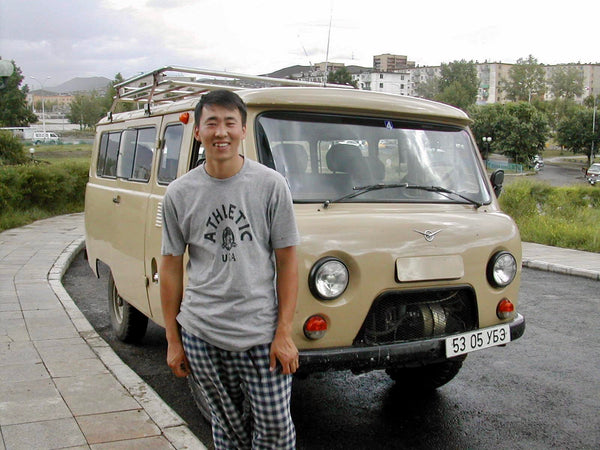
My journey to the ruins of Baldan Baravain started in early morning as we embarked in what I can only describe as a minibus crossed with a tank. Built in Russia, as most of Mongolia’s vehicles are, this machine is a marvel. At first, I remembered its name as “Flowbee,” but that turned out to be a vacuum-driven haircutting device touted on campy late-night infomercials (alas, it seems my spongy, advertising-soaked brain was traveling with me). Our affable young driver, Bagi, referred to it as a “Forgon,” and it is designed with a philosophy different than our western consumerist economy would understand or allow: the vehicle’s shape and parts barely change over decades. Spare parts are interchangeable across model years, making repairs in the remote countryside possible – a feature I found myself very grateful for on the journey ahead.

A few miles out of the capitol, the terrain changes to an endless expanse of green hills, the kind that impels you to run with abandon, head back, arms wide in the wind, smiling, and egged on by the syrupy orchestral music in your head.

An hour into our ride east on a roughly paved road built with Japan’s financial help, it became obvious that the funds ran out, as did the road. Bagi, our driver, calmly wheeling headlong towards a deliberate and definitive roadblock, revealed no intimation of slowing down. My knuckles turned white on the door handle. A few feet before the barrier, Bagi made a well-executed hard right and we were on what would be for us another nine hours of off-road insanity, careening through a land with little resembling a road, no traffic signs or advertising at all, and to make it really interesting, no seat belts! Dodging marmot holes, sheep and goats at 60 kph would at times have us airborne, as young Bagi, who knew his vehicle well, surfed the waves of green turf nonplussed –possibly without the knowledge that he was defying both gravity and some laws of physics at every turn.

My respect for the Flowbee (sorry, the name just stuck) and Bagi increased with every mile. The machine was obviously built for this terrain and our driver proved competent in piloting the two tons of steel and humanity. Some color returned to my knuckles.
Venturing deeper into the green, a sight off to the right took my breath away…wild horses, dozens of them, galloping on the grassland like a school of fish, leaderless, manes windswept, muscled bodies shining in the sun, joyous. It was like a dream. I wanted to go out and run with them through their home. I now understand why even around a race track these beautiful creatures run – it’s programmed into their cellular memory. They simply have to.

As a wild land, Mongolia shows its bounty of nature untouched. A dark blur on the bumpy terrain ahead caught my attention – maybe a marmot? no, too big – it was standing almost a yard tall; perhaps a species of feral dog? Since it stood in our path, Bagi actually slowed down. Holding us fast in its majestic gaze, it didn’t move as we approached, obviously unimpressed by the purring mass of steel in which we were ensconced. We stopped, three feet and an open window between its fierce beauty and my unprotected pate, the astonishingly large golden eagle locked defiantly onto my eyes, its power over me mesmerizing. As I fumbled for my camera, this regal native released its gaze and took wing, disappearing into its blue domain.

My arm, extended out the window, felt its first drops of Mongolian rain. In a heartbeat the sky relieved its clouds of their burden and drowned what earlier passed as semi-navigable tracks under fast silvery rivers. Not surprisingly, this beautiful display of nature’s power didn’t make lighter our driver’s weighty foot. Bagi just turned on the wipers and continued his unruffled command, expertly turning into the spins as our rear wheels lost their grip in the slick mud. There were never any discernible landmarks to guide us along our route, so not being able to see anything at all didn’t seem to be a problem. Out here, you either know the way or you’re vulture food.

******

Mongolia is one of the least-touristed countries in the world, attracting only 28,000 foreigners a year. For perspective, during its entire tourist season, this country gets as many visitors as Thailand attracts each week. In the countryside, where most of Mongolia’s 2.3 million people live, many young faces look like they’ve never seen a foreigner. I felt like quite an attraction as we passed through the occasional settlement.

My first sight of the ruins of Baldan Baravain was breathtaking. I can only imagine what awe it inspired when it was active and whole. The sun was low on the horizon, illuminating the temple with a warm glow. The valley that enshrouds the monastery is so beautiful I found myself just staring, open-jawed. As we pulled up to the camp, we were greeted by a smiling young man named Guré, the newly ordained Lama of Baldan Baravain, who would become a friend to us all.

Part Two will follow in a future issue.

Header image courtesy of Wikipedia/Marcin Konsek.

More from Issue 123

View All Articles in Issue 123

Search Copper Magazine

#227 How to Play in a Rock Band, 20: On the Road With Blood, Sweat & Tears’ Guitarist Gabe Cummins by Frank Doris Feb 02, 2026 #227 From The Audiophile’s Guide: Audio Specs and Measuring by Paul McGowan Feb 02, 2026 #227 Our Brain is Always Listening by Peter Trübner Feb 02, 2026 #227 PS Audio in the News by PS Audio Staff Feb 02, 2026 #227 The Listening Chair: Sleek Style and Sound From the Luxman L3 by Howard Kneller Feb 02, 2026 #227 The Los Angeles and Orange County Audio Society Celebrates Its 32nd Anniversary, Honoring David Wilson and Bernie Grundman by Harris Fogel Feb 02, 2026 #227 Back to My Reel-to-Reel Roots, Part 26: Half Full – Not Half Empty, Redux by Ken Kessler Feb 02, 2026 #227 That's What Puzzles Us... by Frank Doris Feb 02, 2026 #227 Record-Breaking by Peter Xeni Feb 02, 2026 #227 The Long and Winding Road by B. Jan Montana Feb 02, 2026 #226 JJ Murphy’s Sleep Paralysis is a Genre-Bending Musical Journey Through Jazz, Fusion and More by Frank Doris Jan 05, 2026 #226 Stewardship by Consent by B. Jan Montana Jan 05, 2026 #226 Food, Music, and Sensory Experience: An Interview With Professor Jonathan Zearfoss of the Culinary Institute of America by Joe Caplan Jan 05, 2026 #226 Studio Confidential: A Who’s Who of Recording Engineers Tell Their Stories by Frank Doris Jan 05, 2026 #226 Pilot Radio is Reborn, 50 Years Later: Talking With CEO Barak Epstein by Frank Doris Jan 05, 2026 #226 The Vinyl Beat Goes Down to Tijuana (By Way of Los Angeles), Part One by Rudy Radelic Jan 05, 2026 #226 Capital Audiofest 2025: Must-See Stereo, Part Two by Frank Doris Jan 05, 2026 #226 My Morning Jacket’s Carl Broemel and Tyler Ramsey Collaborate on Their Acoustic Guitar Album, Celestun by Ray Chelstowski Jan 05, 2026 #226 The People Who Make Audio Happen: CanJam SoCal 2025, Part Two by Harris Fogel Jan 05, 2026 #226 How to Play in a Rock Band, 19: Touring Can Make You Crazy, Part One by Frank Doris Jan 05, 2026 #226 Linda Ronstadt Goes Bigger by Wayne Robins Jan 05, 2026 #226 From The Audiophile’s Guide: Active Room Correction and Digital Signal Processing by Paul McGowan Jan 05, 2026 #226 PS Audio in the News by Frank Doris Jan 05, 2026 #226 Back to My Reel-to-Reel Roots, Part 25: Half-Full, Not Empty by Ken Kessler Jan 05, 2026 #226 Happy New Year! by Frank Doris Jan 05, 2026 #226 Turn It Down! by Peter Xeni Jan 05, 2026 #226 Ghost Riders by James Schrimpf Jan 05, 2026 #226 A Factory Tour of Audio Manufacturer German Physiks by Markus "Marsu" Manthey Jan 04, 2026 #225 Capital Audiofest 2025: Must-See Stereo, Part One by Frank Doris Dec 01, 2025 #225 Otis Taylor and the Electrics Delivers a Powerful Set of Hypnotic Modern Blues by Frank Doris Dec 01, 2025 #225 A Christmas Miracle by B. Jan Montana Dec 01, 2025 #225 T.H.E. Show New York 2025, Part Two: Plenty to See, Hear, and Enjoy by Frank Doris Dec 01, 2025 #225 Underappreciated Artists, Part One: Martin Briley by Rich Isaacs Dec 01, 2025 #225 Rock and Roll is Here to Stay by Wayne Robins Dec 01, 2025 #225 A Lifetime of Holiday Record (and CD) Listening by Rudy Radelic Dec 01, 2025 #225 Little Feat: Not Saying Goodbye, Not Yet by Ray Chelstowski Dec 01, 2025 #225 How to Play in a Rock Band, Part 18: Dealing With Burnout by Frank Doris Dec 01, 2025 #225 The People Who Make Audio Happen: CanJam SoCal 2025 by Harris Fogel Dec 01, 2025 #225 Chicago’s Sonic Sanctuaries: Four Hi‑Fi Listening Bars Channeling the Jazz‑Kissa Spirit by Olivier Meunier-Plante Dec 01, 2025 #225 From The Audiophile’s Guide: Controlling Bass Frequencies Through Membrane Absorbers (and How to Build Your Own) by Paul McGowan Dec 01, 2025 #225 Your Editor’s Tips for Attending Audio Shows by Frank Doris Dec 01, 2025 #225 PS Audio in the News by Frank Doris Dec 01, 2025 #225 Back to My Reel-to-Reel Roots, Part 24 by Ken Kessler Dec 01, 2025 #225 Holiday Music by Frank Doris Dec 01, 2025 #225 Puppy Prognostication by Peter Xeni Dec 01, 2025 #225 How to Post Comments on Copper by Frank Doris Dec 01, 2025 #225 Living Color by Rudy Radelic Dec 01, 2025

Five Weeks in Mongolia, Part One

Five Weeks in Mongolia, Part One

It’s morning in Ulan Bator, Mongolia. I feel green, shaken and dehydrated from a rather spectacular night of diarrhea and vomiting. In matters of revenge, Montezuma has got nothing on Genghis Khan.

Comforting me, snuggled close to my exhausted abdomen is an adorable, stunted little black cat with half an ear missing.

The last year’s winter was classified as a “Zud” by Mongolia’s government. A Zud is a winter so harsh that it completely covers the grasslands with a season-long permafrost, burying the only source of food for the herds that sustain this country. Over three million sheep, goats, camels and horses were lost to starvation and frostbite. As well as half a feline ear.

My furry little Mongolian friend is in a deep shamanic trance, muttering some nasal invocation of healing to speed my recovery. Or, more likely, snoring and talking in her sleep while chasing prey in the big world of her dreams. Either way, when alone, far from home, and not feeling perfectly well, the simple unconditional company of a borrowed pet works its soft magic.

It’s a good day to tell my story…I’ll start at the end.

******

Arriving back in Mongolia’s capitol felt somehow empty after weeks of living and working with the nomads that sparsely populate the vast steppes of this raw and beautiful country.

A few days prior in that remote countryside, western and Mongolian eyes turned glassy during an emotional good-bye as we loaded onto the van to depart. It always amazes me how close people can get in such a short time, especially with only facial expressions, a handful of semi-intelligible words from a phrase book, and my apparently comical attempts at pronunciation of the written Mongolian Cyrillic.

I fell in love with these people. Living as their forbears have for centuries in a distinct, loosely-knit rural society, hospitality is of paramount cultural importance. Socializing is ingrained in the very fabric of their daily lives, and doors are always open. It is commonplace for total strangers to arrive unannounced and be welcomed warmly no matter what other things the family may have been involved in. They love to talk, or just sit with guests in a silence devoid of awkward expectation.

There is no word for ‘please’ in Mongolian – their unpretentious courtesy is simply a way of life.

On paper, Mongolia is a poor country, but there is no sense of poverty in the countryside. In terms of traditional society, not much has changed out here for a very long time. Our standards as to what comprises a fulfilled life simply don’t apply.

******

In its heyday as one of the largest Buddhist temples in Mongolia, Baldan Baravain flourished as a center for education, religion and culture for over 200 years, until communist China ended its glory. In 1937, under the pretense of needing information on the monks to assess taxes, the occupation authorities were able to compile a list of the Lamas by hierarchy. The most senior third of the temple’s monks were immediately shot. The next third was sent to work camps in Siberia and never heard from again. The youngest third of monks were allowed to return to their families. All in all, over 3,000 monks and nuns were slaughtered and their temple destroyed.

Practicing Buddhism in Mongolia only became legal again in the 1990s. In 2002, I joined a small team of Americans determined to restore the ruined temple to its former glory and reestablish the community. As altruistic as that may sound, these people had been betrayed by foreigners their whole lives and not surprisingly, the local Mongolian craftsmen and masons who were hired to help us with the restoration doubted our intentions. Rumors circulated that we were secretly building our summer palace and would kick them out once it was completed.

******

My journey to the ruins of Baldan Baravain started in early morning as we embarked in what I can only describe as a minibus crossed with a tank. Built in Russia, as most of Mongolia’s vehicles are, this machine is a marvel. At first, I remembered its name as “Flowbee,” but that turned out to be a vacuum-driven haircutting device touted on campy late-night infomercials (alas, it seems my spongy, advertising-soaked brain was traveling with me). Our affable young driver, Bagi, referred to it as a “Forgon,” and it is designed with a philosophy different than our western consumerist economy would understand or allow: the vehicle’s shape and parts barely change over decades. Spare parts are interchangeable across model years, making repairs in the remote countryside possible – a feature I found myself very grateful for on the journey ahead.

A few miles out of the capitol, the terrain changes to an endless expanse of green hills, the kind that impels you to run with abandon, head back, arms wide in the wind, smiling, and egged on by the syrupy orchestral music in your head.

An hour into our ride east on a roughly paved road built with Japan’s financial help, it became obvious that the funds ran out, as did the road. Bagi, our driver, calmly wheeling headlong towards a deliberate and definitive roadblock, revealed no intimation of slowing down. My knuckles turned white on the door handle. A few feet before the barrier, Bagi made a well-executed hard right and we were on what would be for us another nine hours of off-road insanity, careening through a land with little resembling a road, no traffic signs or advertising at all, and to make it really interesting, no seat belts! Dodging marmot holes, sheep and goats at 60 kph would at times have us airborne, as young Bagi, who knew his vehicle well, surfed the waves of green turf nonplussed –possibly without the knowledge that he was defying both gravity and some laws of physics at every turn.

My respect for the Flowbee (sorry, the name just stuck) and Bagi increased with every mile. The machine was obviously built for this terrain and our driver proved competent in piloting the two tons of steel and humanity. Some color returned to my knuckles.

Venturing deeper into the green, a sight off to the right took my breath away…wild horses, dozens of them, galloping on the grassland like a school of fish, leaderless, manes windswept, muscled bodies shining in the sun, joyous. It was like a dream. I wanted to go out and run with them through their home. I now understand why even around a race track these beautiful creatures run – it’s programmed into their cellular memory. They simply have to.

As a wild land, Mongolia shows its bounty of nature untouched. A dark blur on the bumpy terrain ahead caught my attention – maybe a marmot? no, too big – it was standing almost a yard tall; perhaps a species of feral dog? Since it stood in our path, Bagi actually slowed down. Holding us fast in its majestic gaze, it didn’t move as we approached, obviously unimpressed by the purring mass of steel in which we were ensconced. We stopped, three feet and an open window between its fierce beauty and my unprotected pate, the astonishingly large golden eagle locked defiantly onto my eyes, its power over me mesmerizing. As I fumbled for my camera, this regal native released its gaze and took wing, disappearing into its blue domain.

My arm, extended out the window, felt its first drops of Mongolian rain. In a heartbeat the sky relieved its clouds of their burden and drowned what earlier passed as semi-navigable tracks under fast silvery rivers. Not surprisingly, this beautiful display of nature’s power didn’t make lighter our driver’s weighty foot. Bagi just turned on the wipers and continued his unruffled command, expertly turning into the spins as our rear wheels lost their grip in the slick mud. There were never any discernible landmarks to guide us along our route, so not being able to see anything at all didn’t seem to be a problem. Out here, you either know the way or you’re vulture food.

******

Mongolia is one of the least-touristed countries in the world, attracting only 28,000 foreigners a year. For perspective, during its entire tourist season, this country gets as many visitors as Thailand attracts each week. In the countryside, where most of Mongolia’s 2.3 million people live, many young faces look like they’ve never seen a foreigner. I felt like quite an attraction as we passed through the occasional settlement.

My first sight of the ruins of Baldan Baravain was breathtaking. I can only imagine what awe it inspired when it was active and whole. The sun was low on the horizon, illuminating the temple with a warm glow. The valley that enshrouds the monastery is so beautiful I found myself just staring, open-jawed. As we pulled up to the camp, we were greeted by a smiling young man named Guré, the newly ordained Lama of Baldan Baravain, who would become a friend to us all.

Part Two will follow in a future issue.

Header image courtesy of Wikipedia/Marcin Konsek.

0 comments

Leave a comment

0 Comments

Your avatar

Loading comments...

🗑️ Delete Comment

Enter moderator password to delete this comment: