COPPER

A PS Audio Publication

Issue 126 • Free Online Magazine

Issue 126 TRUE-LIFE ROCK TALES

Johnny "Guitar" Watson: A Real Mother for Ya

Johnny "Guitar" Watson: A Real Mother for Ya
In 1980 I find myself working on another bus tour in Europe. Jim Kellem of CMA (Creative Management Associates, later ICM Partners) calls and says that an acquaintance of his is manager of Johnny “Guitar” Watson. There is a tour of Germany and Spain scheduled, and the manager cannot go because he is working on the movie Take This Job and Shove It. I am not familiar with Johnny “Guitar” Watson, but things seem on the level and it is a pretty short tour, so I say OK and sign on.
Johnny "Guitar" Watson. Courtesy of Wikipedia/Mikamote.

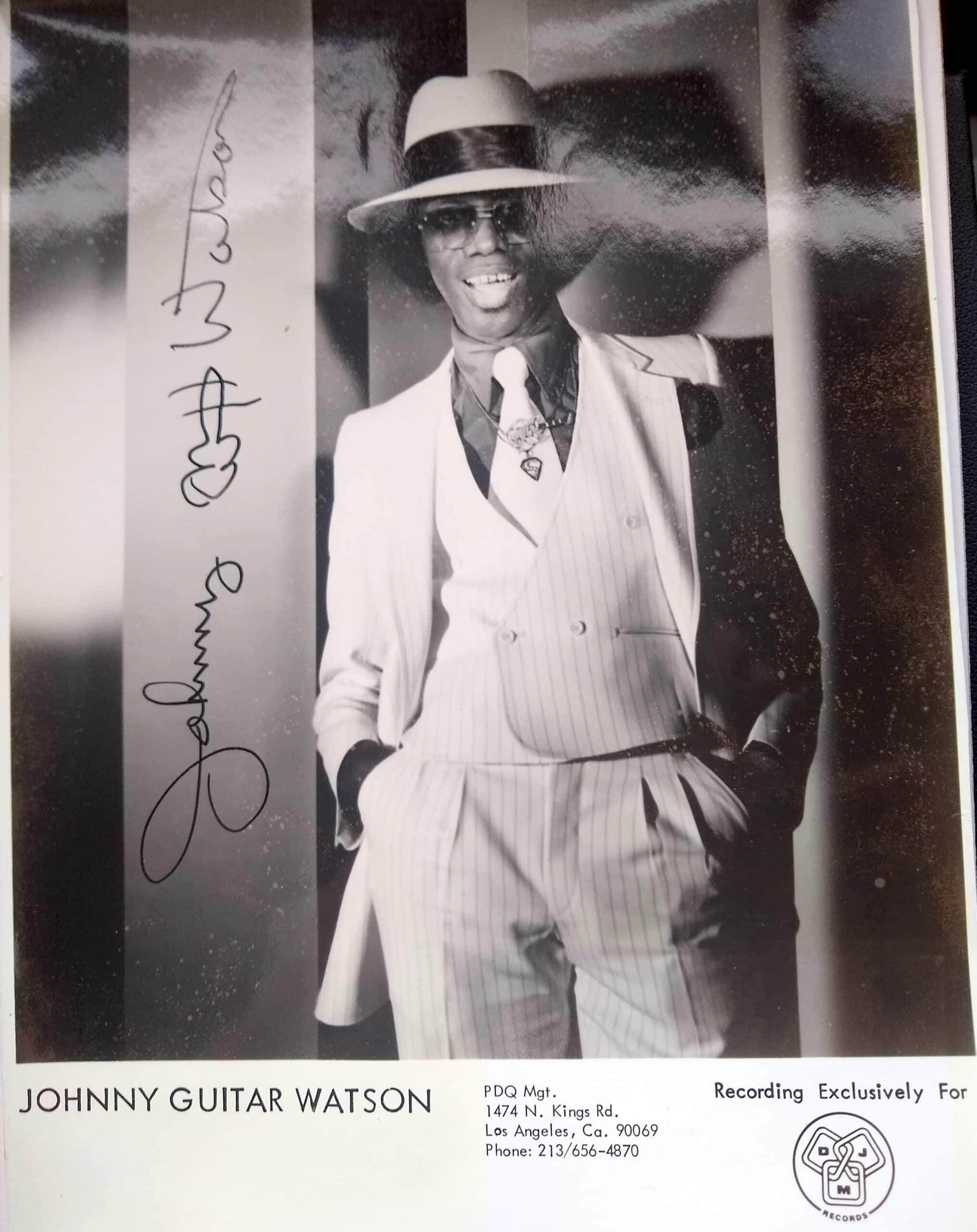
Johnny “Guitar” Watson (1935 – 1996) started out as a blues artist in the 1950s, moving to soul and funk by the 1970s. His distinctive stinging, cutting guitar style was characterized by plucking the strings with his fingers and using a capo to change keys. He was a flamboyant performer who liked outlandish clothes, and had success with his song “Gangster of Love,” “A Real Mother for Ya” and others. Frank Zappa said Watson’s “Three Hours Past Midnight” inspired him to play guitar.


I am advised to call Beverly Woodman; she is Johnny’s sister, and day-to-day manager. I make contact and we go over tour details and I ask her if she can wire my first week’s pay into my bank account before we leave. No problem. She explains to me that she lives her life on the straight and narrow. She carries her Bible everywhere.

We fly into Frankfurt and the first concert takes place the next evening. I seek out Beverly because I had checked before I had left New York and the money had not arrived at my bank. I ask Beverly about the money and she assures me that she wired it into my account and everything is fine. Since I’m in Germany I cannot check so I must take her word for it.

The first date will be at the Stadthalle Offenbach, a concert hall with the capacity of 2,000. This represents the type of venues we will be playing in Europe: older concert halls in good shape, acoustically sound and very ornate. Kind of cool.

The afternoon before the first show I am introduced to everyone and we board our tour bus for the short ride to the concert hall. Johnny has an assistant, and he sits next to me on the bus and starts to give me the lay of the land. He tells me Johnny is a preacher and a pimp. Johnny is across the aisle and one seat forward up towards the front of the bus, and he turns around and gives me a big smile. All right, I think to myself, so Johnny is not just a musician but also religious and a gangster.

That night the show was amazing. Really incredible. I was totally impressed. The show flowed back and forth like a beautiful stream. Johnny didn’t just sing and play incredible guitar; he mixed things up. The show featured Randi Redman, this beautiful Black gal with an incredible voice. Then there was J.J., a piano player and singer who had a tremendous stage personality. J.J., a young guy in his early twenties, was entertaining and lovable. There was not a person in the hall who was not totally taken by him.

Of course the key ingredient in the mix was Johnny with his smooth singing and guitar playing that was just outta sight. Watching Johnny work his magic with the guitar, I could not help but think that he reminds me of a combination of Sly Stone and Jimi Hendrix and one of his mentors, T-Bone Walker. But wait a minute.

An alarm went off in my head. Johnny is easily 15 or 20 years older than any of them, so it might be correct to think that they inherited something from him. Hmmm, being the first at something doesn’t always mean that you’ll be the one who’s the most successful at it. Sometimes the one who did it first does not get the credit they deserve, or is even acknowledged at all. But is anyone really “the first,” or are we all just pushing forward what has come before?

I ask you, our readers, for your comments and any information you might have about Johnny “Guitar Watson” (on his style, his influences or his history) to start a dialog in the Comments area below.

Next day we are on the bus to Cologne/Duesseldorf to play at the Philipshalle that night, another beautiful facility. I do not see Johnny on the bus, and ask Beverly where he is. She says he is either flying to the next gig or being driven by limousine, and we will not see him on the bus very often.


The show that night was awesome again, in one of the biggest concert halls we would play during the tour. My hat is off to Johnny “Guitar” Watson as he put together a very entertaining show. It is not easy to do that and I speak from experience. [See Ken’s article about the Peace Parade in Issue 118 – Ed.]

There was no opening act on the Johnny “Guitar” Watson tour. It was a much shorter show then the ones I usually was part of, about 75 to 90 minutes in all.

As the tour went on, I became more friendly with the band, which by the way was particularly good, especially considering that they had just formed for this tour. I was surprised; I mean, this is not unheard of, but they were really tight and together. One of them mentioned that before getting this gig, he was a census taker. I was truly surprised, and it bothered me that such a talented musician in Los Angeles couldn’t find work and had to take a temporary job as a census taker just to keep body and soul together.
We had a date in Barcelona, and had to cross France to get to Spain. At customs in France they pulled all of us off the bus. While standing there I looked back at the bus and every window was greased up. What an odd sight! It took a moment for me to figure out why. Everyone in the band was using Jheri Curl on their hair. Jheri Curl was greasy, and when they leaned their heads on the window it smeared the window big time. It was popular in the 1980s. In a half hour or so the customs officials let us pass and we start driving through the South of France.

Later that night we are in Lyon and lost and can’t find our hotel, or I should say, the bus driver is lost. We stop in front of a neighborhood bar and I go in to ask directions to our hotel. I walk in and there are about 20 men in the establishment. I ask the bartender for directions. Of course, no one in the bar can speak any English, but everyone in the place comes over trying to help. They pile outside of the bar to look at this big bus on their tiny street and they get the bus driver and with a map and hand signals they point out the correct way. Their friendship is a nice experience, and if we hadn’t been riding for so many hours I would have suggested going in for a drink, but everyone is really bushed. So, we drive off, waving goodbye to our new friends.

We get to the hotel, check in and once in my room I call my wife in New York. She answers and is quite annoyed. “It is 4 o’clock in the morning! you woke me up!” “Oh, I’m sorry,” I replied; “did you get the money from JGWs people?” “No,” she says, “and good night,” and she hangs up on me. Next morning when I check out, I get a room charge for $21 for my 40-second phone call. “What is with this big phone bill?” I say to the people at the front desk and they just shrug. That was the last personal long-distance phone call I ever made from a hotel room.

On the bus I tell Beverly that the money has not arrived, and she said, “I sent it, maybe it will be there tomorrow.” But I’m starting to doubt her.

Arriving in Barcelona that day we go to a tremendous arena. This is a festival, but what kind of festival I do not know. This arena is easily 400 years old and immense. However, our dressing or staging area is out in the open, and Randi needs to change and there is no privacy. So, both of us go in search of a changing area. We start walking through huge this circular arena looking for a ladies room or something private. And do we walk! This place really is tremendous. At one point we passed a boxing area where as many as 30 fighters were working out on punching bags and even a ring with two fighters sparring in it; it was a full-scale boxing gym. Finally, we find a small L-shaped area where she could have some privacy while I stood guard. When she was ready, we started the long walk back. Halfway there some guy goes running past us and right behind him is a policeman chasing him. Right in front of us the policeman tackles him and starts beating the guy with his night stick. “What is that?” Randi asks. “I guess the guy tried to sneak in,” I answered. “That is a pretty drastic response, don’t you think?” “Yeah,” I say, “Violent, but who knows what is going on. “We made a wide circle walking around and past the struggle.

Back to Germany on a long overnight bus ride with no stopping that night. We arrive in Mannheim the next day around noon. The show tonight is at Musensaal, 1,800 seats, a lovely concert hall. Tonight’s show is sold out, like many are on this tour. These international tours are interesting and different and I love the exposure to different cultures.


The majority of international performers want to tour the States, but conversely, there are some American acts that thrive in Europe and the Far East but not so much at home. That being said, I accept that it is a big world entertainment-wise, with different tastes and biases. When the day comes that we all start traveling again, I suggest that you check out international talent and shows; you will find some amazing entertainment off the beaten path. For example, on the Stranglers tour (see article in Issue 111) a special event for me was catching Wang Chung play their first show ever in London on the Chinese New Year.

We finished the tour with dates in Hanover and Hamburg. The night after the last show Johnny was in a bad mood, giving grief to the band and shooting me dirty looks. I don’t know why but he was unhappy with that night’s performance. That evening was the last time I saw him.

Early the next afternoon I board a TWA 747 for the flight back to New York. As I am walking the aisle to my seat I notice yesterday’s New York Post lying on an open seat and the headline is of the volcanic eruption of Mount St Helens. Wow, shocking. I had no idea. While touring, you are in a bubble far removed from the news of the day.

My plane lands at JFK in the late afternoon and I take a taxi back to our duplex apartment on East 18th Street. I unpack, throwing my dirty laundry in the hamper and about an hour later my wife comes home from work. She was happy to see me.

Next day I check with my bank and guess what? My first week’s pay had never arrived. I am not happy about it but I am not surprised either. A first for me as a road manager but life goes on.

Postscript: Johnny “Guitar” Watson passed away from a heart attack on May 17, 1996 while playing a concert in Yokohama, Japan. One report said the heart attack happened backstage and another said it happened within moments of him going on stage. Bad drugs? Maybe quite likely in my opinion, but Japan is not a country known for drugs or drug usage so who knows if some idiot might had have given him something tainted. Johnny liked to party, but he was smooth, not overweight, and I do not remember him smoking. He did not have the charm of Jimi Hendrix but he had the talent.

More from Issue 126

View All Articles in Issue 126

Search Copper Magazine

#233 A Report From The Total Hi-Fi Experience Show SoCal 2026 by B. Jan Montana Aug 03, 2026 #233 Bluegrass Meets Country, Folk, Jazz and More in All That We Carried by The Squid City Slingers by Frank Doris Aug 03, 2026 #233 Corey Glover and One Tribe Nation: A Variegated Musical Collective by Ray Chelstowski Aug 03, 2026 #233 Excursions with Clive: The Late Clive Davis, A Personal History by Wayne Robins Aug 03, 2026 #233 AI, Art, and Music: A Conversation With Synthography Art by Joe Caplan Aug 03, 2026 #233 New American Symphonies: A Rediscovered Gem and a Vital Contemporary Work by Frank Doris Aug 03, 2026 #233 The Vinyl Beat: Genesis, the Dave Clark Five, Antonio Carlos Jobim and More by Rudy Radelic Aug 03, 2026 #233 How to Play in a Rock Band, 26: When It's Time to Record Your Music by Frank Doris Aug 03, 2026 #233 More From T.H.E. Show 2026, and the People Who Made it Happen by Harris Fogel Aug 03, 2026 #233 Underappreciated Artists, Part Three: Icehouse by Rich Isaacs Aug 03, 2026 #233 The Surprisingly Rich and Varied Music of Somalia by Steve Kindig Aug 03, 2026 #233 A Remarkable Discographic Legacy: The LP Recordings of the Basel Symphony Orchestra by Stephan Haberthür Aug 03, 2026 #233 From The Audiophile’s Guide: The Importance of Loudspeakers by Paul McGowan Aug 03, 2026 #233 From Swimming Pool to New Listening Room: A Conversation with Norman Varney of AV RoomService by Gilles Laferrière Aug 03, 2026 #233 PS Audio in the News by PS Audio Staff Aug 03, 2026 #233 Audio Jewelry by Peter Xeni Aug 03, 2026 #233 Enrich Your Life by Frank Doris Aug 03, 2026 #233 The Searcher by James Schrimpf Aug 03, 2026 #232 What came first: Art or Music? A Conversation With Artist Jose Acosta by Joe Caplan Jul 06, 2026 #232 Blow By Blow: The Jeff Beck Story: An Insightful Book About a Guitar Icon by Ray Chelstowski Jul 06, 2026 #232 Creed Over Camaraderie? by B. Jan Montana Jul 06, 2026 #232 Chronicles of a Sound Pilgrim at the 2026 Montreal Audiofest by Hugues Morin Jul 06, 2026 #232 The Vinyl Beat: Summer Grooves by Rudy Radelic Jul 06, 2026 #232 Hibbing Hillbilly Dylan's Acoustic Rock by Wayne Robins Jul 06, 2026 #232 Quad Quads and Plasmatronics Tweeters: An Extraordinary System Comes to Life by Frank Doris Jul 06, 2026 #232 In Praise of Live Music, Once Again by Ted Shafran Jul 06, 2026 #232 Allnic Audio’s L-9000 Preamplifier: Design and Engineering Innovation by Howard Kneller Jul 06, 2026 #232 “Best Of” Lists and Rage Bait: Enough Already by Frank Doris Jul 06, 2026 #232 Quick Takes: Bud Shank, Paulo Almeida, Jakob Dreyer, Tim Eriksen and Peter Irvine by Frank Doris Jul 06, 2026 #232 My Impressions of AXPONA 2026, Part 2 by Frank Doris Jul 06, 2026 #232 How to Play in a Rock Band, 25: Encounters With Famous Musicians, Part Three by Frank Doris Jul 06, 2026 #232 Budgets, and Systems From Small to Outrageous by Paul McGowan Jul 06, 2026 #232 PS Audio in the News by PS Audio Staff Jul 06, 2026 #232 Hand It Over by Frank Doris Jul 06, 2026 #232 Difference of Opinion by Peter Xeni Jul 06, 2026 #232 Wabi-sabi Tree by James Schrimpf Jul 06, 2026 #231 Piano Prodigy Jude Kofie Releases His Debut Album On Octave Records by Frank Doris Jun 01, 2026 #231 Underappreciated Artists, Part Two: City Boy by Rich Isaacs Jun 01, 2026 #231 Music and the Art of Creation: Talking With Saxophonist Rob Scheps by Joe Caplan Jun 01, 2026 #231 How to Play in a Rock Band, 24: Further Adventures at the 2026 Montauk Music Festival by Frank Doris Jun 01, 2026 #231 Courtney Barnett: Creature of Habit by Wayne Robins Jun 01, 2026 #231 Angine de Poitrine: Interstellar Guitar Rock Saviors Headed for Late-Night TV Pop Stardom? by Mark Lepage Jun 01, 2026 #231 My Impressions of AXPONA 2026, Part One by Frank Doris Jun 01, 2026 #231 2026 La Jolla Concours d'Elegance: Another Aesthetic Feast by B. Jan Montana Jun 01, 2026 #231 Country Music Icon Jo Dee Messina’s Bridges: A New Beginning by Ray Chelstowski Jun 01, 2026 #231 The Luxury Dispatch Hosts a Video Podcast With Ken Kessler by Ken Kessler Jun 01, 2026 #231 The Vinyl Beat: Tracking in the Motor City by Rudy Radelic Jun 01, 2026

Johnny "Guitar" Watson: A Real Mother for Ya

Johnny "Guitar" Watson: A Real Mother for Ya
In 1980 I find myself working on another bus tour in Europe. Jim Kellem of CMA (Creative Management Associates, later ICM Partners) calls and says that an acquaintance of his is manager of Johnny “Guitar” Watson. There is a tour of Germany and Spain scheduled, and the manager cannot go because he is working on the movie Take This Job and Shove It. I am not familiar with Johnny “Guitar” Watson, but things seem on the level and it is a pretty short tour, so I say OK and sign on.
Johnny "Guitar" Watson. Courtesy of Wikipedia/Mikamote.

Johnny “Guitar” Watson (1935 – 1996) started out as a blues artist in the 1950s, moving to soul and funk by the 1970s. His distinctive stinging, cutting guitar style was characterized by plucking the strings with his fingers and using a capo to change keys. He was a flamboyant performer who liked outlandish clothes, and had success with his song “Gangster of Love,” “A Real Mother for Ya” and others. Frank Zappa said Watson’s “Three Hours Past Midnight” inspired him to play guitar.


I am advised to call Beverly Woodman; she is Johnny’s sister, and day-to-day manager. I make contact and we go over tour details and I ask her if she can wire my first week’s pay into my bank account before we leave. No problem. She explains to me that she lives her life on the straight and narrow. She carries her Bible everywhere.

We fly into Frankfurt and the first concert takes place the next evening. I seek out Beverly because I had checked before I had left New York and the money had not arrived at my bank. I ask Beverly about the money and she assures me that she wired it into my account and everything is fine. Since I’m in Germany I cannot check so I must take her word for it.

The first date will be at the Stadthalle Offenbach, a concert hall with the capacity of 2,000. This represents the type of venues we will be playing in Europe: older concert halls in good shape, acoustically sound and very ornate. Kind of cool.

The afternoon before the first show I am introduced to everyone and we board our tour bus for the short ride to the concert hall. Johnny has an assistant, and he sits next to me on the bus and starts to give me the lay of the land. He tells me Johnny is a preacher and a pimp. Johnny is across the aisle and one seat forward up towards the front of the bus, and he turns around and gives me a big smile. All right, I think to myself, so Johnny is not just a musician but also religious and a gangster.

That night the show was amazing. Really incredible. I was totally impressed. The show flowed back and forth like a beautiful stream. Johnny didn’t just sing and play incredible guitar; he mixed things up. The show featured Randi Redman, this beautiful Black gal with an incredible voice. Then there was J.J., a piano player and singer who had a tremendous stage personality. J.J., a young guy in his early twenties, was entertaining and lovable. There was not a person in the hall who was not totally taken by him.

Of course the key ingredient in the mix was Johnny with his smooth singing and guitar playing that was just outta sight. Watching Johnny work his magic with the guitar, I could not help but think that he reminds me of a combination of Sly Stone and Jimi Hendrix and one of his mentors, T-Bone Walker. But wait a minute.

An alarm went off in my head. Johnny is easily 15 or 20 years older than any of them, so it might be correct to think that they inherited something from him. Hmmm, being the first at something doesn’t always mean that you’ll be the one who’s the most successful at it. Sometimes the one who did it first does not get the credit they deserve, or is even acknowledged at all. But is anyone really “the first,” or are we all just pushing forward what has come before?

I ask you, our readers, for your comments and any information you might have about Johnny “Guitar Watson” (on his style, his influences or his history) to start a dialog in the Comments area below.

Next day we are on the bus to Cologne/Duesseldorf to play at the Philipshalle that night, another beautiful facility. I do not see Johnny on the bus, and ask Beverly where he is. She says he is either flying to the next gig or being driven by limousine, and we will not see him on the bus very often.


The show that night was awesome again, in one of the biggest concert halls we would play during the tour. My hat is off to Johnny “Guitar” Watson as he put together a very entertaining show. It is not easy to do that and I speak from experience. [See Ken’s article about the Peace Parade in Issue 118 – Ed.]

There was no opening act on the Johnny “Guitar” Watson tour. It was a much shorter show then the ones I usually was part of, about 75 to 90 minutes in all.

As the tour went on, I became more friendly with the band, which by the way was particularly good, especially considering that they had just formed for this tour. I was surprised; I mean, this is not unheard of, but they were really tight and together. One of them mentioned that before getting this gig, he was a census taker. I was truly surprised, and it bothered me that such a talented musician in Los Angeles couldn’t find work and had to take a temporary job as a census taker just to keep body and soul together.

We had a date in Barcelona, and had to cross France to get to Spain. At customs in France they pulled all of us off the bus. While standing there I looked back at the bus and every window was greased up. What an odd sight! It took a moment for me to figure out why. Everyone in the band was using Jheri Curl on their hair. Jheri Curl was greasy, and when they leaned their heads on the window it smeared the window big time. It was popular in the 1980s. In a half hour or so the customs officials let us pass and we start driving through the South of France.

Later that night we are in Lyon and lost and can’t find our hotel, or I should say, the bus driver is lost. We stop in front of a neighborhood bar and I go in to ask directions to our hotel. I walk in and there are about 20 men in the establishment. I ask the bartender for directions. Of course, no one in the bar can speak any English, but everyone in the place comes over trying to help. They pile outside of the bar to look at this big bus on their tiny street and they get the bus driver and with a map and hand signals they point out the correct way. Their friendship is a nice experience, and if we hadn’t been riding for so many hours I would have suggested going in for a drink, but everyone is really bushed. So, we drive off, waving goodbye to our new friends.

We get to the hotel, check in and once in my room I call my wife in New York. She answers and is quite annoyed. “It is 4 o’clock in the morning! you woke me up!” “Oh, I’m sorry,” I replied; “did you get the money from JGWs people?” “No,” she says, “and good night,” and she hangs up on me. Next morning when I check out, I get a room charge for $21 for my 40-second phone call. “What is with this big phone bill?” I say to the people at the front desk and they just shrug. That was the last personal long-distance phone call I ever made from a hotel room.

On the bus I tell Beverly that the money has not arrived, and she said, “I sent it, maybe it will be there tomorrow.” But I’m starting to doubt her.

Arriving in Barcelona that day we go to a tremendous arena. This is a festival, but what kind of festival I do not know. This arena is easily 400 years old and immense. However, our dressing or staging area is out in the open, and Randi needs to change and there is no privacy. So, both of us go in search of a changing area. We start walking through huge this circular arena looking for a ladies room or something private. And do we walk! This place really is tremendous. At one point we passed a boxing area where as many as 30 fighters were working out on punching bags and even a ring with two fighters sparring in it; it was a full-scale boxing gym. Finally, we find a small L-shaped area where she could have some privacy while I stood guard. When she was ready, we started the long walk back. Halfway there some guy goes running past us and right behind him is a policeman chasing him. Right in front of us the policeman tackles him and starts beating the guy with his night stick. “What is that?” Randi asks. “I guess the guy tried to sneak in,” I answered. “That is a pretty drastic response, don’t you think?” “Yeah,” I say, “Violent, but who knows what is going on. “We made a wide circle walking around and past the struggle.

Back to Germany on a long overnight bus ride with no stopping that night. We arrive in Mannheim the next day around noon. The show tonight is at Musensaal, 1,800 seats, a lovely concert hall. Tonight’s show is sold out, like many are on this tour. These international tours are interesting and different and I love the exposure to different cultures.


The majority of international performers want to tour the States, but conversely, there are some American acts that thrive in Europe and the Far East but not so much at home. That being said, I accept that it is a big world entertainment-wise, with different tastes and biases. When the day comes that we all start traveling again, I suggest that you check out international talent and shows; you will find some amazing entertainment off the beaten path. For example, on the Stranglers tour (see article in Issue 111) a special event for me was catching Wang Chung play their first show ever in London on the Chinese New Year.

We finished the tour with dates in Hanover and Hamburg. The night after the last show Johnny was in a bad mood, giving grief to the band and shooting me dirty looks. I don’t know why but he was unhappy with that night’s performance. That evening was the last time I saw him.

Early the next afternoon I board a TWA 747 for the flight back to New York. As I am walking the aisle to my seat I notice yesterday’s New York Post lying on an open seat and the headline is of the volcanic eruption of Mount St Helens. Wow, shocking. I had no idea. While touring, you are in a bubble far removed from the news of the day.

My plane lands at JFK in the late afternoon and I take a taxi back to our duplex apartment on East 18th Street. I unpack, throwing my dirty laundry in the hamper and about an hour later my wife comes home from work. She was happy to see me.

Next day I check with my bank and guess what? My first week’s pay had never arrived. I am not happy about it but I am not surprised either. A first for me as a road manager but life goes on.

Postscript: Johnny “Guitar” Watson passed away from a heart attack on May 17, 1996 while playing a concert in Yokohama, Japan. One report said the heart attack happened backstage and another said it happened within moments of him going on stage. Bad drugs? Maybe quite likely in my opinion, but Japan is not a country known for drugs or drug usage so who knows if some idiot might had have given him something tainted. Johnny liked to party, but he was smooth, not overweight, and I do not remember him smoking. He did not have the charm of Jimi Hendrix but he had the talent.

0 comments

Leave a comment

0 Comments

Your avatar

Loading comments...

🗑️ Delete Comment

Enter moderator password to delete this comment:

✏️ Edit Comment

Enter your email to verify ownership: