Copper Magazine · Issue 160 · A free PS Audio publication
Issue 160 Featured

Three Days with Frank Sinatra, Part Three: The Cole Porter Suite

Three Days with Frank Sinatra, Part Three: The Cole Porter Suite

I’m sure it was pizza and ice cream that soothed my ego the day after Frank and Barbara abandoned me in the parking lot of Christina’s school. I learned to get over stuff like that by cultivating various addictions. Although Frank treated me like a stranger, his valet, Mikey, did not, and Mikey was back at the house to pick up the Sinatras’ effects before they all headed back to California. And out of nowhere, Mikey asked if I wanted to stay at the hotel tonight while he packed up Mr. S’s suite. Yes! Finally, someone was repaying everything I had done for Frank. I really earned this perk.

My mother quickly gave her permission for me to go on an overnight trip to Manhattan with a man we barely knew – being a parent was different back in 1979. But, I wasn’t worried. Mikey seemed like a solid guy, and I risked my life in Times Square whenever my friends and I waded through perverts, pushers, and predators as we shopped for porn magazines, bongs, and records. Plus, I was going to be safely inside a hotel most of the time. With $20 in my wallet and a change of clothes in my school bag, I was ready to leave – until my mother made me repack my “nice pants and shirt” into a proper leather suitcase, the same baby blue one I had carried around since age four. She wanted me to make a good impression as her envoy to the Waldorf Astoria.

At dusk, Mikey picked me up in a boat-length two-door Cadillac, and we flew down the Saw Mill River Parkway blasting the radio, not at all concerned about cops and speeding tickets. I didn’t know what possibilities the night held but my excitement grew as Manhattan’s skyline became more visible along the Henry Hudson Parkway. We made our way into Midtown, eastbound down the canyon of 57th Street, bathed by street lamps and smoggy warm air. He took the longer scenic route to unwind before the night’s work, and without having to provide directions, I could sit back and relax. I thought we would cruise around for a bit, maybe drink a six-pack of beer or smoke pot the way I did with some of my older friends – being a teen was different back in 1979. I was up for anything, but Mikey turned out to be a complete square. I was really disappointed when the trip abruptly ended at the hotel’s side entrance. Still, it was a pleasant surprise to have a bunch of attendants running around, opening and closing my doors, parking the car, and assisting me with my petit overnight bag. I felt so important for once.
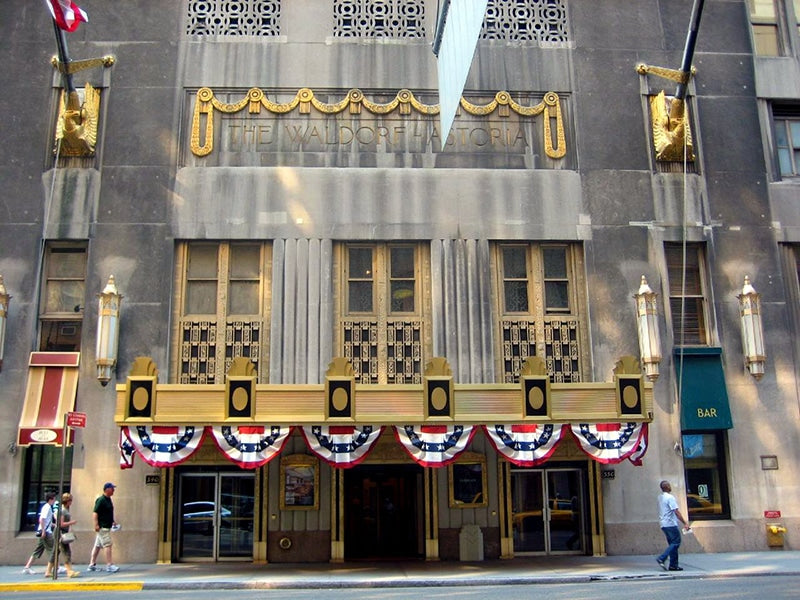
 

The Waldorf Astoria in 2008. Courtesy of Wikimedia Commons/Jordi Sabaté.

The Waldorf Astoria in 2008. Courtesy of Wikimedia Commons/Jordi Sabaté.


We were taken directly to the 33rd floor of the Waldorf Towers (an exclusive section of the hotel between the 27th and 42nd floors); the elevator operator stopped for no other passengers. I knew Frank’s hotel room would be nicer than any my family stayed in, but his cavernous “room” seemed to continue endlessly. After a long walk through the entrance halls and past a kitchen and dining area, we finally arrived in the parlor. “HOLY SH*T! How big is this place, and where the hell are the beds?!” I asked naively, having never been in a suite before.

“The beds are in the bedrooms. It’s an apartment, probably the biggest in the building.” Mikey said “bedrooms,” as in five, each with its own private bathroom. Frank’s suite was bigger than any of my friends’ houses.

I was dying to snoop around the place to see how Frank lived, but Mikey walked me over to a couch in the living room and instructed me to sit and not touch anything. All I could do was gaze out the windows, one whole side facing south towards the Pan Am building and other looking over the East River, and take in a sky with airplanes and helicopters darting like fireflies, streets flowing with gold and red car lights, and the peaks of buildings twinkling like Christmas trees as far as my eye could see. I had never seen Manhattan from this perspective before. Little did I know that I was already in the best part of the apartment. This is where Cole Porter played his piano named “High Society” while living in Suite 33A between 1939 and 1964. The hotel gifted him the ornate mahogany baby grand Steinway, which makes one wonder how many hits were written on High Society. Sometimes, Frank Sinatra would join him, and other times musicians accompanied Porter on an adjoining baby grand piano set curve to curve. With the roster of artists who walked the halls and worked the Starlight Roof and the Empire Room during its golden age, there’s no telling how many celebrities sat where I sat – it could have been Count Basie, Benny Goodman, George M. Cohan, Glenn Miller, or Lena Horne. After Porter’s death in 1964, Frank and Barbara Sinatra moved into the suite and rented it for one million dollars per year until 1988.

After the porters brought everything up from the car, including my suitcase, Mikey took me down to his room in the regular part of the Waldorf. The quarters were spacious and pleasant but nothing like the Towers where royalty, presidents, and world-renowned celebrities could be found any day of the week. “You can have anything in my fridge,” Mikey instructed. “I’ll call you early in the morning, so answer the phone but don’t make any calls. Lock the door and don’t leave the room. They won’t let you back up.” As much I wanted to run around the lobby and neighborhood, I had to stay put. Who would believe that I was Frank Sinatra’s guest if I got stopped in the lobby? I didn’t even know Mikey’s last name.

I stayed up most of the night watching late-night TV, splashing around in the deluxe bathtub, helping myself to everything in the mini-fridge, and studying the hotel guide on the desk. There were a bunch of bars and restaurants where I was itching to spend my $20 the next day: Sir Harry’s, Peacock Alley, Oscar’s, or The Bull and Bear.

Sometime during my solo all-night party, the phone rang. Figuring it was Mikey, I answered in a familiar tone, “Hell-oooooo,” I said in the high-pitched voice of 13-year-old boy.

The man on the other end was taken aback, “Whooz dis?”

“Tommy!”

“Dis is Jilly… Where’s Mikey?”

You don’t ever forget a man nicknamed Jilly. Ermenigildo Rizzo sounded tough with his native New York accent.


I’d never met him, but I heard his name whenever Frank was around. Jilly was always stopping by the house or taking Frank somewhere, and he seemed to be Mikey’s boss when Frank wasn’t there.

Snapping to, I said, “He’s in Mr. S’s room!” I tried to sound like I was part of the organization and not someone who snuck into the room, “I’m Mikey’s friend. Frank and Barbara are staying at our house!” I pictured Jilly kicking me out onto Park Avenue in the middle of the night, “And don’t forget your periwinkle valise, ya bum!” as all the doormen laughed. I guess Jilly called right over, because Mikey came down and said Mr. Rizzo wanted to know why some broad named “Tammy” answered the phone. I’m not sure how Mikey explained who I was or what I was doing there, but he assured me I wasn’t in any trouble.

It would make life worth living if I had been placed in that hotel room as a pawn in some nefarious scheme. Maybe Mikey had a dame stashed in Frank’s place, or he needed to leave the hotel to “take care of business.” Whatever it was, I would certainly vouch that he was in Frank’s apartment packing if anyone asked. I’ll never know, but I reveled in the unlikely possibility of being a minor character in the plot: “Ya need someone loyal. How about that kid you’re drivin’ around with, you know, the one who found them tomatoes? He’s not too sharp, anyways. Put him in the room and let him answer the phone. If anyone starts nosing around, just tell ’em his mother needed you to keep an eye on him for the night. It’s an airtight alibi.”

I slept a few hours before check-out and the looming train ride back to the suburbs. Mikey called my room to tell me the bellhop was bringing me down to the big clock in the lobby. I thought Mikey and I were going to have breakfast at Oscar’s, but he was flying to Los Angeles. He offered me a ride to Grand Central just eight blocks away, but I wanted to explore the parts of the hotel I hadn’t seen. I passed by lounges, restaurants, and shops, and perused old black and white photographs of famous residents and extravagant galas.

I probably walked by Cole Porter’s piano without realizing it. He’d bequeathed it to the Waldorf, and it had been in the lobby since 1964. Then I marveled at the hotel’s daytime exterior, an entire city block from 49th to 50th Streets between Park and Lexington Avenues. The lettering of “The Waldorf Astoria” shimmered in gold. I wished I could have stayed there forever as Frank’s guest instead of returning to my boring life in Mount Kisco.

I didn’t get to revisit the Waldorf until our honeymoon. My wife and I happened to get a suite in the Waldorf Towers, just a few floors below Frank and Barbara’s old apartment. As a paying guest, I could soak in the Art Deco nostalgia of the lobby without the fear of not being let back upstairs. Unlike my last visit, I had a room key to prove that I belonged there, at least for a little while. We had drinks at Peacock Alley and imagined celebrities and socialites crowding the lobby and ballrooms. Best of all, Cole Porter’s piano was still in the grand lobby and being played regularly by Ms. Daryl Sherman from 1994 to 2008. This was the very tail end of an era when elegant hotels employed musicians to create a sophisticated ambience. I enjoyed the luxury and opulence, but it never fails to remind of the anonymous people laboring away behind the scenes like my parents who spent ten years serving, cooking, and cleaning for rich people. But even with all the complications, embarrassment, and loneliness of feeling like a second-class citizen in other people’s mansions, I am now wealthy with memories and experiences from living on all those magnificent properties.

I never heard from Mikey again. Except for Christina and my mother, most of the participants in this story have died, and the Greens’ estate was sold long ago. Yet anytime I think of the Waldorf Astoria, mash up a can of San Marzanos, or buy fresh basil at the farmers market, I am reminded of that kid forty years ago, begrudgingly spending a few hours with Frank Sinatra. I can see us standing in the garden among the herbs as he says, “Ah, there it is… basilico. You can always smell it.”


Header image: Capitol Records promo photo, circa 1955.

Previous installments appeared in Issue 158 and Issue 159.

More from Issue 160

View All Articles in Issue 160

Search Copper Magazine

Favorites From T.H.E. Show SoCal 2026 by Cam Martin Oct 05, 2026 #235 Singer/Songwriter John David Schrader: On the Need to Create, Part Two by Joe Caplan Oct 05, 2026 #235 A Life in High-End Audio: The Roy Hall Interview, Part Two by Frank Doris Oct 05, 2026 #235 Grammy-Winning Producer, Songwriter, and Guitarist John Leventhal Goes Instrumental With National Drift by Ray Chelstowski Oct 05, 2026 #235 From Swimming Pool to New Listening Room—to Founding an Accidental Audio Company by Gilles Laferrière Oct 05, 2026 #235 The Vinyl Beat’s Size Matters Edition by Rudy Radelic Oct 05, 2026 #235 The Sublime Complexities of Nature by B. Jan Montana Oct 05, 2026 #235 How to Play In a Rock Band, 28: Growing Older and Dealing With It by Frank Doris Oct 05, 2026 #235 Young Rascals: From Bar Band to Stardom by Wayne Robins Oct 05, 2026 #235 Duncan Sheik: In Memoriam by Ray Chelstowski Oct 05, 2026 #235 From The Listening Chair: The Meze Audio 105 Silva Headphones by Howard Kneller Oct 05, 2026 #235 Checking Out Some NOLA Loudspeakers – and Some Thoughts About Audio Writing by Frank Doris Oct 05, 2026 #235 The Kanazawa Phonograph Museum: Music from a Time Capsule by Sebastian Polcyn Oct 05, 2026 #235 PS Audio in the News by PS Audio Staff Oct 05, 2026 #235 From The Audiophile’s Guide: Making the Most Critical Choice by Paul McGowan Oct 05, 2026 #235 Evolutionary Growth by Frank Doris Oct 05, 2026 #235 Speed Racer by Peter Xeni Oct 05, 2026 #235 Happy Halloween! by James Schrimpf Oct 05, 2026 #234 A Life in High-End Audio: The Roy Hall Interview, Part One by Frank Doris Sep 07, 2026 #234 Jason Greenlaw Offers His Personal Perspective on Jazz Guitar in Vantage Point by Frank Doris Sep 07, 2026 #234 Transcendent Phoenix: Lucina Yue Brings the Ancient Konghou Into Modern Times by Frank Doris Sep 07, 2026 #234 We Must All Follow Our Bliss by B. Jan Montana Sep 07, 2026 #234 How to Play in a Rock Band, 27: Leveling Up by Frank Doris Sep 07, 2026 #234 Ross Valory: Traveling Into New Musical Territory With All of the Above by Ray Chelstowski Sep 07, 2026 #234 Singer/Songwriter John David Schrader: On the Need to Create by Joe Caplan Sep 07, 2026 #234 The People Who Make Audio Happen: More From T.H.E. Show SoCal 2026 by Harris Fogel Sep 07, 2026 #234 The Vinyl Beat Digs Into the Gadget Box by Rudy Radelic Sep 07, 2026 #234 The Rolling Stones: Foreign Tongues Spoken Loud by Wayne Robins Sep 07, 2026 #234 Musical Moments by Rich Isaacs Sep 07, 2026 #234 Rags for Solo Piano and a Dog: David Chesky's Ragtime Music for the Modern Age by Frankly Speaking Sep 07, 2026 #234 HIGH END 2026, Vienna: Here to Stay by Carsten Barnbeck Sep 07, 2026 #234 From The Audiophile’s Guide: The Two Main Types of Loudpeakers – Box and Panel by Paul McGowan Sep 07, 2026 #234 Letting it Slide by Frank Doris Sep 07, 2026 #234 PS Audio in the News by PS Audio Staff Sep 07, 2026 #234 Long Playing by Peter Xeni Sep 07, 2026 #234 La Mer by B. Jan Montana Sep 07, 2026 #233 A Report From The Total Hi-Fi Experience Show SoCal 2026 by B. Jan Montana Aug 03, 2026 #233 Bluegrass Meets Country, Folk, Jazz and More in All That We Carried by The Squid City Slingers by Frank Doris Aug 03, 2026 #233 Corey Glover and One Tribe Nation: A Variegated Musical Collective by Ray Chelstowski Aug 03, 2026 #233 Excursions with Clive: The Late Clive Davis, A Personal History by Wayne Robins Aug 03, 2026 #233 AI, Art, and Music: A Conversation With Synthography Art by Joe Caplan Aug 03, 2026 #233 New American Symphonies: A Rediscovered Gem and a Vital Contemporary Work by Frank Doris Aug 03, 2026 #233 The Vinyl Beat: Genesis, the Dave Clark Five, Antonio Carlos Jobim and More by Rudy Radelic Aug 03, 2026 #233 How to Play in a Rock Band, 26: When It's Time to Record Your Music by Frank Doris Aug 03, 2026 #233 More From T.H.E. Show 2026, and the People Who Made it Happen by Harris Fogel Aug 03, 2026 #233 Underappreciated Artists, Part Three: Icehouse by Rich Isaacs Aug 03, 2026 #233 The Surprisingly Rich and Varied Music of Somalia by Steve Kindig Aug 03, 2026

Three Days with Frank Sinatra, Part Three: The Cole Porter Suite

Three Days with Frank Sinatra, Part Three: The Cole Porter Suite

I’m sure it was pizza and ice cream that soothed my ego the day after Frank and Barbara abandoned me in the parking lot of Christina’s school. I learned to get over stuff like that by cultivating various addictions. Although Frank treated me like a stranger, his valet, Mikey, did not, and Mikey was back at the house to pick up the Sinatras’ effects before they all headed back to California. And out of nowhere, Mikey asked if I wanted to stay at the hotel tonight while he packed up Mr. S’s suite. Yes! Finally, someone was repaying everything I had done for Frank. I really earned this perk.

My mother quickly gave her permission for me to go on an overnight trip to Manhattan with a man we barely knew – being a parent was different back in 1979. But, I wasn’t worried. Mikey seemed like a solid guy, and I risked my life in Times Square whenever my friends and I waded through perverts, pushers, and predators as we shopped for porn magazines, bongs, and records. Plus, I was going to be safely inside a hotel most of the time. With $20 in my wallet and a change of clothes in my school bag, I was ready to leave – until my mother made me repack my “nice pants and shirt” into a proper leather suitcase, the same baby blue one I had carried around since age four. She wanted me to make a good impression as her envoy to the Waldorf Astoria.

At dusk, Mikey picked me up in a boat-length two-door Cadillac, and we flew down the Saw Mill River Parkway blasting the radio, not at all concerned about cops and speeding tickets. I didn’t know what possibilities the night held but my excitement grew as Manhattan’s skyline became more visible along the Henry Hudson Parkway. We made our way into Midtown, eastbound down the canyon of 57th Street, bathed by street lamps and smoggy warm air. He took the longer scenic route to unwind before the night’s work, and without having to provide directions, I could sit back and relax. I thought we would cruise around for a bit, maybe drink a six-pack of beer or smoke pot the way I did with some of my older friends – being a teen was different back in 1979. I was up for anything, but Mikey turned out to be a complete square. I was really disappointed when the trip abruptly ended at the hotel’s side entrance. Still, it was a pleasant surprise to have a bunch of attendants running around, opening and closing my doors, parking the car, and assisting me with my petit overnight bag. I felt so important for once.


The Waldorf Astoria in 2008. Courtesy of Wikimedia Commons/Jordi Sabaté.

The Waldorf Astoria in 2008. Courtesy of Wikimedia Commons/Jordi Sabaté.


We were taken directly to the 33rd floor of the Waldorf Towers (an exclusive section of the hotel between the 27th and 42nd floors); the elevator operator stopped for no other passengers. I knew Frank’s hotel room would be nicer than any my family stayed in, but his cavernous “room” seemed to continue endlessly. After a long walk through the entrance halls and past a kitchen and dining area, we finally arrived in the parlor. “HOLY SH*T! How big is this place, and where the hell are the beds?!” I asked naively, having never been in a suite before.

“The beds are in the bedrooms. It’s an apartment, probably the biggest in the building.” Mikey said “bedrooms,” as in five, each with its own private bathroom. Frank’s suite was bigger than any of my friends’ houses.

I was dying to snoop around the place to see how Frank lived, but Mikey walked me over to a couch in the living room and instructed me to sit and not touch anything. All I could do was gaze out the windows, one whole side facing south towards the Pan Am building and other looking over the East River, and take in a sky with airplanes and helicopters darting like fireflies, streets flowing with gold and red car lights, and the peaks of buildings twinkling like Christmas trees as far as my eye could see. I had never seen Manhattan from this perspective before. Little did I know that I was already in the best part of the apartment. This is where Cole Porter played his piano named “High Society” while living in Suite 33A between 1939 and 1964. The hotel gifted him the ornate mahogany baby grand Steinway, which makes one wonder how many hits were written on High Society. Sometimes, Frank Sinatra would join him, and other times musicians accompanied Porter on an adjoining baby grand piano set curve to curve. With the roster of artists who walked the halls and worked the Starlight Roof and the Empire Room during its golden age, there’s no telling how many celebrities sat where I sat – it could have been Count Basie, Benny Goodman, George M. Cohan, Glenn Miller, or Lena Horne. After Porter’s death in 1964, Frank and Barbara Sinatra moved into the suite and rented it for one million dollars per year until 1988.

After the porters brought everything up from the car, including my suitcase, Mikey took me down to his room in the regular part of the Waldorf. The quarters were spacious and pleasant but nothing like the Towers where royalty, presidents, and world-renowned celebrities could be found any day of the week. “You can have anything in my fridge,” Mikey instructed. “I’ll call you early in the morning, so answer the phone but don’t make any calls. Lock the door and don’t leave the room. They won’t let you back up.” As much I wanted to run around the lobby and neighborhood, I had to stay put. Who would believe that I was Frank Sinatra’s guest if I got stopped in the lobby? I didn’t even know Mikey’s last name.

I stayed up most of the night watching late-night TV, splashing around in the deluxe bathtub, helping myself to everything in the mini-fridge, and studying the hotel guide on the desk. There were a bunch of bars and restaurants where I was itching to spend my $20 the next day: Sir Harry’s, Peacock Alley, Oscar’s, or The Bull and Bear.

Sometime during my solo all-night party, the phone rang. Figuring it was Mikey, I answered in a familiar tone, “Hell-oooooo,” I said in the high-pitched voice of 13-year-old boy.

The man on the other end was taken aback, “Whooz dis?”

“Tommy!”

“Dis is Jilly… Where’s Mikey?”

You don’t ever forget a man nicknamed Jilly. Ermenigildo Rizzo sounded tough with his native New York accent.


I’d never met him, but I heard his name whenever Frank was around. Jilly was always stopping by the house or taking Frank somewhere, and he seemed to be Mikey’s boss when Frank wasn’t there.

Snapping to, I said, “He’s in Mr. S’s room!” I tried to sound like I was part of the organization and not someone who snuck into the room, “I’m Mikey’s friend. Frank and Barbara are staying at our house!” I pictured Jilly kicking me out onto Park Avenue in the middle of the night, “And don’t forget your periwinkle valise, ya bum!” as all the doormen laughed. I guess Jilly called right over, because Mikey came down and said Mr. Rizzo wanted to know why some broad named “Tammy” answered the phone. I’m not sure how Mikey explained who I was or what I was doing there, but he assured me I wasn’t in any trouble.

It would make life worth living if I had been placed in that hotel room as a pawn in some nefarious scheme. Maybe Mikey had a dame stashed in Frank’s place, or he needed to leave the hotel to “take care of business.” Whatever it was, I would certainly vouch that he was in Frank’s apartment packing if anyone asked. I’ll never know, but I reveled in the unlikely possibility of being a minor character in the plot: “Ya need someone loyal. How about that kid you’re drivin’ around with, you know, the one who found them tomatoes? He’s not too sharp, anyways. Put him in the room and let him answer the phone. If anyone starts nosing around, just tell ’em his mother needed you to keep an eye on him for the night. It’s an airtight alibi.”

I slept a few hours before check-out and the looming train ride back to the suburbs. Mikey called my room to tell me the bellhop was bringing me down to the big clock in the lobby. I thought Mikey and I were going to have breakfast at Oscar’s, but he was flying to Los Angeles. He offered me a ride to Grand Central just eight blocks away, but I wanted to explore the parts of the hotel I hadn’t seen. I passed by lounges, restaurants, and shops, and perused old black and white photographs of famous residents and extravagant galas.

I probably walked by Cole Porter’s piano without realizing it. He’d bequeathed it to the Waldorf, and it had been in the lobby since 1964. Then I marveled at the hotel’s daytime exterior, an entire city block from 49th to 50th Streets between Park and Lexington Avenues. The lettering of “The Waldorf Astoria” shimmered in gold. I wished I could have stayed there forever as Frank’s guest instead of returning to my boring life in Mount Kisco.

I didn’t get to revisit the Waldorf until our honeymoon. My wife and I happened to get a suite in the Waldorf Towers, just a few floors below Frank and Barbara’s old apartment. As a paying guest, I could soak in the Art Deco nostalgia of the lobby without the fear of not being let back upstairs. Unlike my last visit, I had a room key to prove that I belonged there, at least for a little while. We had drinks at Peacock Alley and imagined celebrities and socialites crowding the lobby and ballrooms. Best of all, Cole Porter’s piano was still in the grand lobby and being played regularly by Ms. Daryl Sherman from 1994 to 2008. This was the very tail end of an era when elegant hotels employed musicians to create a sophisticated ambience. I enjoyed the luxury and opulence, but it never fails to remind of the anonymous people laboring away behind the scenes like my parents who spent ten years serving, cooking, and cleaning for rich people. But even with all the complications, embarrassment, and loneliness of feeling like a second-class citizen in other people’s mansions, I am now wealthy with memories and experiences from living on all those magnificent properties.

I never heard from Mikey again. Except for Christina and my mother, most of the participants in this story have died, and the Greens’ estate was sold long ago. Yet anytime I think of the Waldorf Astoria, mash up a can of San Marzanos, or buy fresh basil at the farmers market, I am reminded of that kid forty years ago, begrudgingly spending a few hours with Frank Sinatra. I can see us standing in the garden among the herbs as he says, “Ah, there it is… basilico. You can always smell it.”


Header image: Capitol Records promo photo, circa 1955.

Previous installments appeared in Issue 158 and Issue 159.

0 comments

Leave a comment

0 Comments

Your avatar

Loading comments...

🗑️ Delete Comment

Enter moderator password to delete this comment:

✏️ Edit Comment

Enter your email to verify ownership: