COPPER

A PS Audio Publication

Issue 177 • Free Online Magazine

Issue 177

The Earth's Heartbeat: Native American Music, Redux

The Earth's Heartbeat: Native American Music, Redux

All plants are our brothers and sisters,
they talk to us and if we listen, we can hear them.
If we wonder often, the gift of knowledge will come.

Arapaho nation literature [1]

You’ve seen and heard it before: American Indians playing drums and other instruments while vocalizing in a language you don’t understand. At least that’s how Native American music has generally been depicted in films and on television. But unless you happen to have studied and already enjoy the music of indigenous tribes, there’s much to be discovered about this rarely explored area of music.

Indian culture is closely tied to nature, and music has always played a meaningful role in this relationship. Although the earliest examples of Indian music can be found in documents written by European explorers, researchers believe American Indian music dates back many centuries before those documents were written.[2]

There are hundreds of Native American tribes throughout the United States and every tribe has music that reflects its own traditions. Music performances tell stories about a tribe’s heritage, wars, triumphs and defeats, are essential for ceremonies and celebrations, and employed for specific purposes like asking for rain or a successful hunt. [3] From invoking spirits and speaking to the dead, from singing prayers and songs to curing the sick, traditional Indian music is an integral part of people’s daily lives and  includes some of the most haunting songs and instrumentals you’re likely to hear.

The most important instrument used in Indian culture is the human voice. Solos, duos and group singing are common but unlike most European music, early American Indian music generally doesn’t include vocal harmonies and can often sound “out of tune.” [4]  For example, when people sing together they may perform on pitch (blended unison) or without trying to sing exactly together (unblended unison). The Inuits use throat singing which produces a wailing sound by tightening and loosening the muscles in the throat, and may emphasize vibrato (a rapid, slight variation in pitch) as part of the aesthetic. When several tribes meet to share each others’ music, vocables (words that don’t have meanings) are often substituted for actual words so everyone can sing the songs performed by other tribes. [5] Adding unconventional rhythms and accompanying them with irregular drum beats results in music that can sound unusual and complex.

Even though vocal harmonies may not be present, Indians do create harmonies by merging instruments built from materials found in nature. The three most significant types of instruments used by almost all of the tribes are drums, flutes, and rattles.
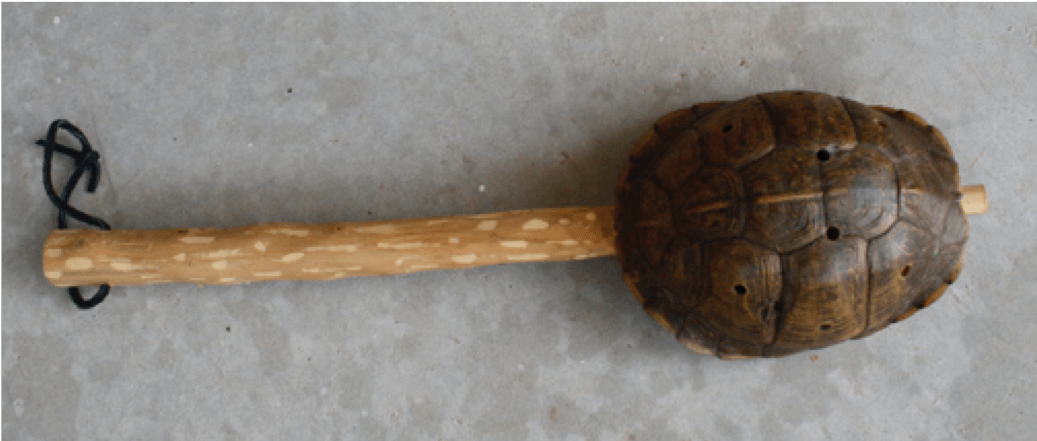
Turtle shell rattle made by Tommy Wildcat, 2009. Courtesy of Wikimedia Commons.

Drums are the oldest instruments on earth and the ones most important to Native Americans. Drums are thought to speak to the player: The vibrations help the player tune into the natural frequency of the earth and bring balance and renewal to the drummer. Numerous oral traditions refer to drumbeats as the earth’s heartbeat (the spirit of life) and rapid drumming can signal the manifestation of a spirit presence.

The drums are usually made using hollowed logs or wooden frames with animal skin stretched across the opening. Some small drums are hand held, single-sided drums on a frame; other small drums like water drums are created by stretching a moist, tanned hide over a wooden vessel or gourd filled with water. Extremely large drums are built so many men and women can play the instrument simultaneously when Indian nations come together to share songs and dances. The process of creating and playing a drum combines earth, air, water, and fire — all of the earth’s elements each with its own sound — resulting in an instrument that represents the circle of life. [6] Because of their significance, small Native American drums often become treasured family heirlooms: They stay with the family for generations and are played during family gatherings.

The Native American flute is believed to be the third oldest known musical instrument in the world. Created after drums and rattles, bone flutes date back over 60,000 years. Originally played for personal reasons like meditation and healing, one of its uses was for finding a mate. A common Dakota legend about the creation of the wood flute tells the story of a young man who wanted to attract the attention of a maiden:

“A very long time ago there was a young man who was very interested in a beautiful young girl. He was always trying to get her attention, but she never seemed to notice him. Whenever she was present he would ride his horse proudly, but nothing he did seemed to attract her. One day when the girls were down by the river getting water, the young man went down to the river and began diving off rocks and swimming across the river, to show her how skilled he was, but again she paid him no mind.

Dejected, the young man walked into the nearby old growth forest and sat down at the base of a long dead cedar tree. As he sat there thinking about this girl, a woodpecker landed on a hollowed limb that was over his head… the limb had been hollowed over time from the wind and weather. The woodpecker began to peck holes….tap, tap, tap……… along the length of this hollowed limb……..tap. tap, tap…….as the woodpecker pecked, the limb broke off and fell next to the young man…[and] as the wind blew over this hollow limb with the holes in it, he heard musical voices coming from it. He picked it up and found that when he blew into this limb and covered the holes, he could make beautiful, mournful music to match the feelings in his heart. He sat there for a time making up haunting melodies.

The young girl heard this music coming from the old growth forest, and it was such a soulful sound that it captured her heart. She followed the sound of music into the woods, where she saw him sitting there at the base of this cedar tree playing this first flute that was given to him by the woodpecker, and as she listened she fell in love with his music and fell in love with him. They went off hand in hand to live happily ever after.” [7]
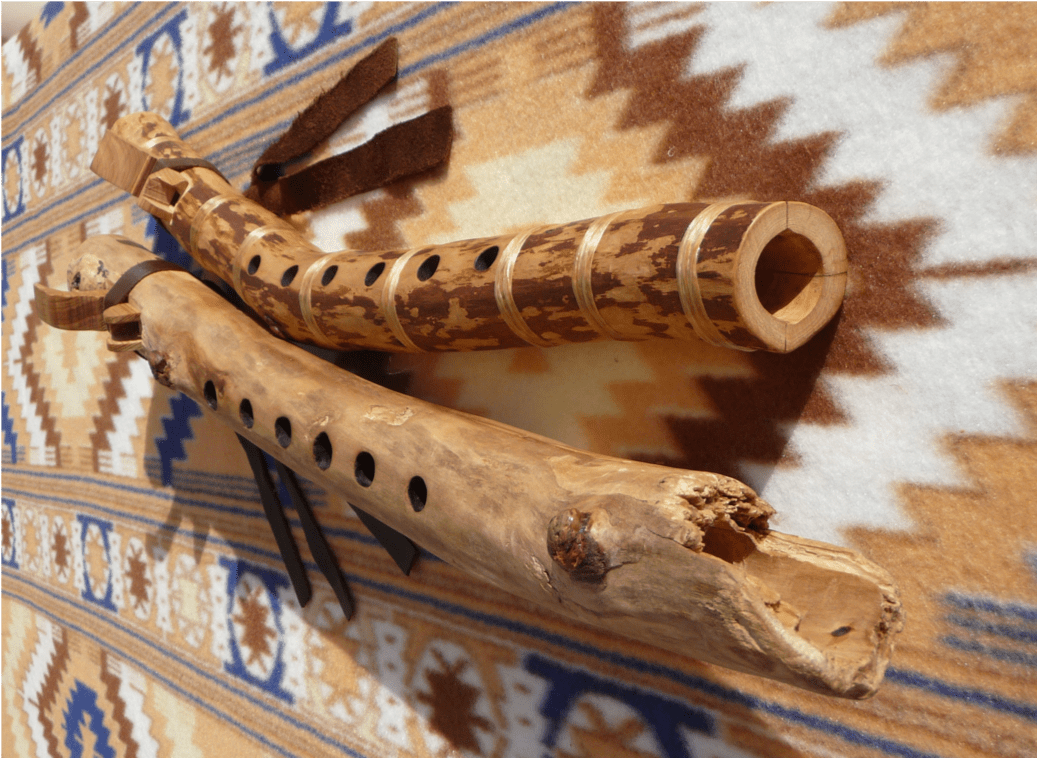
Two Native American flutes crafted from branches by Robert Willasch, 2010.

The story is also a cautionary tale: It says that once you find a mate, you should put the flute away and never play it in public again. If you do play it in public, you might attract another possible mate’s attention.

The indigenous flute is unique to Native Americans and has a distinctive sound that differs from the flutes we’re more familiar with. [8] Wood and bone flutes were utilized for  many purposes including entertainment (e.g., the Lakota Tribes used the flute for courting and love songs), dancing, healing, meditation, and spirit calling ceremonies (e.g., the Hopi Tribe had flute societies that performed prayer ceremonies). Some listeners today feel there is almost nothing more relaxing and meditative than authentic Native American flute music because it enables them to feel more connected to the natural and spiritual world around us. [9]

Other significant melodic and percussion instruments played by various tribes include the Apache fiddle made from the stalk of an agave plant, rattles created from gourds or bones like small horns filled with seeds or other objects, and turtle rattles made from the shell of a turtle filled with objects like cherry pits. [10] Along with the drum and flute, the rattle was one of the most meaningful, significant and valued instruments used by most tribes:
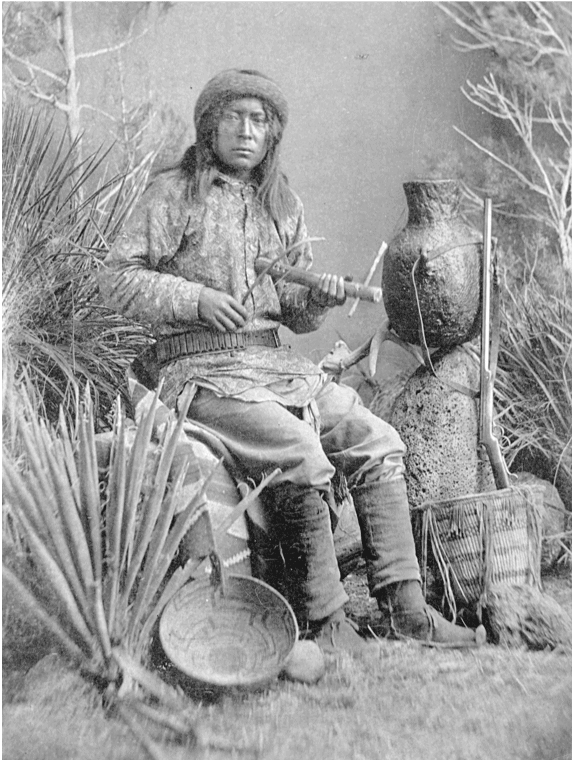
An Apache musician playing the “Apache fiddle,” 1886. Courtesy of Wikimedia Commons.

“When you see Native American rattles, you may not realize all that they symbolize. The rattle is an instrument of independence. It is a piece that utilizes what the Native Americans refer to as the three kingdoms or nations. The animal kingdom is represented by the container or feather decorations used on the rattle. The mineral kingdom is represented by rocks used for sound or the paint used for decoration. The plant kingdom is represented by the container (if a gourd is used) or the wooden handle of the rattle. The Native Americans realize that spiritual energy can be derived from the trance like state that can be induced by music. The rattle causes our bodies and minds both to respond to it. Some cultures believe that music can unblock energy within our bodies and thus heal us of ailments.  The beating of the rattle helps break up stagnant energy that is blocking the natural flow within your body. It can also help us focus on our souls, our cores. If you sit quietly alone or with friends and shake a Native American rattle, the music will help you clear your mind and open a doorway to a different emotional place.” [11]

Or at the very least, open your ears and help you explore a different style of music.
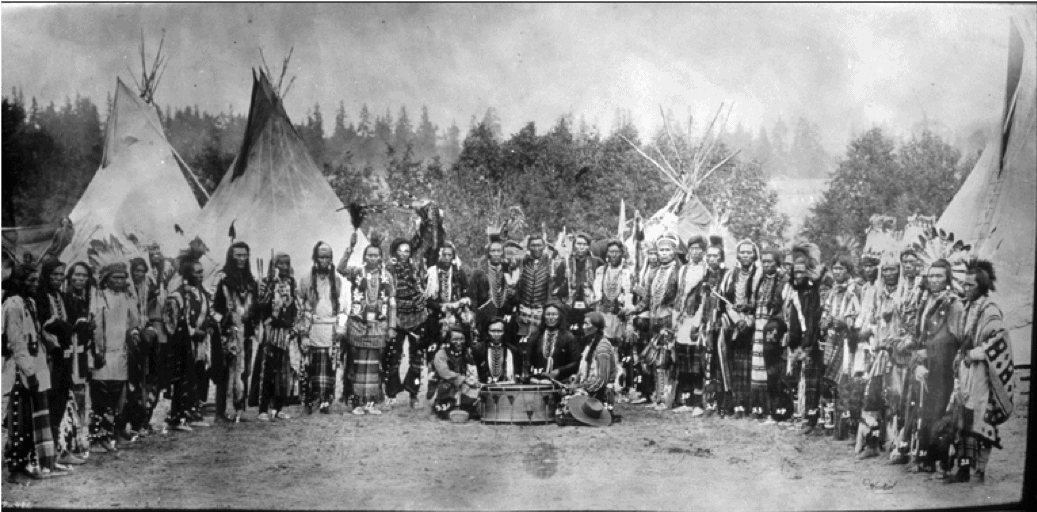
Salish Indians on July 4th Stand by Tepees Near St. Ignatius Mission, Flathead Reservation, Montana, 1903. Note men in the center playing the same large drum.

[1] “Arapaho,” in Indigenous Peoples’ Literature (Indians.org).

[2] The term “Indian” usually doesn’t include culturally and linguistically distinct groups like the Inuits (Eskimos). Inuits belong to the indigenous population of the Arctic and subarctic regions of Greenland, Canada, the United States and far eastern Russia (Siberia), and their history dates back thousands of years. These groups are nonetheless considered peoples of the Americas along with the Indians of North, Central and South America.

[3] Some Indians believe music comes to them in their dreams and is performed upon wakening.

[4] An attractive Navajo healing song for two voices in the newer style of harmonized chanting can be found at youtube.com/watch?v=3S2He2Ypvq4.

[5] Vocables are also used on their own as a musical style.

[6] “How to Play the Four Elements on Drums,” at youtube.com/watch?v=b6UOFw5jNy  is an informational video that demonstrates the sound of each element. Another informational video, this one explaining the significance of the drum, can be found at  youtube.com/watch?v=cXw4iHh71yc.

[7] Story as told by Phillip Lane (Phillip Brown Bear), a Lakota Elder, to flute maker Roger McGee  (wind-dancer-flutes.com).

[8] The Native American flute is unique because it has two air chambers: one located at the top, the other at the bottom with finger holes. Over time the instrument evolved and was carved using all types of hard and soft woods depending on what was available in the area and the sound the player wanted to produce.

[9] Try listening to “Heart is sad, The Morning Song” for flute at youtube.com/watch?v=h1pxzStAAwk. Stay tuned after that selection: It’s followed by a variety of chants and songs.

[10] “Native American Shamanic Meditation Drums for Healing Body, Mind and Soul” includes a rattle, drums and an accompanying explanation of Shamanism at  youtube.com/watch?v=XXsX7fNzJcE.

[11] “Native American Rattles” (Indians.org).


This article was originally published in Issue 115.

More from Issue 177

View All Articles in Issue 177

Search Copper Magazine

#232 What came first: Art or Music? A Conversation With Artist Jose Acosta by Joe Caplan Jul 06, 2026 #232 Blow By Blow: The Jeff Beck Story: An Insightful Book About a Guitar Icon by Ray Chelstowski Jul 06, 2026 #232 Creed Over Camaraderie? by B. Jan Montana Jul 06, 2026 #232 Chronicles of a Sound Pilgrim at the 2026 Montreal Audiofest by Hugues Morin Jul 06, 2026 #232 The Vinyl Beat: Summer Grooves by Rudy Radelic Jul 06, 2026 #232 Hibbing Hillbilly Dylan's Acoustic Rock by Wayne Robins Jul 06, 2026 #232 Quad Quads and Plasmatronics Tweeters: An Extraordinary System Comes to Life by Frank Doris Jul 06, 2026 #232 In Praise of Live Music, Once Again by Ted Shafran Jul 06, 2026 #232 Allnic Audio’s L-9000 Preamplifier: Design and Engineering Innovation by Howard Kneller Jul 06, 2026 #232 “Best Of” Lists and Rage Bait: Enough Already by Frank Doris Jul 06, 2026 #232 Quick Takes: Bud Shank, Paulo Almeida, Jakob Dreyer, Tim Eriksen and Peter Irvine by Frank Doris Jul 06, 2026 #232 My Impressions of AXPONA 2026, Part 2 by Frank Doris Jul 06, 2026 #232 How to Play in a Rock Band, 25: Encounters With Famous Musicians, Part Three by Frank Doris Jul 06, 2026 #232 Budgets, and Systems From Small to Outrageous by Paul McGowan Jul 06, 2026 #232 PS Audio in the News by PS Audio Staff Jul 06, 2026 #232 Hand It Over by Frank Doris Jul 06, 2026 #232 Difference of Opinion by Peter Xeni Jul 06, 2026 #232 Wabi-sabi Tree by James Schrimpf Jul 06, 2026 #231 Piano Prodigy Jude Kofie Releases His Debut Album On Octave Records by Frank Doris Jun 01, 2026 #231 Underappreciated Artists, Part Two: City Boy by Rich Isaacs Jun 01, 2026 #231 Music and the Art of Creation: Talking With Saxophonist Rob Scheps by Joe Caplan Jun 01, 2026 #231 How to Play in a Rock Band, 24: Further Adventures at the 2026 Montauk Music Festival by Frank Doris Jun 01, 2026 #231 Courtney Barnett: Creature of Habit by Wayne Robins Jun 01, 2026 #231 Angine de Poitrine: Interstellar Guitar Rock Saviors Headed for Late-Night TV Pop Stardom? by Mark Lepage Jun 01, 2026 #231 My Impressions of AXPONA 2026, Part One by Frank Doris Jun 01, 2026 #231 2026 La Jolla Concours d'Elegance: Another Aesthetic Feast by B. Jan Montana Jun 01, 2026 #231 Country Music Icon Jo Dee Messina’s Bridges: A New Beginning by Ray Chelstowski Jun 01, 2026 #231 The Luxury Dispatch Hosts a Video Podcast With Ken Kessler by Ken Kessler Jun 01, 2026 #231 The Vinyl Beat: Tracking in the Motor City by Rudy Radelic Jun 01, 2026 #231 Lots of Fun With DSP: The Ferrum Audio WANDLA DAC and Its Tube Mode by Frank Doris Jun 01, 2026 #231 From The Audiophile's Guide: Digital Source Components and Streaming Audio by Paul McGowan Jun 01, 2026 #231 Onkyo’s Monster M-510 power amplifier by The Staff at Just Audio Jun 01, 2026 #231 PS Audio in the News by PS Audio Staff Jun 01, 2026 #231 Naming Convention by Peter Xeni Jun 01, 2026 #231 Les Invisibles by Frank Doris Jun 01, 2026 #231 Wildlife Scene by James Schrimpf Jun 01, 2026 #230 Camaraderie by B. Jan Montana May 04, 2026 #230 AXPONA 2026: A Family Gathering by Paul McGowan May 04, 2026 #230 Pianist Ryan Benthall Explores Jazz Realms and Far Beyond With Divine Sky by Frank Doris May 04, 2026 #230 The Vinyl Beat in AXPONA-Land by Rudy Radelic May 04, 2026 #230 Teddy Thompson’s Musical Growth Deepens With Never Be the Same by Ray Chelstowski May 04, 2026 #230 More Fun in the Sun: Florida Audio Expo, Part Two by Frank Doris May 04, 2026 #230 CanJam NYC 2026 Show Report: Heady Sound, Part Two by Frank Doris and Harris Fogel May 04, 2026 #230 Sonic Youth On Murray Street by Wayne Robins May 04, 2026 #230 Graffeo Coffee: A Symphony of Sensory Experience by Joe Caplan May 04, 2026 #230 The Saul Authority: The Story of Hi-Fi Pioneer Saul Marantz by Olivier Meunier-Plante May 04, 2026 #230 How to Play in a Rock Band, 23: Encounters With Famous Musicians, Part Two by Frank Doris May 04, 2026

The Earth's Heartbeat: Native American Music, Redux

The Earth's Heartbeat: Native American Music, Redux

All plants are our brothers and sisters,
they talk to us and if we listen, we can hear them.
If we wonder often, the gift of knowledge will come.

Arapaho nation literature [1]

You’ve seen and heard it before: American Indians playing drums and other instruments while vocalizing in a language you don’t understand. At least that’s how Native American music has generally been depicted in films and on television. But unless you happen to have studied and already enjoy the music of indigenous tribes, there’s much to be discovered about this rarely explored area of music.

Indian culture is closely tied to nature, and music has always played a meaningful role in this relationship. Although the earliest examples of Indian music can be found in documents written by European explorers, researchers believe American Indian music dates back many centuries before those documents were written.[2]

There are hundreds of Native American tribes throughout the United States and every tribe has music that reflects its own traditions. Music performances tell stories about a tribe’s heritage, wars, triumphs and defeats, are essential for ceremonies and celebrations, and employed for specific purposes like asking for rain or a successful hunt. [3] From invoking spirits and speaking to the dead, from singing prayers and songs to curing the sick, traditional Indian music is an integral part of people’s daily lives and  includes some of the most haunting songs and instrumentals you’re likely to hear.

The most important instrument used in Indian culture is the human voice. Solos, duos and group singing are common but unlike most European music, early American Indian music generally doesn’t include vocal harmonies and can often sound “out of tune.” [4]  For example, when people sing together they may perform on pitch (blended unison) or without trying to sing exactly together (unblended unison). The Inuits use throat singing which produces a wailing sound by tightening and loosening the muscles in the throat, and may emphasize vibrato (a rapid, slight variation in pitch) as part of the aesthetic. When several tribes meet to share each others’ music, vocables (words that don’t have meanings) are often substituted for actual words so everyone can sing the songs performed by other tribes. [5] Adding unconventional rhythms and accompanying them with irregular drum beats results in music that can sound unusual and complex.

Even though vocal harmonies may not be present, Indians do create harmonies by merging instruments built from materials found in nature. The three most significant types of instruments used by almost all of the tribes are drums, flutes, and rattles.

Turtle shell rattle made by Tommy Wildcat, 2009. Courtesy of Wikimedia Commons.

Drums are the oldest instruments on earth and the ones most important to Native Americans. Drums are thought to speak to the player: The vibrations help the player tune into the natural frequency of the earth and bring balance and renewal to the drummer. Numerous oral traditions refer to drumbeats as the earth’s heartbeat (the spirit of life) and rapid drumming can signal the manifestation of a spirit presence.

The drums are usually made using hollowed logs or wooden frames with animal skin stretched across the opening. Some small drums are hand held, single-sided drums on a frame; other small drums like water drums are created by stretching a moist, tanned hide over a wooden vessel or gourd filled with water. Extremely large drums are built so many men and women can play the instrument simultaneously when Indian nations come together to share songs and dances. The process of creating and playing a drum combines earth, air, water, and fire — all of the earth’s elements each with its own sound — resulting in an instrument that represents the circle of life. [6] Because of their significance, small Native American drums often become treasured family heirlooms: They stay with the family for generations and are played during family gatherings.

The Native American flute is believed to be the third oldest known musical instrument in the world. Created after drums and rattles, bone flutes date back over 60,000 years. Originally played for personal reasons like meditation and healing, one of its uses was for finding a mate. A common Dakota legend about the creation of the wood flute tells the story of a young man who wanted to attract the attention of a maiden:

“A very long time ago there was a young man who was very interested in a beautiful young girl. He was always trying to get her attention, but she never seemed to notice him. Whenever she was present he would ride his horse proudly, but nothing he did seemed to attract her. One day when the girls were down by the river getting water, the young man went down to the river and began diving off rocks and swimming across the river, to show her how skilled he was, but again she paid him no mind.

Dejected, the young man walked into the nearby old growth forest and sat down at the base of a long dead cedar tree. As he sat there thinking about this girl, a woodpecker landed on a hollowed limb that was over his head… the limb had been hollowed over time from the wind and weather. The woodpecker began to peck holes….tap, tap, tap……… along the length of this hollowed limb……..tap. tap, tap…….as the woodpecker pecked, the limb broke off and fell next to the young man…[and] as the wind blew over this hollow limb with the holes in it, he heard musical voices coming from it. He picked it up and found that when he blew into this limb and covered the holes, he could make beautiful, mournful music to match the feelings in his heart. He sat there for a time making up haunting melodies.

The young girl heard this music coming from the old growth forest, and it was such a soulful sound that it captured her heart. She followed the sound of music into the woods, where she saw him sitting there at the base of this cedar tree playing this first flute that was given to him by the woodpecker, and as she listened she fell in love with his music and fell in love with him. They went off hand in hand to live happily ever after.” [7]

Two Native American flutes crafted from branches by Robert Willasch, 2010.

The story is also a cautionary tale: It says that once you find a mate, you should put the flute away and never play it in public again. If you do play it in public, you might attract another possible mate’s attention.

The indigenous flute is unique to Native Americans and has a distinctive sound that differs from the flutes we’re more familiar with. [8] Wood and bone flutes were utilized for  many purposes including entertainment (e.g., the Lakota Tribes used the flute for courting and love songs), dancing, healing, meditation, and spirit calling ceremonies (e.g., the Hopi Tribe had flute societies that performed prayer ceremonies). Some listeners today feel there is almost nothing more relaxing and meditative than authentic Native American flute music because it enables them to feel more connected to the natural and spiritual world around us. [9]

Other significant melodic and percussion instruments played by various tribes include the Apache fiddle made from the stalk of an agave plant, rattles created from gourds or bones like small horns filled with seeds or other objects, and turtle rattles made from the shell of a turtle filled with objects like cherry pits. [10] Along with the drum and flute, the rattle was one of the most meaningful, significant and valued instruments used by most tribes:

An Apache musician playing the “Apache fiddle,” 1886. Courtesy of Wikimedia Commons.

“When you see Native American rattles, you may not realize all that they symbolize. The rattle is an instrument of independence. It is a piece that utilizes what the Native Americans refer to as the three kingdoms or nations. The animal kingdom is represented by the container or feather decorations used on the rattle. The mineral kingdom is represented by rocks used for sound or the paint used for decoration. The plant kingdom is represented by the container (if a gourd is used) or the wooden handle of the rattle. The Native Americans realize that spiritual energy can be derived from the trance like state that can be induced by music. The rattle causes our bodies and minds both to respond to it. Some cultures believe that music can unblock energy within our bodies and thus heal us of ailments.  The beating of the rattle helps break up stagnant energy that is blocking the natural flow within your body. It can also help us focus on our souls, our cores. If you sit quietly alone or with friends and shake a Native American rattle, the music will help you clear your mind and open a doorway to a different emotional place.” [11]

Or at the very least, open your ears and help you explore a different style of music.

Salish Indians on July 4th Stand by Tepees Near St. Ignatius Mission, Flathead Reservation, Montana, 1903. Note men in the center playing the same large drum.

[1] “Arapaho,” in Indigenous Peoples’ Literature (Indians.org).

[2] The term “Indian” usually doesn’t include culturally and linguistically distinct groups like the Inuits (Eskimos). Inuits belong to the indigenous population of the Arctic and subarctic regions of Greenland, Canada, the United States and far eastern Russia (Siberia), and their history dates back thousands of years. These groups are nonetheless considered peoples of the Americas along with the Indians of North, Central and South America.

[3] Some Indians believe music comes to them in their dreams and is performed upon wakening.

[4] An attractive Navajo healing song for two voices in the newer style of harmonized chanting can be found at youtube.com/watch?v=3S2He2Ypvq4.

[5] Vocables are also used on their own as a musical style.

[6] “How to Play the Four Elements on Drums,” at youtube.com/watch?v=b6UOFw5jNy  is an informational video that demonstrates the sound of each element. Another informational video, this one explaining the significance of the drum, can be found at  youtube.com/watch?v=cXw4iHh71yc.

[7] Story as told by Phillip Lane (Phillip Brown Bear), a Lakota Elder, to flute maker Roger McGee  (wind-dancer-flutes.com).

[8] The Native American flute is unique because it has two air chambers: one located at the top, the other at the bottom with finger holes. Over time the instrument evolved and was carved using all types of hard and soft woods depending on what was available in the area and the sound the player wanted to produce.

[9] Try listening to “Heart is sad, The Morning Song” for flute at youtube.com/watch?v=h1pxzStAAwk. Stay tuned after that selection: It’s followed by a variety of chants and songs.

[10] “Native American Shamanic Meditation Drums for Healing Body, Mind and Soul” includes a rattle, drums and an accompanying explanation of Shamanism at  youtube.com/watch?v=XXsX7fNzJcE.

[11] “Native American Rattles” (Indians.org).


This article was originally published in Issue 115.

0 comments

Leave a comment

0 Comments

Your avatar

Loading comments...

🗑️ Delete Comment

Enter moderator password to delete this comment:

✏️ Edit Comment

Enter your email to verify ownership: