
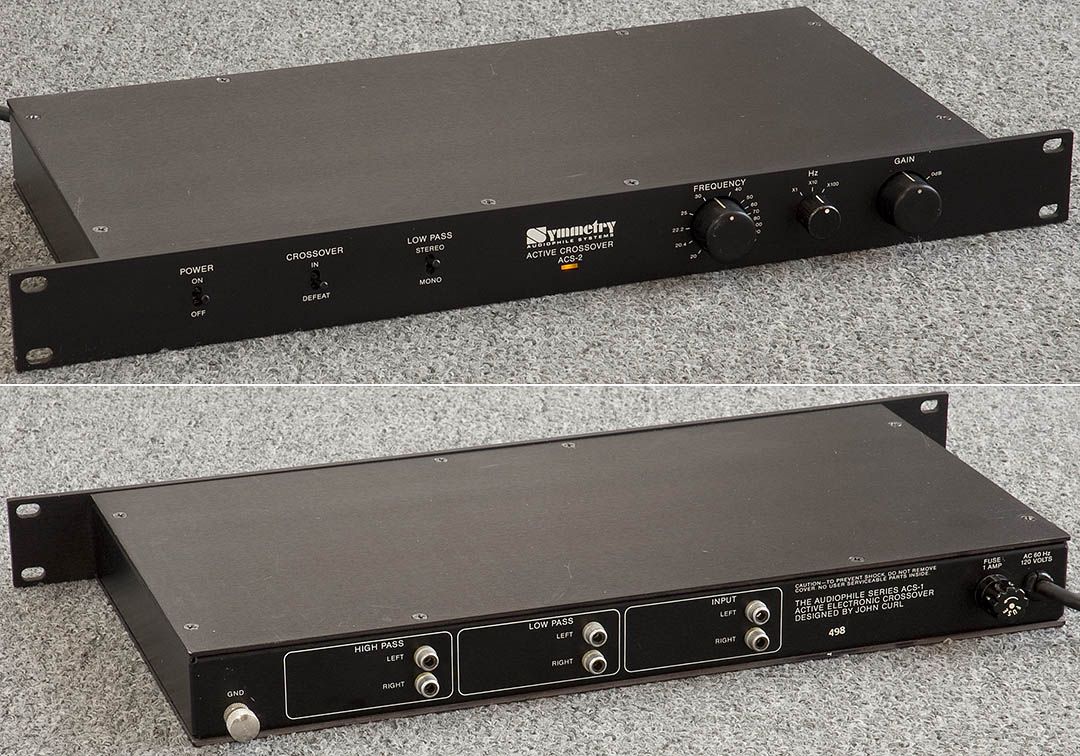
 What made this crossover unique was its ability to defeat the Humpty Dumpty effect. Put a signal in, recombine the output, and you get an exact replica. Symmetrical.
The circuitry to do this was clever enough.
In most crossovers, a separate high pass and low pass function is designed, each with (hopefully) the same characteristics. But, of course, that never really happens—each a little different if just from parts tolerances if nothing else.
What Curl did was make a derivative crossover. That means that one of the two functions (high pass or low pass) is derived from the output of the other.
In the case of the Symmetry, John designed a variable low pass filter (varied from a knob on the front panel). He then took the output of this filter (which hasn't any highs) and popped it into one input of a differential amplifier. To the other input, he placed the original musical signal. The output of this differential amplifier is the exact difference between what we started with (a full range musical signal) and the output of the low pass filter (all lows, no highs).
A perfect high pass filter.
Brilliant.
What made this crossover unique was its ability to defeat the Humpty Dumpty effect. Put a signal in, recombine the output, and you get an exact replica. Symmetrical.
The circuitry to do this was clever enough.
In most crossovers, a separate high pass and low pass function is designed, each with (hopefully) the same characteristics. But, of course, that never really happens—each a little different if just from parts tolerances if nothing else.
What Curl did was make a derivative crossover. That means that one of the two functions (high pass or low pass) is derived from the output of the other.
In the case of the Symmetry, John designed a variable low pass filter (varied from a knob on the front panel). He then took the output of this filter (which hasn't any highs) and popped it into one input of a differential amplifier. To the other input, he placed the original musical signal. The output of this differential amplifier is the exact difference between what we started with (a full range musical signal) and the output of the low pass filter (all lows, no highs).
A perfect high pass filter.
Brilliant.
The Humpty Dumpty Effect
Loudspeaker and electronic crossovers have one purpose: separate the frequencies of music into high and low ranges and deliver them to different places: drivers or amplifiers.
One of the problems with all crossovers, passive or active, might be what you call the Humpty Dumpty effect. It's easy to take frequencies apart, but hard to put them back together again.
Woofers use low pass filters specially designed to match a particular woofer. Tweeters use high pass filters tailored to the driver too. Since each driver is very different than the other, the types of filters rarely match. And even if they did, there's a still a problem.
When you use a filter to divide frequencies, rarely can you recombine the outputs of the two filters to get back a perfect replica of what you started with. And this is especially true if different filters are used for the different tasks.
Yet, the idea is that when we playback the music, we get as close to the original content as possible. Filters make that more difficult.
One of the coolest filter designs I know of was introduced by designer John Curl, many years ago. John built what's known as a derivative crossover, put it in a nice box, and called it The Symmetry Crossover. To this day, people still covet this ancient device.
What made this crossover unique was its ability to defeat the Humpty Dumpty effect. Put a signal in, recombine the output, and you get an exact replica. Symmetrical.
The circuitry to do this was clever enough.
In most crossovers, a separate high pass and low pass function is designed, each with (hopefully) the same characteristics. But, of course, that never really happens—each a little different if just from parts tolerances if nothing else.
What Curl did was make a derivative crossover. That means that one of the two functions (high pass or low pass) is derived from the output of the other.
In the case of the Symmetry, John designed a variable low pass filter (varied from a knob on the front panel). He then took the output of this filter (which hasn't any highs) and popped it into one input of a differential amplifier. To the other input, he placed the original musical signal. The output of this differential amplifier is the exact difference between what we started with (a full range musical signal) and the output of the low pass filter (all lows, no highs).
A perfect high pass filter.
Brilliant.
What made this crossover unique was its ability to defeat the Humpty Dumpty effect. Put a signal in, recombine the output, and you get an exact replica. Symmetrical.
The circuitry to do this was clever enough.
In most crossovers, a separate high pass and low pass function is designed, each with (hopefully) the same characteristics. But, of course, that never really happens—each a little different if just from parts tolerances if nothing else.
What Curl did was make a derivative crossover. That means that one of the two functions (high pass or low pass) is derived from the output of the other.
In the case of the Symmetry, John designed a variable low pass filter (varied from a knob on the front panel). He then took the output of this filter (which hasn't any highs) and popped it into one input of a differential amplifier. To the other input, he placed the original musical signal. The output of this differential amplifier is the exact difference between what we started with (a full range musical signal) and the output of the low pass filter (all lows, no highs).
A perfect high pass filter.
Brilliant.

0 comments