COPPER

A PS Audio Publication

Issue 135 • Free Online Magazine

Issue 135 FEATURED

The Yamaha Influence, Part Two

The Yamaha Influence, Part Two

In Part One (Issue 134), we looked at Yamaha as being both a musical instrument maker and a manufacturer of audio components, and how each of those sides of the company influenced the other.

In this second installment, we further examine the company’s take on the production and reproduction of musical tone, and suggestions on how to get the best from their approach to high quality sound. I interviewed members of Yamaha UK’s Technical team and Customer Support sage Richard Billings.

Russ Welton: What is the best advice you can give to your customers for setting up their room when running the Yamaha Parametric room Acoustic Optimizer YPAO automatic room correction system, especially in a multichannel home theatre setup? (YPAO compensates for in-room frequency response irregularities to give listeners a smoother, more accurate frequency response from their systems.)

Yamaha Technical: The trick is what you do before running YPAO. The first thing to check is the phase of the subwoofer(s). [You want to do this] manually, [by listening]. Usually [you will set them to either] 0 or 180 degrees [out of phase]. You want to run [the system in] stereo with the sub on while listening to some music with good bass content and that you know well. You need to identify which setting sounds louder. This can be done even if you are right next to the sub, flicking the switch from 0 to 180.

Next step is [adjusting] the subwoofer’s volume. Although setting your subwoofer’s volume to halfway (as suggested by many) is normally OK, there’s a chance it’s not. If after running an [initial] measurement of YPAO you see -10db or +10db on the sub’s volume, reduce or increase the main volume on the back of your sub and start again. You want YPAO to be in full control of the volume, so seeing -7db or +8db is good, and tells you that YPAO is still in control.
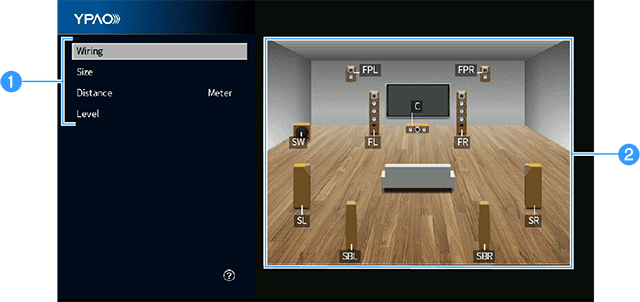

Setup screen from the Yamaha Parametric room Acoustic Optimizer (YPAO) system. Setup screen from the Yamaha Parametric room Acoustic Optimizer (YPAO) system.

The next bit of advice can make that last 5 percent of difference, and transform a great system into an excellent one, [whether you have YPAO or not – Ed.]. Trust your ears. Asking too much from any room correction [system] is ill-advised. My approach is to set up your speakers the best you can before [implementing] room correction, with a view to removing any dips in frequency response, Ultimately, you want to ensure each pair of speakers in your setup is pressuring the room to the best of their ability. That leaves YPAO mainly [for the task of] turning down or supressing [the] volumes of [certain] frequencies, not trying to add sounds that aren’t there in the first place!

I use a method very loosely based on the Master Set procedure created by John Hunter, owner of REL Acoustics. It has three main steps. One, clearing the dead zone – your speakers will sound flat if they are too close to a rear wall. Two, finding increased bass, by moving one speaker at a time out towards the side walls. Three, locking in the center image: vocals should sound like they are coming from somebody’s mouth and while standing up at a mic. Toeing in and adjusting the rake (vertical) angle of your speakers can achieve this.

A similar procedure can be done with your subwoofer. Step one, move the sub out from the corner of your room – there will be a point where you’ll feel and hear more focused energy and volume from the sub. Step two, [adjust the angle of] your sub so it fires across [the room] to the longest opposite corner. This helps the subwoofer frequencies build momentum and “breathe” within the room. You want the low stuff!

After you have run the YPAO, check the “speaker size” setting [to make sure your main speakers will optimally integrate with your subwoofer(s)]. In most cases what we run at home would be classed as “small,” meaning the speakers cannot reproduce frequencies down to 20 Hz. The crossover frequency is likely to be 80 Hz for most systems, which will produce a good amount of “slam.” Use this as a guide if you want to experiment. I found that my speakers, with bass response rated down to 38 Hz in ideal conditions, had more detail in the upper bass frequencies if I ran [the crossover at 60 Hz.


TT-S303 turntable and system. TT-S303 turntable and system.

After this I like to check each pair of speakers in the system. [First, I’ll] only connect the left and right front channels, and check [to make sure I have a good] centered image and adjust level and distance if required. Then repeat this using only the left and right rear (surround) channels. Finally, connect just the left and right front presence (height) speakers (if you have a Dolby Atmos setup), and then play all the speakers [in the system]. It should sound like the music is in your head with no emphasis on any one pair of speakers; it should all blend together. Everything will simply gel and work together as one.

Finally, you can select your preferred YPAO EQ setting, to Flat (consistent volume across all frequencies), Natural (softer treble, which some may prefer if you have hard furnishings) or Front (which timbre-matches all the speakers to follow the non EQ’d front channels).

Richard Billings: Small rooms are quite lively and can produce some problematic frequency areas. By taking multi-point sampling frequency sweeps of the room, this helps to give a fuller impression of what is happening in that space, so that the processor can deal with, for example, issues at 400 Hz, 800Hz and 1,600Hz. The YPAO system works by measuring volume levels, and your speakers have a nominal volume. With that appropriate acoustic information, the system can be played [at different volumes] using adaptive EQ [and sound optimal at any volume,] because the EQ is based on the volume level. The system can be optionally run for late-night low-volume listening, for example.


CX-A5200 Aventage 11.2 A/V preamplifier with MusicCast wireless technology. CX-A5200 Aventage 11.2 A/V preamplifier with MusicCast wireless technology.

RW: What are some examples of how a customer can get the most out of their surround system by using the technology in you’re A/V equipment? For example, how to adjust room size and speaker delay settings appropriately, or “stacking” DSP functions by using more than one at a time.

YT: DSP programs have gotten so much easier now. With the introduction of our Surround:AI, which is found on the Aventage RX-A1080, RX-A2080, RX-A3080 and CX-A5200 receivers, you don’t need to adjust anything. Surround:AI will intelligently select the most appropriate Cinema DSP mode on the fly, as you listen or watch your favorite films or concerts. By reading the incoming metadata of a Blu-ray disc or 5.1 audio stream, it can dynamically change to extract the very best [surround sound performance for any genre] without any negative [effects]. Our engineers have been busy analysing hundreds of different materials to tune and teach Surround:AI to behave. The result is DSP like you’ve never heard it before, and an evolution of the technology.

RW: You make some of your own internal components, such as loudspeaker drivers. What are some examples, and are these made exclusively for Yamaha products?

YT: Yes, we do. All of the ZYLON (synthetic fiber) driver units found within the NS-5000 and NS-3000 loudspeakers are made exclusively by us for us.


Manufacturing an NS-3000 diaphragm. Manufacturing an NS-3000 diaphragm.

RW: You support the use of wireless rear speakers for Dolby Atmos and DTS:X. Also, tell us about MusicCast, your wireless technology for stereo, surround and multiroom audio.

YT: All of our current MusicCast audio/video receivers now support MusicCast Surround; this enables our MusicCast 20 or MusicCast 50 streaming speakers to be used as wireless rears and our MusicCast SUB 100 to be used as a wireless subwoofer. Our customers can create up to 5.1.2 Dolby Atmos systems and only need to wire the front speakers to the amp. With the introduction of our modular upward-firing Atmos (height-channel) speakers, which can sit on top of existing floorstanding speakers, creating a high-quality 5.1.2 system is now even easier.

RW: What are the newest developments audiophiles should be excited about from Yamaha?

YT: As discussed, DSP has become much more advanced with the introduction of Surround:AI and [it has been] accepted more widely by our customers. Our audio components lineup (GT-5000, C-5000, M-5000, NS-5000, A-S3200, A-S2200, A-S1200 and NS-3000) is the best we’ve seen in many years. [The] investment in R&D [we made] when developing our 5000 Series will continue to appear in future products, which are still under wraps! Our A/V lineup also continues to benefit from [the R&D we put into] our CX-A5200 and MX-A5200; again, we will have more to share on this in the coming months.

Hi-fi and A/V are both changing and advancing more than we’ve seen in over 10 years – it’s an exciting time to say the least.

RB: There have been great strides made in the improvement of wireless technology, which is particularly useful for rear speakers. Previously they had [to work with] quite a compressed signal, but now [our wireless is] equipped with Master Audio DTS:X support and support for Dolby Atmos. It’s also scalable according to the height of your speakers, for an immersive 3-D sound. Live [performances] really showcase this well when sounds are coming from different places on stage. It’s like the equivalent jump of the Beatles going from mono to stereo, or quadraphonic to 3-D sound.

[We are adapting to the times and providing for the way people now like to listen to streamed music, to make that sound as good as it possibly can. Our Compressed Music Enhancer function, [included in A/V receivers], decompresses the losses in MP3 files that result from having been made into a small file. It’s reverse-engineering the [data] compression and adding that information back in, [and can be turned on or off at the user’s discretion when listening to streaming audio or compressed music files]. Bass and treble dynamics are lost when compressed, but we can restore it.


A-S3200 integrated amplifier. A-S3200 integrated amplifier.

RW: When a firmware update improves the sound, what is this a result of?

YT: Firmware updates will mostly fix bugs in software. In the event that we release firmware to improve sound, this will be as a result of further tuning of EQ and DSP parameters, which can be done digitally and does not require any hardware changes.

RB: Yamaha makes something like seven new A/V [receiver models] per year, which covers most people’s wants and needs. The large range of our products helps customers [accommodate] a vast array of sound reproduction solutions. We can continue to support your product [as the result of] trickle-down technology and with new firmware updates until the hardware has reached its limitations.

RW: What else is of importance to Yamaha as a company?

RB: The importance of great support. Buying a product in the knowledge that there is after-sales support gives peace of mind for our customer should things go wrong. We don’t want to give our customers any reason not to be happy, because the products are good. Also, a good-quality retailer will help and support you.

The best judge is your ears. No one can trick you here.


Header image of Yamaha Aventage RX-A2A Dolby Atmos receiver and components, and all images courtesy of Yamaha.


More from Issue 135

View All Articles in Issue 135

Search Copper Magazine

#225 Capital Audiofest 2025: Must-See Stereo, Part One by Frank Doris Dec 01, 2025 #225 Otis Taylor and the Electrics Delivers a Powerful Set of Hypnotic Modern Blues by Frank Doris Dec 01, 2025 #225 A Christmas Miracle by B. Jan Montana Dec 01, 2025 #225 T.H.E. Show New York 2025, Part Two: Plenty to See, Hear, and Enjoy by Frank Doris Dec 01, 2025 #225 Underappreciated Artists, Part One: Martin Briley by Rich Isaacs Dec 01, 2025 #225 Rock and Roll is Here to Stay by Wayne Robins Dec 01, 2025 #225 A Lifetime of Holiday Record (and CD) Listening by Rudy Radelic Dec 01, 2025 #225 Little Feat: Not Saying Goodbye, Not Yet by Ray Chelstowski Dec 01, 2025 #225 How to Play in a Rock Band, Part 18: Dealing With Burnout by Frank Doris Dec 01, 2025 #225 The People Who Make Audio Happen: CanJam SoCal 2025 by Harris Fogel Dec 01, 2025 #225 Chicago’s Sonic Sanctuaries: Four Hi‑Fi Listening Bars Channeling the Jazz‑Kissa Spirit by Olivier Meunier-Plante Dec 01, 2025 #225 From The Audiophile’s Guide: Controlling Bass Frequencies Through Membrane Absorbers (and How to Build Your Own) by Paul McGowan Dec 01, 2025 #225 Your Editor’s Tips for Attending Audio Shows by Frank Doris Dec 01, 2025 #225 PS Audio in the News by Frank Doris Dec 01, 2025 #225 Back to My Reel-to-Reel Roots, Part 24 by Ken Kessler Dec 01, 2025 #225 Holiday Music by Frank Doris Dec 01, 2025 #225 Puppy Prognostication by Peter Xeni Dec 01, 2025 #225 How to Post Comments on Copper by Frank Doris Dec 01, 2025 #225 Living Color by Rudy Radelic Dec 01, 2025 #224 T.H.E. Show New York 2025, Part One: A New Beginning by Frank Doris Nov 03, 2025 #224 Fool’s Leap of Faith is the Extraordinary Octave Records Debut from Singer/Songwriter Tyler Burba and Visit by Frank Doris Nov 03, 2025 #224 The Beatles’ “Aeolian Cadences.” What? by Wayne Robins Nov 03, 2025 #224 Persona Non Grata by B. Jan Montana Nov 03, 2025 #224 Talking With Recording Engineer Barry Diament of Soundkeeper Recordings, Part Two by Frank Doris Nov 03, 2025 #224 B Sides, B Movies, and Beware of Zombies by Rudy Radelic Nov 03, 2025 #224 The Burn-In Chronicles: 1,000 Hours to Sonic Salvation by Olivier Meunier-Plante Nov 03, 2025 #224 A Conversation With Mat Weisfeld of VPI Industries by Joe Caplan Nov 03, 2025 #224 Blues-Rocker Kenny Wayne Shepherd Celebrates 30 Years of Ledbetter Heights by Ray Chelstowski Nov 03, 2025 #224 Playing in a Rock Band, 17: When Good Gigs Go Bad, Part Two by Frank Doris Nov 03, 2025 #224 From The Audiophile’s Guide: Dealing with Odd-Shaped Rooms by Paul McGowan Nov 03, 2025 #224 TEAC’s TN-3B-SE Turntable Plays Bob Dylan by Howard Kneller Nov 03, 2025 #224 PS Audio in the News by Frank Doris Nov 03, 2025 #224 Lost in Translation by Peter Xeni Nov 03, 2025 #224 Reel-to-Reel Roots, Part 23: Better Than Rice Krispies by Ken Kessler Nov 03, 2025 #224 I Bring Joy! by Frank Doris Nov 03, 2025 #224 Screen Test by Rich Isaacs Nov 03, 2025 #224 How to Post Comments on Copper by Frank Doris Nov 03, 2025 #132 Dr. Patrick Gleeson: The Interview, Part Two by Rich Isaacs Oct 07, 2025 #223 World Fusion Meets Flamenco in Gratitude from Steve Mullins and Rim of the Well by Frank Doris Oct 06, 2025 #223 Judging Albums by Their Covers by Rich Isaacs Oct 06, 2025 #223 Recent Arrivals and 12-inch Royalty by Rudy Radelic Oct 06, 2025 #223 Summer of Creem, Part Two by Wayne Robins Oct 06, 2025 #223 Recording Engineer Barry Diament of Soundkeeper Recordings: Striving for Natural Sound by Frank Doris Oct 06, 2025 #223 Tea on the Terrace by B. Jan Montana Oct 06, 2025 #223 How Good Can Car Audio Get? by Joe Caplan Oct 06, 2025 #223 The Advantages of a Dedicated Listening Room by Paul McGowan Oct 06, 2025 #223 1! 2! 3! 4! Surrounded by the Ramones in Dolby Atmos! by Frank Doris Oct 06, 2025

The Yamaha Influence, Part Two

The Yamaha Influence, Part Two

In Part One (Issue 134), we looked at Yamaha as being both a musical instrument maker and a manufacturer of audio components, and how each of those sides of the company influenced the other.

In this second installment, we further examine the company’s take on the production and reproduction of musical tone, and suggestions on how to get the best from their approach to high quality sound. I interviewed members of Yamaha UK’s Technical team and Customer Support sage Richard Billings.

Russ Welton: What is the best advice you can give to your customers for setting up their room when running the Yamaha Parametric room Acoustic Optimizer YPAO automatic room correction system, especially in a multichannel home theatre setup? (YPAO compensates for in-room frequency response irregularities to give listeners a smoother, more accurate frequency response from their systems.)

Yamaha Technical: The trick is what you do before running YPAO. The first thing to check is the phase of the subwoofer(s). [You want to do this] manually, [by listening]. Usually [you will set them to either] 0 or 180 degrees [out of phase]. You want to run [the system in] stereo with the sub on while listening to some music with good bass content and that you know well. You need to identify which setting sounds louder. This can be done even if you are right next to the sub, flicking the switch from 0 to 180.

Next step is [adjusting] the subwoofer’s volume. Although setting your subwoofer’s volume to halfway (as suggested by many) is normally OK, there’s a chance it’s not. If after running an [initial] measurement of YPAO you see -10db or +10db on the sub’s volume, reduce or increase the main volume on the back of your sub and start again. You want YPAO to be in full control of the volume, so seeing -7db or +8db is good, and tells you that YPAO is still in control.


Setup screen from the Yamaha Parametric room Acoustic Optimizer (YPAO) system. Setup screen from the Yamaha Parametric room Acoustic Optimizer (YPAO) system.

The next bit of advice can make that last 5 percent of difference, and transform a great system into an excellent one, [whether you have YPAO or not – Ed.]. Trust your ears. Asking too much from any room correction [system] is ill-advised. My approach is to set up your speakers the best you can before [implementing] room correction, with a view to removing any dips in frequency response, Ultimately, you want to ensure each pair of speakers in your setup is pressuring the room to the best of their ability. That leaves YPAO mainly [for the task of] turning down or supressing [the] volumes of [certain] frequencies, not trying to add sounds that aren’t there in the first place!

I use a method very loosely based on the Master Set procedure created by John Hunter, owner of REL Acoustics. It has three main steps. One, clearing the dead zone – your speakers will sound flat if they are too close to a rear wall. Two, finding increased bass, by moving one speaker at a time out towards the side walls. Three, locking in the center image: vocals should sound like they are coming from somebody’s mouth and while standing up at a mic. Toeing in and adjusting the rake (vertical) angle of your speakers can achieve this.

A similar procedure can be done with your subwoofer. Step one, move the sub out from the corner of your room – there will be a point where you’ll feel and hear more focused energy and volume from the sub. Step two, [adjust the angle of] your sub so it fires across [the room] to the longest opposite corner. This helps the subwoofer frequencies build momentum and “breathe” within the room. You want the low stuff!

After you have run the YPAO, check the “speaker size” setting [to make sure your main speakers will optimally integrate with your subwoofer(s)]. In most cases what we run at home would be classed as “small,” meaning the speakers cannot reproduce frequencies down to 20 Hz. The crossover frequency is likely to be 80 Hz for most systems, which will produce a good amount of “slam.” Use this as a guide if you want to experiment. I found that my speakers, with bass response rated down to 38 Hz in ideal conditions, had more detail in the upper bass frequencies if I ran [the crossover at 60 Hz.


TT-S303 turntable and system. TT-S303 turntable and system.

After this I like to check each pair of speakers in the system. [First, I’ll] only connect the left and right front channels, and check [to make sure I have a good] centered image and adjust level and distance if required. Then repeat this using only the left and right rear (surround) channels. Finally, connect just the left and right front presence (height) speakers (if you have a Dolby Atmos setup), and then play all the speakers [in the system]. It should sound like the music is in your head with no emphasis on any one pair of speakers; it should all blend together. Everything will simply gel and work together as one.

Finally, you can select your preferred YPAO EQ setting, to Flat (consistent volume across all frequencies), Natural (softer treble, which some may prefer if you have hard furnishings) or Front (which timbre-matches all the speakers to follow the non EQ’d front channels).

Richard Billings: Small rooms are quite lively and can produce some problematic frequency areas. By taking multi-point sampling frequency sweeps of the room, this helps to give a fuller impression of what is happening in that space, so that the processor can deal with, for example, issues at 400 Hz, 800Hz and 1,600Hz. The YPAO system works by measuring volume levels, and your speakers have a nominal volume. With that appropriate acoustic information, the system can be played [at different volumes] using adaptive EQ [and sound optimal at any volume,] because the EQ is based on the volume level. The system can be optionally run for late-night low-volume listening, for example.


CX-A5200 Aventage 11.2 A/V preamplifier with MusicCast wireless technology. CX-A5200 Aventage 11.2 A/V preamplifier with MusicCast wireless technology.

RW: What are some examples of how a customer can get the most out of their surround system by using the technology in you’re A/V equipment? For example, how to adjust room size and speaker delay settings appropriately, or “stacking” DSP functions by using more than one at a time.

YT: DSP programs have gotten so much easier now. With the introduction of our Surround:AI, which is found on the Aventage RX-A1080, RX-A2080, RX-A3080 and CX-A5200 receivers, you don’t need to adjust anything. Surround:AI will intelligently select the most appropriate Cinema DSP mode on the fly, as you listen or watch your favorite films or concerts. By reading the incoming metadata of a Blu-ray disc or 5.1 audio stream, it can dynamically change to extract the very best [surround sound performance for any genre] without any negative [effects]. Our engineers have been busy analysing hundreds of different materials to tune and teach Surround:AI to behave. The result is DSP like you’ve never heard it before, and an evolution of the technology.

RW: You make some of your own internal components, such as loudspeaker drivers. What are some examples, and are these made exclusively for Yamaha products?

YT: Yes, we do. All of the ZYLON (synthetic fiber) driver units found within the NS-5000 and NS-3000 loudspeakers are made exclusively by us for us.


Manufacturing an NS-3000 diaphragm. Manufacturing an NS-3000 diaphragm.

RW: You support the use of wireless rear speakers for Dolby Atmos and DTS:X. Also, tell us about MusicCast, your wireless technology for stereo, surround and multiroom audio.

YT: All of our current MusicCast audio/video receivers now support MusicCast Surround; this enables our MusicCast 20 or MusicCast 50 streaming speakers to be used as wireless rears and our MusicCast SUB 100 to be used as a wireless subwoofer. Our customers can create up to 5.1.2 Dolby Atmos systems and only need to wire the front speakers to the amp. With the introduction of our modular upward-firing Atmos (height-channel) speakers, which can sit on top of existing floorstanding speakers, creating a high-quality 5.1.2 system is now even easier.

RW: What are the newest developments audiophiles should be excited about from Yamaha?

YT: As discussed, DSP has become much more advanced with the introduction of Surround:AI and [it has been] accepted more widely by our customers. Our audio components lineup (GT-5000, C-5000, M-5000, NS-5000, A-S3200, A-S2200, A-S1200 and NS-3000) is the best we’ve seen in many years. [The] investment in R&D [we made] when developing our 5000 Series will continue to appear in future products, which are still under wraps! Our A/V lineup also continues to benefit from [the R&D we put into] our CX-A5200 and MX-A5200; again, we will have more to share on this in the coming months.

Hi-fi and A/V are both changing and advancing more than we’ve seen in over 10 years – it’s an exciting time to say the least.

RB: There have been great strides made in the improvement of wireless technology, which is particularly useful for rear speakers. Previously they had [to work with] quite a compressed signal, but now [our wireless is] equipped with Master Audio DTS:X support and support for Dolby Atmos. It’s also scalable according to the height of your speakers, for an immersive 3-D sound. Live [performances] really showcase this well when sounds are coming from different places on stage. It’s like the equivalent jump of the Beatles going from mono to stereo, or quadraphonic to 3-D sound.

[We are adapting to the times and providing for the way people now like to listen to streamed music, to make that sound as good as it possibly can. Our Compressed Music Enhancer function, [included in A/V receivers], decompresses the losses in MP3 files that result from having been made into a small file. It’s reverse-engineering the [data] compression and adding that information back in, [and can be turned on or off at the user’s discretion when listening to streaming audio or compressed music files]. Bass and treble dynamics are lost when compressed, but we can restore it.


A-S3200 integrated amplifier. A-S3200 integrated amplifier.

RW: When a firmware update improves the sound, what is this a result of?

YT: Firmware updates will mostly fix bugs in software. In the event that we release firmware to improve sound, this will be as a result of further tuning of EQ and DSP parameters, which can be done digitally and does not require any hardware changes.

RB: Yamaha makes something like seven new A/V [receiver models] per year, which covers most people’s wants and needs. The large range of our products helps customers [accommodate] a vast array of sound reproduction solutions. We can continue to support your product [as the result of] trickle-down technology and with new firmware updates until the hardware has reached its limitations.

RW: What else is of importance to Yamaha as a company?

RB: The importance of great support. Buying a product in the knowledge that there is after-sales support gives peace of mind for our customer should things go wrong. We don’t want to give our customers any reason not to be happy, because the products are good. Also, a good-quality retailer will help and support you.

The best judge is your ears. No one can trick you here.


Header image of Yamaha Aventage RX-A2A Dolby Atmos receiver and components, and all images courtesy of Yamaha.


0 comments

Leave a comment

0 Comments

Your avatar

Loading comments...

🗑️ Delete Comment

Enter moderator password to delete this comment: