COPPER

A PS Audio Publication

Issue 167 • Free Online Magazine

Issue 167 Featured

Reconsider Baby: Elvis, the Movie

Reconsider Baby: Elvis, the Movie

Among other things, Elvis Presley invented the rock ’n’ roll comeback. Up until 1968, ”coming back” from a career break barely existed in the new style since most fell short, or failed. Carl Perkins’s 1956 car crash just before his first appearance on The Ed Sullivan Show interrupted his “Blue Suede Shoes” momentum at a crucial moment. When it leaked on his 1958 UK tour that his wife was only 13, Jerry Lee Lewis sought redemption by appealing to the only audience that might forgive him: country and western, and country-gospel. With many others (Chuck Berry, Little Richard, Gene Vincent), fate delivered a cold, hard slap.

Elvis bombed during his first Vegas stint in 1956 just as he tried to break nationwide, and when called him up for peacetime Army service in 1958, he feared losing most of his listeners. His 1960 Welcome Home Elvis TV appearance with Frank Sinatra sent his career into ultra-safe mode. John Lennon liked to say Elvis “died when he went into the Army.” Presley had so much ambition that comebacks turned into a defining feature of his career. His talent, and what it signaled, foretold of such flamboyance and shock that the world needed time to keep readjusting. It’s still adjusting.

Now, the biggest Elvis comeback of all, Baz Luhrmann’s feature biopic, places all these others in a new context. Given its many flaws, and overbearing length, that’s impressive. History’s distortions can prove pitiless; pillars of the style have long since faded, or morphed into caricatures. Bloated biopics for Ray Charles and James Brown fell away almost instantly. And rock continues to manufacture irony: the idea of the Young Mick Jagger now gets trotted out and explained. Partly because Presley’s daughter, Lisa Marie, and former wife, Priscilla, have not captured attention since Marie’s divorce from Michael Jackson in 1996, and major film references to the King have dropped off after Michael Madsen’s soft-core cameo as an apparition in Thelma and Louise in 1991, and a brief sequence in Forrest Gump (1994), the Presley persona hasn’t carried over into digital as much as some others.
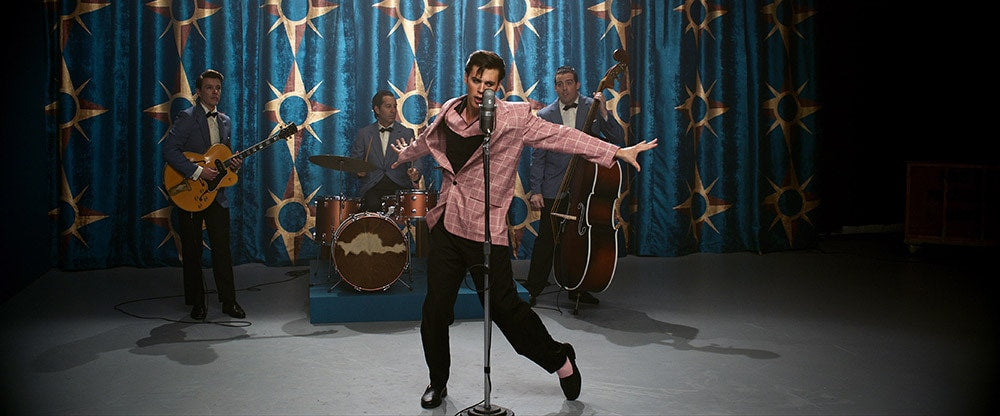
 

Austin Butler as Elvis in Warner Bros. Pictures’ Elvis. Courtesy of Warner Bros. Pictures.

Austin Butler as Elvis in Warner Bros. Pictures’ Elvis. Courtesy of Warner Bros. Pictures.


So it’s important to understand: Presley once dominated a stage far bigger than a thousand Beyoncés or Harry Potters. It’s a measure of Luhrmann’s imagination that he senses just how much Elvis warrants another return, and has plenty of arresting ideas. Maybe one too many. Elvis broke the summer movie season open big, holding its own as a hit alongside Tom Cruise’s Top Gun sequel as a major blockbuster, and that contrast proves useful.


Luhrmann also makes the connection between Cruise’s All-American Action Hero and King Elvis, and the contrast effect helps Presley loom even larger. Elvis once acted like a Superman of Song, someone with the supernatural sweep and daring of a Marvel figure exploding into your imagination, a figure so wild-eyed and all-knowing he seemed to spring directly from cartoons. It was this “other” aspect that created a fascinating tension between Elvis, the surviving twin from Memphis, and the King, who straddled our inner galaxy. You can still feel the Elvis influence everywhere, in the way Lady Gaga careens through styles like a trickster, or how Madonna’s grizzled eminence sidesteps her many Hollywood flops. Presley’s volcanic heat lives on his recordings, but his signal has dimmed, perhaps because his range was so vast, his omnipresence so out of reach.

The very idea that Elvis could fall off America’s radar seems profane. And yet today Elvis needs reintroduction when some assume the most deflating things about him – that he “stole” black music, shot out TVs in drug rants, that his cartoon shadow stood for nothing more than American trash. You can trace a lot of this misconception to how Hollywood completely fumbled early rock ’n’ roll and has only caught up in lurching increments; the idea that someone as brazen and quirky as Elvis could wedge himself into a stock boy-meets-girl musical is preposterous, and tells of how thrilling his live act must have been for many. Luhrmann turns this tension between Elvis’s flair and the prevailing showbiz frames into a motif.

As the consensus King of youth music, post-Army Elvis found himself stranded as a movie star famous for awful films. Everybody blamed his manager, “Colonel” Tom Parker, who played the game as though rock hadn’t changed anything. The legacy entertainment machine diluted Presley’s spark, and as long as the movies sold tickets, Parker couldn’t be bothered to change strategy. Luhrmann portrays this dilemma with a dazzling efficiency through a series of madcap montages and cacophonous travelogues that convey both the rush of Elvis’s fame and the fleeting nature of his flash. As the movie slows to its closing 2 hours and 40 minutes, you get the stale sense of time running Presley’s energy down the way it did in real life as the Sixties and rock’s next generation lapped him, and a crippling addiction to pills turned him into a has-been. It was a shock to learn he was only 42 when he died in 1977; he seemed to have lived for so much longer, and his career had so many odd corners and sideshows that it barely seemed possible he wasn’t at least 60.

In an early set-piece that replays the peculiarities of an early Elvis live show, Luhrmann stretches out an early sequence for Col. Tom Parker’s narration (Tom Hanks). “It is hard to overstate how strange he seemed…” Parker says, anticipating a giant belly flop. And then, in an instant, you see Austin Butler light into “Baby, Let’s Play House,” the thunderbolt strikes, the crowd goes batty, and the sequence delivers some second-hand hysteria.
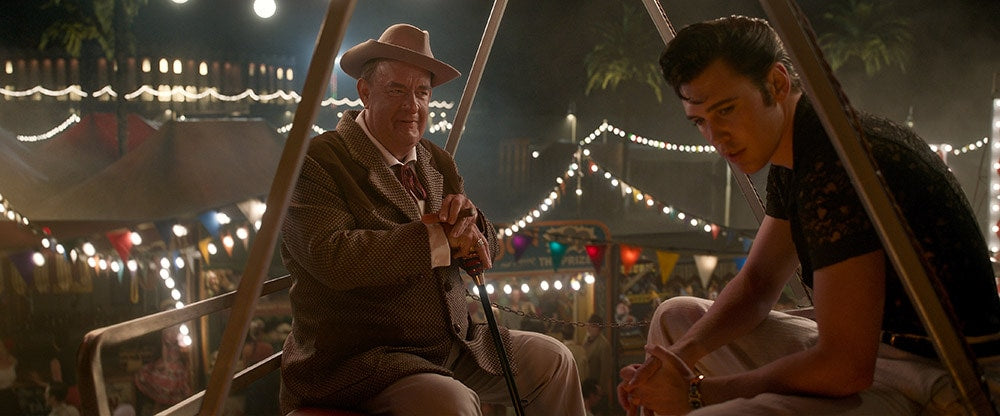
 

Tom Hanks as Colonel Tom Parker and Austin Butler as Elvis. Courtesy of Warner Bros. Pictures.

Tom Hanks as Colonel Tom Parker and Austin Butler as Elvis. Courtesy of Warner Bros. Pictures.


Luhrmann’s style precedes him; he finds his voice where the overwrought nestles up to the baroque. In many of his films, you see this same reach for redemption through refuse, as when a pair of amateur hoofers dance out a grandiose love affair in Strictly Ballroom (1992), or Nicole Kidman swings atop a chandelier through an after-hours club singing “Diamonds Are a Girl’s Best Friend,” hich segues into Madonna’s “Material Girl,” in Moulin Rouge (2001). The Great Gatsby (2013) presents the limits of this reach, if only for the added tension between the tragedy of the source material and this Australian’s response; it’s an outsider’s view of Gatsby, and that rings the bell sideways.

Like Elvis, Luhrmann commands a huge technique even while people keep underestimating him. Because he invests so much in flash and sizzle, few catch the number of striking details that spur this script (by Luhrmann with Sam Bromell, Craig Pearce, and Jeremy Doner). Parker describes Presley’s early look as passing strange, with “girl’s makeup,” and you suddenly remember that in addition to his pompadour, Elvis’s early good looks seemed markedly androgynous, what the Beatles later expressed through long hair. At one point, as “Heartbreak Hotel” whizzes by, someone calls out, “It’s a suicide note!” the number’s perfect thought bubble. Presley’s beleaguered mother, Gladys, gets an agonizing turn from Helen Thomson, who looks like half a ghost long before she dies. Sam Phillips (Josh McConville), Presley’s original Sun Records producer, gets lost amid one of the many postcard flurries, and yet Marion Keisker (Kate Mulvaney), the “secretary” who singles out Presley’s promise, finally gets some big-screen credit.

The first half of the movie luxuriates on the young Elvis and his wayward charisma. Presley’s sexual release feels so pent-up that its audience succumbs to a higher liberation, freedom sprinting ahead on a sweeping array of metaphors. Luhrmann portrays this all as part of black music’s continuum, where B.B. King (Kelvin Harrison Jr.), Sister Rosetta Tharpe (Yola Quartey), and Little Richard (Alton Mason) all share complicated feelings (every shade between envy and gratitude) about the King’s massive breakthrough.

Some choices seem questionable. Luhrmann brushes past how Priscilla (Olivia DeJonge) was only 14 when Elvis courted her in Germany, or what we now call at least “grooming.” Her fortitude matches Elvis’s own inner furies once celebrity turns him into one more lonely figure, adored for being adored.

By 1968, tired of stiff hit movies and lack of live audiences, Elvis rebelled by hiring a young director, Steve Binder, to producer his Christmas special. His favorite segment involved sitting encircled by his fans, running down oldies with his original players, singing some original dirty lyrics to songs like “One Night Of Sin” (originally released as “One Night With You”). A huge hit, the counterculture largely ignored this TV material until Greil Marcus wrote his famous “Presliad” essay in Mystery Train in 1975. Marcus nudged history in the right direction. This comeback made you wonder: could rock ’n’ roll, the ultimate youth music, conquer middle age, retain its relevance, and sustain careers beyond that scary precipice of 30? Now we know that all those Sixties rockers had their eyes on Presley, wondering how they might confront the same dilemma.

By the time Elvis wins his argument with Parker and books Vegas, Luhrmann posits Vegas Elvis as the real Elvis, or at least the longest-lasting Elvis, reaching towards his early Sun Records moments: a figure so grand and abiding, if the hippies couldn’t sense it, it said more about their own elitist club. Now that history has remastered all of Elvis (in three giant box sets, great outweighing schlock), you can hear him singing straight through the morass, as if he could out-sing any injustice or any slight, sing America right back to its better nature, and sing a divided nation back into something worth arguing about. (This is where Luhrmann plays the biopic game better than recent hackneyed treatments of Freddie Mercury and Elton John: Presley had importance, but he also exuded good humor, as his best onstage self battled his private lack of self-worth.)
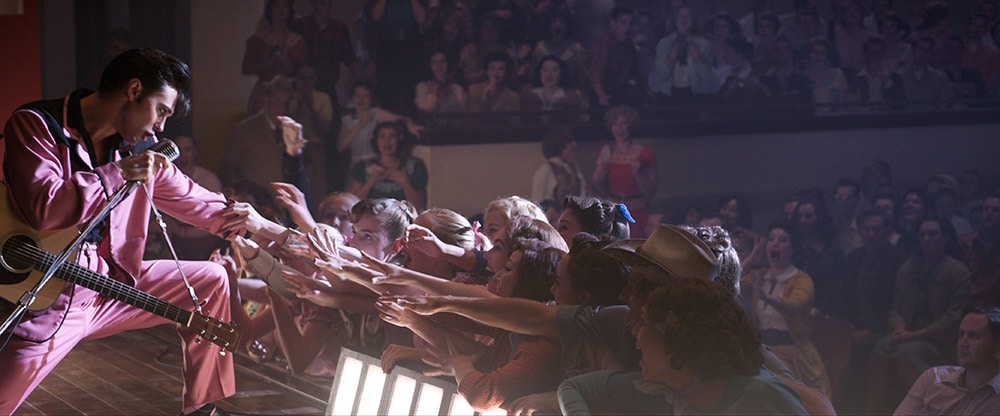
 

Courtesy of Warner Bros. Pictures.

Courtesy of Warner Bros. Pictures.


Of course, conquering mainstream entertainment meant suffering its soap opera sins of gluttony and pills, so Presley died slumped over his toilet at age 42 in Graceland (”A whole lotta trouble runnin’ through his veins,” wrote Bruce Springsteen). To the rock culture he inspired, he had drifted into celebrity cliché.

The movie ends with 1977 footage of Elvis singing “Unchained Melody” at the piano, panting, howling, moaning, and exorcising Gawd Knows What for a scene that animates his pomposity with a twisted pathetic verve. Cross-cutting between Butler and the real Elvis, it’s a dazzling piece of editing that seals Butler’s gift for mimicry. You’ll think of another breakout performance from an inferior film : Val Kilmer as Jim Morrison in The Doors (Oliver Stone, 1991). Like Kilmer, Butler swivels effortlessly between homage and a unique, detailed actorly examination; his performance fuses fevered identification with critical distance.

Tom Hanks seems curiously miscast here: it’s not that he can’t or should play villains – he should definitely play more (his Road to Perdition character’s revenge plot almost counts). Hanks’s Good Guy persona looms so credulously it makes you want to see his venal side. And it’s not that we sympathize with Parker so much as sympathize with Hanks himself… it’s a thankless, two-dimensional role more suited to a Tom Sizemore or Mickey Rourke. Better yet, call back Brendan Gleason as the deliciously aberrant Trump from The Comey Rule (2020).

Parker as narrator waters down our desire for Elvis. Butler hits so many perfect notes, losing himself onstage or submitting to a song that carries him out of himself, that Parker turns into a distraction; he makes the least interesting vantage on this material. As Elvis tries to find something profound inside “If I Can Dream” to close his 1968 special, we don’t want to cut away to Hanks, wincing at greatness, worrying whether its sponsor might flee.

Sure, Parker pitched the world to the kid on that carnival Ferris wheel. But the musicians around Elvis had so much more to talk about, so much more to learn and share with others; their perspective has always gone underdeveloped. The script could use more of the backstage moments where Presley enjoys talking trash with B.B. King and fewer “loneliest idol in the world” sequences atop the International Hotel. Presley wound up hanging out with his Memphis Mafia yobs because he felt so stifled by the fixed Hollywood mindset that rock had supposedly blasted open. Turning a figure like Elvis into a mainstream star perverted his best impulses: that’s what Luhrmann dramatizes in his better scenes. When he died, Rolling Stone’s Greil Marcus quoted the poet William Carlos Williams (“To Elsie”), about how “the pure products of America go crazy.” Luhrmann links Elvis to that same poem’s “devil-may-care men who have taken/to railroading/out of sheer lust of adventure” in a movie that goes on too long but glimpses greatness.


Header image: Austin Butler as Elvis in Warner Bros. Pictures’ Elvis, a Warner Bros. Pictures release. Photo by Hugh Stewart.

More from Issue 167

View All Articles in Issue 167

Search Copper Magazine

#231 Piano Prodigy Jude Kofie Releases His Debut Album On Octave Records by Frank Doris Jun 01, 2026 #231 Underappreciated Artists, Part Two: City Boy by Rich Isaacs Jun 01, 2026 #231 Music and the Art of Creation: Talking With Saxophonist Rob Scheps by Joe Caplan Jun 01, 2026 #231 How to Play in a Rock Band, 24: Further Adventures at the 2026 Montauk Music Festival by Frank Doris Jun 01, 2026 #231 Courtney Barnett: Creature of Habit by Wayne Robins Jun 01, 2026 #231 Angine de Poitrine: Interstellar Guitar Rock Saviors Headed for Late-Night TV Pop Stardom? by Mark Lepage Jun 01, 2026 #231 My Impressions of AXPONA 2026, Part One by Frank Doris Jun 01, 2026 #231 2026 La Jolla Concours d'Elegance: Another Aesthetic Feast by B. Jan Montana Jun 01, 2026 #231 Country Music Icon Jo Dee Messina’s Bridges: A New Beginning by Ray Chelstowski Jun 01, 2026 #231 The Luxury Dispatch Hosts a Video Podcast With Ken Kessler by Ken Kessler Jun 01, 2026 #231 The Vinyl Beat: Tracking in the Motor City by Rudy Radelic Jun 01, 2026 #231 Lots of Fun With DSP: The Ferrum Audio WANDLA DAC and Its Tube Mode by Frank Doris Jun 01, 2026 #231 From The Audiophile's Guide: Digital Source Components and Streaming Audio by Paul McGowan Jun 01, 2026 #231 Onkyo’s Monster M-510 power amplifier by The Staff at Just Audio Jun 01, 2026 #231 PS Audio in the News by PS Audio Staff Jun 01, 2026 #231 Naming Convention by Peter Xeni Jun 01, 2026 #231 Les Invisibles by Frank Doris Jun 01, 2026 #231 Wildlife Scene by James Schrimpf Jun 01, 2026 #230 Camaraderie by B. Jan Montana May 04, 2026 #230 AXPONA 2026: A Family Gathering by Paul McGowan May 04, 2026 #230 Pianist Ryan Benthall Explores Jazz Realms and Far Beyond With Divine Sky by Frank Doris May 04, 2026 #230 The Vinyl Beat in AXPONA-Land by Rudy Radelic May 04, 2026 #230 Teddy Thompson’s Musical Growth Deepens With Never Be the Same by Ray Chelstowski May 04, 2026 #230 More Fun in the Sun: Florida Audio Expo, Part Two by Frank Doris May 04, 2026 #230 CanJam NYC 2026 Show Report: Heady Sound, Part Two by Frank Doris and Harris Fogel May 04, 2026 #230 Sonic Youth On Murray Street by Wayne Robins May 04, 2026 #230 Graffeo Coffee: A Symphony of Sensory Experience by Joe Caplan May 04, 2026 #230 The Saul Authority: The Story of Hi-Fi Pioneer Saul Marantz by Olivier Meunier-Plante May 04, 2026 #230 How to Play in a Rock Band, 23: Encounters With Famous Musicians, Part Two by Frank Doris May 04, 2026 #230 An Outlier in the Rack: A Vintage BIC Beam Box by The Staff at Just Audio May 04, 2026 #230 PS Audio in the News by PS Audio Staff May 04, 2026 #230 A Cautionary Tale by Rich Isaacs May 04, 2026 #230 Reel-to-Reel Roots, Part 33 (Revised): Ken Kessler Reports On the 2026 (British) AudioJumble by Ken Kessler May 04, 2026 #230 Text Messaging by Frank Doris May 04, 2026 #230 The Audiophile Rat Race by Peter Xeni May 04, 2026 #230 On the Rocks by Rich Isaacs May 04, 2026 #229 The Earliest Stars of Country Music, Part Three by Jeff Weiner Apr 06, 2026 #229 The Healing Power of Music and Sound at the Omega Institute by Joe Caplan Apr 06, 2026 #229 CanJam NYC 2026 Show Report: Heady Sound, Part One by Frank Doris Apr 06, 2026 #229 Florida Audio Expo 2026: Warming Up to High-End Audio, Part One by Frank Doris Apr 06, 2026 #229 Quick Takes: Anne Bisson, Sam Morrison, The Velvet Underground, and the Stooges by Frank Doris Apr 06, 2026 #229 The Vinyl Beat: New Arrivals, and Old Audio Show Demo Scores to Settle by Rudy Radelic Apr 06, 2026 #229 Harvard Gets a High-End Audio Education by Frank Doris Apr 06, 2026 #229 No Country for Old Knees by B. Jan Montana Apr 06, 2026 #229 How To Play in A Rock Band, 22: Encounters With Famous Musicians, Part 1 by Frank Doris Apr 06, 2026 #229 The Soulful Grooves of Guinea-Bissau by Steve Kindig Apr 06, 2026 #229 Four-Hand Piano Performance at Its Finest by Stephan Haberthür Apr 06, 2026

Reconsider Baby: Elvis, the Movie

Reconsider Baby: <em>Elvis</em>, the Movie

Among other things, Elvis Presley invented the rock ’n’ roll comeback. Up until 1968, ”coming back” from a career break barely existed in the new style since most fell short, or failed. Carl Perkins’s 1956 car crash just before his first appearance on The Ed Sullivan Show interrupted his “Blue Suede Shoes” momentum at a crucial moment. When it leaked on his 1958 UK tour that his wife was only 13, Jerry Lee Lewis sought redemption by appealing to the only audience that might forgive him: country and western, and country-gospel. With many others (Chuck Berry, Little Richard, Gene Vincent), fate delivered a cold, hard slap.

Elvis bombed during his first Vegas stint in 1956 just as he tried to break nationwide, and when called him up for peacetime Army service in 1958, he feared losing most of his listeners. His 1960 Welcome Home Elvis TV appearance with Frank Sinatra sent his career into ultra-safe mode. John Lennon liked to say Elvis “died when he went into the Army.” Presley had so much ambition that comebacks turned into a defining feature of his career. His talent, and what it signaled, foretold of such flamboyance and shock that the world needed time to keep readjusting. It’s still adjusting.

Now, the biggest Elvis comeback of all, Baz Luhrmann’s feature biopic, places all these others in a new context. Given its many flaws, and overbearing length, that’s impressive. History’s distortions can prove pitiless; pillars of the style have long since faded, or morphed into caricatures. Bloated biopics for Ray Charles and James Brown fell away almost instantly. And rock continues to manufacture irony: the idea of the Young Mick Jagger now gets trotted out and explained. Partly because Presley’s daughter, Lisa Marie, and former wife, Priscilla, have not captured attention since Marie’s divorce from Michael Jackson in 1996, and major film references to the King have dropped off after Michael Madsen’s soft-core cameo as an apparition in Thelma and Louise in 1991, and a brief sequence in Forrest Gump (1994), the Presley persona hasn’t carried over into digital as much as some others.


Austin Butler as Elvis in Warner Bros. Pictures’ Elvis. Courtesy of Warner Bros. Pictures.

Austin Butler as Elvis in Warner Bros. Pictures’ Elvis. Courtesy of Warner Bros. Pictures.


So it’s important to understand: Presley once dominated a stage far bigger than a thousand Beyoncés or Harry Potters. It’s a measure of Luhrmann’s imagination that he senses just how much Elvis warrants another return, and has plenty of arresting ideas. Maybe one too many. Elvis broke the summer movie season open big, holding its own as a hit alongside Tom Cruise’s Top Gun sequel as a major blockbuster, and that contrast proves useful.


Luhrmann also makes the connection between Cruise’s All-American Action Hero and King Elvis, and the contrast effect helps Presley loom even larger. Elvis once acted like a Superman of Song, someone with the supernatural sweep and daring of a Marvel figure exploding into your imagination, a figure so wild-eyed and all-knowing he seemed to spring directly from cartoons. It was this “other” aspect that created a fascinating tension between Elvis, the surviving twin from Memphis, and the King, who straddled our inner galaxy. You can still feel the Elvis influence everywhere, in the way Lady Gaga careens through styles like a trickster, or how Madonna’s grizzled eminence sidesteps her many Hollywood flops. Presley’s volcanic heat lives on his recordings, but his signal has dimmed, perhaps because his range was so vast, his omnipresence so out of reach.

The very idea that Elvis could fall off America’s radar seems profane. And yet today Elvis needs reintroduction when some assume the most deflating things about him – that he “stole” black music, shot out TVs in drug rants, that his cartoon shadow stood for nothing more than American trash. You can trace a lot of this misconception to how Hollywood completely fumbled early rock ’n’ roll and has only caught up in lurching increments; the idea that someone as brazen and quirky as Elvis could wedge himself into a stock boy-meets-girl musical is preposterous, and tells of how thrilling his live act must have been for many. Luhrmann turns this tension between Elvis’s flair and the prevailing showbiz frames into a motif.

As the consensus King of youth music, post-Army Elvis found himself stranded as a movie star famous for awful films. Everybody blamed his manager, “Colonel” Tom Parker, who played the game as though rock hadn’t changed anything. The legacy entertainment machine diluted Presley’s spark, and as long as the movies sold tickets, Parker couldn’t be bothered to change strategy. Luhrmann portrays this dilemma with a dazzling efficiency through a series of madcap montages and cacophonous travelogues that convey both the rush of Elvis’s fame and the fleeting nature of his flash. As the movie slows to its closing 2 hours and 40 minutes, you get the stale sense of time running Presley’s energy down the way it did in real life as the Sixties and rock’s next generation lapped him, and a crippling addiction to pills turned him into a has-been. It was a shock to learn he was only 42 when he died in 1977; he seemed to have lived for so much longer, and his career had so many odd corners and sideshows that it barely seemed possible he wasn’t at least 60.

In an early set-piece that replays the peculiarities of an early Elvis live show, Luhrmann stretches out an early sequence for Col. Tom Parker’s narration (Tom Hanks). “It is hard to overstate how strange he seemed…” Parker says, anticipating a giant belly flop. And then, in an instant, you see Austin Butler light into “Baby, Let’s Play House,” the thunderbolt strikes, the crowd goes batty, and the sequence delivers some second-hand hysteria.


Tom Hanks as Colonel Tom Parker and Austin Butler as Elvis. Courtesy of Warner Bros. Pictures.

Tom Hanks as Colonel Tom Parker and Austin Butler as Elvis. Courtesy of Warner Bros. Pictures.


Luhrmann’s style precedes him; he finds his voice where the overwrought nestles up to the baroque. In many of his films, you see this same reach for redemption through refuse, as when a pair of amateur hoofers dance out a grandiose love affair in Strictly Ballroom (1992), or Nicole Kidman swings atop a chandelier through an after-hours club singing “Diamonds Are a Girl’s Best Friend,” hich segues into Madonna’s “Material Girl,” in Moulin Rouge (2001). The Great Gatsby (2013) presents the limits of this reach, if only for the added tension between the tragedy of the source material and this Australian’s response; it’s an outsider’s view of Gatsby, and that rings the bell sideways.

Like Elvis, Luhrmann commands a huge technique even while people keep underestimating him. Because he invests so much in flash and sizzle, few catch the number of striking details that spur this script (by Luhrmann with Sam Bromell, Craig Pearce, and Jeremy Doner). Parker describes Presley’s early look as passing strange, with “girl’s makeup,” and you suddenly remember that in addition to his pompadour, Elvis’s early good looks seemed markedly androgynous, what the Beatles later expressed through long hair. At one point, as “Heartbreak Hotel” whizzes by, someone calls out, “It’s a suicide note!” the number’s perfect thought bubble. Presley’s beleaguered mother, Gladys, gets an agonizing turn from Helen Thomson, who looks like half a ghost long before she dies. Sam Phillips (Josh McConville), Presley’s original Sun Records producer, gets lost amid one of the many postcard flurries, and yet Marion Keisker (Kate Mulvaney), the “secretary” who singles out Presley’s promise, finally gets some big-screen credit.

The first half of the movie luxuriates on the young Elvis and his wayward charisma. Presley’s sexual release feels so pent-up that its audience succumbs to a higher liberation, freedom sprinting ahead on a sweeping array of metaphors. Luhrmann portrays this all as part of black music’s continuum, where B.B. King (Kelvin Harrison Jr.), Sister Rosetta Tharpe (Yola Quartey), and Little Richard (Alton Mason) all share complicated feelings (every shade between envy and gratitude) about the King’s massive breakthrough.

Some choices seem questionable. Luhrmann brushes past how Priscilla (Olivia DeJonge) was only 14 when Elvis courted her in Germany, or what we now call at least “grooming.” Her fortitude matches Elvis’s own inner furies once celebrity turns him into one more lonely figure, adored for being adored.

By 1968, tired of stiff hit movies and lack of live audiences, Elvis rebelled by hiring a young director, Steve Binder, to producer his Christmas special. His favorite segment involved sitting encircled by his fans, running down oldies with his original players, singing some original dirty lyrics to songs like “One Night Of Sin” (originally released as “One Night With You”). A huge hit, the counterculture largely ignored this TV material until Greil Marcus wrote his famous “Presliad” essay in Mystery Train in 1975. Marcus nudged history in the right direction. This comeback made you wonder: could rock ’n’ roll, the ultimate youth music, conquer middle age, retain its relevance, and sustain careers beyond that scary precipice of 30? Now we know that all those Sixties rockers had their eyes on Presley, wondering how they might confront the same dilemma.

By the time Elvis wins his argument with Parker and books Vegas, Luhrmann posits Vegas Elvis as the real Elvis, or at least the longest-lasting Elvis, reaching towards his early Sun Records moments: a figure so grand and abiding, if the hippies couldn’t sense it, it said more about their own elitist club. Now that history has remastered all of Elvis (in three giant box sets, great outweighing schlock), you can hear him singing straight through the morass, as if he could out-sing any injustice or any slight, sing America right back to its better nature, and sing a divided nation back into something worth arguing about. (This is where Luhrmann plays the biopic game better than recent hackneyed treatments of Freddie Mercury and Elton John: Presley had importance, but he also exuded good humor, as his best onstage self battled his private lack of self-worth.)


Courtesy of Warner Bros. Pictures.

Courtesy of Warner Bros. Pictures.


Of course, conquering mainstream entertainment meant suffering its soap opera sins of gluttony and pills, so Presley died slumped over his toilet at age 42 in Graceland (”A whole lotta trouble runnin’ through his veins,” wrote Bruce Springsteen). To the rock culture he inspired, he had drifted into celebrity cliché.

The movie ends with 1977 footage of Elvis singing “Unchained Melody” at the piano, panting, howling, moaning, and exorcising Gawd Knows What for a scene that animates his pomposity with a twisted pathetic verve. Cross-cutting between Butler and the real Elvis, it’s a dazzling piece of editing that seals Butler’s gift for mimicry. You’ll think of another breakout performance from an inferior film : Val Kilmer as Jim Morrison in The Doors (Oliver Stone, 1991). Like Kilmer, Butler swivels effortlessly between homage and a unique, detailed actorly examination; his performance fuses fevered identification with critical distance.

Tom Hanks seems curiously miscast here: it’s not that he can’t or should play villains – he should definitely play more (his Road to Perdition character’s revenge plot almost counts). Hanks’s Good Guy persona looms so credulously it makes you want to see his venal side. And it’s not that we sympathize with Parker so much as sympathize with Hanks himself… it’s a thankless, two-dimensional role more suited to a Tom Sizemore or Mickey Rourke. Better yet, call back Brendan Gleason as the deliciously aberrant Trump from The Comey Rule (2020).

Parker as narrator waters down our desire for Elvis. Butler hits so many perfect notes, losing himself onstage or submitting to a song that carries him out of himself, that Parker turns into a distraction; he makes the least interesting vantage on this material. As Elvis tries to find something profound inside “If I Can Dream” to close his 1968 special, we don’t want to cut away to Hanks, wincing at greatness, worrying whether its sponsor might flee.

Sure, Parker pitched the world to the kid on that carnival Ferris wheel. But the musicians around Elvis had so much more to talk about, so much more to learn and share with others; their perspective has always gone underdeveloped. The script could use more of the backstage moments where Presley enjoys talking trash with B.B. King and fewer “loneliest idol in the world” sequences atop the International Hotel. Presley wound up hanging out with his Memphis Mafia yobs because he felt so stifled by the fixed Hollywood mindset that rock had supposedly blasted open. Turning a figure like Elvis into a mainstream star perverted his best impulses: that’s what Luhrmann dramatizes in his better scenes. When he died, Rolling Stone’s Greil Marcus quoted the poet William Carlos Williams (“To Elsie”), about how “the pure products of America go crazy.” Luhrmann links Elvis to that same poem’s “devil-may-care men who have taken/to railroading/out of sheer lust of adventure” in a movie that goes on too long but glimpses greatness.


Header image: Austin Butler as Elvis in Warner Bros. Pictures’ Elvis, a Warner Bros. Pictures release. Photo by Hugh Stewart.

0 comments

Leave a comment

0 Comments

Your avatar

Loading comments...

🗑️ Delete Comment

Enter moderator password to delete this comment:

✏️ Edit Comment

Enter your email to verify ownership: