COPPER

A PS Audio Publication

Issue 129 • Free Online Magazine

Issue 129 FEATURED

Playing the Back Holes

Playing the Back Holes

One of my favorite motorcycling buddies, Ralph, invited me over yesterday to listen to his stereo system. Although he’s retired, he refuses to grow up and is still obsessed with motorcycles and music, just like me. The occasion of my visit was to audition the “new” Cerwin-Vega (CV) speakers he’d found at a thrift shop.

You might ask, “Wow, Ralph couldn’t afford better stuff at his age?”

Yes, he could buy a full Burmester system if he was so inclined. He owns five rental properties in San Diego and a ranch in Idaho. He spends his summers at the ranch, and his winters at the smallest, most dilapidated of his properties in San Diego. He laughingly advises newcomers that his neighborhood is located below the hovering police helicopters with the bright lights. His house has been broken into twice – each time he had to make insurance claims.

The irony is that one of the houses he owns is located in an exclusive beach community in North San Diego County, but he has never lived there. He feels more comfortable in the neighborhood he occupied as a starving student. Only now he doesn’t pay rent, he collects it.

In any case, he expressed delight at his thrift shop find, a pair of almost square, 3-way speakers, each with a 12-inch woofer featuring a red “racing stripe” surround like those found on redline tires. He’d placed them at the same spot we’d situated the Dynaco A25s I sold him a decade earlier, on coffee tables facing the listener about seven feet away.

Although the Dynacos sounded good at that location, I found the CVs to be unlistenable. Ralph seemed to enjoy the improved dynamics, but the shrill highs, exaggerated mids, and flabby bass made me wince like fingernails across a blackboard. The sound wasn’t helped by the poor recording quality of the pop album he was playing. I wondered about Ralph’s hearing acuity.

I remembered hearing CV speakers at audio shows in the 1970s. As they were considered “rock” speakers, I expect tight, deep bass. I knew Gene Czerwinski, founder of the Cerwin-Vega company, was certainly capable of producing it. At the 1972 Toronto hi-fi show, which was located in a hotel next to the international airport, he snuck unto the airfield at night and recorded jets taking off. On the last day of the show, it seemed jets were taking off every two minutes. Attendees complained about the difficulty of auditioning audio systems, and about the noisy location of the hotel. But when they got to the CV demo room, they found the real problem. Czerwinski was playing his jet-sounds tape on four pro audio sub-woofers loud enough to be heard across six floors.

“For god’s sake Ralph, turn it down, before you cause permanent hearing damage!” I demanded.

“What’s the matter?” he innocently asked.

“Remember when we set-up your Dynacos, I talked about the importance of the speaker/room interface?”

“Yah, but I didn’t understand what the hell you were talking about.”

“OK, trust me when I tell you that the perfect spot for the Dynacos is the worst spot for these CVs. Let’s try relocating them to make them sound better?”

“That’s what I was hoping for,” he responded.

“All right, give me a hand.”

In the interests of full disclosure, I secretly harbored a selfish reason for doing all this. Despite his quirks, I really enjoy Ralph’s company, but I’d have to stop visiting him if I was expected to tolerate those Cerwin-Vegas head-on any longer.

They were situated on a coffee table about six feet from the sidewall and three feet from the back wall. I asked him to move the left speaker into the corner and unto the floor –  face-up.

“Won’t that plug the back hole?” (He meant the rear-facing bass port.)

“Oh yah, we don’t want to plug the “back hole.” Got some 2×4 lumber?”

Vintage Cerwin-Vega D-5 speakers with that familiar red woofer surround. These have front ports though! Vintage Cerwin-Vega D-5 speakers with that familiar red woofer surround. These have front ports though! Image courtesy of Tony Carrollo.


He led me into the garage. He was obviously excited. It was difficult to avoid tripping over motorcycle parts, old appliances, and sports equipment. No 2×4 pieces anywhere.

“Let’s look around back,” he suggested.

We found a warped 2×4 which had spent its life as a flying buttress for the Leaning Garage of East San Diego. It was vintage grey, highlighted with brown water streaks from the rusted bed frame stored on the roof.

“Nice patina,” he commented as we cut it into four pieces. I guess it’s all in how you look at it.

We placed two pieces under the left speaker already in the corner. Similarly, we placed the right speaker on the floor face-up and jammed into the right corner, also with two chunks of 2×4 underneath it to avoid plugging the “back hole.”

The results were exactly what I’d hoped for. The tweeters and mids sounded much smoother pointed away from the listener. The bass tightened up dramatically given the acoustic reinforcement from the corner. And as I’d anticipated, with relatively louder bass, Ralph was satisfied to listen at lower volumes. Those horrible speakers became listenable, even enjoyable.

“I’m hearing a wall of sound, Montana, just like at a concert,” Ralph hollered over the sound of Steppenwolf. “It’s exactly what I was looking for!”

This is the first time I’d ever set up a system in this manner, and it certainly wouldn’t suit most audiophiles. But hey, different strokes for different folks. We’re not all looking for the same thing in music, audio systems, or life.

Ralph pulled out his best bottle of cheap Scotch and we spent the rest of the afternoon on a musical exploration of the Age of Aquarius. I’m looking forward to my next visit.
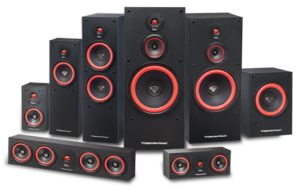
Today's Cerwin-Vega SL Series loudspeakers still sport the classic red trim. The red and the black: today's Cerwin-Vega SL Series loudspeakers still sport the classic carmine trim.

More from Issue 129

View All Articles in Issue 129

Search Copper Magazine

#233 A Report From The Total Hi-Fi Experience Show SoCal 2026 by B. Jan Montana Aug 03, 2026 #233 Bluegrass Meets Country, Folk, Jazz and More in All That We Carried by The Squid City Slingers by Frank Doris Aug 03, 2026 #233 Corey Glover and One Tribe Nation: A Variegated Musical Collective by Ray Chelstowski Aug 03, 2026 #233 Excursions with Clive: The Late Clive Davis, A Personal History by Wayne Robins Aug 03, 2026 #233 AI, Art, and Music: A Conversation With Synthography Art by Joe Caplan Aug 03, 2026 #233 New American Symphonies: A Rediscovered Gem and a Vital Contemporary Work by Frank Doris Aug 03, 2026 #233 The Vinyl Beat: Genesis, the Dave Clark Five, Antonio Carlos Jobim and More by Rudy Radelic Aug 03, 2026 #233 How to Play in a Rock Band, 26: When It's Time to Record Your Music by Frank Doris Aug 03, 2026 #233 More From T.H.E. Show 2026, and the People Who Made it Happen by Harris Fogel Aug 03, 2026 #233 Underappreciated Artists, Part Three: Icehouse by Rich Isaacs Aug 03, 2026 #233 The Surprisingly Rich and Varied Music of Somalia by Steve Kindig Aug 03, 2026 #233 A Remarkable Discographic Legacy: The LP Recordings of the Basel Symphony Orchestra by Stephan Haberthür Aug 03, 2026 #233 From The Audiophile’s Guide: The Importance of Loudspeakers by Paul McGowan Aug 03, 2026 #233 From Swimming Pool to New Listening Room: A Conversation with Norman Varney of AV RoomService by Gilles Laferrière Aug 03, 2026 #233 PS Audio in the News by PS Audio Staff Aug 03, 2026 #233 Audio Jewelry by Peter Xeni Aug 03, 2026 #233 Enrich Your Life by Frank Doris Aug 03, 2026 #233 The Searcher by James Schrimpf Aug 03, 2026 #232 What came first: Art or Music? A Conversation With Artist Jose Acosta by Joe Caplan Jul 06, 2026 #232 Blow By Blow: The Jeff Beck Story: An Insightful Book About a Guitar Icon by Ray Chelstowski Jul 06, 2026 #232 Creed Over Camaraderie? by B. Jan Montana Jul 06, 2026 #232 Chronicles of a Sound Pilgrim at the 2026 Montreal Audiofest by Hugues Morin Jul 06, 2026 #232 The Vinyl Beat: Summer Grooves by Rudy Radelic Jul 06, 2026 #232 Hibbing Hillbilly Dylan's Acoustic Rock by Wayne Robins Jul 06, 2026 #232 Quad Quads and Plasmatronics Tweeters: An Extraordinary System Comes to Life by Frank Doris Jul 06, 2026 #232 In Praise of Live Music, Once Again by Ted Shafran Jul 06, 2026 #232 Allnic Audio’s L-9000 Preamplifier: Design and Engineering Innovation by Howard Kneller Jul 06, 2026 #232 “Best Of” Lists and Rage Bait: Enough Already by Frank Doris Jul 06, 2026 #232 Quick Takes: Bud Shank, Paulo Almeida, Jakob Dreyer, Tim Eriksen and Peter Irvine by Frank Doris Jul 06, 2026 #232 My Impressions of AXPONA 2026, Part 2 by Frank Doris Jul 06, 2026 #232 How to Play in a Rock Band, 25: Encounters With Famous Musicians, Part Three by Frank Doris Jul 06, 2026 #232 Budgets, and Systems From Small to Outrageous by Paul McGowan Jul 06, 2026 #232 PS Audio in the News by PS Audio Staff Jul 06, 2026 #232 Hand It Over by Frank Doris Jul 06, 2026 #232 Difference of Opinion by Peter Xeni Jul 06, 2026 #232 Wabi-sabi Tree by James Schrimpf Jul 06, 2026 #231 Piano Prodigy Jude Kofie Releases His Debut Album On Octave Records by Frank Doris Jun 01, 2026 #231 Underappreciated Artists, Part Two: City Boy by Rich Isaacs Jun 01, 2026 #231 Music and the Art of Creation: Talking With Saxophonist Rob Scheps by Joe Caplan Jun 01, 2026 #231 How to Play in a Rock Band, 24: Further Adventures at the 2026 Montauk Music Festival by Frank Doris Jun 01, 2026 #231 Courtney Barnett: Creature of Habit by Wayne Robins Jun 01, 2026 #231 Angine de Poitrine: Interstellar Guitar Rock Saviors Headed for Late-Night TV Pop Stardom? by Mark Lepage Jun 01, 2026 #231 My Impressions of AXPONA 2026, Part One by Frank Doris Jun 01, 2026 #231 2026 La Jolla Concours d'Elegance: Another Aesthetic Feast by B. Jan Montana Jun 01, 2026 #231 Country Music Icon Jo Dee Messina’s Bridges: A New Beginning by Ray Chelstowski Jun 01, 2026 #231 The Luxury Dispatch Hosts a Video Podcast With Ken Kessler by Ken Kessler Jun 01, 2026 #231 The Vinyl Beat: Tracking in the Motor City by Rudy Radelic Jun 01, 2026

Playing the Back Holes

Playing the Back Holes

One of my favorite motorcycling buddies, Ralph, invited me over yesterday to listen to his stereo system. Although he’s retired, he refuses to grow up and is still obsessed with motorcycles and music, just like me. The occasion of my visit was to audition the “new” Cerwin-Vega (CV) speakers he’d found at a thrift shop.

You might ask, “Wow, Ralph couldn’t afford better stuff at his age?”

Yes, he could buy a full Burmester system if he was so inclined. He owns five rental properties in San Diego and a ranch in Idaho. He spends his summers at the ranch, and his winters at the smallest, most dilapidated of his properties in San Diego. He laughingly advises newcomers that his neighborhood is located below the hovering police helicopters with the bright lights. His house has been broken into twice – each time he had to make insurance claims.

The irony is that one of the houses he owns is located in an exclusive beach community in North San Diego County, but he has never lived there. He feels more comfortable in the neighborhood he occupied as a starving student. Only now he doesn’t pay rent, he collects it.

In any case, he expressed delight at his thrift shop find, a pair of almost square, 3-way speakers, each with a 12-inch woofer featuring a red “racing stripe” surround like those found on redline tires. He’d placed them at the same spot we’d situated the Dynaco A25s I sold him a decade earlier, on coffee tables facing the listener about seven feet away.

Although the Dynacos sounded good at that location, I found the CVs to be unlistenable. Ralph seemed to enjoy the improved dynamics, but the shrill highs, exaggerated mids, and flabby bass made me wince like fingernails across a blackboard. The sound wasn’t helped by the poor recording quality of the pop album he was playing. I wondered about Ralph’s hearing acuity.

I remembered hearing CV speakers at audio shows in the 1970s. As they were considered “rock” speakers, I expect tight, deep bass. I knew Gene Czerwinski, founder of the Cerwin-Vega company, was certainly capable of producing it. At the 1972 Toronto hi-fi show, which was located in a hotel next to the international airport, he snuck unto the airfield at night and recorded jets taking off. On the last day of the show, it seemed jets were taking off every two minutes. Attendees complained about the difficulty of auditioning audio systems, and about the noisy location of the hotel. But when they got to the CV demo room, they found the real problem. Czerwinski was playing his jet-sounds tape on four pro audio sub-woofers loud enough to be heard across six floors.

“For god’s sake Ralph, turn it down, before you cause permanent hearing damage!” I demanded.

“What’s the matter?” he innocently asked.

“Remember when we set-up your Dynacos, I talked about the importance of the speaker/room interface?”

“Yah, but I didn’t understand what the hell you were talking about.”

“OK, trust me when I tell you that the perfect spot for the Dynacos is the worst spot for these CVs. Let’s try relocating them to make them sound better?”

“That’s what I was hoping for,” he responded.

“All right, give me a hand.”

In the interests of full disclosure, I secretly harbored a selfish reason for doing all this. Despite his quirks, I really enjoy Ralph’s company, but I’d have to stop visiting him if I was expected to tolerate those Cerwin-Vegas head-on any longer.

They were situated on a coffee table about six feet from the sidewall and three feet from the back wall. I asked him to move the left speaker into the corner and unto the floor –  face-up.

“Won’t that plug the back hole?” (He meant the rear-facing bass port.)

“Oh yah, we don’t want to plug the “back hole.” Got some 2×4 lumber?”

Vintage Cerwin-Vega D-5 speakers with that familiar red woofer surround. These have front ports though! Vintage Cerwin-Vega D-5 speakers with that familiar red woofer surround. These have front ports though! Image courtesy of Tony Carrollo.


He led me into the garage. He was obviously excited. It was difficult to avoid tripping over motorcycle parts, old appliances, and sports equipment. No 2×4 pieces anywhere.

“Let’s look around back,” he suggested.

We found a warped 2×4 which had spent its life as a flying buttress for the Leaning Garage of East San Diego. It was vintage grey, highlighted with brown water streaks from the rusted bed frame stored on the roof.

“Nice patina,” he commented as we cut it into four pieces. I guess it’s all in how you look at it.

We placed two pieces under the left speaker already in the corner. Similarly, we placed the right speaker on the floor face-up and jammed into the right corner, also with two chunks of 2×4 underneath it to avoid plugging the “back hole.”

The results were exactly what I’d hoped for. The tweeters and mids sounded much smoother pointed away from the listener. The bass tightened up dramatically given the acoustic reinforcement from the corner. And as I’d anticipated, with relatively louder bass, Ralph was satisfied to listen at lower volumes. Those horrible speakers became listenable, even enjoyable.

“I’m hearing a wall of sound, Montana, just like at a concert,” Ralph hollered over the sound of Steppenwolf. “It’s exactly what I was looking for!”

This is the first time I’d ever set up a system in this manner, and it certainly wouldn’t suit most audiophiles. But hey, different strokes for different folks. We’re not all looking for the same thing in music, audio systems, or life.

Ralph pulled out his best bottle of cheap Scotch and we spent the rest of the afternoon on a musical exploration of the Age of Aquarius. I’m looking forward to my next visit.

Today's Cerwin-Vega SL Series loudspeakers still sport the classic red trim. The red and the black: today's Cerwin-Vega SL Series loudspeakers still sport the classic carmine trim.

0 comments

Leave a comment

0 Comments

Your avatar

Loading comments...

🗑️ Delete Comment

Enter moderator password to delete this comment:

✏️ Edit Comment

Enter your email to verify ownership: