COPPER

A PS Audio Publication

Issue 176 • Free Online Magazine

Issue 176 Natural Born Kessler

Michael Jackson’s Thriller: Mobile Fidelity’s 40th Anniversary Edition LP

Michael Jackson’s Thriller: Mobile Fidelity’s 40th Anniversary Edition LP

As one who has been reviewing reissues on vinyl and CD for nearly 40 years – yes, I’ve been around the hi-fi press for that long – two or three salient points make such assessments different from all others. The first is that there is nothing left to say about milestone albums, so evaluating reissues of said titles need only deal with sound quality and any changes to the content: remixing, remastering or augmentation with extra material.

That immediately calls to mind all of the 50th anniversary box sets currently depleting the disposable income reserves of baby boomers. In the case of, say, the recent reissue of the Beatles’ Revolver, remastering, remixing, and a plethora of extras do warrant study. (See Jay Jay French’s review in this issue.) But the music itself? Beyond comment. Is there anything left to be said about “Good Day Sunshine” or “Tomorrow Never Knows” or “Taxman”? Is there a more beautiful love song than “Here, There and Everywhere”?

Yes, I realize that every work of genius in every art form inspires further analysis, and the creations of Mozart, Shakespeare, Hitchcock, Cezanne, Picasso, Scorsese and others of that elevated level of brilliance will always fascinate scholars. I get it. But analyzing their works, and that includes Beatles albums, is to me both fruitless and unnecessary, save for discussing previously-unreleased matter, whether bonus tracks on an album or an unpublished chapter of Finnegan’s Wake.

Ultimately, especially in the context of Copper, Hi-Fi News, Stereophile, The Absolute Sound, etc., the primary role of a review of any reissue is sound quality. That applies to both deluxe, remastered audiophile editions, from the usual suspects such as Impex, MoFi, Analogue Productions, and others of that ilk, and reissues from labels more concerned with collector appeal and content than sheer sonic merit. Those include reissue specialists such as Sundazed, Bear Family, Ace, Speakers Corner and myriad others, though labels such as these are fastidious about sound, too.

Inevitably, when reissues of near-sacred albums such as those by the Beatles, Miles Davis, the Rolling Stones, Bob Dylan and other giants do generate controversy, it’s usually because some purist hack doesn’t like anything other than an original pressing. Audiophiles, I fear, are like politicians, who must disagree furiously with the opposition, no matter what. If Trump cured cancer, he would still be hated by Democrats; ditto if Biden ended all wars; Republicans would still detest him. Though hardly as grave as a battle for the Senate, this brings us to the furor surrounding the new Mobile Fidelity Ultradisc One-Step release of Michael Jackson’s inarguable magnum opus, Thriller (Mobile Fidelity UD1S 1-042).

What has rendered this controversial is not the content: Mobile Fidelity has reissued the original LP sans bonus cuts. MoFi has, however, broken tradition with its own One-Step procedure, in that this is a single LP playing at 33-1/3 RPM, rather than a double at 45 RPM. This has actually resulted in nicer packaging: a slim, sturdy slipcase rather than the unnecessarily bloated boxes of other One-Steps – which gratuitously waste precious shelf space for those with huge libraries and nowhere to grow. Another change is the quantity being offered. To meet the inevitable demand, the production run is 40,000 copies to mark Thriller’s 40th anniversary.
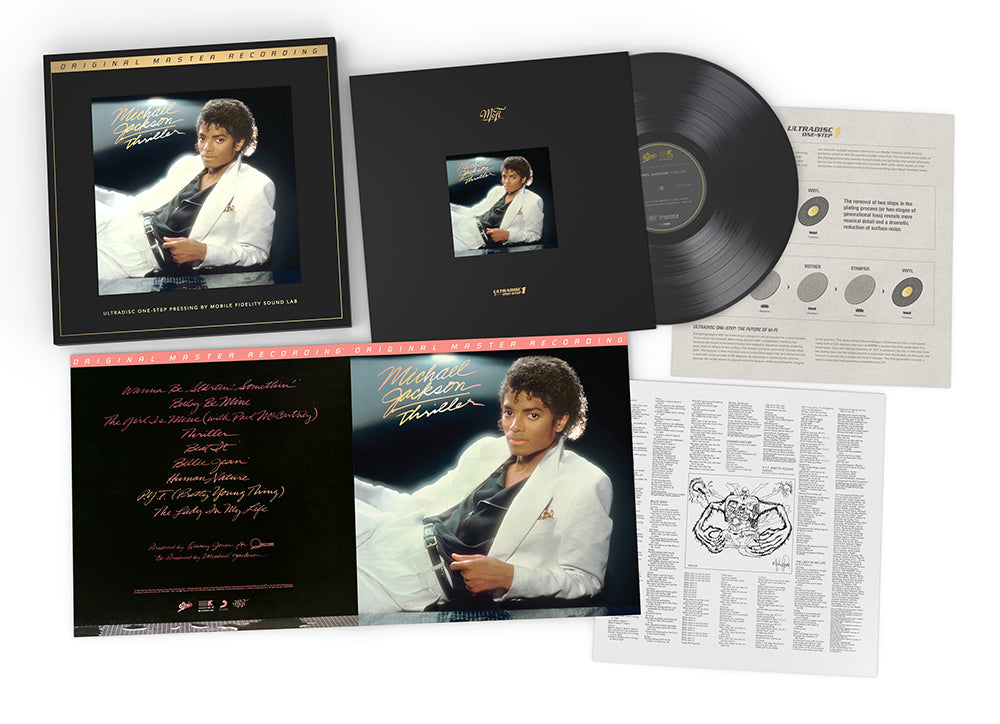
 

Courtesy of Mobile Fidelity Sound Labs.

Courtesy of Mobile Fidelity Sound Labs.

And that number is what sired the controversy, a fracas unlike anything I can recall since I first succumbed to hi-fi 54 years ago. A record retailer put two-and-two together and realized that, given the finite number of LPs which can be pressed from a stamper, MoFi would have to access the master tapes more often than any label would allow such priceless recordings to be handled.

This led to the conclusion that the LP had to be mastered from a high-res digital source because of the number of stampers that needed to be produced. Or something like that. In a series of events that recall the farce A Funny Thing Happened On the Way To the Forum, only without the humor, MoFi replied with a video of its engineers being grilled, which did little to assuage incandescent purists. As it’s all out there for those who care to wallow in taurean feces, I am not going to waste any more precious space (unlike One-Step boxes) in regurgitating what has preoccupied the audio community via social media, save for one thing. It is something which I find odious beyond belief, especially given the self-righteousness of most audiophiles. And how hi-fi per se is in enough trouble without enemies from within.

Some decades ago, the UK was subject to the censorial campaigns of one Mary Whitehouse, the most outrageously unharnessed do-gooder I can recall. While she was entitled to hate every film or TV show with any sexual scenes, nudity, blasphemy, drug use or attacks on her religion, Whitehouse’s main weakness was condemning films without even having seen them. So, too, have detractors of Mobile Fidelity gone on a rampage before the One-Step Thriller was even pressed!

OK, so MoFi was economical with the truth in that it failed to reveal the use of digital sources. That’s it. As far as sins go, it was hardly something which should result in cancelled orders, lawsuits or other overreactions on the part of a bunch of simpering audiophiles, pitchforks at the ready. Here’s why: the Thriller One-Step is so sonically sublime that it makes a mockery of any who negatively pre-judged it. As an editor of another publication for which I write said to me about both hardware and software, “KK, I don’t care what the means or methods were, if the result is exceptional.”

Even if the sonic worth of Thriller is ignored or discounted, as far as achievements go, it’s up there with precious few other albums, like The Dark Side of the Moon. According to the sources I’ve accessed, it is still the best-selling album of all time, in excess of 70 million copies worldwide. It’s the second best-selling album ever in the USA, a 34x -platinum certified release according to the RIAA as of 2021, the winner of eight Grammy Awards, ad infinitum. Like I said, any criticism of the content is pointless.

Considered culturally important by the Library of Congress, it’s easy to understand why: Thriller is an inescapable part of the zeitgeist of the 1980s, just as, say, Charlie Chaplin’s films are emblematic of the silent era, or how Richard Petty personifies NASCAR, or the way that Levis are the defining garment of the 20th century. As a result of its omnipresence, due as well to the plethora of singles culled from it, even I, someone who detested Michael Jackson long before he emerged as one of the creepiest performers in rock’s history, know every track.

And here’s where I am eager to swallow my antipathy in print or online by confessing that this one of the finest-sounding records I have ever heard. I’ve been a fan of Quincy Jones’ production skills ever since I first heard Lesley Gore on a decent sound system, so – One-Step gains aside – Thriller has sounded mighty fine regardless of format, and I’ve heard at least five versions. But then we have to weigh familiarity with critical faculty: we can hear the damned thing in our heads, especially if we were record buyers in 1982. And yet I doubt there are many Millennials (or later) who are not equally au fait with this album. Jackson is part of the landscape.

How many times have any of us heard those irresistible earworms, “Billie Jean” and “Beat It?” The maudlin “The Girl Is Mine?” Or the title track, with its pre-The Walking Dead video? What the One-Step edition brings to the table – the turntable – are the fruits of the late Tim de Paravicini’s design prowess in co-creating the process, MoFi’s resolute quest for killer sound (despite all the controversy), and an end product that is nothing short of dazzling.

Using a current-fave DS Audio optical cartridge, I cued up the first track and was immediately impressed by both bass extension and attack. It was repeated with every number, with the aforementioned stand-out cuts enjoying a freshness that can only be attributed to the unparalleled extraction of low-level detail coupled to ultra-wide dynamics. Every transient seemed somehow faster. The massive sense of space gave each sound its own turf. But there were other artifacts which eluded me as a Jackson-loather. So, I recruited a second pair of ears.

Ex-studio engineer: check. Speaker designer: check. Tape enthusiast: check. Bass addict: check. Michael Jackson fan: check. Thriller devotee: double check. Within seconds, he was raving about the lower octaves. By the end of the first track, he observed what I had missed: that Jackson’s voice was somehow less shrill, less whiny. We listened further and he praised the soundstage, especially the depth, which I noted through Quad ESL63s was extending back to an imaginary horizon. It was, in a word, “revelatory,” something rarely applied to an album so well-known, so overly-recognizable that to hear it as if it was a new release, after four decades’ exposure to it, somehow defies credibility. Yes, it’s that spectacular.

Among the many charming British expressions I have absorbed here in exile is a favorite which describes petulance as “cutting off one’s nose to spite one’s face.” For those who slammed MoFi’s Thriller without even hearing it, and who will only be able to avoid charges of hypocrisy by shunning it, change that expression to “cutting one’s ears off.”

They will never know what they are missing, unless they sneak a listen or a purchase so as not to be caught in the act of denial. For prejudging this LP alone, condemning without hearing, shame on them. Without foundation, they dishonor what is a Herculean effort in high-end audio, serving the audiophile’s never-ending quest for better sound.

More to the point, though, it’s “Bravo!” to MoFi. Now, where’s the SACD?


Header image courtesy of Mobile Fidelity Sound Labs.

More from Issue 176

View All Articles in Issue 176

Search Copper Magazine

#226 JJ Murphy’s Sleep Paralysis is a Genre-Bending Musical Journey Through Jazz, Fusion and More by Frank Doris Jan 05, 2026 #226 Stewardship by Consent by B. Jan Montana Jan 05, 2026 #226 Food, Music, and Sensory Experience: An Interview With Professor Jonathan Zearfoss of the Culinary Institute of America by Joe Caplan Jan 05, 2026 #226 Studio Confidential: A Who’s Who of Recording Engineers Tell Their Stories by Frank Doris Jan 05, 2026 #226 Pilot Radio is Reborn, 50 Years Later: Talking With CEO Barak Epstein by Frank Doris Jan 05, 2026 #226 The Vinyl Beat Goes Down to Tijuana (By Way of Los Angeles), Part One by Rudy Radelic Jan 05, 2026 #226 Capital Audiofest 2025: Must-See Stereo, Part Two by Frank Doris Jan 05, 2026 #226 My Morning Jacket’s Carl Broemel and Tyler Ramsey Collaborate on Their Acoustic Guitar Album, Celestun by Ray Chelstowski Jan 05, 2026 #226 The People Who Make Audio Happen: CanJam SoCal 2025, Part Two by Harris Fogel Jan 05, 2026 #226 How to Play in a Rock Band, 19: Touring Can Make You Crazy, Part One by Frank Doris Jan 05, 2026 #226 Linda Ronstadt Goes Bigger by Wayne Robins Jan 05, 2026 #226 From The Audiophile’s Guide: Active Room Correction and Digital Signal Processing by Paul McGowan Jan 05, 2026 #226 PS Audio in the News by Frank Doris Jan 05, 2026 #226 Back to My Reel-to-Reel Roots, Part 25: Half-Full, Not Empty by Ken Kessler Jan 05, 2026 #226 Happy New Year! by Frank Doris Jan 05, 2026 #226 Turn It Down! by Peter Xeni Jan 05, 2026 #226 Ghost Riders by James Schrimpf Jan 05, 2026 #226 A Factory Tour of Audio Manufacturer German Physiks by Markus "Marsu" Manthey Jan 04, 2026 #225 Capital Audiofest 2025: Must-See Stereo, Part One by Frank Doris Dec 01, 2025 #225 Otis Taylor and the Electrics Delivers a Powerful Set of Hypnotic Modern Blues by Frank Doris Dec 01, 2025 #225 A Christmas Miracle by B. Jan Montana Dec 01, 2025 #225 T.H.E. Show New York 2025, Part Two: Plenty to See, Hear, and Enjoy by Frank Doris Dec 01, 2025 #225 Underappreciated Artists, Part One: Martin Briley by Rich Isaacs Dec 01, 2025 #225 Rock and Roll is Here to Stay by Wayne Robins Dec 01, 2025 #225 A Lifetime of Holiday Record (and CD) Listening by Rudy Radelic Dec 01, 2025 #225 Little Feat: Not Saying Goodbye, Not Yet by Ray Chelstowski Dec 01, 2025 #225 How to Play in a Rock Band, Part 18: Dealing With Burnout by Frank Doris Dec 01, 2025 #225 The People Who Make Audio Happen: CanJam SoCal 2025 by Harris Fogel Dec 01, 2025 #225 Chicago’s Sonic Sanctuaries: Four Hi‑Fi Listening Bars Channeling the Jazz‑Kissa Spirit by Olivier Meunier-Plante Dec 01, 2025 #225 From The Audiophile’s Guide: Controlling Bass Frequencies Through Membrane Absorbers (and How to Build Your Own) by Paul McGowan Dec 01, 2025 #225 Your Editor’s Tips for Attending Audio Shows by Frank Doris Dec 01, 2025 #225 PS Audio in the News by Frank Doris Dec 01, 2025 #225 Back to My Reel-to-Reel Roots, Part 24 by Ken Kessler Dec 01, 2025 #225 Holiday Music by Frank Doris Dec 01, 2025 #225 Puppy Prognostication by Peter Xeni Dec 01, 2025 #225 How to Post Comments on Copper by Frank Doris Dec 01, 2025 #225 Living Color by Rudy Radelic Dec 01, 2025 #224 T.H.E. Show New York 2025, Part One: A New Beginning by Frank Doris Nov 03, 2025 #224 Fool’s Leap of Faith is the Extraordinary Octave Records Debut from Singer/Songwriter Tyler Burba and Visit by Frank Doris Nov 03, 2025 #224 The Beatles’ “Aeolian Cadences.” What? by Wayne Robins Nov 03, 2025 #224 Persona Non Grata by B. Jan Montana Nov 03, 2025 #224 Talking With Recording Engineer Barry Diament of Soundkeeper Recordings, Part Two by Frank Doris Nov 03, 2025 #224 B Sides, B Movies, and Beware of Zombies by Rudy Radelic Nov 03, 2025 #224 The Burn-In Chronicles: 1,000 Hours to Sonic Salvation by Olivier Meunier-Plante Nov 03, 2025 #224 A Conversation With Mat Weisfeld of VPI Industries by Joe Caplan Nov 03, 2025 #224 Blues-Rocker Kenny Wayne Shepherd Celebrates 30 Years of Ledbetter Heights by Ray Chelstowski Nov 03, 2025 #224 Playing in a Rock Band, 17: When Good Gigs Go Bad, Part Two by Frank Doris Nov 03, 2025

Michael Jackson’s Thriller: Mobile Fidelity’s 40th Anniversary Edition LP

Michael Jackson’s Thriller: Mobile Fidelity’s 40th Anniversary Edition LP

As one who has been reviewing reissues on vinyl and CD for nearly 40 years – yes, I’ve been around the hi-fi press for that long – two or three salient points make such assessments different from all others. The first is that there is nothing left to say about milestone albums, so evaluating reissues of said titles need only deal with sound quality and any changes to the content: remixing, remastering or augmentation with extra material.

That immediately calls to mind all of the 50th anniversary box sets currently depleting the disposable income reserves of baby boomers. In the case of, say, the recent reissue of the Beatles’ Revolver, remastering, remixing, and a plethora of extras do warrant study. (See Jay Jay French’s review in this issue.) But the music itself? Beyond comment. Is there anything left to be said about “Good Day Sunshine” or “Tomorrow Never Knows” or “Taxman”? Is there a more beautiful love song than “Here, There and Everywhere”?

Yes, I realize that every work of genius in every art form inspires further analysis, and the creations of Mozart, Shakespeare, Hitchcock, Cezanne, Picasso, Scorsese and others of that elevated level of brilliance will always fascinate scholars. I get it. But analyzing their works, and that includes Beatles albums, is to me both fruitless and unnecessary, save for discussing previously-unreleased matter, whether bonus tracks on an album or an unpublished chapter of Finnegan’s Wake.

Ultimately, especially in the context of Copper, Hi-Fi News, Stereophile, The Absolute Sound, etc., the primary role of a review of any reissue is sound quality. That applies to both deluxe, remastered audiophile editions, from the usual suspects such as Impex, MoFi, Analogue Productions, and others of that ilk, and reissues from labels more concerned with collector appeal and content than sheer sonic merit. Those include reissue specialists such as Sundazed, Bear Family, Ace, Speakers Corner and myriad others, though labels such as these are fastidious about sound, too.

Inevitably, when reissues of near-sacred albums such as those by the Beatles, Miles Davis, the Rolling Stones, Bob Dylan and other giants do generate controversy, it’s usually because some purist hack doesn’t like anything other than an original pressing. Audiophiles, I fear, are like politicians, who must disagree furiously with the opposition, no matter what. If Trump cured cancer, he would still be hated by Democrats; ditto if Biden ended all wars; Republicans would still detest him. Though hardly as grave as a battle for the Senate, this brings us to the furor surrounding the new Mobile Fidelity Ultradisc One-Step release of Michael Jackson’s inarguable magnum opus, Thriller (Mobile Fidelity UD1S 1-042).

What has rendered this controversial is not the content: Mobile Fidelity has reissued the original LP sans bonus cuts. MoFi has, however, broken tradition with its own One-Step procedure, in that this is a single LP playing at 33-1/3 RPM, rather than a double at 45 RPM. This has actually resulted in nicer packaging: a slim, sturdy slipcase rather than the unnecessarily bloated boxes of other One-Steps – which gratuitously waste precious shelf space for those with huge libraries and nowhere to grow. Another change is the quantity being offered. To meet the inevitable demand, the production run is 40,000 copies to mark Thriller’s 40th anniversary.


Courtesy of Mobile Fidelity Sound Labs.

Courtesy of Mobile Fidelity Sound Labs.

And that number is what sired the controversy, a fracas unlike anything I can recall since I first succumbed to hi-fi 54 years ago. A record retailer put two-and-two together and realized that, given the finite number of LPs which can be pressed from a stamper, MoFi would have to access the master tapes more often than any label would allow such priceless recordings to be handled.

This led to the conclusion that the LP had to be mastered from a high-res digital source because of the number of stampers that needed to be produced. Or something like that. In a series of events that recall the farce A Funny Thing Happened On the Way To the Forum, only without the humor, MoFi replied with a video of its engineers being grilled, which did little to assuage incandescent purists. As it’s all out there for those who care to wallow in taurean feces, I am not going to waste any more precious space (unlike One-Step boxes) in regurgitating what has preoccupied the audio community via social media, save for one thing. It is something which I find odious beyond belief, especially given the self-righteousness of most audiophiles. And how hi-fi per se is in enough trouble without enemies from within.

Some decades ago, the UK was subject to the censorial campaigns of one Mary Whitehouse, the most outrageously unharnessed do-gooder I can recall. While she was entitled to hate every film or TV show with any sexual scenes, nudity, blasphemy, drug use or attacks on her religion, Whitehouse’s main weakness was condemning films without even having seen them. So, too, have detractors of Mobile Fidelity gone on a rampage before the One-Step Thriller was even pressed!

OK, so MoFi was economical with the truth in that it failed to reveal the use of digital sources. That’s it. As far as sins go, it was hardly something which should result in cancelled orders, lawsuits or other overreactions on the part of a bunch of simpering audiophiles, pitchforks at the ready. Here’s why: the Thriller One-Step is so sonically sublime that it makes a mockery of any who negatively pre-judged it. As an editor of another publication for which I write said to me about both hardware and software, “KK, I don’t care what the means or methods were, if the result is exceptional.”

Even if the sonic worth of Thriller is ignored or discounted, as far as achievements go, it’s up there with precious few other albums, like The Dark Side of the Moon. According to the sources I’ve accessed, it is still the best-selling album of all time, in excess of 70 million copies worldwide. It’s the second best-selling album ever in the USA, a 34x -platinum certified release according to the RIAA as of 2021, the winner of eight Grammy Awards, ad infinitum. Like I said, any criticism of the content is pointless.

Considered culturally important by the Library of Congress, it’s easy to understand why: Thriller is an inescapable part of the zeitgeist of the 1980s, just as, say, Charlie Chaplin’s films are emblematic of the silent era, or how Richard Petty personifies NASCAR, or the way that Levis are the defining garment of the 20th century. As a result of its omnipresence, due as well to the plethora of singles culled from it, even I, someone who detested Michael Jackson long before he emerged as one of the creepiest performers in rock’s history, know every track.

And here’s where I am eager to swallow my antipathy in print or online by confessing that this one of the finest-sounding records I have ever heard. I’ve been a fan of Quincy Jones’ production skills ever since I first heard Lesley Gore on a decent sound system, so – One-Step gains aside – Thriller has sounded mighty fine regardless of format, and I’ve heard at least five versions. But then we have to weigh familiarity with critical faculty: we can hear the damned thing in our heads, especially if we were record buyers in 1982. And yet I doubt there are many Millennials (or later) who are not equally au fait with this album. Jackson is part of the landscape.

How many times have any of us heard those irresistible earworms, “Billie Jean” and “Beat It?” The maudlin “The Girl Is Mine?” Or the title track, with its pre-The Walking Dead video? What the One-Step edition brings to the table – the turntable – are the fruits of the late Tim de Paravicini’s design prowess in co-creating the process, MoFi’s resolute quest for killer sound (despite all the controversy), and an end product that is nothing short of dazzling.

Using a current-fave DS Audio optical cartridge, I cued up the first track and was immediately impressed by both bass extension and attack. It was repeated with every number, with the aforementioned stand-out cuts enjoying a freshness that can only be attributed to the unparalleled extraction of low-level detail coupled to ultra-wide dynamics. Every transient seemed somehow faster. The massive sense of space gave each sound its own turf. But there were other artifacts which eluded me as a Jackson-loather. So, I recruited a second pair of ears.

Ex-studio engineer: check. Speaker designer: check. Tape enthusiast: check. Bass addict: check. Michael Jackson fan: check. Thriller devotee: double check. Within seconds, he was raving about the lower octaves. By the end of the first track, he observed what I had missed: that Jackson’s voice was somehow less shrill, less whiny. We listened further and he praised the soundstage, especially the depth, which I noted through Quad ESL63s was extending back to an imaginary horizon. It was, in a word, “revelatory,” something rarely applied to an album so well-known, so overly-recognizable that to hear it as if it was a new release, after four decades’ exposure to it, somehow defies credibility. Yes, it’s that spectacular.

Among the many charming British expressions I have absorbed here in exile is a favorite which describes petulance as “cutting off one’s nose to spite one’s face.” For those who slammed MoFi’s Thriller without even hearing it, and who will only be able to avoid charges of hypocrisy by shunning it, change that expression to “cutting one’s ears off.”

They will never know what they are missing, unless they sneak a listen or a purchase so as not to be caught in the act of denial. For prejudging this LP alone, condemning without hearing, shame on them. Without foundation, they dishonor what is a Herculean effort in high-end audio, serving the audiophile’s never-ending quest for better sound.

More to the point, though, it’s “Bravo!” to MoFi. Now, where’s the SACD?


Header image courtesy of Mobile Fidelity Sound Labs.

0 comments

Leave a comment

0 Comments

Your avatar

Loading comments...

🗑️ Delete Comment

Enter moderator password to delete this comment: