COPPER

A PS Audio Publication

Issue 127 • Free Online Magazine

Issue 127 FEATURED

Interviewing Genesis in the 1970s, Part Two

Interviewing Genesis in the 1970s, Part Two

Or, How I Got to Meet My Idols

My first two interviews with members of Genesis, in 1974 and 1975, were initially made possible by the fact that I was the music director of KRTG, the radio station of San Francisco State University. They had come about through a series of unlikely events (see Issue 125). I graduated later in 1975, and lost the “in” that I had with the record label. I had hoped to continue getting to speak with the band after that, especially since, in the interim, Peter Gabriel had left Genesis for a solo career and drummer Phil Collins had taken over as lead vocalist. Without any connections, I had no idea of how to make that happen. What ultimately ended up transpiring involved another set of serendipitous circumstances.

Genesis was going to play at the Berkeley Community Theater on April 29, 1976, in support of A Trick of the Tail, their first album without Gabriel. My roommate, Dave, was another progressive rock fan and he played bass guitar. He decided to try to get me an interview. In the days before cell phones, one had to pay for long distance calls, and they could be expensive. He got hold of someone’s telephone credit card (I didn’t ask questions) and made a bunch of calls, ultimately finding the travel agency that was booking the tour. He learned that the band would be staying at the Marriott Inn on the Berkeley Marina.


Early in the afternoon of the show, we parked ourselves in the lobby of the Marriott and waited. Soon, a nondescript station wagon pulled up and Phil Collins got out. In a gutsy move that I now can’t believe I did, I just walked up and started helping him unload the car. I introduced myself and asked if he remembered the interview I had done. He wasn’t sure my face looked familiar, and certainly didn’t remember my name. I asked if he remembered me asking him about a Flaming Youth album. He replied, “Oh yeah, at the Holiday Inn two years ago.” Bingo! I then asked if he thought I could do another interview. He said, “Yes,” and had me follow him toward his room. As we crossed the parking lot, tour manager Dik Fraser intercepted me and told me to leave Phil alone. There went my shot at the interview – or so I thought.

That evening, my seat in the theater just happened to be behind that of Stephen M.H. Braitman, another music writer that I knew. I said, “hi,” and we talked for a bit. He told me that he had an interview lined up with guitarist Steve Hackett after the show. Hackett had just released a solo album, Voyage of the Acolyte, on the Chrysalis label. Stephen had more mainstream tastes in music and was not really a fan of progressive rock. He said that a friend of his was going to help with questions, but the friend had backed out. He asked if I wanted to do the interview myself! I told him, “my tape recorder is in the car – I’d love to!” After the show, which was great, Stephen brought me backstage while Dave waited. I spotted the tour manager, Dik, and when he saw me, I could tell he was thinking, “how the hell did he get in here?”


After some conversation, it was decided that we would do the interview back at the lobby of the hotel, so Dave and I headed that way. Steve Hackett sat down with us, and bassist Mike Rutherford joined in. Dave and Mike hit it off talking about bass guitars, particularly Dave’s custom Alembic bass. I finally got a complete set of autographs on my Selling England by the Pound and The Lamb Lies Down on Broadway albums, and I was able to use material from this and the prior interviews for an article that was published in a Sacramento-based music magazine called the Rock-N-ROLL news. (That article will be reprinted in a future issue of Copper.) I ended up doing a few more articles for the publication. Editor Mike Farrace would go on to establish Pulse!, the in-house magazine of Tower Records.

In March of 1977, Genesis was returning to the Bay Area for two nights, touring in support of their album Wind and Wuthering. I wanted another shot at an interview, but there just didn’t seem to be a way to make it happen, despite having now become a published writer. Once again, Dave had a plan. On the afternoon of the first show, we went to the backstage entrance of Winterland. Dave had brought along the aforementioned Alembic bass guitar. We knocked on the door, and when a roadie came out, Dave said, “Mike Rutherford wants to see this bass.” I was amazed when he was ushered in. While I waited outside for him, I watched as the road crew came out and gathered for a group photo alongside one of the equipment trucks. That picture ended up printed on one of the inner sleeves for the double live album Seconds Out. (Note: Fraser’s name was misspelled as Frazer on the sleeve.) When Dave came out a while later, he had secured an interview for me with Phil Collins at the Miyako Hotel, where the band was staying.
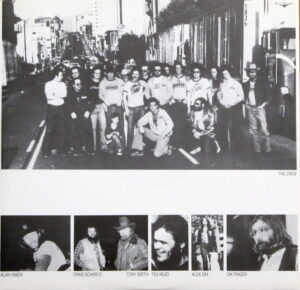
An inner sleeve of the Seconds Out album with the road crew photograph.

Two days later at the Miyako, Phil was as personable as he had been the first time we talked. His solo career hadn’t begun, and he was not yet the major star he would become. I asked how he thought the tour was going, and he was happy to say that they were drawing significantly larger crowds in the venues they had played previously, along with gratifying turnouts where they were playing for the first time.  He also discussed the possibility of the band doing a tour of smaller, club-type venues, noting that he saw The Tubes at The Roxy in Los Angeles and thought they were amazing. Unless I missed something, a Genesis club tour never materialized.

That turned out to be my last interview of any kind for 43 years. (I recently conducted one with musician/engineer/producer Patrick Gleeson for Copper to be published in January.)


Header image: 1970s Genesis promotional photo.

More from Issue 127

View All Articles in Issue 127

Search Copper Magazine

#231 Piano Prodigy Jude Kofie Releases His Debut Album On Octave Records by Frank Doris Jun 01, 2026 #231 Underappreciated Artists, Part Two: City Boy by Rich Isaacs Jun 01, 2026 #231 Music and the Art of Creation: Talking With Saxophonist Rob Scheps by Joe Caplan Jun 01, 2026 #231 How to Play in a Rock Band, 24: Further Adventures at the 2026 Montauk Music Festival by Frank Doris Jun 01, 2026 #231 Courtney Barnett: Creature of Habit by Wayne Robins Jun 01, 2026 #231 Angine de Poitrine: Interstellar Guitar Rock Saviors Headed for Late-Night TV Pop Stardom? by Mark Lepage Jun 01, 2026 #231 My Impressions of AXPONA 2026, Part One by Frank Doris Jun 01, 2026 #231 2026 La Jolla Concours d'Elegance: Another Aesthetic Feast by B. Jan Montana Jun 01, 2026 #231 Country Music Icon Jo Dee Messina’s Bridges: A New Beginning by Ray Chelstowski Jun 01, 2026 #231 The Luxury Dispatch Hosts a Video Podcast With Ken Kessler by Ken Kessler Jun 01, 2026 #231 The Vinyl Beat: Tracking in the Motor City by Rudy Radelic Jun 01, 2026 #231 Lots of Fun With DSP: The Ferrum Audio WANDLA DAC and Its Tube Mode by Frank Doris Jun 01, 2026 #231 From The Audiophile's Guide: Digital Source Components and Streaming Audio by Paul McGowan Jun 01, 2026 #231 Onkyo’s Monster M-510 power amplifier by The Staff at Just Audio Jun 01, 2026 #231 PS Audio in the News by PS Audio Staff Jun 01, 2026 #231 Naming Convention by Peter Xeni Jun 01, 2026 #231 Les Invisibles by Frank Doris Jun 01, 2026 #231 Wildlife Scene by James Schrimpf Jun 01, 2026 #230 Camaraderie by B. Jan Montana May 04, 2026 #230 AXPONA 2026: A Family Gathering by Paul McGowan May 04, 2026 #230 Pianist Ryan Benthall Explores Jazz Realms and Far Beyond With Divine Sky by Frank Doris May 04, 2026 #230 The Vinyl Beat in AXPONA-Land by Rudy Radelic May 04, 2026 #230 Teddy Thompson’s Musical Growth Deepens With Never Be the Same by Ray Chelstowski May 04, 2026 #230 More Fun in the Sun: Florida Audio Expo, Part Two by Frank Doris May 04, 2026 #230 CanJam NYC 2026 Show Report: Heady Sound, Part Two by Frank Doris and Harris Fogel May 04, 2026 #230 Sonic Youth On Murray Street by Wayne Robins May 04, 2026 #230 Graffeo Coffee: A Symphony of Sensory Experience by Joe Caplan May 04, 2026 #230 The Saul Authority: The Story of Hi-Fi Pioneer Saul Marantz by Olivier Meunier-Plante May 04, 2026 #230 How to Play in a Rock Band, 23: Encounters With Famous Musicians, Part Two by Frank Doris May 04, 2026 #230 An Outlier in the Rack: A Vintage BIC Beam Box by The Staff at Just Audio May 04, 2026 #230 PS Audio in the News by PS Audio Staff May 04, 2026 #230 A Cautionary Tale by Rich Isaacs May 04, 2026 #230 Reel-to-Reel Roots, Part 33 (Revised): Ken Kessler Reports On the 2026 (British) AudioJumble by Ken Kessler May 04, 2026 #230 Text Messaging by Frank Doris May 04, 2026 #230 The Audiophile Rat Race by Peter Xeni May 04, 2026 #230 On the Rocks by Rich Isaacs May 04, 2026 #229 The Earliest Stars of Country Music, Part Three by Jeff Weiner Apr 06, 2026 #229 The Healing Power of Music and Sound at the Omega Institute by Joe Caplan Apr 06, 2026 #229 CanJam NYC 2026 Show Report: Heady Sound, Part One by Frank Doris Apr 06, 2026 #229 Florida Audio Expo 2026: Warming Up to High-End Audio, Part One by Frank Doris Apr 06, 2026 #229 Quick Takes: Anne Bisson, Sam Morrison, The Velvet Underground, and the Stooges by Frank Doris Apr 06, 2026 #229 The Vinyl Beat: New Arrivals, and Old Audio Show Demo Scores to Settle by Rudy Radelic Apr 06, 2026 #229 Harvard Gets a High-End Audio Education by Frank Doris Apr 06, 2026 #229 No Country for Old Knees by B. Jan Montana Apr 06, 2026 #229 How To Play in A Rock Band, 22: Encounters With Famous Musicians, Part 1 by Frank Doris Apr 06, 2026 #229 The Soulful Grooves of Guinea-Bissau by Steve Kindig Apr 06, 2026 #229 Four-Hand Piano Performance at Its Finest by Stephan Haberthür Apr 06, 2026

Interviewing Genesis in the 1970s, Part Two

Interviewing Genesis in the 1970s, Part Two

Or, How I Got to Meet My Idols

My first two interviews with members of Genesis, in 1974 and 1975, were initially made possible by the fact that I was the music director of KRTG, the radio station of San Francisco State University. They had come about through a series of unlikely events (see Issue 125). I graduated later in 1975, and lost the “in” that I had with the record label. I had hoped to continue getting to speak with the band after that, especially since, in the interim, Peter Gabriel had left Genesis for a solo career and drummer Phil Collins had taken over as lead vocalist. Without any connections, I had no idea of how to make that happen. What ultimately ended up transpiring involved another set of serendipitous circumstances.

Genesis was going to play at the Berkeley Community Theater on April 29, 1976, in support of A Trick of the Tail, their first album without Gabriel. My roommate, Dave, was another progressive rock fan and he played bass guitar. He decided to try to get me an interview. In the days before cell phones, one had to pay for long distance calls, and they could be expensive. He got hold of someone’s telephone credit card (I didn’t ask questions) and made a bunch of calls, ultimately finding the travel agency that was booking the tour. He learned that the band would be staying at the Marriott Inn on the Berkeley Marina.


Early in the afternoon of the show, we parked ourselves in the lobby of the Marriott and waited. Soon, a nondescript station wagon pulled up and Phil Collins got out. In a gutsy move that I now can’t believe I did, I just walked up and started helping him unload the car. I introduced myself and asked if he remembered the interview I had done. He wasn’t sure my face looked familiar, and certainly didn’t remember my name. I asked if he remembered me asking him about a Flaming Youth album. He replied, “Oh yeah, at the Holiday Inn two years ago.” Bingo! I then asked if he thought I could do another interview. He said, “Yes,” and had me follow him toward his room. As we crossed the parking lot, tour manager Dik Fraser intercepted me and told me to leave Phil alone. There went my shot at the interview – or so I thought.

That evening, my seat in the theater just happened to be behind that of Stephen M.H. Braitman, another music writer that I knew. I said, “hi,” and we talked for a bit. He told me that he had an interview lined up with guitarist Steve Hackett after the show. Hackett had just released a solo album, Voyage of the Acolyte, on the Chrysalis label. Stephen had more mainstream tastes in music and was not really a fan of progressive rock. He said that a friend of his was going to help with questions, but the friend had backed out. He asked if I wanted to do the interview myself! I told him, “my tape recorder is in the car – I’d love to!” After the show, which was great, Stephen brought me backstage while Dave waited. I spotted the tour manager, Dik, and when he saw me, I could tell he was thinking, “how the hell did he get in here?”


After some conversation, it was decided that we would do the interview back at the lobby of the hotel, so Dave and I headed that way. Steve Hackett sat down with us, and bassist Mike Rutherford joined in. Dave and Mike hit it off talking about bass guitars, particularly Dave’s custom Alembic bass. I finally got a complete set of autographs on my Selling England by the Pound and The Lamb Lies Down on Broadway albums, and I was able to use material from this and the prior interviews for an article that was published in a Sacramento-based music magazine called the Rock-N-ROLL news. (That article will be reprinted in a future issue of Copper.) I ended up doing a few more articles for the publication. Editor Mike Farrace would go on to establish Pulse!, the in-house magazine of Tower Records.

In March of 1977, Genesis was returning to the Bay Area for two nights, touring in support of their album Wind and Wuthering. I wanted another shot at an interview, but there just didn’t seem to be a way to make it happen, despite having now become a published writer. Once again, Dave had a plan. On the afternoon of the first show, we went to the backstage entrance of Winterland. Dave had brought along the aforementioned Alembic bass guitar. We knocked on the door, and when a roadie came out, Dave said, “Mike Rutherford wants to see this bass.” I was amazed when he was ushered in. While I waited outside for him, I watched as the road crew came out and gathered for a group photo alongside one of the equipment trucks. That picture ended up printed on one of the inner sleeves for the double live album Seconds Out. (Note: Fraser’s name was misspelled as Frazer on the sleeve.) When Dave came out a while later, he had secured an interview for me with Phil Collins at the Miyako Hotel, where the band was staying.

An inner sleeve of the Seconds Out album with the road crew photograph.

Two days later at the Miyako, Phil was as personable as he had been the first time we talked. His solo career hadn’t begun, and he was not yet the major star he would become. I asked how he thought the tour was going, and he was happy to say that they were drawing significantly larger crowds in the venues they had played previously, along with gratifying turnouts where they were playing for the first time.  He also discussed the possibility of the band doing a tour of smaller, club-type venues, noting that he saw The Tubes at The Roxy in Los Angeles and thought they were amazing. Unless I missed something, a Genesis club tour never materialized.

That turned out to be my last interview of any kind for 43 years. (I recently conducted one with musician/engineer/producer Patrick Gleeson for Copper to be published in January.)


Header image: 1970s Genesis promotional photo.

0 comments

Leave a comment

0 Comments

Your avatar

Loading comments...

🗑️ Delete Comment

Enter moderator password to delete this comment:

✏️ Edit Comment

Enter your email to verify ownership: