COPPER

A PS Audio Publication

Issue 92 • Free Online Magazine

Issue 92 IN MY ROOM

A Turntable of my Own, Part 3

A Turntable of my Own, Part 3
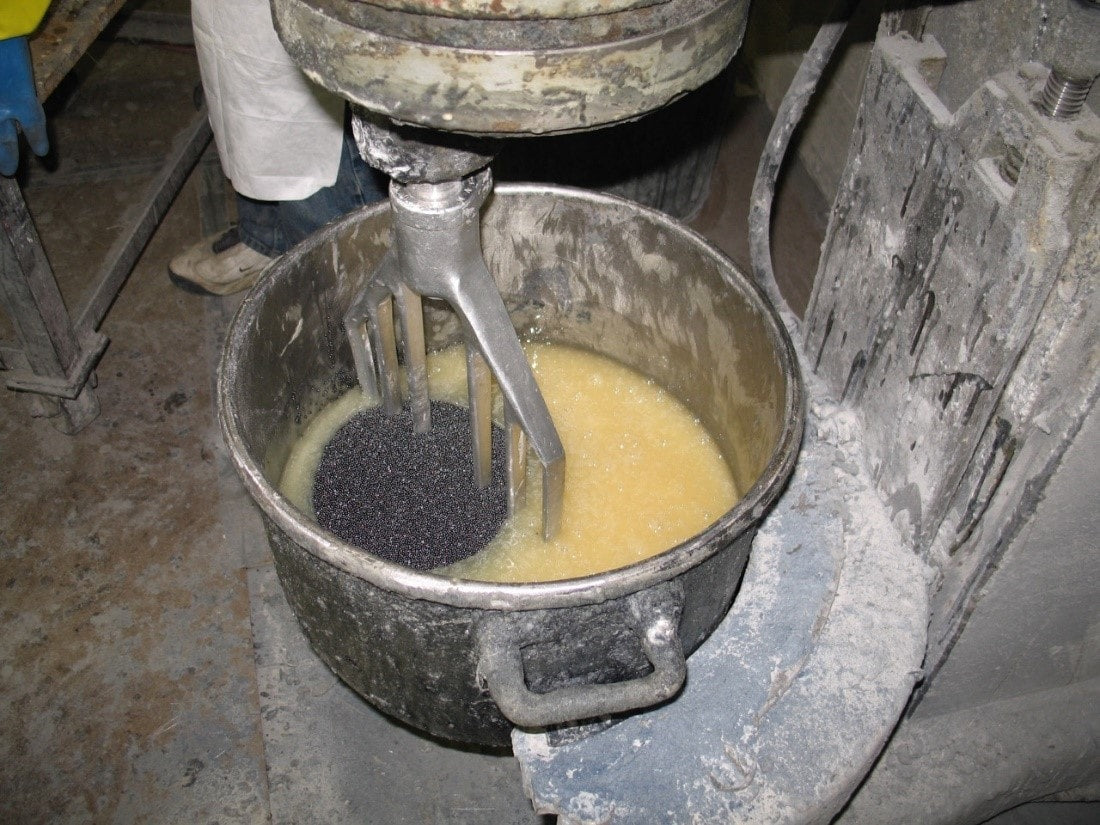
Copper#90 ; Part 2, in Copper #91---Ed.> All of the brass points/receptor cups were designed to have cored-out cups so they could be filled with a lead/elastomer matrix. Using a urethane matrix eliminated the possibility of the lead shrinking away from the brass cups as it cooled. The bottom of all of the cups were fitted with ¼” diameter steel ball bearings bonded into recesses machined into the bottom of the cups; therefore, assuring a three-point contact. Here we see epoxy resin being blended with #9 lead shot in a Hobart mixer just before being poured into the undersides of the main plinth and drive motor support bases. This is the underside of the sub-base for the VPI double motor flywheel drives, ready to be filled with the epoxy/lead matrix. This is the underside of the main turntable plinth, ready to be filled with the epoxy/lead matrix. The next step in getting the Minus K properly set up to support the weight of the turntable is to bond ½” thick high durometer rubber to the center top plate on the Minus K unit. It is being bonded down with a polyurethane elastomer adhesive. This adhesive will remain flexible after it is fully cured. Initially it was my thought to install a pair of air pressure gauges, one for each of the Kuzma Air Lines and a vacuum gauge for the Sota vacuum pump. After thinking about it, I thought the gauges really serve no purpose and look out of place, as it made the unit look too industrial, so I ended up removing them. After applying a layer of polyurethane adhesive to the top of the rubber blocks on the Minus K, I lowered into place the aluminum plate that will accept the plinth for the turntable. This plate has become part of the Minus K isolator. Immediately after applying the adhesive, the plate was lowered and accurately positioned squarely on top of the rubber pads on the Minus K isolator. The adhesive was then allowed to cure. I might add the following; the thin sheet metal box that came with the Minus K, protecting the inner workings from dust, debris, etc., has been replaced by a number of ½” thick aluminum plates that will not only serve the same purpose but be much more aesthetically pleasing. Ed.>
More from Issue 92

View All Articles in Issue 92

Search Copper Magazine

#227 Seth Lewis Gets in the Groove With Take a Look Around: a Tribute to the Meters by Frank Doris Feb 02, 2026 #227 Passport to Sound: May Anwar’s Audio Learning Experience for Young People by Frank Doris Feb 02, 2026 #227 Conjectures on Cosmic Consciousness by B. Jan Montana Feb 02, 2026 #227 The Big Takeover Turns 45 by Wayne Robins Feb 02, 2026 #227 Music and Chocolate: On the Sensory Connection by Joe Caplan Feb 02, 2026 #227 Singer/Songwriter Chris Berardo: Getting Wilder All the Time by Ray Chelstowski Feb 02, 2026 #227 The Earliest Stars of Country Music, Part One by Jeff Weiner Feb 02, 2026 #227 The Vinyl Beat Goes Down to Tijuana (By Way of Los Angeles), Part Two by Rudy Radelic Feb 02, 2026 #227 How to Play in a Rock Band, 20: On the Road With Blood, Sweat & Tears’ Guitarist Gabe Cummins by Frank Doris Feb 02, 2026 #227 From The Audiophile’s Guide: Audio Specs and Measuring by Paul McGowan Feb 02, 2026 #227 Our Brain is Always Listening by Peter Trübner Feb 02, 2026 #227 PS Audio in the News by PS Audio Staff Feb 02, 2026 #227 The Listening Chair: Sleek Style and Sound From the Luxman L3 by Howard Kneller Feb 02, 2026 #227 The Los Angeles and Orange County Audio Society Celebrates Its 32nd Anniversary, Honoring David and Sheryl Lee Wilson and Bernie Grundman by Harris Fogel Feb 02, 2026 #227 Back to My Reel-to-Reel Roots, Part 26: Half Full – Not Half Empty, Redux by Ken Kessler Feb 02, 2026 #227 That's What Puzzles Us... by Frank Doris Feb 02, 2026 #227 Record-Breaking by Peter Xeni Feb 02, 2026 #227 The Long and Winding Road by B. Jan Montana Feb 02, 2026 #226 JJ Murphy’s Sleep Paralysis is a Genre-Bending Musical Journey Through Jazz, Fusion and More by Frank Doris Jan 05, 2026 #226 Stewardship by Consent by B. Jan Montana Jan 05, 2026 #226 Food, Music, and Sensory Experience: An Interview With Professor Jonathan Zearfoss of the Culinary Institute of America by Joe Caplan Jan 05, 2026 #226 Studio Confidential: A Who’s Who of Recording Engineers Tell Their Stories by Frank Doris Jan 05, 2026 #226 Pilot Radio is Reborn, 50 Years Later: Talking With CEO Barak Epstein by Frank Doris Jan 05, 2026 #226 The Vinyl Beat Goes Down to Tijuana (By Way of Los Angeles), Part One by Rudy Radelic Jan 05, 2026 #226 Capital Audiofest 2025: Must-See Stereo, Part Two by Frank Doris Jan 05, 2026 #226 My Morning Jacket’s Carl Broemel and Tyler Ramsey Collaborate on Their Acoustic Guitar Album, Celestun by Ray Chelstowski Jan 05, 2026 #226 The People Who Make Audio Happen: CanJam SoCal 2025, Part Two by Harris Fogel Jan 05, 2026 #226 How to Play in a Rock Band, 19: Touring Can Make You Crazy, Part One by Frank Doris Jan 05, 2026 #226 Linda Ronstadt Goes Bigger by Wayne Robins Jan 05, 2026 #226 From The Audiophile’s Guide: Active Room Correction and Digital Signal Processing by Paul McGowan Jan 05, 2026 #226 PS Audio in the News by Frank Doris Jan 05, 2026 #226 Back to My Reel-to-Reel Roots, Part 25: Half-Full, Not Empty by Ken Kessler Jan 05, 2026 #226 Happy New Year! by Frank Doris Jan 05, 2026 #226 Turn It Down! by Peter Xeni Jan 05, 2026 #226 Ghost Riders by James Schrimpf Jan 05, 2026 #226 A Factory Tour of Audio Manufacturer German Physiks by Markus "Marsu" Manthey Jan 04, 2026 #225 Capital Audiofest 2025: Must-See Stereo, Part One by Frank Doris Dec 01, 2025 #225 Otis Taylor and the Electrics Delivers a Powerful Set of Hypnotic Modern Blues by Frank Doris Dec 01, 2025 #225 A Christmas Miracle by B. Jan Montana Dec 01, 2025 #225 T.H.E. Show New York 2025, Part Two: Plenty to See, Hear, and Enjoy by Frank Doris Dec 01, 2025 #225 Underappreciated Artists, Part One: Martin Briley by Rich Isaacs Dec 01, 2025 #225 Rock and Roll is Here to Stay by Wayne Robins Dec 01, 2025 #225 A Lifetime of Holiday Record (and CD) Listening by Rudy Radelic Dec 01, 2025 #225 Little Feat: Not Saying Goodbye, Not Yet by Ray Chelstowski Dec 01, 2025 #225 How to Play in a Rock Band, Part 18: Dealing With Burnout by Frank Doris Dec 01, 2025 #225 The People Who Make Audio Happen: CanJam SoCal 2025 by Harris Fogel Dec 01, 2025 #225 Chicago’s Sonic Sanctuaries: Four Hi‑Fi Listening Bars Channeling the Jazz‑Kissa Spirit by Olivier Meunier-Plante Dec 01, 2025

A Turntable of my Own, Part 3

A Turntable of my Own, Part 3
Copper#90 ; Part 2, in Copper #91---Ed.> All of the brass points/receptor cups were designed to have cored-out cups so they could be filled with a lead/elastomer matrix. Using a urethane matrix eliminated the possibility of the lead shrinking away from the brass cups as it cooled. The bottom of all of the cups were fitted with ¼” diameter steel ball bearings bonded into recesses machined into the bottom of the cups; therefore, assuring a three-point contact. Here we see epoxy resin being blended with #9 lead shot in a Hobart mixer just before being poured into the undersides of the main plinth and drive motor support bases. This is the underside of the sub-base for the VPI double motor flywheel drives, ready to be filled with the epoxy/lead matrix. This is the underside of the main turntable plinth, ready to be filled with the epoxy/lead matrix. The next step in getting the Minus K properly set up to support the weight of the turntable is to bond ½” thick high durometer rubber to the center top plate on the Minus K unit. It is being bonded down with a polyurethane elastomer adhesive. This adhesive will remain flexible after it is fully cured. Initially it was my thought to install a pair of air pressure gauges, one for each of the Kuzma Air Lines and a vacuum gauge for the Sota vacuum pump. After thinking about it, I thought the gauges really serve no purpose and look out of place, as it made the unit look too industrial, so I ended up removing them. After applying a layer of polyurethane adhesive to the top of the rubber blocks on the Minus K, I lowered into place the aluminum plate that will accept the plinth for the turntable. This plate has become part of the Minus K isolator. Immediately after applying the adhesive, the plate was lowered and accurately positioned squarely on top of the rubber pads on the Minus K isolator. The adhesive was then allowed to cure. I might add the following; the thin sheet metal box that came with the Minus K, protecting the inner workings from dust, debris, etc., has been replaced by a number of ½” thick aluminum plates that will not only serve the same purpose but be much more aesthetically pleasing. Ed.>

0 comments

Leave a comment

0 Comments

Your avatar

Loading comments...

🗑️ Delete Comment

Enter moderator password to delete this comment:

✏️ Edit Comment

Enter your email to verify ownership: