COPPER

A PS Audio Publication

Issue 178 • Free Online Magazine

Issue 178 Revolutions Per Minute

Around the World In 80 Lathes, Part 28

Around the World In 80 Lathes, Part 28

Having visited the Great British disk recording industry in our last episode (Issue 177), it is now time to ask where it all began. How did they start eating beans on toast, and why would anyone think that manufacturing a bonsai car in large numbers would be a good idea (not to mention the millions of people who actually bought them)?

Or better, we could explore the humble early beginnings of sound recording instead. Where did it all start, and what were the earliest machines like? Who made them, and what were they thinking?

I will start from the very beginning, highlighting the evolutionary milestones that led to the invention, development and refinement of the disk recording lathe from the dawn of time to the present day. First came the big bang, then dinosaurs, some other unimportant stuff, and a few thousand years down the line, came sound recording, finally bringing some sense to this world. (I really tried to offer an unbiased perspective…and failed!)

The concept of sound recording dates to the middle of the 19th century, developed by what we would now consider over-skilled individuals, in different parts of the world, in dimly-lit, unheated sheds and workshops, before electricity was a thing. It escalated rather rapidly into one of the largest industries of the past century, all the way to luxury goods marketed as being made from hair collected from a unicorn’s posterior under the full moon.

Sound recording did not start with the disk medium and in fact, it did not start with a medium that could be reproduced. In 1857, Édouard-Léon Scott de Martinville invented the Phonautograph, a device that could record sound on paper or glass by drawing the soundwaves, but offered no means of playing it back again as sound. In 1877, Charles Cross described a device that could record sound on a cylinder using a screw, but hadn’t actually succeeded in building one yet, when Thomas Edison came up with the Phonograph. The Phonograph was the first invention that would not only record, but also subsequently play back sound. This essentially means that our industry will be celebrating 146 years of existence in the new year. In 1887, Emile Berliner joined the game with his own cylinder recorder, but in 1888 decided to use a flat disk as the recording medium, creating the disk record.

The very first disk recording lathe in the world was therefore built by Emile Berliner. It was rather crude, but the idea was out there, and it would see constant refinement for many decades to come.
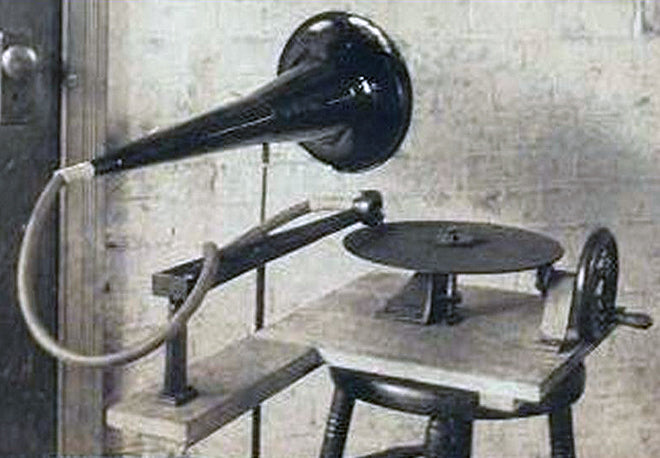
A hand-cranked disk recording lathe by Emile Berliner.
  A hand-cranked disk recording lathe by Emile Berliner.
Drawing of the Emile Berliner hand-cranked lathe.
  Drawing of the Emile Berliner hand-cranked lathe.

Columbia Records started in 1888 as well, followed a year later by the Gramophone Company in London. This was the acoustic recording era, meaning that all recordings during this time were conducted without using electrical equipment. There were no microphones, no mixing consoles, no amplifiers and no electric motors to power the lathes. This was not a situation particular to the sound recording industry. Manufacturing during that time did not rely on electricity and electric power was not widely available. Early electric motors were prohibitively expensive, and it was unheard of for multiple motors to be used in a factory to power the machinery.

Early disk recording lathe used by The Gramophone Company.

At the time, a typical factory would have a single source of power, typically a steam engine, which was sometimes shared by neighboring factories. The steam engine would drive a long shaft spanning the entire length of a building, fitted with multiple pulleys, on which flat leather belts would run, with a tensioning system that would allow the belts to be slid on and off the pulleys as needed. The long shaft, typically situated overhead, right under the ceiling, was called a line shaft. The various machines in the factory were all powered by the same line shaft system, which would always remain in motion. The individual machines could be started and stopped by engaging or disengaging their belts while the line shaft was running. There were no belt guards or emergency stop buttons, and pressure vessels were not known to be the safest things to sit around. OSHA (the Occupational Health and Safety Administration) had not been yet been created!

This kind of setup was not suitable for powering sound recording equipment. Line shaft systems were only used in large factories, where a lot of power was needed for powering hundreds of machines. They were very expensive, noisy, not at all portable and worst of all, did not run at a steady or even predictable speed. Small workshops that only had a metalworking lathe or a drill would often power these machines using a treadle, in a manner similar to early treadle-operated sewing machines. Unlike a sewing machine, however, it took quite some muscle to run a metalworking lathe in this manner. To be able to do that while actually machining was quite a feat, as anyone who has ever tried to operate a treadle-powered lathe will have quickly found out. Yet, this was exactly the environment in which early disk recording lathes were made.

The very early units were simply hand-cranked, but it was impossible to maintain speed stability in this manner, so more elaborate mechanisms were developed. In the mid-1890s, Eldridge Johnson of Camden, New Jersey, was commissioned by The Gramophone Company and their associates in the US to develop a spring-powered and mechanically-speed-governed drive system, similar to what most people associate with gramophones nowadays. This became one of the two established ways to power such devices prior to the shift to electric motor in the late 1920s. The other method involved a weight -driven mechanism, again utilizing a mechanical speed governor.

There is very little information available regarding the exact construction of the early disk recording lathes used commercially by the record labels of the time for their acoustic recordings, and very few photographs. The basic design principles were shared among the machines. They all had a platter driven by one of the two purely mechanical drive systems. They all had a sound box consisting of a thin glass diaphragm, and a horn to “collect” the sound. The diaphragm would vibrate with the sound, imparting this motion to a cutting stylus that would wiggle while cutting the groove on a blank disk. Shapes, sizes and degree of sophistication would vary greatly, but the general operation was the same.

The early disk recording lathes seen in the limited photographic documentation that survives appear to have been very crudely made, mostly out of wood, with very few accurately machined metal parts.

Emile Berliner with the hand-cranked lathe.
  Emile Berliner with the hand-cranked lathe.
The Berliner lathe as featured in Scientific American, 1896.
  The Berliner lathe as featured in Scientific American, 1896.
The improved Berliner gramophone.

In 1909, an experienced machinist by the name of John J. Scully made his first disk recording lathe, while employed by the Columbia Phonograph Company, where he was contributing improvements to the Dictaphone. He left Columbia in 1918 and went on to briefly work for the General Phonograph Corporation, before establishing the Scully Recording Instruments Corporation in 1919 in Bridgeport, Connecticut. The early Scully lathes were weight-driven and were a game-changer in terms of design and build quality. In these early lathes, it was the platter and drive assembly that would advance under the stationary soundbox. Scully lathes were made of machined metal, in the tradition of proper machine tools, for which Bridgeport was well known, having been a hub for the development of the machine tool industry in the US. The Scully lathe was the first disk recording lathe truly worthy of being called a lathe.

In 1924, Western Electric purchased a Scully lathe, which they equipped with their first cutter head for electric recording. Western Electric demonstrated and licensed their system to Columbia and the Victor Talking Machine Company, prompting Scully to update the design of their lathe. The changes included an electric motor, a stationary platter, and a carriage advancing over the platter. In the second half of the 1920s, the acoustic era came to an end and electric recording took over. Scully had set the bar very high and dominated the disk mastering market for several decades, keeping their high-quality standards intact until the end. John Scully can be credited with introducing the first properly engineered solution to the problem of developing a disk recording lathe, utilizing his skills in machining and industrial manufacturing to create a machine that brought new standards to the industry and pointed to the direction things would be heading in the decades to come. Nevertheless, I believe that fewer than 10 acoustic recording lathes were made by Scully in total. His son, Lawrence J. Scully, joined the company in 1933 and carried on the torch.

Bernard MacMahon and Nick Bergh with the Western Electric Recording System in The American Epic Sessions. Courtesy of American Epic, © 2017 Lo-Max Records Ltd.

Bernard MacMahon and Nick Bergh with the Western Electric Recording System in The American Epic Sessions. Courtesy of American Epic, © 2017 Lo-Max Records Ltd.

The price of the early acoustic-era Scully lathe is not known, but the first electrical-era Scully lathes cost approximately $30,000 in modern dollars (adjusted for inflation), not including the cutter head, cutting amplifier rack and several other pieces of equipment that would be needed to be able to use the lathe. The later model Scully, with manually adjustable, electronically variable pitch would be priced at $90,000 in modern dollars, again not including anything but the bare lathe. This sector always had a pretty high entry level, but considering the materials and level of craftsmanship that went into these machines, their prices were quite reasonable.

If you don’t believe me, try to make one!

I have!

At least, by the time the electrical era had arrived, it was possible to buy a disk recording lathe and the associated equipment to get started. In the early days of acoustic recording, if you wanted to get involved in sound recording, you had to make everything from scratch!

One thing is certain: We owe the existence of sound recording to the creative, crafty and resourceful individuals who dared to dive into the unknown, into uncharted waters, to develop something nobody had done before. Similarly, we owe its continued development and refinement to those who dared to take it a few steps further, believing that there is room for improvement. There always is.
It just takes someone to believe in it and dare to do it.


Header image: from the documentary American Epic, a restored Western Electric recording system with Western Electric recording rack. Scully Lathe, and Western Electric microphone. Courtesy of American Epic,© 2017 Lo-Max Records Ltd.

More from Issue 178

View All Articles in Issue 178

Search Copper Magazine

#234 A Life in High-End Audio: The Roy Hall Interview, Part One by Frank Doris Sep 07, 2026 #234 Jason Greenlaw Offers His Personal Perspective on Jazz Guitar in Vantage Point by Frank Doris Sep 07, 2026 #234 Transcendent Phoenix: Lucina Yue Brings the Ancient Konghou Into Modern Times by Frank Doris Sep 07, 2026 #234 We Must All Follow Our Bliss by B. Jan Montana Sep 07, 2026 #234 How to Play in a Rock Band, 27: Leveling Up by Frank Doris Sep 07, 2026 #234 Ross Valory: Traveling Into New Musical Territory With All of the Above by Ray Chelstowski Sep 07, 2026 #234 Singer/Songwriter John David Schrader: On the Need to Create by Joe Caplan Sep 07, 2026 #234 The People Who Make Audio Happen: More From T.H.E. Show SoCal 2026 by Harris Fogel Sep 07, 2026 #234 The Vinyl Beat Digs Into the Gadget Box by Rudy Radelic Sep 07, 2026 #234 The Rolling Stones: Foreign Tongues Spoken Loud by Wayne Robins Sep 07, 2026 #234 Musical Moments by Rich Isaacs Sep 07, 2026 #234 Rags for Solo Piano and a Dog: David Chesky's Ragtime Music for the Modern Age by Frankly Speaking Sep 07, 2026 #234 HIGH END 2026, Vienna: Here to Stay by Carsten Barnbeck Sep 07, 2026 #234 From The Audiophile’s Guide: The Two Main Types of Loudpeakers – Box and Panel by Paul McGowan Sep 07, 2026 #234 Letting it Slide by Frank Doris Sep 07, 2026 #234 PS Audio in the News by PS Audio Staff Sep 07, 2026 #234 Long Playing by Peter Xeni Sep 07, 2026 #234 La Mer by B. Jan Montana Sep 07, 2026 #233 A Report From The Total Hi-Fi Experience Show SoCal 2026 by B. Jan Montana Aug 03, 2026 #233 Bluegrass Meets Country, Folk, Jazz and More in All That We Carried by The Squid City Slingers by Frank Doris Aug 03, 2026 #233 Corey Glover and One Tribe Nation: A Variegated Musical Collective by Ray Chelstowski Aug 03, 2026 #233 Excursions with Clive: The Late Clive Davis, A Personal History by Wayne Robins Aug 03, 2026 #233 AI, Art, and Music: A Conversation With Synthography Art by Joe Caplan Aug 03, 2026 #233 New American Symphonies: A Rediscovered Gem and a Vital Contemporary Work by Frank Doris Aug 03, 2026 #233 The Vinyl Beat: Genesis, the Dave Clark Five, Antonio Carlos Jobim and More by Rudy Radelic Aug 03, 2026 #233 How to Play in a Rock Band, 26: When It's Time to Record Your Music by Frank Doris Aug 03, 2026 #233 More From T.H.E. Show 2026, and the People Who Made it Happen by Harris Fogel Aug 03, 2026 #233 Underappreciated Artists, Part Three: Icehouse by Rich Isaacs Aug 03, 2026 #233 The Surprisingly Rich and Varied Music of Somalia by Steve Kindig Aug 03, 2026 #233 A Remarkable Discographic Legacy: The LP Recordings of the Basel Symphony Orchestra by Stephan Haberthür Aug 03, 2026 #233 From The Audiophile’s Guide: The Importance of Loudspeakers by Paul McGowan Aug 03, 2026 #233 From Swimming Pool to New Listening Room: A Conversation with Norman Varney of AV RoomService by Gilles Laferrière Aug 03, 2026 #233 PS Audio in the News by PS Audio Staff Aug 03, 2026 #233 Audio Jewelry by Peter Xeni Aug 03, 2026 #233 Enrich Your Life by Frank Doris Aug 03, 2026 #233 The Searcher by James Schrimpf Aug 03, 2026 #232 What came first: Art or Music? A Conversation With Artist Jose Acosta by Joe Caplan Jul 06, 2026 #232 Blow By Blow: The Jeff Beck Story: An Insightful Book About a Guitar Icon by Ray Chelstowski Jul 06, 2026 #232 Creed Over Camaraderie? by B. Jan Montana Jul 06, 2026 #232 Chronicles of a Sound Pilgrim at the 2026 Montreal Audiofest by Hugues Morin Jul 06, 2026 #232 The Vinyl Beat: Summer Grooves by Rudy Radelic Jul 06, 2026 #232 Hibbing Hillbilly Dylan's Acoustic Rock by Wayne Robins Jul 06, 2026 #232 Quad Quads and Plasmatronics Tweeters: An Extraordinary System Comes to Life by Frank Doris Jul 06, 2026 #232 In Praise of Live Music, Once Again by Ted Shafran Jul 06, 2026 #232 Allnic Audio’s L-9000 Preamplifier: Design and Engineering Innovation by Howard Kneller Jul 06, 2026 #232 “Best Of” Lists and Rage Bait: Enough Already by Frank Doris Jul 06, 2026 #232 Quick Takes: Bud Shank, Paulo Almeida, Jakob Dreyer, Tim Eriksen and Peter Irvine by Frank Doris Jul 06, 2026

Around the World In 80 Lathes, Part 28

Around the World In 80 Lathes, Part 28

Having visited the Great British disk recording industry in our last episode (Issue 177), it is now time to ask where it all began. How did they start eating beans on toast, and why would anyone think that manufacturing a bonsai car in large numbers would be a good idea (not to mention the millions of people who actually bought them)?

Or better, we could explore the humble early beginnings of sound recording instead. Where did it all start, and what were the earliest machines like? Who made them, and what were they thinking?

I will start from the very beginning, highlighting the evolutionary milestones that led to the invention, development and refinement of the disk recording lathe from the dawn of time to the present day. First came the big bang, then dinosaurs, some other unimportant stuff, and a few thousand years down the line, came sound recording, finally bringing some sense to this world. (I really tried to offer an unbiased perspective…and failed!)

The concept of sound recording dates to the middle of the 19th century, developed by what we would now consider over-skilled individuals, in different parts of the world, in dimly-lit, unheated sheds and workshops, before electricity was a thing. It escalated rather rapidly into one of the largest industries of the past century, all the way to luxury goods marketed as being made from hair collected from a unicorn’s posterior under the full moon.

Sound recording did not start with the disk medium and in fact, it did not start with a medium that could be reproduced. In 1857, Édouard-Léon Scott de Martinville invented the Phonautograph, a device that could record sound on paper or glass by drawing the soundwaves, but offered no means of playing it back again as sound. In 1877, Charles Cross described a device that could record sound on a cylinder using a screw, but hadn’t actually succeeded in building one yet, when Thomas Edison came up with the Phonograph. The Phonograph was the first invention that would not only record, but also subsequently play back sound. This essentially means that our industry will be celebrating 146 years of existence in the new year. In 1887, Emile Berliner joined the game with his own cylinder recorder, but in 1888 decided to use a flat disk as the recording medium, creating the disk record.

The very first disk recording lathe in the world was therefore built by Emile Berliner. It was rather crude, but the idea was out there, and it would see constant refinement for many decades to come.

A hand-cranked disk recording lathe by Emile Berliner.
  A hand-cranked disk recording lathe by Emile Berliner.
Drawing of the Emile Berliner hand-cranked lathe.
  Drawing of the Emile Berliner hand-cranked lathe.

Columbia Records started in 1888 as well, followed a year later by the Gramophone Company in London. This was the acoustic recording era, meaning that all recordings during this time were conducted without using electrical equipment. There were no microphones, no mixing consoles, no amplifiers and no electric motors to power the lathes. This was not a situation particular to the sound recording industry. Manufacturing during that time did not rely on electricity and electric power was not widely available. Early electric motors were prohibitively expensive, and it was unheard of for multiple motors to be used in a factory to power the machinery.

Early disk recording lathe used by The Gramophone Company.

At the time, a typical factory would have a single source of power, typically a steam engine, which was sometimes shared by neighboring factories. The steam engine would drive a long shaft spanning the entire length of a building, fitted with multiple pulleys, on which flat leather belts would run, with a tensioning system that would allow the belts to be slid on and off the pulleys as needed. The long shaft, typically situated overhead, right under the ceiling, was called a line shaft. The various machines in the factory were all powered by the same line shaft system, which would always remain in motion. The individual machines could be started and stopped by engaging or disengaging their belts while the line shaft was running. There were no belt guards or emergency stop buttons, and pressure vessels were not known to be the safest things to sit around. OSHA (the Occupational Health and Safety Administration) had not been yet been created!

This kind of setup was not suitable for powering sound recording equipment. Line shaft systems were only used in large factories, where a lot of power was needed for powering hundreds of machines. They were very expensive, noisy, not at all portable and worst of all, did not run at a steady or even predictable speed. Small workshops that only had a metalworking lathe or a drill would often power these machines using a treadle, in a manner similar to early treadle-operated sewing machines. Unlike a sewing machine, however, it took quite some muscle to run a metalworking lathe in this manner. To be able to do that while actually machining was quite a feat, as anyone who has ever tried to operate a treadle-powered lathe will have quickly found out. Yet, this was exactly the environment in which early disk recording lathes were made.

The very early units were simply hand-cranked, but it was impossible to maintain speed stability in this manner, so more elaborate mechanisms were developed. In the mid-1890s, Eldridge Johnson of Camden, New Jersey, was commissioned by The Gramophone Company and their associates in the US to develop a spring-powered and mechanically-speed-governed drive system, similar to what most people associate with gramophones nowadays. This became one of the two established ways to power such devices prior to the shift to electric motor in the late 1920s. The other method involved a weight -driven mechanism, again utilizing a mechanical speed governor.

There is very little information available regarding the exact construction of the early disk recording lathes used commercially by the record labels of the time for their acoustic recordings, and very few photographs. The basic design principles were shared among the machines. They all had a platter driven by one of the two purely mechanical drive systems. They all had a sound box consisting of a thin glass diaphragm, and a horn to “collect” the sound. The diaphragm would vibrate with the sound, imparting this motion to a cutting stylus that would wiggle while cutting the groove on a blank disk. Shapes, sizes and degree of sophistication would vary greatly, but the general operation was the same.

The early disk recording lathes seen in the limited photographic documentation that survives appear to have been very crudely made, mostly out of wood, with very few accurately machined metal parts.

Emile Berliner with the hand-cranked lathe.
  Emile Berliner with the hand-cranked lathe.
The Berliner lathe as featured in Scientific American, 1896.
  The Berliner lathe as featured in Scientific American, 1896.
The improved Berliner gramophone.

In 1909, an experienced machinist by the name of John J. Scully made his first disk recording lathe, while employed by the Columbia Phonograph Company, where he was contributing improvements to the Dictaphone. He left Columbia in 1918 and went on to briefly work for the General Phonograph Corporation, before establishing the Scully Recording Instruments Corporation in 1919 in Bridgeport, Connecticut. The early Scully lathes were weight-driven and were a game-changer in terms of design and build quality. In these early lathes, it was the platter and drive assembly that would advance under the stationary soundbox. Scully lathes were made of machined metal, in the tradition of proper machine tools, for which Bridgeport was well known, having been a hub for the development of the machine tool industry in the US. The Scully lathe was the first disk recording lathe truly worthy of being called a lathe.

In 1924, Western Electric purchased a Scully lathe, which they equipped with their first cutter head for electric recording. Western Electric demonstrated and licensed their system to Columbia and the Victor Talking Machine Company, prompting Scully to update the design of their lathe. The changes included an electric motor, a stationary platter, and a carriage advancing over the platter. In the second half of the 1920s, the acoustic era came to an end and electric recording took over. Scully had set the bar very high and dominated the disk mastering market for several decades, keeping their high-quality standards intact until the end. John Scully can be credited with introducing the first properly engineered solution to the problem of developing a disk recording lathe, utilizing his skills in machining and industrial manufacturing to create a machine that brought new standards to the industry and pointed to the direction things would be heading in the decades to come. Nevertheless, I believe that fewer than 10 acoustic recording lathes were made by Scully in total. His son, Lawrence J. Scully, joined the company in 1933 and carried on the torch.

Bernard MacMahon and Nick Bergh with the Western Electric Recording System in The American Epic Sessions. Courtesy of American Epic, © 2017 Lo-Max Records Ltd.

Bernard MacMahon and Nick Bergh with the Western Electric Recording System in The American Epic Sessions. Courtesy of American Epic, © 2017 Lo-Max Records Ltd.

The price of the early acoustic-era Scully lathe is not known, but the first electrical-era Scully lathes cost approximately $30,000 in modern dollars (adjusted for inflation), not including the cutter head, cutting amplifier rack and several other pieces of equipment that would be needed to be able to use the lathe. The later model Scully, with manually adjustable, electronically variable pitch would be priced at $90,000 in modern dollars, again not including anything but the bare lathe. This sector always had a pretty high entry level, but considering the materials and level of craftsmanship that went into these machines, their prices were quite reasonable.

If you don’t believe me, try to make one!

I have!

At least, by the time the electrical era had arrived, it was possible to buy a disk recording lathe and the associated equipment to get started. In the early days of acoustic recording, if you wanted to get involved in sound recording, you had to make everything from scratch!

One thing is certain: We owe the existence of sound recording to the creative, crafty and resourceful individuals who dared to dive into the unknown, into uncharted waters, to develop something nobody had done before. Similarly, we owe its continued development and refinement to those who dared to take it a few steps further, believing that there is room for improvement. There always is.
It just takes someone to believe in it and dare to do it.


Header image: from the documentary American Epic, a restored Western Electric recording system with Western Electric recording rack. Scully Lathe, and Western Electric microphone. Courtesy of American Epic,© 2017 Lo-Max Records Ltd.

0 comments

Leave a comment

0 Comments

Your avatar

Loading comments...

🗑️ Delete Comment

Enter moderator password to delete this comment:

✏️ Edit Comment

Enter your email to verify ownership: