COPPER

A PS Audio Publication

Issue 156 • Free Online Magazine

Issue 156 Speaker Stories

Choosing New Speakers: Using Spinorama, Part Two

Choosing New Speakers: Using Spinorama, Part Two

In our first installment of this two-part series examining Spinorama data (Part One ran in Issue 155), we looked at the information represented by the plots at the top of an example Spinorama graph, and what this information reveals about a speaker’s performance. These plots are: On-Axis response, the Listening Window, Early Reflections, and Sound Power. Here in Part Two, we’ll look at the plots at the base of the graph: the Sound Power Directivity Index and the Early Reflections Directivity Index (DI), both of which serve to further lift the veil on a loudspeaker’s sonic behavior, and critically, what all this means for us as discerning listeners and potential customers. First, though, let’s briefly recap what Spinorama is. Spinorama is a method of loudspeaker measurement pioneered by Dr. Floyd Toole. This method helps the listener by revealing a speaker’s performance characteristics, and their correlation to sound reproduction. Spinorama produces a set of data derived from measuring a speaker from multiple positions, with microphones measuring the speaker’s output through 360 degrees around the speaker. The measurements are done in an anechoic chamber. The resulting computer-processed Spinorama charts are based on measurements of the speaker’s frequency response at 70 different points, starting on axis, and then at each 10-degree angle around the speaker both horizontally and vertically. The difference between these curves and normal anechoic frequency responses is that they have been selected and processed to reveal aspects of loudspeaker performance as they are likely to be heard in typical listening rooms. Bumps and ripples that are evident in all of the curves are strong indicators of system resonances, which color the sound, modifying the timbre of voices and instruments. Smoothness is the first requirement.
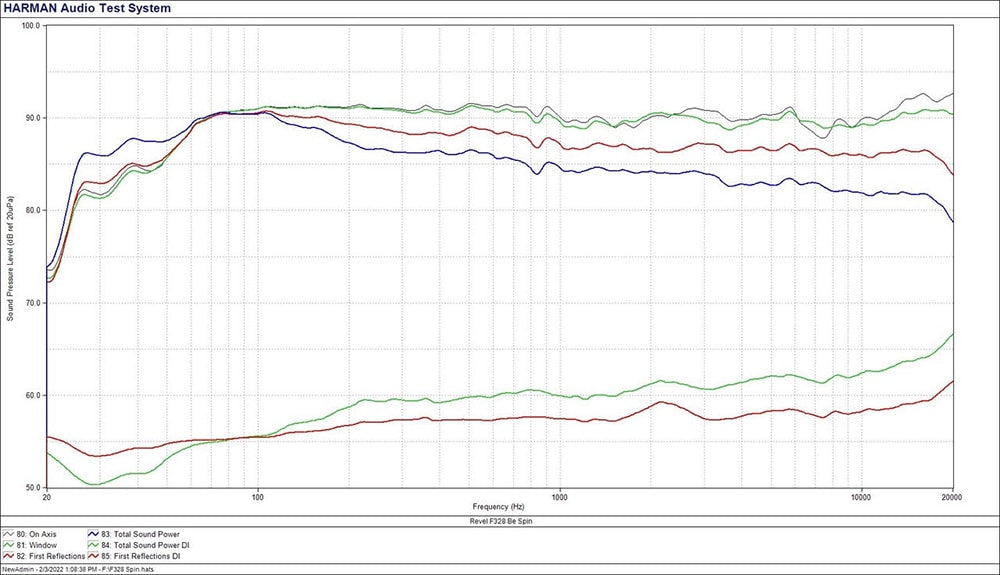
 

Spinorama chart of a Revel Performa F328Be loudspeaker. Image courtesy of Harman International. Spinorama chart of a Revel Performa F328Be loudspeaker. Image courtesy of Harman International.

The results of countless double-blind listening tests indicate that flat and smooth On-Axis and Listening Window plots are generally desirable. However, keep in mind that recordings and movies are not always consistent in spectral balance, especially in the bass region, so it is not uncommon to make small “tone-control” adjustments from time to time. Overall, good Spinorama measurements have been shown to correlate highly with listener loudspeaker preferences among listeners with “normal” hearing, which includes about 75 percent of the population. Even moderate hearing loss causes increased variations in sound quality judgments – opinions are not reliable. Sadly, this is an occupational hazard in many industries (and recreations), including audio professionals and musicians. As stated on page 15 of the online document, “Interpreting Spinorama Charts” by Manny LaCarrubba of Sausalito Audio: “The higher the directivity index, the more directional a speaker is. That is to say that more of the speaker’s energy output is biased forward. Virtually all loudspeakers are omnidirectional (DI = 0 dB) at low bass frequencies, exhibiting a directivity index that slowly rises with frequency, often reaching or exceeding 10 dB at 20 kHz. How smoothly the DI changes over the frequency range is a significant factor in how a loudspeaker sounds in a room. Reflected sounds should resemble the direct (on-axis/listening window) sounds in timbre, otherwise they draw attention to themselves. DI curves that show strong discontinuities indicate design flaws.

Back in 1985 – 1986 Dr. Toole reported that resonances and directivity flaws are readily heard in monophonic (single speaker) listening comparisons, but less so in stereo. In 2008, Olive, Hess and Welti confirmed the finding and observed even less awareness in multi-channel reproduction. It may not seem obvious, but hard-panned left or right stereo sounds are monophonic, and in multichannel programs the (monophonic) center channel delivers the featured artist, and most of the on-screen action in movies and TV. The moderately wide dispersion mid-frequency DI common with forward-firing cone/dome speakers appears to be desirable for stereo reproduction. Stereo is fundamentally a directionally and spatially compromised format – it matters less in multichannel systems (with a higher proportion of direct sound arriving from many directions). The measurements can help us in assessing how accurately a speaker may reproduce its source material, or if it is prone to anomalous resonances and peaks in output. This alone goes a long way in helping to identify a good-sounding speaker. Back to the chart in the illustration. At the bottom are two important frequency response curves which are calculated based on information already obtained from previously plotted measurements. The second (lower) green plot is the Sound Power Directivity Index. This “classic” DI is arrived at by calculating the results of the Listening Window minus the Sound Power plots. This is useful to look at because many of us want to enjoy having good-quality sound in more than one seating position, on a sofa for example. Perhaps the easiest “at a glance” way of determining how directive the sound is, is by examining how steep the slope is. The lower red plot is the Early Reflections Directivity Index, and this is simply derived as the difference between the Listening Window and the Early Reflections graphs. This is a metric invented for Spinorama when it became clear that the early reflections were a powerful indicator of what listeners hear in small listening rooms. If we see a response with little slope to it, that means the speaker has little directivity. What this information helps you to determine is, what amount of directivity you’d want for your personal tastes and room. For example, you may have a room with a lot of hard reflecting surfaces like tiles, large windows, patio doors, or glass cabinets. If so, you may prefer a DI with a higher slope on this plot, meaning the speaker will deliver a higher ratio of direct to reflected sound. Conversely, if you have a more absorptive room with things like carpeted flooring, bookshelves filled with books, heavy curtains, and no open spaces into other rooms, you may enjoy speakers with a lower DI. The steeper the upward slope, the more of the forward directivity of those frequencies you will hear at the listening position.

Revel Performa F328Be loudspeaker in various finishes. Revel Performa F328Be loudspeaker in various finishes.

All of this information may seem a little overwhelming at first, and it’s true to say that ultimately there is a gamut of preferences as to what individual listeners may prefer to hear. (Personally, I enjoy a bright and focused sound and have a particular appreciation for dual-concentric loudspeaker drivers but I completely understand that is not for everyone, and there are of course many approaches to high-quality sound reproduction when it comes to loudspeakers. I have also owned some dual-concentric speakers in the past that were not as good as the ones I have today – though I haven’t done any Spinorama measurements on them yet!) However, when looking at Spinorama information, there are many correlations between the plotted speaker characteristics and what many people consistently find more appealing in the sound of loudspeakers in blind listening tests. According to Dr. Toole, in the real world the problem is that competently-done measurements are unbiased and accurately repeatable, whereas the kinds of subjective evaluations most people (including reviewers) are able to do are biased and not repeatable at different times and places – a true dilemma! (It leads to endless internet discussions, though.) Much of the rigor in testing and in verifying the attributes of loudspeaker sound that listeners generally agree upon can be read about in detail in Dr. Floyd Toole’s publication, Sound Reproduction: the Acoustics and Psychoacoustics of Loudspeakers and Rooms, now in its third edition. Below is a link to an informative seminar conducted by Dr. Toole in conjunction with the CIRMMT Distinguished Lectures in the Science and Technology of Music. httpv://www.youtube.com/watch?v=zrpUDuUtxPM The video itself is over an hour long but it is highly insightful and outlines decades of pioneering research, and I recommend you watch it right now! In my humble attempt at oversimplification, here are some helpful bullet points garnered from the seminar:
  • The Early Reflections curves will look very similar to the On-Axis and Listening Window curves in good-sounding speakers.
  • The nearer the Listening Window curve matches the On-Axis response, the better the sound will be for those seated in the listening area.
  • Large peaks and troughs in the graphs usually portray undesirable resonances or uncontrolled frequency response deviations in less-well-designed speakers.
  • The higher the Directivity Index, the more directional the speaker will be.

Of course, there are limitations with Spinorama information. The main thing to keep in mind is that every room will massively influence the sound heard from the loudspeakers, each room imposing itself on the sound in its own unique way. Additionally, it’s important to remember that the Spinorama data itself is collected from the speaker’s behavior when measured in an anechoic chamber, a controlled acoustic environment which is very different from any room in which a speaker will be listened to. That said, it would be impossible to collect the extremely useful Spinorama data any other way. (Others have attempted Spinorama measurements in rooms other than anechoic chambers and have had to add caveats to their measurements as a result.) You could perhaps think of the Spinorama data as akin to the manufacturer’s specifications for a vehicle’s mileage ratings. When you drive your car, it’s likely that the routes you drive on won’t match the manufacturer’s test conditions. Yes – your mileage may vary. But this does not invalidate the value of the specifications provided by the car’s manufacturer, in the same way that Spinorama measurements will be a valid indicator of a speaker’s performance. One could hope that the use of Spinorama will become more prevalent in the industry and among reviewers. An experiment worth trying out, which I have found to be very supportive of the value of Spinorama data, is to listen to a demonstration of, say, three or more different sets of speaker pairs (if the audio salon will accommodate you). I find it’s easier to compare just a few at a time, for the sake of recalling details and mental notes. (In an ideal world you would conduct the test under double-blind conditions to enable non-visually influenced assessments.) Take note of the speakers you like the most and simply rank them. When you return home, look up the Spinorama data for each, if it exists of course, and see for yourself if the best-sounding speakers conform to the Spinorama data indicating which would be best. You may be encouraged to discover that the speakers you enjoyed the most did in fact follow the desirable characteristics in their measurement plots, whereas those you disliked did not. I will have a little more to say about this experiment in a future article. As always, enjoy your listening-comparison experiments with music that is most familiar and well-known to you in its nuances, whether focusing on the vocals, drums, woodwinds, strings, or each in turn. It’s all part of striving towards a positive listening experience. It’s worth the proportionately small investment of time compared to the many years of listening pleasure you will likely derive from your speakers.

Header image: from Sound Reproduction: the Acoustics and Psychoacoustics of Loudspeakers and Rooms, third edition.

More from Issue 156

View All Articles in Issue 156

Search Copper Magazine

#231 Piano Prodigy Jude Kofie Releases His Debut Album On Octave Records by Frank Doris Jun 01, 2026 #231 Underappreciated Artists, Part Two: City Boy by Rich Isaacs Jun 01, 2026 #231 Music and the Art of Creation: Talking With Saxophonist Rob Scheps by Joe Caplan Jun 01, 2026 #231 How to Play in a Rock Band, 24: Further Adventures at the 2026 Montauk Music Festival by Frank Doris Jun 01, 2026 #231 Courtney Barnett: Creature of Habit by Wayne Robins Jun 01, 2026 #231 Angine de Poitrine: Interstellar Guitar Rock Saviors Headed for Late-Night TV Pop Stardom? by Mark Lepage Jun 01, 2026 #231 My Impressions of AXPONA 2026, Part One by Frank Doris Jun 01, 2026 #231 2026 La Jolla Concours d'Elegance: Another Aesthetic Feast by B. Jan Montana Jun 01, 2026 #231 Country Music Icon Jo Dee Messina’s Bridges: A New Beginning by Ray Chelstowski Jun 01, 2026 #231 The Luxury Dispatch Hosts a Video Podcast With Ken Kessler by Ken Kessler Jun 01, 2026 #231 The Vinyl Beat: Tracking in the Motor City by Rudy Radelic Jun 01, 2026 #231 Lots of Fun With DSP: The Ferrum Audio WANDLA DAC and Its Tube Mode by Frank Doris Jun 01, 2026 #231 From The Audiophile's Guide: Digital Source Components and Streaming Audio by Paul McGowan Jun 01, 2026 #231 Onkyo’s Monster M-510 power amplifier by The Staff at Just Audio Jun 01, 2026 #231 PS Audio in the News by PS Audio Staff Jun 01, 2026 #231 Naming Convention by Peter Xeni Jun 01, 2026 #231 Les Invisibles by Frank Doris Jun 01, 2026 #231 Wildlife Scene by James Schrimpf Jun 01, 2026 #230 Camaraderie by B. Jan Montana May 04, 2026 #230 AXPONA 2026: A Family Gathering by Paul McGowan May 04, 2026 #230 Pianist Ryan Benthall Explores Jazz Realms and Far Beyond With Divine Sky by Frank Doris May 04, 2026 #230 The Vinyl Beat in AXPONA-Land by Rudy Radelic May 04, 2026 #230 Teddy Thompson’s Musical Growth Deepens With Never Be the Same by Ray Chelstowski May 04, 2026 #230 More Fun in the Sun: Florida Audio Expo, Part Two by Frank Doris May 04, 2026 #230 CanJam NYC 2026 Show Report: Heady Sound, Part Two by Frank Doris and Harris Fogel May 04, 2026 #230 Sonic Youth On Murray Street by Wayne Robins May 04, 2026 #230 Graffeo Coffee: A Symphony of Sensory Experience by Joe Caplan May 04, 2026 #230 The Saul Authority: The Story of Hi-Fi Pioneer Saul Marantz by Olivier Meunier-Plante May 04, 2026 #230 How to Play in a Rock Band, 23: Encounters With Famous Musicians, Part Two by Frank Doris May 04, 2026 #230 An Outlier in the Rack: A Vintage BIC Beam Box by The Staff at Just Audio May 04, 2026 #230 PS Audio in the News by PS Audio Staff May 04, 2026 #230 A Cautionary Tale by Rich Isaacs May 04, 2026 #230 Reel-to-Reel Roots, Part 33 (Revised): Ken Kessler Reports On the 2026 (British) AudioJumble by Ken Kessler May 04, 2026 #230 Text Messaging by Frank Doris May 04, 2026 #230 The Audiophile Rat Race by Peter Xeni May 04, 2026 #230 On the Rocks by Rich Isaacs May 04, 2026 #229 The Earliest Stars of Country Music, Part Three by Jeff Weiner Apr 06, 2026 #229 The Healing Power of Music and Sound at the Omega Institute by Joe Caplan Apr 06, 2026 #229 CanJam NYC 2026 Show Report: Heady Sound, Part One by Frank Doris Apr 06, 2026 #229 Florida Audio Expo 2026: Warming Up to High-End Audio, Part One by Frank Doris Apr 06, 2026 #229 Quick Takes: Anne Bisson, Sam Morrison, The Velvet Underground, and the Stooges by Frank Doris Apr 06, 2026 #229 The Vinyl Beat: New Arrivals, and Old Audio Show Demo Scores to Settle by Rudy Radelic Apr 06, 2026 #229 Harvard Gets a High-End Audio Education by Frank Doris Apr 06, 2026 #229 No Country for Old Knees by B. Jan Montana Apr 06, 2026 #229 How To Play in A Rock Band, 22: Encounters With Famous Musicians, Part 1 by Frank Doris Apr 06, 2026 #229 The Soulful Grooves of Guinea-Bissau by Steve Kindig Apr 06, 2026 #229 Four-Hand Piano Performance at Its Finest by Stephan Haberthür Apr 06, 2026

Choosing New Speakers: Using Spinorama, Part Two

Choosing New Speakers: Using Spinorama, Part Two

In our first installment of this two-part series examining Spinorama data (Part One ran in Issue 155), we looked at the information represented by the plots at the top of an example Spinorama graph, and what this information reveals about a speaker’s performance. These plots are: On-Axis response, the Listening Window, Early Reflections, and Sound Power. Here in Part Two, we’ll look at the plots at the base of the graph: the Sound Power Directivity Index and the Early Reflections Directivity Index (DI), both of which serve to further lift the veil on a loudspeaker’s sonic behavior, and critically, what all this means for us as discerning listeners and potential customers. First, though, let’s briefly recap what Spinorama is. Spinorama is a method of loudspeaker measurement pioneered by Dr. Floyd Toole. This method helps the listener by revealing a speaker’s performance characteristics, and their correlation to sound reproduction. Spinorama produces a set of data derived from measuring a speaker from multiple positions, with microphones measuring the speaker’s output through 360 degrees around the speaker. The measurements are done in an anechoic chamber. The resulting computer-processed Spinorama charts are based on measurements of the speaker’s frequency response at 70 different points, starting on axis, and then at each 10-degree angle around the speaker both horizontally and vertically. The difference between these curves and normal anechoic frequency responses is that they have been selected and processed to reveal aspects of loudspeaker performance as they are likely to be heard in typical listening rooms. Bumps and ripples that are evident in all of the curves are strong indicators of system resonances, which color the sound, modifying the timbre of voices and instruments. Smoothness is the first requirement.


Spinorama chart of a Revel Performa F328Be loudspeaker. Image courtesy of Harman International. Spinorama chart of a Revel Performa F328Be loudspeaker. Image courtesy of Harman International.

The results of countless double-blind listening tests indicate that flat and smooth On-Axis and Listening Window plots are generally desirable. However, keep in mind that recordings and movies are not always consistent in spectral balance, especially in the bass region, so it is not uncommon to make small “tone-control” adjustments from time to time. Overall, good Spinorama measurements have been shown to correlate highly with listener loudspeaker preferences among listeners with “normal” hearing, which includes about 75 percent of the population. Even moderate hearing loss causes increased variations in sound quality judgments – opinions are not reliable. Sadly, this is an occupational hazard in many industries (and recreations), including audio professionals and musicians. As stated on page 15 of the online document, “Interpreting Spinorama Charts” by Manny LaCarrubba of Sausalito Audio: “The higher the directivity index, the more directional a speaker is. That is to say that more of the speaker’s energy output is biased forward. Virtually all loudspeakers are omnidirectional (DI = 0 dB) at low bass frequencies, exhibiting a directivity index that slowly rises with frequency, often reaching or exceeding 10 dB at 20 kHz. How smoothly the DI changes over the frequency range is a significant factor in how a loudspeaker sounds in a room. Reflected sounds should resemble the direct (on-axis/listening window) sounds in timbre, otherwise they draw attention to themselves. DI curves that show strong discontinuities indicate design flaws.

Back in 1985 – 1986 Dr. Toole reported that resonances and directivity flaws are readily heard in monophonic (single speaker) listening comparisons, but less so in stereo. In 2008, Olive, Hess and Welti confirmed the finding and observed even less awareness in multi-channel reproduction. It may not seem obvious, but hard-panned left or right stereo sounds are monophonic, and in multichannel programs the (monophonic) center channel delivers the featured artist, and most of the on-screen action in movies and TV. The moderately wide dispersion mid-frequency DI common with forward-firing cone/dome speakers appears to be desirable for stereo reproduction. Stereo is fundamentally a directionally and spatially compromised format – it matters less in multichannel systems (with a higher proportion of direct sound arriving from many directions). The measurements can help us in assessing how accurately a speaker may reproduce its source material, or if it is prone to anomalous resonances and peaks in output. This alone goes a long way in helping to identify a good-sounding speaker. Back to the chart in the illustration. At the bottom are two important frequency response curves which are calculated based on information already obtained from previously plotted measurements. The second (lower) green plot is the Sound Power Directivity Index. This “classic” DI is arrived at by calculating the results of the Listening Window minus the Sound Power plots. This is useful to look at because many of us want to enjoy having good-quality sound in more than one seating position, on a sofa for example. Perhaps the easiest “at a glance” way of determining how directive the sound is, is by examining how steep the slope is. The lower red plot is the Early Reflections Directivity Index, and this is simply derived as the difference between the Listening Window and the Early Reflections graphs. This is a metric invented for Spinorama when it became clear that the early reflections were a powerful indicator of what listeners hear in small listening rooms. If we see a response with little slope to it, that means the speaker has little directivity. What this information helps you to determine is, what amount of directivity you’d want for your personal tastes and room. For example, you may have a room with a lot of hard reflecting surfaces like tiles, large windows, patio doors, or glass cabinets. If so, you may prefer a DI with a higher slope on this plot, meaning the speaker will deliver a higher ratio of direct to reflected sound. Conversely, if you have a more absorptive room with things like carpeted flooring, bookshelves filled with books, heavy curtains, and no open spaces into other rooms, you may enjoy speakers with a lower DI. The steeper the upward slope, the more of the forward directivity of those frequencies you will hear at the listening position.

Revel Performa F328Be loudspeaker in various finishes. Revel Performa F328Be loudspeaker in various finishes.

All of this information may seem a little overwhelming at first, and it’s true to say that ultimately there is a gamut of preferences as to what individual listeners may prefer to hear. (Personally, I enjoy a bright and focused sound and have a particular appreciation for dual-concentric loudspeaker drivers but I completely understand that is not for everyone, and there are of course many approaches to high-quality sound reproduction when it comes to loudspeakers. I have also owned some dual-concentric speakers in the past that were not as good as the ones I have today – though I haven’t done any Spinorama measurements on them yet!) However, when looking at Spinorama information, there are many correlations between the plotted speaker characteristics and what many people consistently find more appealing in the sound of loudspeakers in blind listening tests. According to Dr. Toole, in the real world the problem is that competently-done measurements are unbiased and accurately repeatable, whereas the kinds of subjective evaluations most people (including reviewers) are able to do are biased and not repeatable at different times and places – a true dilemma! (It leads to endless internet discussions, though.) Much of the rigor in testing and in verifying the attributes of loudspeaker sound that listeners generally agree upon can be read about in detail in Dr. Floyd Toole’s publication, Sound Reproduction: the Acoustics and Psychoacoustics of Loudspeakers and Rooms, now in its third edition. Below is a link to an informative seminar conducted by Dr. Toole in conjunction with the CIRMMT Distinguished Lectures in the Science and Technology of Music. httpv://www.youtube.com/watch?v=zrpUDuUtxPM The video itself is over an hour long but it is highly insightful and outlines decades of pioneering research, and I recommend you watch it right now! In my humble attempt at oversimplification, here are some helpful bullet points garnered from the seminar:
  • The Early Reflections curves will look very similar to the On-Axis and Listening Window curves in good-sounding speakers.
  • The nearer the Listening Window curve matches the On-Axis response, the better the sound will be for those seated in the listening area.
  • Large peaks and troughs in the graphs usually portray undesirable resonances or uncontrolled frequency response deviations in less-well-designed speakers.
  • The higher the Directivity Index, the more directional the speaker will be.

Of course, there are limitations with Spinorama information. The main thing to keep in mind is that every room will massively influence the sound heard from the loudspeakers, each room imposing itself on the sound in its own unique way. Additionally, it’s important to remember that the Spinorama data itself is collected from the speaker’s behavior when measured in an anechoic chamber, a controlled acoustic environment which is very different from any room in which a speaker will be listened to. That said, it would be impossible to collect the extremely useful Spinorama data any other way. (Others have attempted Spinorama measurements in rooms other than anechoic chambers and have had to add caveats to their measurements as a result.) You could perhaps think of the Spinorama data as akin to the manufacturer’s specifications for a vehicle’s mileage ratings. When you drive your car, it’s likely that the routes you drive on won’t match the manufacturer’s test conditions. Yes – your mileage may vary. But this does not invalidate the value of the specifications provided by the car’s manufacturer, in the same way that Spinorama measurements will be a valid indicator of a speaker’s performance. One could hope that the use of Spinorama will become more prevalent in the industry and among reviewers. An experiment worth trying out, which I have found to be very supportive of the value of Spinorama data, is to listen to a demonstration of, say, three or more different sets of speaker pairs (if the audio salon will accommodate you). I find it’s easier to compare just a few at a time, for the sake of recalling details and mental notes. (In an ideal world you would conduct the test under double-blind conditions to enable non-visually influenced assessments.) Take note of the speakers you like the most and simply rank them. When you return home, look up the Spinorama data for each, if it exists of course, and see for yourself if the best-sounding speakers conform to the Spinorama data indicating which would be best. You may be encouraged to discover that the speakers you enjoyed the most did in fact follow the desirable characteristics in their measurement plots, whereas those you disliked did not. I will have a little more to say about this experiment in a future article. As always, enjoy your listening-comparison experiments with music that is most familiar and well-known to you in its nuances, whether focusing on the vocals, drums, woodwinds, strings, or each in turn. It’s all part of striving towards a positive listening experience. It’s worth the proportionately small investment of time compared to the many years of listening pleasure you will likely derive from your speakers.

Header image: from Sound Reproduction: the Acoustics and Psychoacoustics of Loudspeakers and Rooms, third edition.

0 comments

Leave a comment

0 Comments

Your avatar

Loading comments...

🗑️ Delete Comment

Enter moderator password to delete this comment:

✏️ Edit Comment

Enter your email to verify ownership: