COPPER

A PS Audio Publication

Issue 211 • Free Online Magazine

Issue 211 Wayne's Words

Perla Batalla's Letter to Leonard Cohen

Perla Batalla's Letter to Leonard Cohen


Happy 90th Birthday, Leonard!

The ease and comfort which Perla Batalla brings to Leonard Cohen songs on A Letter to Leonard Cohen: To a Friend sounds so intimate and personal that it had to be an inside job.

In many ways, it was. The album was released to streaming services in time to celebrate Cohen's 90th birthday on Sept. 21. He mentored her, and encouraged her solo career.

Batalla has been singing Cohen's songs since 1988, when she got a call from Roscoe Beck, Cohen's bass player and a key member of his touring group. Batalla's friend Julie Christensen recommended her to be the other part of the duo that would add richness and range, color and cream, to Cohen's craggy but hypnotic concert vocals. They were more like sidemen, or rather, side-women, collaborators rather than "backup singers" in the band, which was going to leave for Europe in two weeks.
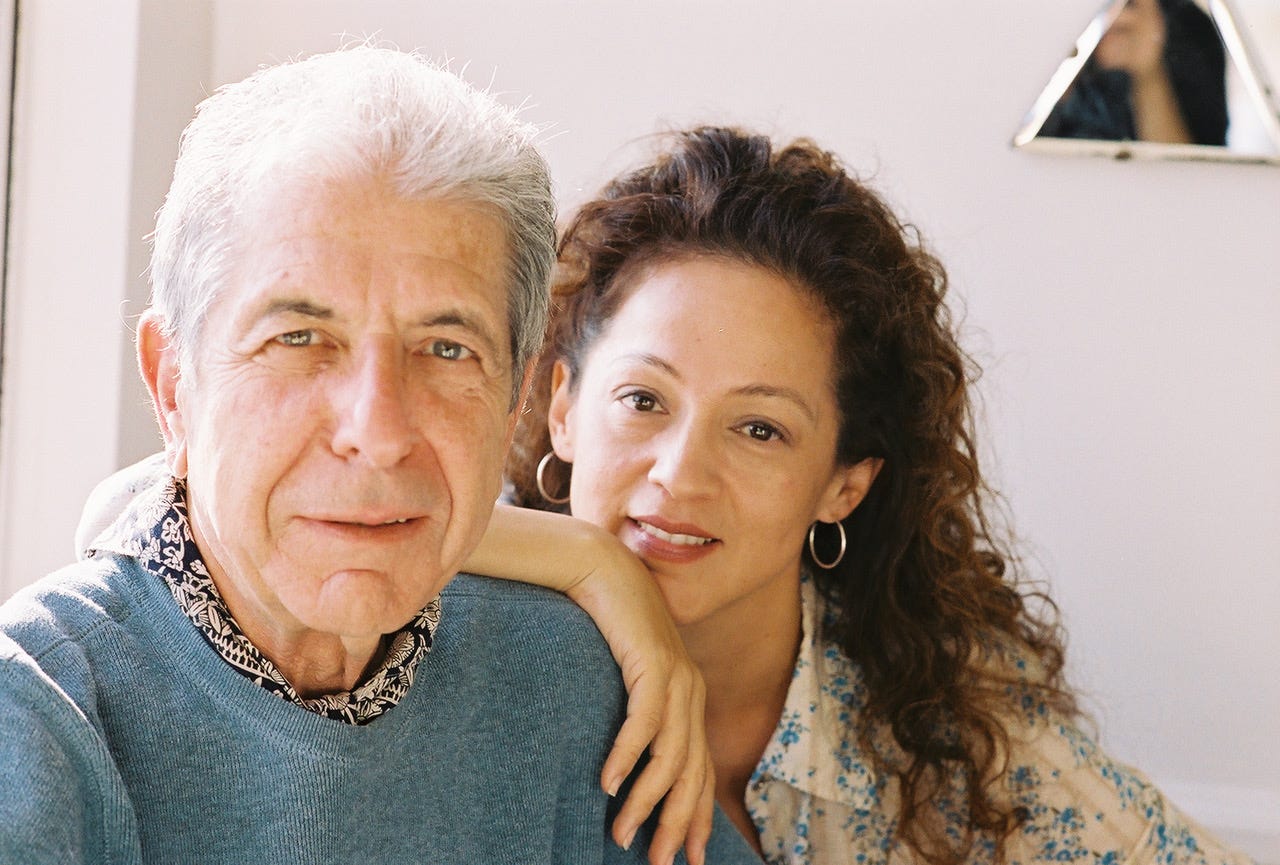
 

Photo: Nancy Santullo, courtesy of Perla Batalla


In a Zoom interview from her California home, Batalla said she agreed to Beck's request to just come meet with Cohen. Then reality struck. "I got off the phone, and my first thought honestly was, 'Who is Leonard Cohen?'"

"I ran to Tower Records and I got all the cassette tapes I could find on Leonard Cohen. I started listening and I was blown away by the poetry of it. I've always been a fan of great lyric writing...I was raised in a Spanish-speaking family (in Los Angeles) and my father was a singer, and I really appreciated a beautiful lyric."

Batalla half-jokingly said that while preparing to meet Cohen, the most important question was, what to wear? “Leonard was wearing black from head to toe, and I was wearing all white, down to the boots. Leonard comes towards me and we’re sort of looking at each other. He starts to sort of giggle, and takes my hand and says, "Darling, look at us, we’re a match made in heaven."

Batalla spent the next five years on the road with Cohen and his band on the I'm Your Man tour, which evolved into The Future tour. Though her voice is capable of extravagant range and power, she learned how to phrase Leonard's songs by working closely with the master, who also eventually encouraged her to step out on her own.

There's some irony in that Roscoe Beck had produced Jennifer Warnes' influential album of Leonard Cohen songs, Famous Blue Raincoat in 1986. Now Batalla is Cohen’s most prolific, dedicated interpreter.

"I have a mission when it comes to Cohen, to any song, really. As a singer I could take out my fancy chops, and do whatever I have to do to impress somebody. But as an artist and singer, my only responsibility is to be of service to the song. And when you have great material like this, it sings itself."

Batalla has recorded a variety of albums in a number of styles and languages: her dark Mexican father and lighter-skinned Argentine mother had an L.A. record store, Discoteca Batalla, which was the name of her 2002 Spanish-language album. She did a bilingual album of mixed-race pride, Mestiza, and its follow up, Heaven and Earth: The Mestiza Voyage. She also sang "Hey Look Me Over" in a 2009 tribute album to the great Broadway tunesmith Cy Coleman, so you can see she's got range.

Batalla's first Cohen album The Songs of Leonard Cohen (2004) featured many of the crowd-pleasers from his songbook: "Suzanne" and "Bird on a Wire," "Dance Me to the End of Love" and "So Long Marianne." On A Letter to Leonard Cohen, there are also a few "household name" songs, such as "Everybody Knows," "Ain't No Cure for Love," and "Sisters of Mercy." But there are also riskier tunes including the mesmerizing "You Want It Darker," and "Democracy" (from 1992's The Future) whose refrain "Democracy is coming, to the U.S.A." could not have been more prophetic if it came from the Book of Jeremiah.


"You Want It Darker" was the title song of Cohen's final studio album, released weeks before his death in 2016.

She also has the confidence now to include two of her own compositions as part of the Letter: "Awakened," and "The L of Your First Name," and a song of the French Resistance during World War II, "The Partisan." The latter song, written in 1943 by Ann Marly and Emmanuel d’Astier de La Vigerie, was recorded by Cohen in French and English in his 1969 album Songs From a Room.

Here are some selected excerpts from a wide-ranging interview about her work with Cohen, and as a brilliant singer who won't be confined to one style in an increasingly niche music industry. It starts with my attempt at a joke at the expense of the one song that somehow became Leonard Cohen's own "Stairway to Heaven" or "Kumbaya."

Wayne Robins: Thank you for not including "Hallelujah" on either of your Cohen albums. Why did you choose to avoid the obvious?

Perla Batalla: Well, for that reason, it's obvious. I mean, love singing this song because people love it so. You know, Leonard was a little bit confused as to why "Hallelujah" took off the way it did. And he said, "it's not my favorite; you know my songs, I've written better songs." But even knowing that, I sing "Hallleujah"at concerts because I would get shot if I didn't! (laughs).

But there is also a respect for how much the audience loves it. And of course, you know, that they know it so well, so it's a beautiful moment for everyone to get together and sing together. It's beautiful, when everyone gathers with a common goal.

WR: You also do new versions of "Democracy" and "You Want it Darker," which are not easy or obvious covers. Did you look deeper into the catalog for this album?

PB: Not at all. I've been touring Leonard's song book for close to 20 years now, in my tours going through Europe, working wherever. I work with a lot of Spanish musicians [much of the recording was in Barcelona], and we discussed, during rehearsals and breaks, "Oh, what about this song." And frankly, I didn't think I could sing "You Want It Darker," much like I thought I would never sing "Bird on the Wire." I didn't think I would sing a lot of Leonard's songs, because frankly, in the early days, I didn't think that anyone but Leonard could sing Leonard. I realized other people did it, and that was all fine and good. But after working with him and seeing how magical he was onstage, I just felt, yeah, I'm not gonna touch that material with a ten-foot pole.

WR: So how and when did that change?

PB: Leonard asked me to sing a song for a special party [likely in the early 1990s] he was giving for his Zen teacher, and he asked me to sing "Bird on a Wire." And I said, "no!" And he said, "why don't you live with the idea a little bit and see, because I would love for you to do that." But I was used to only singing backup vocals for him, so it felt very strange to take charge of one of his songs. So I worked on it quite a bit with a friend of mine, it started to feel part of me, and I started enjoying it, and I said, "I think I own this song now." And my friend said to me, "don't kid yourself. This song owns you."


WR: It seems to have been Cohen's way of pushing you into a solo career again. Since then, it would seem, that you own, or are owned by, a great many Leonard Cohen songs.

PB: I was absolutely taken over, because it's like Shakespeare for an actor. I just choose which ones for right for me, which ones sort of come to me. And I've extensively toured Europe singing the Cohen song book.

I was doing a wonderful event in Frankfurt at a Jewish temple and they asked me to do "You Want It Darker." And I thought, I don't want to touch that. It's like Leonard's last song, and it's pretty intense, because I also hadn't gotten over my grief over Leonard's passing...when I got the news of Leonard's death I was in Barcelona with a bass-playing friend and I said, "I don't know if I'll ever be able to sing another Leonard Cohen song again, without bursting into tears, and he said, 'so sing and cry at the same time, like we Spaniards do." That kind of gave me permission to let it all out, to process my grief while I was performing. So I sang "You Want It Darker" and I understood it, not like the brain understanding something, but with every fiber of my being in a very odd, cosmic way. But you know, stuff like that happens all the time, and I guess you know what I'm saying, is that as an artist, I let things find me.

WR: You said you produced most of the album with [mixing and mastering expert] Bernie Becker, but for "Democracy," you brought in Mike Elizondo, best known for working with Dr. Dre, Eminem, 50 Cent, and many of the great rappers.

PB: Mike was one of my first bass players out of high school in my first touring band, we were good friends. "Democracy," I hadn't really thought about since I did it with Leonard on tour in 1993. And I thought, it's so timely, even though the song has to be 30 years old.

But I saw it as more of a beats track, something of a rap, not something I could do in the studio live. Luckily, when I called Mike Elizondo, he said, "yeah, I'll do it," and he had a track for me in a couple of days. That was fabulous.


Perla Batalla, A Letter to Leonard Cohen: Tribute to a Friend, album cover.


WR: You also have Patrick Page, the Broadway actor, most recently renowned for Hadestown, doing some deep vocal parts on "Democracy."

PB: We had first connected during COVID, through the internet. I told him I was really interested in doing this song, but I think I needed a voice like yours, this grave basso profundo to carry the gravity of this tune, and we'll just sing it together as sort of a rap, talky kind of thing. And he agreed to do it.

And you know, the shocking thing is, I'm not someone that has a lot of money. I produce records with my own money, or I try to raise some money through Go Fund Me, which I did with this one. During COVID, all the files, the hard drive, whatever, to this album, were lost in Spain...the album was done, all I had to do was put vocals on it. So we realized we were going to have to raise some money, and I'm going to tell the truth that I blew it, you know. The response was amazing, and people were so generous.

WR: Where did you get the courage, even audacity, to include two of your own songs amid these Cohen classics?

PB: I don't know that I thought that because Leonard was always so encouraging to me. He'd say, "we're all just different, you just do it, darling." Or, there's no "somebody’s better than anybody else." Or, "you are you, so you go for it." I had written "Awakened" with the thought that artists are the bravest people, especially those of us who came from nothing. So it's very important to say, in my own words, what Leonard brought me, and it was that courage to say "yes, do it. A life in art, that's all we're here for."

WR: And "The L of Your First Name" seems to be more directly personal.

PB: I just wanted to tell the story of my love for Leonard. People don't understand my relationship with Leonard because we were close. We adored one another, and a lot of people think that has to involve a sexual relationship, you know, that you can't get intimacy other than that. I like to think my relationship was deeper than that, that it was spiritual. That we were bonded by something so deep. We could laugh hysterically about things. He was a very, very funny man.

So all of that is in there. I felt like I needed to say how I felt on this record. I don't know if I'll have another opportunity; once you finish a record, you don't know whether you will ever do another one ever again. So I needed to say those things. So this was my opportunity, whether or not it fits in with Leonard Cohen. You know he's a frickin' genius, so there it is. My meager offering, as Leonard would say.


Header image of Perla Batalla courtesy of Diego Cabrera.

This article originally appeared in Wayne Robins’ Substack and is used here by permission. Wayne’s Words columnist Wayne Robins teaches at St. John’s University in Queens, and writes the Critical Conditions Substack, https://waynerobins.substack.com/.

More from Issue 211

View All Articles in Issue 211

Search Copper Magazine

#227 Seth Lewis Gets in the Groove With Take a Look Around: a Tribute to the Meters by Frank Doris Feb 02, 2026 #227 Passport to Sound: May Anwar’s Audio Learning Experience for Young People by Frank Doris Feb 02, 2026 #227 Conjectures on Cosmic Consciousness by B. Jan Montana Feb 02, 2026 #227 The Big Takeover Turns 45 by Wayne Robins Feb 02, 2026 #227 Music and Chocolate: On the Sensory Connection by Joe Caplan Feb 02, 2026 #227 Singer/Songwriter Chris Berardo: Getting Wilder All the Time by Ray Chelstowski Feb 02, 2026 #227 The Earliest Stars of Country Music, Part One by Jeff Weiner Feb 02, 2026 #227 The Vinyl Beat Goes Down to Tijuana (By Way of Los Angeles), Part Two by Rudy Radelic Feb 02, 2026 #227 How to Play in a Rock Band, 20: On the Road With Blood, Sweat & Tears’ Guitarist Gabe Cummins by Frank Doris Feb 02, 2026 #227 From The Audiophile’s Guide: Audio Specs and Measuring by Paul McGowan Feb 02, 2026 #227 Our Brain is Always Listening by Peter Trübner Feb 02, 2026 #227 PS Audio in the News by PS Audio Staff Feb 02, 2026 #227 The Listening Chair: Sleek Style and Sound From the Luxman L3 by Howard Kneller Feb 02, 2026 #227 The Los Angeles and Orange County Audio Society Celebrates Its 32nd Anniversary, Honoring David and Sheryl Lee Wilson and Bernie Grundman by Harris Fogel Feb 02, 2026 #227 Back to My Reel-to-Reel Roots, Part 26: Half Full – Not Half Empty, Redux by Ken Kessler Feb 02, 2026 #227 That's What Puzzles Us... by Frank Doris Feb 02, 2026 #227 Record-Breaking by Peter Xeni Feb 02, 2026 #227 The Long and Winding Road by B. Jan Montana Feb 02, 2026 #226 JJ Murphy’s Sleep Paralysis is a Genre-Bending Musical Journey Through Jazz, Fusion and More by Frank Doris Jan 05, 2026 #226 Stewardship by Consent by B. Jan Montana Jan 05, 2026 #226 Food, Music, and Sensory Experience: An Interview With Professor Jonathan Zearfoss of the Culinary Institute of America by Joe Caplan Jan 05, 2026 #226 Studio Confidential: A Who’s Who of Recording Engineers Tell Their Stories by Frank Doris Jan 05, 2026 #226 Pilot Radio is Reborn, 50 Years Later: Talking With CEO Barak Epstein by Frank Doris Jan 05, 2026 #226 The Vinyl Beat Goes Down to Tijuana (By Way of Los Angeles), Part One by Rudy Radelic Jan 05, 2026 #226 Capital Audiofest 2025: Must-See Stereo, Part Two by Frank Doris Jan 05, 2026 #226 My Morning Jacket’s Carl Broemel and Tyler Ramsey Collaborate on Their Acoustic Guitar Album, Celestun by Ray Chelstowski Jan 05, 2026 #226 The People Who Make Audio Happen: CanJam SoCal 2025, Part Two by Harris Fogel Jan 05, 2026 #226 How to Play in a Rock Band, 19: Touring Can Make You Crazy, Part One by Frank Doris Jan 05, 2026 #226 Linda Ronstadt Goes Bigger by Wayne Robins Jan 05, 2026 #226 From The Audiophile’s Guide: Active Room Correction and Digital Signal Processing by Paul McGowan Jan 05, 2026 #226 PS Audio in the News by Frank Doris Jan 05, 2026 #226 Back to My Reel-to-Reel Roots, Part 25: Half-Full, Not Empty by Ken Kessler Jan 05, 2026 #226 Happy New Year! by Frank Doris Jan 05, 2026 #226 Turn It Down! by Peter Xeni Jan 05, 2026 #226 Ghost Riders by James Schrimpf Jan 05, 2026 #226 A Factory Tour of Audio Manufacturer German Physiks by Markus "Marsu" Manthey Jan 04, 2026 #225 Capital Audiofest 2025: Must-See Stereo, Part One by Frank Doris Dec 01, 2025 #225 Otis Taylor and the Electrics Delivers a Powerful Set of Hypnotic Modern Blues by Frank Doris Dec 01, 2025 #225 A Christmas Miracle by B. Jan Montana Dec 01, 2025 #225 T.H.E. Show New York 2025, Part Two: Plenty to See, Hear, and Enjoy by Frank Doris Dec 01, 2025 #225 Underappreciated Artists, Part One: Martin Briley by Rich Isaacs Dec 01, 2025 #225 Rock and Roll is Here to Stay by Wayne Robins Dec 01, 2025 #225 A Lifetime of Holiday Record (and CD) Listening by Rudy Radelic Dec 01, 2025 #225 Little Feat: Not Saying Goodbye, Not Yet by Ray Chelstowski Dec 01, 2025 #225 How to Play in a Rock Band, Part 18: Dealing With Burnout by Frank Doris Dec 01, 2025 #225 The People Who Make Audio Happen: CanJam SoCal 2025 by Harris Fogel Dec 01, 2025 #225 Chicago’s Sonic Sanctuaries: Four Hi‑Fi Listening Bars Channeling the Jazz‑Kissa Spirit by Olivier Meunier-Plante Dec 01, 2025

Perla Batalla's Letter to Leonard Cohen

Perla Batalla's Letter to Leonard Cohen


Happy 90th Birthday, Leonard!

The ease and comfort which Perla Batalla brings to Leonard Cohen songs on A Letter to Leonard Cohen: To a Friend sounds so intimate and personal that it had to be an inside job.

In many ways, it was. The album was released to streaming services in time to celebrate Cohen's 90th birthday on Sept. 21. He mentored her, and encouraged her solo career.

Batalla has been singing Cohen's songs since 1988, when she got a call from Roscoe Beck, Cohen's bass player and a key member of his touring group. Batalla's friend Julie Christensen recommended her to be the other part of the duo that would add richness and range, color and cream, to Cohen's craggy but hypnotic concert vocals. They were more like sidemen, or rather, side-women, collaborators rather than "backup singers" in the band, which was going to leave for Europe in two weeks.


Photo: Nancy Santullo, courtesy of Perla Batalla


In a Zoom interview from her California home, Batalla said she agreed to Beck's request to just come meet with Cohen. Then reality struck. "I got off the phone, and my first thought honestly was, 'Who is Leonard Cohen?'"

"I ran to Tower Records and I got all the cassette tapes I could find on Leonard Cohen. I started listening and I was blown away by the poetry of it. I've always been a fan of great lyric writing...I was raised in a Spanish-speaking family (in Los Angeles) and my father was a singer, and I really appreciated a beautiful lyric."

Batalla half-jokingly said that while preparing to meet Cohen, the most important question was, what to wear? “Leonard was wearing black from head to toe, and I was wearing all white, down to the boots. Leonard comes towards me and we’re sort of looking at each other. He starts to sort of giggle, and takes my hand and says, "Darling, look at us, we’re a match made in heaven."

Batalla spent the next five years on the road with Cohen and his band on the I'm Your Man tour, which evolved into The Future tour. Though her voice is capable of extravagant range and power, she learned how to phrase Leonard's songs by working closely with the master, who also eventually encouraged her to step out on her own.

There's some irony in that Roscoe Beck had produced Jennifer Warnes' influential album of Leonard Cohen songs, Famous Blue Raincoat in 1986. Now Batalla is Cohen’s most prolific, dedicated interpreter.

"I have a mission when it comes to Cohen, to any song, really. As a singer I could take out my fancy chops, and do whatever I have to do to impress somebody. But as an artist and singer, my only responsibility is to be of service to the song. And when you have great material like this, it sings itself."

Batalla has recorded a variety of albums in a number of styles and languages: her dark Mexican father and lighter-skinned Argentine mother had an L.A. record store, Discoteca Batalla, which was the name of her 2002 Spanish-language album. She did a bilingual album of mixed-race pride, Mestiza, and its follow up, Heaven and Earth: The Mestiza Voyage. She also sang "Hey Look Me Over" in a 2009 tribute album to the great Broadway tunesmith Cy Coleman, so you can see she's got range.

Batalla's first Cohen album The Songs of Leonard Cohen (2004) featured many of the crowd-pleasers from his songbook: "Suzanne" and "Bird on a Wire," "Dance Me to the End of Love" and "So Long Marianne." On A Letter to Leonard Cohen, there are also a few "household name" songs, such as "Everybody Knows," "Ain't No Cure for Love," and "Sisters of Mercy." But there are also riskier tunes including the mesmerizing "You Want It Darker," and "Democracy" (from 1992's The Future) whose refrain "Democracy is coming, to the U.S.A." could not have been more prophetic if it came from the Book of Jeremiah.


"You Want It Darker" was the title song of Cohen's final studio album, released weeks before his death in 2016.

She also has the confidence now to include two of her own compositions as part of the Letter: "Awakened," and "The L of Your First Name," and a song of the French Resistance during World War II, "The Partisan." The latter song, written in 1943 by Ann Marly and Emmanuel d’Astier de La Vigerie, was recorded by Cohen in French and English in his 1969 album Songs From a Room.

Here are some selected excerpts from a wide-ranging interview about her work with Cohen, and as a brilliant singer who won't be confined to one style in an increasingly niche music industry. It starts with my attempt at a joke at the expense of the one song that somehow became Leonard Cohen's own "Stairway to Heaven" or "Kumbaya."

Wayne Robins: Thank you for not including "Hallelujah" on either of your Cohen albums. Why did you choose to avoid the obvious?

Perla Batalla: Well, for that reason, it's obvious. I mean, love singing this song because people love it so. You know, Leonard was a little bit confused as to why "Hallelujah" took off the way it did. And he said, "it's not my favorite; you know my songs, I've written better songs." But even knowing that, I sing "Hallleujah"at concerts because I would get shot if I didn't! (laughs).

But there is also a respect for how much the audience loves it. And of course, you know, that they know it so well, so it's a beautiful moment for everyone to get together and sing together. It's beautiful, when everyone gathers with a common goal.

WR: You also do new versions of "Democracy" and "You Want it Darker," which are not easy or obvious covers. Did you look deeper into the catalog for this album?

PB: Not at all. I've been touring Leonard's song book for close to 20 years now, in my tours going through Europe, working wherever. I work with a lot of Spanish musicians [much of the recording was in Barcelona], and we discussed, during rehearsals and breaks, "Oh, what about this song." And frankly, I didn't think I could sing "You Want It Darker," much like I thought I would never sing "Bird on the Wire." I didn't think I would sing a lot of Leonard's songs, because frankly, in the early days, I didn't think that anyone but Leonard could sing Leonard. I realized other people did it, and that was all fine and good. But after working with him and seeing how magical he was onstage, I just felt, yeah, I'm not gonna touch that material with a ten-foot pole.

WR: So how and when did that change?

PB: Leonard asked me to sing a song for a special party [likely in the early 1990s] he was giving for his Zen teacher, and he asked me to sing "Bird on a Wire." And I said, "no!" And he said, "why don't you live with the idea a little bit and see, because I would love for you to do that." But I was used to only singing backup vocals for him, so it felt very strange to take charge of one of his songs. So I worked on it quite a bit with a friend of mine, it started to feel part of me, and I started enjoying it, and I said, "I think I own this song now." And my friend said to me, "don't kid yourself. This song owns you."


WR: It seems to have been Cohen's way of pushing you into a solo career again. Since then, it would seem, that you own, or are owned by, a great many Leonard Cohen songs.

PB: I was absolutely taken over, because it's like Shakespeare for an actor. I just choose which ones for right for me, which ones sort of come to me. And I've extensively toured Europe singing the Cohen song book.

I was doing a wonderful event in Frankfurt at a Jewish temple and they asked me to do "You Want It Darker." And I thought, I don't want to touch that. It's like Leonard's last song, and it's pretty intense, because I also hadn't gotten over my grief over Leonard's passing...when I got the news of Leonard's death I was in Barcelona with a bass-playing friend and I said, "I don't know if I'll ever be able to sing another Leonard Cohen song again, without bursting into tears, and he said, 'so sing and cry at the same time, like we Spaniards do." That kind of gave me permission to let it all out, to process my grief while I was performing. So I sang "You Want It Darker" and I understood it, not like the brain understanding something, but with every fiber of my being in a very odd, cosmic way. But you know, stuff like that happens all the time, and I guess you know what I'm saying, is that as an artist, I let things find me.

WR: You said you produced most of the album with [mixing and mastering expert] Bernie Becker, but for "Democracy," you brought in Mike Elizondo, best known for working with Dr. Dre, Eminem, 50 Cent, and many of the great rappers.

PB: Mike was one of my first bass players out of high school in my first touring band, we were good friends. "Democracy," I hadn't really thought about since I did it with Leonard on tour in 1993. And I thought, it's so timely, even though the song has to be 30 years old.

But I saw it as more of a beats track, something of a rap, not something I could do in the studio live. Luckily, when I called Mike Elizondo, he said, "yeah, I'll do it," and he had a track for me in a couple of days. That was fabulous.


Perla Batalla, A Letter to Leonard Cohen: Tribute to a Friend, album cover.


WR: You also have Patrick Page, the Broadway actor, most recently renowned for Hadestown, doing some deep vocal parts on "Democracy."

PB: We had first connected during COVID, through the internet. I told him I was really interested in doing this song, but I think I needed a voice like yours, this grave basso profundo to carry the gravity of this tune, and we'll just sing it together as sort of a rap, talky kind of thing. And he agreed to do it.

And you know, the shocking thing is, I'm not someone that has a lot of money. I produce records with my own money, or I try to raise some money through Go Fund Me, which I did with this one. During COVID, all the files, the hard drive, whatever, to this album, were lost in Spain...the album was done, all I had to do was put vocals on it. So we realized we were going to have to raise some money, and I'm going to tell the truth that I blew it, you know. The response was amazing, and people were so generous.

WR: Where did you get the courage, even audacity, to include two of your own songs amid these Cohen classics?

PB: I don't know that I thought that because Leonard was always so encouraging to me. He'd say, "we're all just different, you just do it, darling." Or, there's no "somebody’s better than anybody else." Or, "you are you, so you go for it." I had written "Awakened" with the thought that artists are the bravest people, especially those of us who came from nothing. So it's very important to say, in my own words, what Leonard brought me, and it was that courage to say "yes, do it. A life in art, that's all we're here for."

WR: And "The L of Your First Name" seems to be more directly personal.

PB: I just wanted to tell the story of my love for Leonard. People don't understand my relationship with Leonard because we were close. We adored one another, and a lot of people think that has to involve a sexual relationship, you know, that you can't get intimacy other than that. I like to think my relationship was deeper than that, that it was spiritual. That we were bonded by something so deep. We could laugh hysterically about things. He was a very, very funny man.

So all of that is in there. I felt like I needed to say how I felt on this record. I don't know if I'll have another opportunity; once you finish a record, you don't know whether you will ever do another one ever again. So I needed to say those things. So this was my opportunity, whether or not it fits in with Leonard Cohen. You know he's a frickin' genius, so there it is. My meager offering, as Leonard would say.


Header image of Perla Batalla courtesy of Diego Cabrera.

This article originally appeared in Wayne Robins’ Substack and is used here by permission. Wayne’s Words columnist Wayne Robins teaches at St. John’s University in Queens, and writes the Critical Conditions Substack, https://waynerobins.substack.com/.

0 comments

Leave a comment

0 Comments

Your avatar

Loading comments...

🗑️ Delete Comment

Enter moderator password to delete this comment:

✏️ Edit Comment

Enter your email to verify ownership: