COPPER

A PS Audio Publication

Issue 179 • Free Online Magazine

Issue 179 Frankly Speaking

Confessions of a Record Collector, Part Three

Confessions of a Record Collector, Part Three

We record collectors are a compulsive bunch. I talked about some of the not-quite-rational lengths to which we will go in order to acquire vinyl in Issue 137 and Issue 142, and identified some of the characteristic compulsions – er, traits – that distinguish the true record-collecting fanatic. Since identifying a case of gravis recordum publicanus requires specialized training and analysis, I’ve needed three installments (including this one) to outline all the symptoms.

Although nowadays you can stream almost anything you’d like (OK, Howard Menger’s Authentic Music from Another Planet is not on any streaming service I can find) when it comes to your favorite music, you still have to have the albums – even if the streaming version of the album might have otherwise-unavailable outtakes, and sound better than the LP, although this is far from assured. (Thanks to Ray Chelstowski’s article in this issue prompting my memory, I listened to the Cowsills’ 1967 smash “The Rain, the Park and Other Things” on Qobuz, and it sounded shrill. Sure enough, the YouTube cuts sounded warmer, if not as detailed. Not Qobuz’ fault – they use what the record company supplies.)

But one thing is certain – the original – not the reissue – vinyl LP sounds the way the producers, engineers, and record company and maybe even the artist (if they had a say) intended it to sound at the time it was released. It is the original authentic sonic document.

You sometimes buy a cheap used record just for the cover. I did this all the time when I could get records for a quarter or 50 cents at garage sales and thrift shops. And sometimes the music can be really good, or at least…interesting, like the old RCA “Living Stereo” Esquivel albums, which also sound terrific, or anything by Yma Sumac (Amy Camus?), who is said to have had a four-octave vocal range.
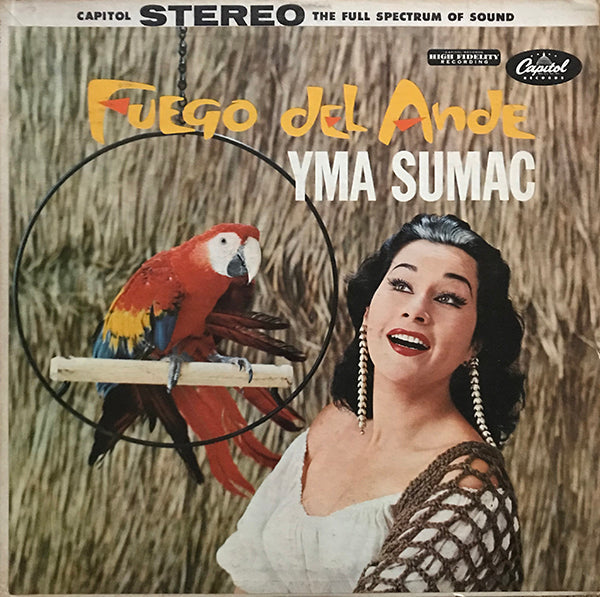
Yma Sumac, Fuego del Ande, album cover.

You get the Music Direct catalog and are very happy that they are willing to spend the money to issue it in this day and age of expensive printing and mailing costs. I guess the fact that it’s almost irresistible not to buy something from the catalog helps offset the cost. They have records you didn’t know you wanted. Hundreds of them, maybe more than a thousand. Not that you don’t also look at websites like Acoustic Sounds, Tower Records, Turntable Lab, Amazon, Amoeba Music, Vinyl Me Please, Discogs, eBay, Experience Vinyl, Sundazed, countless online retailers, and perhaps the most aptly-named of all: Intervention Records.

Although you buy records constantly, you’ve also sold dozens, maybe hundreds of records, and it doesn’t look like you’ve even made a dent in your collection. Selling, as well as buying records just seems to go with the territory after a while. Part of the collector mentality – move the items you don’t want or don’t have an interest in anymore to free up cash and space to buy new ones, whether LPs, HO cars, guitar effects pedals, or…no wonder my house is running out of room.

You use what I call the “chin” method of putting a plastic sleeve on a record. You’ve bought enough plastic record sleeves – of course you put your records in plastic sleeves! – to have noticed that some of them are a really tight fit, especially for gatefold albums. These sleeves can be hard to put on. Well, here’s a way to get them on easily: get the record a little bit into the sleeve, then place the record under your chin and pull on the sleeve with both hands. See how easily it goes on? Much better than trying to “walk” the record into the sleeve with just your two hands! No one has ever caught me doing this, so I’ve never been ridiculed for it, until maybe now.

Keep your chin up! The author demonstrates his preferred method of putting albums into record sleeves. Courtesy of Isla Xi Han.

You have your “good” and your “utility” turntable. Your good one resides in your main audio system, and your other one (or ones) is used for record-grading and seeing if a used record is good enough for more “serious” evaluation. Maybe, like me, your second turntable is fully automatic, great for lazy listening. My second turntable is an old, circa 1970s or ’80sTechnics SL-D3 that I bought from the original owner for $5 in a garage sale. I installed a new cartridge and the turntable works perfectly.

Perhaps this is oversimplified but I’ve encountered mostly two kinds of record collectors. The first group has a system based around a 1970s receiver and big box speakers that are 30 years old or older (perhaps sitting on the floor or propped up on something other than actual speaker stands), all wired with lamp cord and those cheap interconnects many of us have a drawer full of. The second type of collector is the all-out audiophile who prizes beautifully-done reissues and has a high-end system with a really nice turntable setup.

A corollary of this is that you’ve shaken your head at some of the funky stereo systems you’ve seen and heard at record stores. Extra points if the speakers are placed on shelves high up on the walls at opposite ends of the store. When the store plays an early Beatles stereo album you get to either hear the vocals if you're by one side one speaker, or the instruments if you're at the other end of the store. Or wonder: where's the other speaker?

You’ve bought record sleeves, storage boxes, record and CD mailers and maybe other items from Bags Unlimited or ULINE. I get the ULINE catalog, and after you’ve placed your records-related order, you can check out some other handy stuff, like warehouse ventilation fans, conveyor belts, and 60 by 60-foot tarps.

When you’re at a garage sale or thrift shop and see the “Living Presence” or “Living Stereo” logo, you get an honest-to-goodness adrenaline jolt. If you’re in a record store and hear a guy involuntarily exclaiming “Nyaahhh!” a la Curly Howard, that’ll be me finding that insanely rare Edicion Española version of Kraftwerk's Electric Café.

You’ve fallen down the rabbit hole of looking for certain pressings according to their stamper/matrix number. Way back when, when I found out this was a thing, I kind of didn’t want to know about it. Not only did you have to go on a quest for a rare record, you also had to make sure it was the one with the most-desired matrix number! I recall the snobbery of having to not only getting the even-then-rare Casino Royale soundtrack (Colgems COSO-5005), but the “right” pressing (2S/3S if I recall).

You buy records to have, not to play. You want the disc as a collector’s item, not as something you’re actually going to listen to. I mean, if you find a copy of the limited-edition Talking Heads 1983 album Speaking in Tongues with the Robert Rauschenberg cover – and good luck scoring one with unfaded artwork for anything resembling a reasonable price – are you really going to play it?

This particular example reminds me of another sure sign you’re an inveterate vinyl collector: you’ve swiveled over whether or not you should buy a record, decide not to – and then regret it for days, years, decades afterward. When I had the opportunity to buy Speaking in Tongues when it first came out, I balked at the $25 price tag, though I did buy one for a dear friend as a gift. The album quickly disappeared from shelves. I’ve kicked myself ever since. I’ve run into a few copies at used-record stores and record collectors’ conventions since, but in lousy condition. These only remind me that I coulda woulda shoulda grabbed a new one when I had the chance.

You’ve coughed after breathing in record dust. This might be a rare occurrence, but it's happened to me. You go to the basement of a used-record store or home or antique shop, or up in an attic, and while flipping through the long-neglected records, fanned up a cloud of dust and inhaled it with the inevitable results. The odds of getting a real score are slim when the records have been near-abandoned in this manner – but bad odds never discouraged a true record collector from trying to make The Big Score. Your pulmonologist might not agree.

Speaking of basements, it doesn't hurt to ask if a record store has one, or a back room that isn't usually accessible to the public. If you're a regular customer, or simply look desperate enough, they might let you in. After an hour of going through boxes of records in one store's basement, I scored a mint copy of Love Tractor's EP Till the Cows Come Home, featuring their cover of Kraftwerk's "Neon Lights." My back was killing me from stooping over for so long. It was worth it.

If you don’t have a complete set of an artist’s releases, it gives you severe mental unrest. This is not as much of an issue today when you can fill out your collection at the click of a mouse, but in the 1980s and 1990s (in the 1970s I was too broke) I’d literally travel far and wide looking for records by Roy Orbison, to name one example. Even then his old Monument and MGM records were hard to come by. I still vividly remember the day I went to Whirlin’ Disc and they had a nice selection of Orbison discs. After I walked out, they didn’t. And when it comes to having a complete set of records by an artist, bootlegs don’t count.

When you go somewhere to visit you immediately look to see if they have a record store. If you’re with someone else, you’ll plead with them shamelessly to make said record store your first stop on the trip. Of course, if you’re with fellow fanatics, this will be moot. The first time I attended a CES (Consumer Electronics Show) in 1988, I got off the plane and immediately met Michael Fremer and Allen Perkins (of Spiral Groove and MoFi) – I might not have even checked into my hotel – and we walked from the hotel to Record Surplus, in those days a bonanza of used records. My luggage was significantly heavier on the return trip – does that ring any bells, anyone?

You lose interest in collecting an artist’s posthumous releases after they pass away. I know that goes against what I just said about wanting to be a completist, but they’re not the “real” albums. They’re just not!

You’ve opened a gatefold album and seeds have rolled out. Do I even need to mention which album is the most likely to have them wedged in its inner spine?

You’ve encountered the Herb Alpert and the Tijuana Brass’ Whipped Cream & Other Delights album at least 50 times. Probably, more like 100 or 200. I went to one of my formerly-favorite thrift shops (my local Savers, and formerly, because last year they raised the prices of used records from 50 cents to $3.99) and sure enough, there it was again.
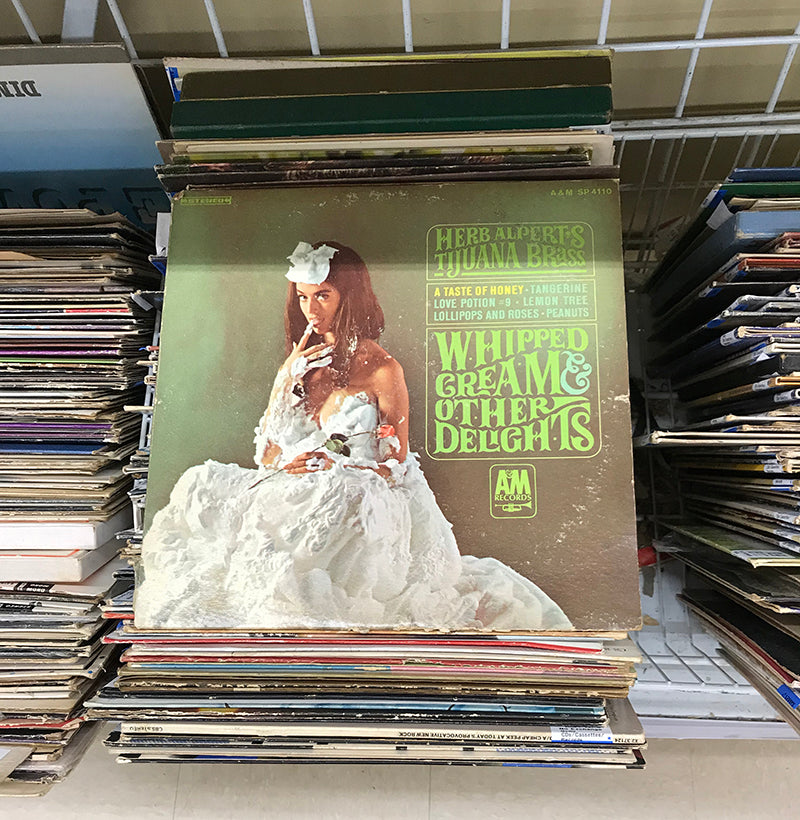
If you're a veteran record collector, you have seen this. If you're a veteran record collector, you have seen this.

CDs have no emotional appeal whatsoever. They’re just objects. Crappy objects that break – “jewel case” has to be the most egregious appellation in the history of recorded sound. Cassettes and reel-to-reels, however, are interesting to vinyl collectors.

It goes without saying that you have multiple records that are worth more than $100. Maybe more than $500. And if you don’t have a “butcher cover” of Yesterday and Today, you wish you did.

It’s not a want, it’s a need. You need records!

Sure, record collecting is fun, and there’s an intrinsic cool factor in having and holding a vinyl record – the cover art, the liner notes, the label designs, the rarity, the memories of the time and effort spent in obtaining them.

Perhaps the ultimate reason to collect records: you think they sound better.

Header image: Hampton Grease Band, Music to Eat, 1971. According to Wikipedia, it's the second-worst-selling album in the history of Columbia Records (a yoga instructional record had the lowest sales). It's far from deserving of that status: the twin-guitar work of Glenn Phillips and Harold Kelling is utterly brilliant and the late Col. Bruce Hampton went on to greater jam band fame. (Columbia has since reissued the album.) Be warned, the music, and especially Hampton's vocals, are avant-garde-out-there. The album never ceases to bring a smile to my face.

More from Issue 179

View All Articles in Issue 179

Search Copper Magazine

#234 A Life in High-End Audio: The Roy Hall Interview, Part One by Frank Doris Sep 07, 2026 #234 Jason Greenlaw Offers His Personal Perspective on Jazz Guitar in Vantage Point by Frank Doris Sep 07, 2026 #234 Transcendent Phoenix: Lucina Yue Brings the Ancient Konghou Into Modern Times by Frank Doris Sep 07, 2026 #234 We Must All Follow Our Bliss by B. Jan Montana Sep 07, 2026 #234 How to Play in a Rock Band, 27: Leveling Up by Frank Doris Sep 07, 2026 #234 Ross Valory: Traveling Into New Musical Territory With All of the Above by Ray Chelstowski Sep 07, 2026 #234 Singer/Songwriter John David Schrader: On the Need to Create by Joe Caplan Sep 07, 2026 #234 The People Who Make Audio Happen: More From T.H.E. Show SoCal 2026 by Harris Fogel Sep 07, 2026 #234 The Vinyl Beat Digs Into the Gadget Box by Rudy Radelic Sep 07, 2026 #234 The Rolling Stones: Foreign Tongues Spoken Loud by Wayne Robins Sep 07, 2026 #234 Musical Moments by Rich Isaacs Sep 07, 2026 #234 Rags for Solo Piano and a Dog: David Chesky's Ragtime Music for the Modern Age by Frankly Speaking Sep 07, 2026 #234 HIGH END 2026, Vienna: Here to Stay by Carsten Barnbeck Sep 07, 2026 #234 From The Audiophile’s Guide: The Two Main Types of Loudpeakers – Box and Panel by Paul McGowan Sep 07, 2026 #234 Letting it Slide by Frank Doris Sep 07, 2026 #234 PS Audio in the News by PS Audio Staff Sep 07, 2026 #234 Long Playing by Peter Xeni Sep 07, 2026 #234 La Mer by B. Jan Montana Sep 07, 2026 #233 A Report From The Total Hi-Fi Experience Show SoCal 2026 by B. Jan Montana Aug 03, 2026 #233 Bluegrass Meets Country, Folk, Jazz and More in All That We Carried by The Squid City Slingers by Frank Doris Aug 03, 2026 #233 Corey Glover and One Tribe Nation: A Variegated Musical Collective by Ray Chelstowski Aug 03, 2026 #233 Excursions with Clive: The Late Clive Davis, A Personal History by Wayne Robins Aug 03, 2026 #233 AI, Art, and Music: A Conversation With Synthography Art by Joe Caplan Aug 03, 2026 #233 New American Symphonies: A Rediscovered Gem and a Vital Contemporary Work by Frank Doris Aug 03, 2026 #233 The Vinyl Beat: Genesis, the Dave Clark Five, Antonio Carlos Jobim and More by Rudy Radelic Aug 03, 2026 #233 How to Play in a Rock Band, 26: When It's Time to Record Your Music by Frank Doris Aug 03, 2026 #233 More From T.H.E. Show 2026, and the People Who Made it Happen by Harris Fogel Aug 03, 2026 #233 Underappreciated Artists, Part Three: Icehouse by Rich Isaacs Aug 03, 2026 #233 The Surprisingly Rich and Varied Music of Somalia by Steve Kindig Aug 03, 2026 #233 A Remarkable Discographic Legacy: The LP Recordings of the Basel Symphony Orchestra by Stephan Haberthür Aug 03, 2026 #233 From The Audiophile’s Guide: The Importance of Loudspeakers by Paul McGowan Aug 03, 2026 #233 From Swimming Pool to New Listening Room: A Conversation with Norman Varney of AV RoomService by Gilles Laferrière Aug 03, 2026 #233 PS Audio in the News by PS Audio Staff Aug 03, 2026 #233 Audio Jewelry by Peter Xeni Aug 03, 2026 #233 Enrich Your Life by Frank Doris Aug 03, 2026 #233 The Searcher by James Schrimpf Aug 03, 2026 #232 What came first: Art or Music? A Conversation With Artist Jose Acosta by Joe Caplan Jul 06, 2026 #232 Blow By Blow: The Jeff Beck Story: An Insightful Book About a Guitar Icon by Ray Chelstowski Jul 06, 2026 #232 Creed Over Camaraderie? by B. Jan Montana Jul 06, 2026 #232 Chronicles of a Sound Pilgrim at the 2026 Montreal Audiofest by Hugues Morin Jul 06, 2026 #232 The Vinyl Beat: Summer Grooves by Rudy Radelic Jul 06, 2026 #232 Hibbing Hillbilly Dylan's Acoustic Rock by Wayne Robins Jul 06, 2026 #232 Quad Quads and Plasmatronics Tweeters: An Extraordinary System Comes to Life by Frank Doris Jul 06, 2026 #232 In Praise of Live Music, Once Again by Ted Shafran Jul 06, 2026 #232 Allnic Audio’s L-9000 Preamplifier: Design and Engineering Innovation by Howard Kneller Jul 06, 2026 #232 “Best Of” Lists and Rage Bait: Enough Already by Frank Doris Jul 06, 2026 #232 Quick Takes: Bud Shank, Paulo Almeida, Jakob Dreyer, Tim Eriksen and Peter Irvine by Frank Doris Jul 06, 2026

Confessions of a Record Collector, Part Three

Confessions of a Record Collector, Part Three

We record collectors are a compulsive bunch. I talked about some of the not-quite-rational lengths to which we will go in order to acquire vinyl in Issue 137 and Issue 142, and identified some of the characteristic compulsions – er, traits – that distinguish the true record-collecting fanatic. Since identifying a case of gravis recordum publicanus requires specialized training and analysis, I’ve needed three installments (including this one) to outline all the symptoms.

Although nowadays you can stream almost anything you’d like (OK, Howard Menger’s Authentic Music from Another Planet is not on any streaming service I can find) when it comes to your favorite music, you still have to have the albums – even if the streaming version of the album might have otherwise-unavailable outtakes, and sound better than the LP, although this is far from assured. (Thanks to Ray Chelstowski’s article in this issue prompting my memory, I listened to the Cowsills’ 1967 smash “The Rain, the Park and Other Things” on Qobuz, and it sounded shrill. Sure enough, the YouTube cuts sounded warmer, if not as detailed. Not Qobuz’ fault – they use what the record company supplies.)

But one thing is certain – the original – not the reissue – vinyl LP sounds the way the producers, engineers, and record company and maybe even the artist (if they had a say) intended it to sound at the time it was released. It is the original authentic sonic document.

You sometimes buy a cheap used record just for the cover. I did this all the time when I could get records for a quarter or 50 cents at garage sales and thrift shops. And sometimes the music can be really good, or at least…interesting, like the old RCA “Living Stereo” Esquivel albums, which also sound terrific, or anything by Yma Sumac (Amy Camus?), who is said to have had a four-octave vocal range.

Yma Sumac, Fuego del Ande, album cover.

You get the Music Direct catalog and are very happy that they are willing to spend the money to issue it in this day and age of expensive printing and mailing costs. I guess the fact that it’s almost irresistible not to buy something from the catalog helps offset the cost. They have records you didn’t know you wanted. Hundreds of them, maybe more than a thousand. Not that you don’t also look at websites like Acoustic Sounds, Tower Records, Turntable Lab, Amazon, Amoeba Music, Vinyl Me Please, Discogs, eBay, Experience Vinyl, Sundazed, countless online retailers, and perhaps the most aptly-named of all: Intervention Records.

Although you buy records constantly, you’ve also sold dozens, maybe hundreds of records, and it doesn’t look like you’ve even made a dent in your collection. Selling, as well as buying records just seems to go with the territory after a while. Part of the collector mentality – move the items you don’t want or don’t have an interest in anymore to free up cash and space to buy new ones, whether LPs, HO cars, guitar effects pedals, or…no wonder my house is running out of room.

You use what I call the “chin” method of putting a plastic sleeve on a record. You’ve bought enough plastic record sleeves – of course you put your records in plastic sleeves! – to have noticed that some of them are a really tight fit, especially for gatefold albums. These sleeves can be hard to put on. Well, here’s a way to get them on easily: get the record a little bit into the sleeve, then place the record under your chin and pull on the sleeve with both hands. See how easily it goes on? Much better than trying to “walk” the record into the sleeve with just your two hands! No one has ever caught me doing this, so I’ve never been ridiculed for it, until maybe now.

Keep your chin up! The author demonstrates his preferred method of putting albums into record sleeves. Courtesy of Isla Xi Han.

You have your “good” and your “utility” turntable. Your good one resides in your main audio system, and your other one (or ones) is used for record-grading and seeing if a used record is good enough for more “serious” evaluation. Maybe, like me, your second turntable is fully automatic, great for lazy listening. My second turntable is an old, circa 1970s or ’80sTechnics SL-D3 that I bought from the original owner for $5 in a garage sale. I installed a new cartridge and the turntable works perfectly.

Perhaps this is oversimplified but I’ve encountered mostly two kinds of record collectors. The first group has a system based around a 1970s receiver and big box speakers that are 30 years old or older (perhaps sitting on the floor or propped up on something other than actual speaker stands), all wired with lamp cord and those cheap interconnects many of us have a drawer full of. The second type of collector is the all-out audiophile who prizes beautifully-done reissues and has a high-end system with a really nice turntable setup.

A corollary of this is that you’ve shaken your head at some of the funky stereo systems you’ve seen and heard at record stores. Extra points if the speakers are placed on shelves high up on the walls at opposite ends of the store. When the store plays an early Beatles stereo album you get to either hear the vocals if you're by one side one speaker, or the instruments if you're at the other end of the store. Or wonder: where's the other speaker?

You’ve bought record sleeves, storage boxes, record and CD mailers and maybe other items from Bags Unlimited or ULINE. I get the ULINE catalog, and after you’ve placed your records-related order, you can check out some other handy stuff, like warehouse ventilation fans, conveyor belts, and 60 by 60-foot tarps.

When you’re at a garage sale or thrift shop and see the “Living Presence” or “Living Stereo” logo, you get an honest-to-goodness adrenaline jolt. If you’re in a record store and hear a guy involuntarily exclaiming “Nyaahhh!” a la Curly Howard, that’ll be me finding that insanely rare Edicion Española version of Kraftwerk's Electric Café.

You’ve fallen down the rabbit hole of looking for certain pressings according to their stamper/matrix number. Way back when, when I found out this was a thing, I kind of didn’t want to know about it. Not only did you have to go on a quest for a rare record, you also had to make sure it was the one with the most-desired matrix number! I recall the snobbery of having to not only getting the even-then-rare Casino Royale soundtrack (Colgems COSO-5005), but the “right” pressing (2S/3S if I recall).

You buy records to have, not to play. You want the disc as a collector’s item, not as something you’re actually going to listen to. I mean, if you find a copy of the limited-edition Talking Heads 1983 album Speaking in Tongues with the Robert Rauschenberg cover – and good luck scoring one with unfaded artwork for anything resembling a reasonable price – are you really going to play it?

This particular example reminds me of another sure sign you’re an inveterate vinyl collector: you’ve swiveled over whether or not you should buy a record, decide not to – and then regret it for days, years, decades afterward. When I had the opportunity to buy Speaking in Tongues when it first came out, I balked at the $25 price tag, though I did buy one for a dear friend as a gift. The album quickly disappeared from shelves. I’ve kicked myself ever since. I’ve run into a few copies at used-record stores and record collectors’ conventions since, but in lousy condition. These only remind me that I coulda woulda shoulda grabbed a new one when I had the chance.

You’ve coughed after breathing in record dust. This might be a rare occurrence, but it's happened to me. You go to the basement of a used-record store or home or antique shop, or up in an attic, and while flipping through the long-neglected records, fanned up a cloud of dust and inhaled it with the inevitable results. The odds of getting a real score are slim when the records have been near-abandoned in this manner – but bad odds never discouraged a true record collector from trying to make The Big Score. Your pulmonologist might not agree.

Speaking of basements, it doesn't hurt to ask if a record store has one, or a back room that isn't usually accessible to the public. If you're a regular customer, or simply look desperate enough, they might let you in. After an hour of going through boxes of records in one store's basement, I scored a mint copy of Love Tractor's EP Till the Cows Come Home, featuring their cover of Kraftwerk's "Neon Lights." My back was killing me from stooping over for so long. It was worth it.

If you don’t have a complete set of an artist’s releases, it gives you severe mental unrest. This is not as much of an issue today when you can fill out your collection at the click of a mouse, but in the 1980s and 1990s (in the 1970s I was too broke) I’d literally travel far and wide looking for records by Roy Orbison, to name one example. Even then his old Monument and MGM records were hard to come by. I still vividly remember the day I went to Whirlin’ Disc and they had a nice selection of Orbison discs. After I walked out, they didn’t. And when it comes to having a complete set of records by an artist, bootlegs don’t count.

When you go somewhere to visit you immediately look to see if they have a record store. If you’re with someone else, you’ll plead with them shamelessly to make said record store your first stop on the trip. Of course, if you’re with fellow fanatics, this will be moot. The first time I attended a CES (Consumer Electronics Show) in 1988, I got off the plane and immediately met Michael Fremer and Allen Perkins (of Spiral Groove and MoFi) – I might not have even checked into my hotel – and we walked from the hotel to Record Surplus, in those days a bonanza of used records. My luggage was significantly heavier on the return trip – does that ring any bells, anyone?

You lose interest in collecting an artist’s posthumous releases after they pass away. I know that goes against what I just said about wanting to be a completist, but they’re not the “real” albums. They’re just not!

You’ve opened a gatefold album and seeds have rolled out. Do I even need to mention which album is the most likely to have them wedged in its inner spine?

You’ve encountered the Herb Alpert and the Tijuana Brass’ Whipped Cream & Other Delights album at least 50 times. Probably, more like 100 or 200. I went to one of my formerly-favorite thrift shops (my local Savers, and formerly, because last year they raised the prices of used records from 50 cents to $3.99) and sure enough, there it was again.

If you're a veteran record collector, you have seen this. If you're a veteran record collector, you have seen this.

CDs have no emotional appeal whatsoever. They’re just objects. Crappy objects that break – “jewel case” has to be the most egregious appellation in the history of recorded sound. Cassettes and reel-to-reels, however, are interesting to vinyl collectors.

It goes without saying that you have multiple records that are worth more than $100. Maybe more than $500. And if you don’t have a “butcher cover” of Yesterday and Today, you wish you did.

It’s not a want, it’s a need. You need records!

Sure, record collecting is fun, and there’s an intrinsic cool factor in having and holding a vinyl record – the cover art, the liner notes, the label designs, the rarity, the memories of the time and effort spent in obtaining them.

Perhaps the ultimate reason to collect records: you think they sound better.

Header image: Hampton Grease Band, Music to Eat, 1971. According to Wikipedia, it's the second-worst-selling album in the history of Columbia Records (a yoga instructional record had the lowest sales). It's far from deserving of that status: the twin-guitar work of Glenn Phillips and Harold Kelling is utterly brilliant and the late Col. Bruce Hampton went on to greater jam band fame. (Columbia has since reissued the album.) Be warned, the music, and especially Hampton's vocals, are avant-garde-out-there. The album never ceases to bring a smile to my face.

0 comments

Leave a comment

0 Comments

Your avatar

Loading comments...

🗑️ Delete Comment

Enter moderator password to delete this comment:

✏️ Edit Comment

Enter your email to verify ownership: