COPPER

A PS Audio Publication

Issue 191 • Free Online Magazine

Issue 191 Revolutions Per Minute

Restoring Vintage SME Tonearms

Restoring Vintage SME Tonearms

Over the past few years, we have restored a number of SME 3009 and 3012 tonearms, covering most of their variants made over the impressively long production life span of this model range.

This outstanding tonearm was first introduced in 1959, setting a standard for high performance tonearm design which is still hard to beat, 60 years later.

We have used our restored SME tonearms on a large number of reference reproduction systems, for our own use and for our customers, such as the Thorens TD160 project which was presented here last February. These systems are excellent for Quality Control in vinyl record manufacturing, to ensure that any defects are caught early.

They are of course also capable of offering an intensely enjoyable, accurate listening experience, coupled with an accurate cartridge.
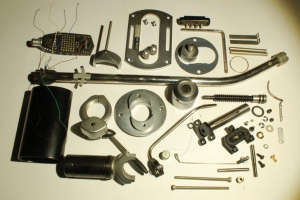
 

This array of parts is an SME 3012, the bigger version of the 3009, from the period of Shure's involvement with SME. It was found on a Neumann disk mastering lathe, a common application for the 3012, its length allowing it to reproduce disks from the massive 16" vacuum platter. The new owner of the Neumann lathe did not want to keep the tonearm, which was admittedly in a very poor state of neglect. As such, it was removed, carefully cleaned and disassembled for the repair and restoration to begin.
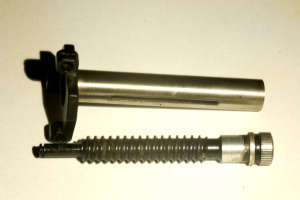
 

The most interesting features on this version of the 3012 are the leadscrew system for advancing the counterweight, along with the method of decoupling the counterweight assembly and adjusting lateral balance.


This system was completely jammed, but with our precision machine tools in our R&D laboratory, it was easy to machine the required replacement parts, in house. It now operates smoothly and is a real pleasure to adjust.
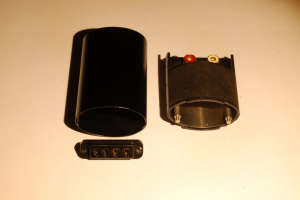
 

This version came with the sliding screening can and 4-pins-in-series connector at the bottom, shown at the left.
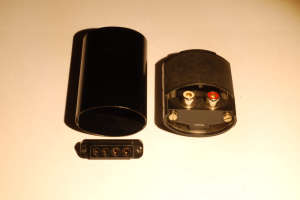
 

An alternative arrangement is the screening can on the right, with a pair of RCA connectors. Our personal preference is no connector at all, with the tonearm wiring soldered directly to the interconnects, or even better, a continuous run of wire all the way to the preamplifier. In fact, on the 3009 versions with non-removable headshell, it is possible and preferable to run twisted pairs, suitably screened, from the cartridge pins to the preamp, with no connectors or soldering in between. Even better, soldered directly to the sockets of the Western Electric 437A tubes in the balanced Agnew Analog Reference Instruments Type 751 reference phonograph preamplifier, keeping wiring accurately balanced throughout.
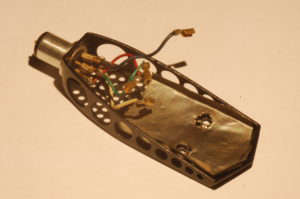
 

The SME 3012 features a removable headshell. This contributes to a higher effective tonearm mass, due to the location of the connector being close to the tip. The 3012, being a 12" arm, is obviously not designed with the lowest possible effective mass as an objective, but was instead offering the comfort of a removable headshell demanded by professional users. In any case, the "tin foil hat" tweak seen here is a very bad idea! Please do not do this to your poor tonearm! It works great as it is, if you are using a decent cartridge and do the wiring properly.
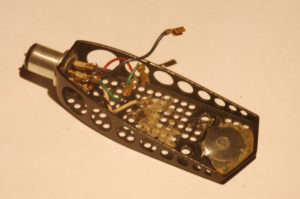
 

Removing the foil, we are left with a mess of glue to clean up, to restore this classic to proper standard.


This is how it should look. Well, almost. We still need to install some proper wires and connectors there. But we shall defer this to the end of the restoration process.


While on the subject of headshells, SME made their version "rigid": The mounting faces are metallic, as seen on the SME headshell on the left. The headshell on the right uses a rubber ring gasket as the mounting face. This is easier/cheaper to manufacture, but the performance is worse, as it allows more flexing and a sloppier registration of location.
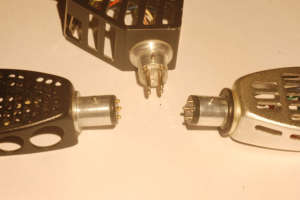
 

The SME headshell mounting system (left and right) is generally not the most accurate way to mount a removable headshell. Better geometric accuracy and repeatability over multiple mounting cycles can be achieved with a cone-type mount, as can be seen on the headshell in the middle, from a Thorens TP16 tonearm. However, this is more difficult to manufacture accurately and if badly executed, it would be worse than a flat-face mount.

The anti-skating arrangement on the SME 3012 and 3009 tonearms is a weight on a string. Gravity acts on the weight, which pulls on the string, going through a guide and attached to a lever at the back of the tonearm. The notches on the lever allow anti-skating force adjustment for different values of vertical tracking force.
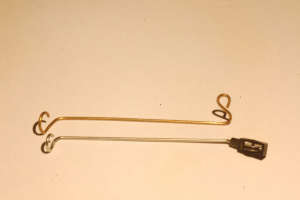
 

The original guide, shown on the top, was just a suitably bent wire. Friction at the point of contact was high, so this was later re-engineered with a pulley on the top.

This was a significant improvement, and while it could possibly get even better with jewelled bearings, the cost would be much higher.

The story of the evolution of the SME 3009 and 3012 tonearms reveals, once again, that the limit to what can reasonably be achieved, is more often than not economically imposed rather than technologically imposed.


Header image courtesy of Wikimedia Commons/Jacques. All other images courtesy of Agnew Analog Reference Instruments.

This article originally appeared on the Agnew Analog Reference Instruments blog and is used by permission.

More from Issue 191

View All Articles in Issue 191

Search Copper Magazine

#225 Capital Audiofest 2025: Must-See Stereo, Part One by Frank Doris Dec 01, 2025 #225 Otis Taylor and the Electrics Delivers a Powerful Set of Hypnotic Modern Blues by Frank Doris Dec 01, 2025 #225 A Christmas Miracle by B. Jan Montana Dec 01, 2025 #225 T.H.E. Show New York 2025, Part Two: Plenty to See, Hear, and Enjoy by Frank Doris Dec 01, 2025 #225 Underappreciated Artists, Part One: Martin Briley by Rich Isaacs Dec 01, 2025 #225 Rock and Roll is Here to Stay by Wayne Robins Dec 01, 2025 #225 A Lifetime of Holiday Record (and CD) Listening by Rudy Radelic Dec 01, 2025 #225 Little Feat: Not Saying Goodbye, Not Yet by Ray Chelstowski Dec 01, 2025 #225 How to Play in a Rock Band, Part 18: Dealing With Burnout by Frank Doris Dec 01, 2025 #225 The People Who Make Audio Happen: CanJam SoCal 2025 by Harris Fogel Dec 01, 2025 #225 Chicago’s Sonic Sanctuaries: Four Hi‑Fi Listening Bars Channeling the Jazz‑Kissa Spirit by Olivier Meunier-Plante Dec 01, 2025 #225 From The Audiophile’s Guide: Controlling Bass Frequencies Through Membrane Absorbers (and How to Build Your Own) by Paul McGowan Dec 01, 2025 #225 Your Editor’s Tips for Attending Audio Shows by Frank Doris Dec 01, 2025 #225 PS Audio in the News by Frank Doris Dec 01, 2025 #225 Back to My Reel-to-Reel Roots, Part 24 by Ken Kessler Dec 01, 2025 #225 Holiday Music by Frank Doris Dec 01, 2025 #225 Puppy Prognostication by Peter Xeni Dec 01, 2025 #225 How to Post Comments on Copper by Frank Doris Dec 01, 2025 #225 Living Color by Rudy Radelic Dec 01, 2025 #224 T.H.E. Show New York 2025, Part One: A New Beginning by Frank Doris Nov 03, 2025 #224 Fool’s Leap of Faith is the Extraordinary Octave Records Debut from Singer/Songwriter Tyler Burba and Visit by Frank Doris Nov 03, 2025 #224 The Beatles’ “Aeolian Cadences.” What? by Wayne Robins Nov 03, 2025 #224 Persona Non Grata by B. Jan Montana Nov 03, 2025 #224 Talking With Recording Engineer Barry Diament of Soundkeeper Recordings, Part Two by Frank Doris Nov 03, 2025 #224 B Sides, B Movies, and Beware of Zombies by Rudy Radelic Nov 03, 2025 #224 The Burn-In Chronicles: 1,000 Hours to Sonic Salvation by Olivier Meunier-Plante Nov 03, 2025 #224 A Conversation With Mat Weisfeld of VPI Industries by Joe Caplan Nov 03, 2025 #224 Blues-Rocker Kenny Wayne Shepherd Celebrates 30 Years of Ledbetter Heights by Ray Chelstowski Nov 03, 2025 #224 Playing in a Rock Band, 17: When Good Gigs Go Bad, Part Two by Frank Doris Nov 03, 2025 #224 From The Audiophile’s Guide: Dealing with Odd-Shaped Rooms by Paul McGowan Nov 03, 2025 #224 TEAC’s TN-3B-SE Turntable Plays Bob Dylan by Howard Kneller Nov 03, 2025 #224 PS Audio in the News by Frank Doris Nov 03, 2025 #224 Lost in Translation by Peter Xeni Nov 03, 2025 #224 Reel-to-Reel Roots, Part 23: Better Than Rice Krispies by Ken Kessler Nov 03, 2025 #224 I Bring Joy! by Frank Doris Nov 03, 2025 #224 Screen Test by Rich Isaacs Nov 03, 2025 #224 How to Post Comments on Copper by Frank Doris Nov 03, 2025 #132 Dr. Patrick Gleeson: The Interview, Part Two by Rich Isaacs Oct 07, 2025 #223 World Fusion Meets Flamenco in Gratitude from Steve Mullins and Rim of the Well by Frank Doris Oct 06, 2025 #223 Judging Albums by Their Covers by Rich Isaacs Oct 06, 2025 #223 Recent Arrivals and 12-inch Royalty by Rudy Radelic Oct 06, 2025 #223 Summer of Creem, Part Two by Wayne Robins Oct 06, 2025 #223 Recording Engineer Barry Diament of Soundkeeper Recordings: Striving for Natural Sound by Frank Doris Oct 06, 2025 #223 Tea on the Terrace by B. Jan Montana Oct 06, 2025 #223 How Good Can Car Audio Get? by Joe Caplan Oct 06, 2025 #223 The Advantages of a Dedicated Listening Room by Paul McGowan Oct 06, 2025 #223 1! 2! 3! 4! Surrounded by the Ramones in Dolby Atmos! by Frank Doris Oct 06, 2025

Restoring Vintage SME Tonearms

Restoring Vintage SME Tonearms

Over the past few years, we have restored a number of SME 3009 and 3012 tonearms, covering most of their variants made over the impressively long production life span of this model range.

This outstanding tonearm was first introduced in 1959, setting a standard for high performance tonearm design which is still hard to beat, 60 years later.

We have used our restored SME tonearms on a large number of reference reproduction systems, for our own use and for our customers, such as the Thorens TD160 project which was presented here last February. These systems are excellent for Quality Control in vinyl record manufacturing, to ensure that any defects are caught early.

They are of course also capable of offering an intensely enjoyable, accurate listening experience, coupled with an accurate cartridge.


This array of parts is an SME 3012, the bigger version of the 3009, from the period of Shure's involvement with SME. It was found on a Neumann disk mastering lathe, a common application for the 3012, its length allowing it to reproduce disks from the massive 16" vacuum platter. The new owner of the Neumann lathe did not want to keep the tonearm, which was admittedly in a very poor state of neglect. As such, it was removed, carefully cleaned and disassembled for the repair and restoration to begin.


The most interesting features on this version of the 3012 are the leadscrew system for advancing the counterweight, along with the method of decoupling the counterweight assembly and adjusting lateral balance.


This system was completely jammed, but with our precision machine tools in our R&D laboratory, it was easy to machine the required replacement parts, in house. It now operates smoothly and is a real pleasure to adjust.


This version came with the sliding screening can and 4-pins-in-series connector at the bottom, shown at the left.


An alternative arrangement is the screening can on the right, with a pair of RCA connectors. Our personal preference is no connector at all, with the tonearm wiring soldered directly to the interconnects, or even better, a continuous run of wire all the way to the preamplifier. In fact, on the 3009 versions with non-removable headshell, it is possible and preferable to run twisted pairs, suitably screened, from the cartridge pins to the preamp, with no connectors or soldering in between. Even better, soldered directly to the sockets of the Western Electric 437A tubes in the balanced Agnew Analog Reference Instruments Type 751 reference phonograph preamplifier, keeping wiring accurately balanced throughout.


The SME 3012 features a removable headshell. This contributes to a higher effective tonearm mass, due to the location of the connector being close to the tip. The 3012, being a 12" arm, is obviously not designed with the lowest possible effective mass as an objective, but was instead offering the comfort of a removable headshell demanded by professional users. In any case, the "tin foil hat" tweak seen here is a very bad idea! Please do not do this to your poor tonearm! It works great as it is, if you are using a decent cartridge and do the wiring properly.


Removing the foil, we are left with a mess of glue to clean up, to restore this classic to proper standard.


This is how it should look. Well, almost. We still need to install some proper wires and connectors there. But we shall defer this to the end of the restoration process.


While on the subject of headshells, SME made their version "rigid": The mounting faces are metallic, as seen on the SME headshell on the left. The headshell on the right uses a rubber ring gasket as the mounting face. This is easier/cheaper to manufacture, but the performance is worse, as it allows more flexing and a sloppier registration of location.


The SME headshell mounting system (left and right) is generally not the most accurate way to mount a removable headshell. Better geometric accuracy and repeatability over multiple mounting cycles can be achieved with a cone-type mount, as can be seen on the headshell in the middle, from a Thorens TP16 tonearm. However, this is more difficult to manufacture accurately and if badly executed, it would be worse than a flat-face mount.

The anti-skating arrangement on the SME 3012 and 3009 tonearms is a weight on a string. Gravity acts on the weight, which pulls on the string, going through a guide and attached to a lever at the back of the tonearm. The notches on the lever allow anti-skating force adjustment for different values of vertical tracking force.


The original guide, shown on the top, was just a suitably bent wire. Friction at the point of contact was high, so this was later re-engineered with a pulley on the top.

This was a significant improvement, and while it could possibly get even better with jewelled bearings, the cost would be much higher.

The story of the evolution of the SME 3009 and 3012 tonearms reveals, once again, that the limit to what can reasonably be achieved, is more often than not economically imposed rather than technologically imposed.


Header image courtesy of Wikimedia Commons/Jacques. All other images courtesy of Agnew Analog Reference Instruments.

This article originally appeared on the Agnew Analog Reference Instruments blog and is used by permission.

0 comments

Leave a comment

0 Comments

Your avatar

Loading comments...

🗑️ Delete Comment

Enter moderator password to delete this comment: