COPPER

A PS Audio Publication

Issue 129 • Free Online Magazine

Issue 129 REVOLUTIONS PER MINUTE

The Story of a Vintage Piano, Part the First

The Story of a Vintage Piano, Part the First

In previous issues I have gone into some detail about disk recording, tape recording, the technical challenges of accurate reproduction, audio electronics, vacuum tubes and even professional recording facilities. But, while all of these topics are important when sound recording is given any serious consideration, no degree of proficiency in the above can make up for the lack of a good source.

I am not only referring to talented musicians, who are of course essential, but also their instruments. The combination of musician, instrument and the acoustics of the space in which the performance takes place pretty much define the limits of what can be captured in a recording. It is already a challenge to record all of what is there as faithfully as possible.

One of the most difficult instruments to record in a realistic manner is the piano. There are two basic reasons for this, the first one of which is related to the nature of the piano itself. It has one of the widest musical ranges of any instrument, with an 88-key piano extending from a low A at 27.5 Hz to a high C at around 4,186 Hz. These frequencies only represent the fundamental, but the piano is naturally rich in harmonics, extending to very high frequencies. Most domestic listening systems cannot reproduce 27.5 Hz, nor can they reproduce very high frequencies accurately, even if these were captured in the recording, which is questionable in itself. Moreover, a skilled pianist can get a very wide dynamic range out of a good piano, challenging the capabilities of both recording and playback equipment.

The second reason has to do with the fact that many music lovers have often experienced a real piano being played in a room. It is a very common instrument, playing a fundamental role in western musical education. As such, most of us have a solid reference for comparison and the weaknesses in piano recordings really stand out as not sounding like the real thing. Most musicians tend to experience the same effect when it comes to listening to recordings of their own particular instrument, but even non-musicians are usually very familiar with what a real piano sounds like. For example, I can reliably detect even very small amounts of wow and flutter on guitar recordings, because being a guitar player myself, I know what guitar vibrato can sound like and will not confuse wow and flutter for vibrato. But with instruments I am not as familiar with, it would take a greater amount of it for me to detect.

The soundboard of a Steinway grand piano. Courtesy of Wikimedia Commons/Halley from Boston. The soundboard of a Steinway grand piano. Courtesy of Wikimedia Commons/Halley from Boston.

It is a bit like the sound of the human voice. We have evolved as a species to be particularly sensitive to the vocal sounds of other humans and especially the ones who we are the most familiar with. We are able to recognize the voice of our mother even if it’s presented in very low quality, via the telephone or in a voice message, yet it is obvious that their voice is only coming through a loudspeaker. Our hearing mechanism can pick up on even the most subtle hints that our mother’s voice does not sound like it should, from our reference to real-life experiences, and it is difficult to fool someone into thinking that a recording of their mother’s voice is actually her speaking directly.

But, this is exactly what we are trying to achieve in high-fidelity sound recordings: to present a recorded sound of an instrument to an audience familiar with the actual sound of that instrument, hoping that the clues which would inform their hearing mechanisms that this is not how the instrument is supposed to sound will be absent or well-concealed.

I have a particularly soft spot for the sound of the piano and have heard many good pianos in real life. However, I have heard very few convincing piano recordings. My own experiments to date in this regard have never yielded anything I would consider worthy of commercial release, but I have learned a lot about what not to do in the process.

A few years ago, upon completing some modifications to my personal studio, I decided to record my grandmother telling stories from World War II, for historical documentation and preservation for our next family generation. I did the same with all of our close family members, who were all present at the session. Each one would enter the soundproof recording space alone, while I was monitoring the recording from the soundproof control room, alone. The rest of the family waited in the lounge.

When all the stories were told, the family was invited to the control room to hear the recordings. My grandmother’s recording started with her just asking if I can hear her, to which my father reacted by turning towards her to reply, only to be shocked when he realized she had not actually spoken in real life, but only on the recording. My dad has spent most of his life listening to high-fidelity recordings on a decent system and has excellent hearing, so at that point, seeing that my father had been fooled into thinking a recording was a real-life voice, I realized I really was ready to approach piano recording (and recording in general) from a fresh perspective. The electronics in the recording chain, and the recording devices, monitoring conditions and microphones were now on a very good level, and with further improvements in mind for the near future, it was time to give some serious thought to the first link in the chain: The musical instrument itself.

During the course of several years of consideration, experimentation and discussion, I had experienced a wide range of excellent pianos by Steinway, Bösendorfer, Blüthner and several other well-known manufacturers. One thing I realized was that a great concert piano is not necessarily as great for recording purposes, which introduces further challenges in the pursuit of the holy grail of instruments to be used for recording.

Lizst at the Piano, by Josef Danhauser. Liszt at the Piano, by Josef Danhauser.

The most realistic piano recording I have ever heard involved a vintage Mason and Hamlin grand piano. However, many pianists who I’d had discussions with tended to prefer recently-manufactured pianos, primarily due to the fact that a new piano does not yet have wear on its action and as such, tends to be easier to play. Vintage pianos can of course be kept well-maintained, but if something wrong with a piano is not noticed in time, the pianist would have to deal with a defect which could prove detrimental to the accuracy of their performance.

A piano action is an elaborate mechanical assembly, consisting of thousands of tiny parts, which tend to wear out. When they do, this causes inconsistencies between keys, produces unwanted sounds and makes it difficult for a pianist to control the nuances of their playing. All parts can be renewed when worn, but this is quite a task and requires an experienced piano technician, which often proves uneconomical. Vintage pianos are commonly replaced by newer pianos, ensuring the comfort of the performers with little risk of technical glitches.

The action of an 1884 Broadwood grand piano. Courtesy of Wikimedia Commons/Encyclopedia Brittanica/John Broadwood. The action of an 1884 Broadwood grand piano. Courtesy of Wikimedia Commons/Encyclopedia Brittanica/John Broadwood.

But just as with classic cars, vintage audio equipment and carefully-aged wine, vintage pianos can have something really special about them, perhaps worth the extra effort in restoring them and keeping them in good shape.

Also, while some parts in a piano do wear out over time with use, other parts tend to improve and stabilize, such as the cast iron frame.

My early investigation of the option of acquiring a high-quality vintage piano was not particularly fruitful. Many pianos were simply in a terrible state of disrepair and others didn’t sound like anything special.

Until one day, I fell in love! It was a beautiful John Broadwood & Sons grand piano, dating from 1904. It had been privately owned and had seen very little use, as evidenced by the original parts still only showing minimal wear. It was a beautifully made instrument, complete with rosewood finish and ornamental lathe-turned legs.

The frame of J.I.'s John Broadwood & Sons piano. The frame of J.I.'s John Broadwood & Sons piano.

John Broadwood started out as an apprentice of Burkat Shudi. After marrying Shudi’s daughter Barbara in 1769, he joined Shudi’s venture as a partner, and the company evolved from being a small harpsichord manufacturer, to eventually becoming the foremost piano manufacturer in England. Ludwig van Beethoven owned a Broadwood, and so did several other world-renowned composers of the time. Broadwood pianos were very highly regarded and for some time, the company was considered to be producing some of the finest-sounding pianos in the world.

This particular piano had to be transported halfway around the world, under time pressure, in very challenging circumstances, and required the finely coordinated services of six different specialist companies. It was a daunting logistics nightmare, especially considering the sensitive nature of the piano. Fortunately, through my work, I have become quite accustomed to logistics nightmares involving shipping very heavy and extremely fragile disk mastering systems all over the world on a regular basis, so I had the experience, the contacts and the nerves for it. But it was still daunting. The worst part was when the piano actually arrived: in a gargantuan 1,200 lb. crate that was too large to fit into the building, and was delivered on a cloudy day, with rain being just minutes away!
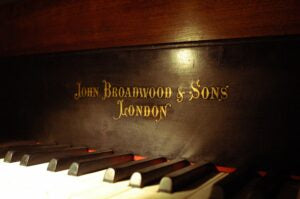
The front of J.I.'s John Broadwood & Sons piano.

More from Issue 129

View All Articles in Issue 129

Search Copper Magazine

#231 Piano Prodigy Jude Kofie Releases His Debut Album On Octave Records by Frank Doris Jun 01, 2026 #231 Underappreciated Artists, Part Two: City Boy by Rich Isaacs Jun 01, 2026 #231 Music and the Art of Creation: Talking With Saxophonist Rob Scheps by Joe Caplan Jun 01, 2026 #231 How to Play in a Rock Band, 24: Further Adventures at the 2026 Montauk Music Festival by Frank Doris Jun 01, 2026 #231 Courtney Barnett: Creature of Habit by Wayne Robins Jun 01, 2026 #231 Angine de Poitrine: Interstellar Guitar Rock Saviors Headed for Late-Night TV Pop Stardom? by Mark Lepage Jun 01, 2026 #231 My Impressions of AXPONA 2026, Part One by Frank Doris Jun 01, 2026 #231 2026 La Jolla Concours d'Elegance: Another Aesthetic Feast by B. Jan Montana Jun 01, 2026 #231 Country Music Icon Jo Dee Messina’s Bridges: A New Beginning by Ray Chelstowski Jun 01, 2026 #231 The Luxury Dispatch Hosts a Video Podcast With Ken Kessler by Ken Kessler Jun 01, 2026 #231 The Vinyl Beat: Tracking in the Motor City by Rudy Radelic Jun 01, 2026 #231 Lots of Fun With DSP: The Ferrum Audio WANDLA DAC and Its Tube Mode by Frank Doris Jun 01, 2026 #231 From The Audiophile's Guide: Digital Source Components and Streaming Audio by Paul McGowan Jun 01, 2026 #231 Onkyo’s Monster M-510 power amplifier by The Staff at Just Audio Jun 01, 2026 #231 PS Audio in the News by PS Audio Staff Jun 01, 2026 #231 Naming Convention by Peter Xeni Jun 01, 2026 #231 Les Invisibles by Frank Doris Jun 01, 2026 #231 Wildlife Scene by James Schrimpf Jun 01, 2026 #230 Camaraderie by B. Jan Montana May 04, 2026 #230 AXPONA 2026: A Family Gathering by Paul McGowan May 04, 2026 #230 Pianist Ryan Benthall Explores Jazz Realms and Far Beyond With Divine Sky by Frank Doris May 04, 2026 #230 The Vinyl Beat in AXPONA-Land by Rudy Radelic May 04, 2026 #230 Teddy Thompson’s Musical Growth Deepens With Never Be the Same by Ray Chelstowski May 04, 2026 #230 More Fun in the Sun: Florida Audio Expo, Part Two by Frank Doris May 04, 2026 #230 CanJam NYC 2026 Show Report: Heady Sound, Part Two by Frank Doris and Harris Fogel May 04, 2026 #230 Sonic Youth On Murray Street by Wayne Robins May 04, 2026 #230 Graffeo Coffee: A Symphony of Sensory Experience by Joe Caplan May 04, 2026 #230 The Saul Authority: The Story of Hi-Fi Pioneer Saul Marantz by Olivier Meunier-Plante May 04, 2026 #230 How to Play in a Rock Band, 23: Encounters With Famous Musicians, Part Two by Frank Doris May 04, 2026 #230 An Outlier in the Rack: A Vintage BIC Beam Box by The Staff at Just Audio May 04, 2026 #230 PS Audio in the News by PS Audio Staff May 04, 2026 #230 A Cautionary Tale by Rich Isaacs May 04, 2026 #230 Reel-to-Reel Roots, Part 33 (Revised): Ken Kessler Reports On the 2026 (British) AudioJumble by Ken Kessler May 04, 2026 #230 Text Messaging by Frank Doris May 04, 2026 #230 The Audiophile Rat Race by Peter Xeni May 04, 2026 #230 On the Rocks by Rich Isaacs May 04, 2026 #229 The Earliest Stars of Country Music, Part Three by Jeff Weiner Apr 06, 2026 #229 The Healing Power of Music and Sound at the Omega Institute by Joe Caplan Apr 06, 2026 #229 CanJam NYC 2026 Show Report: Heady Sound, Part One by Frank Doris Apr 06, 2026 #229 Florida Audio Expo 2026: Warming Up to High-End Audio, Part One by Frank Doris Apr 06, 2026 #229 Quick Takes: Anne Bisson, Sam Morrison, The Velvet Underground, and the Stooges by Frank Doris Apr 06, 2026 #229 The Vinyl Beat: New Arrivals, and Old Audio Show Demo Scores to Settle by Rudy Radelic Apr 06, 2026 #229 Harvard Gets a High-End Audio Education by Frank Doris Apr 06, 2026 #229 No Country for Old Knees by B. Jan Montana Apr 06, 2026 #229 How To Play in A Rock Band, 22: Encounters With Famous Musicians, Part 1 by Frank Doris Apr 06, 2026 #229 The Soulful Grooves of Guinea-Bissau by Steve Kindig Apr 06, 2026 #229 Four-Hand Piano Performance at Its Finest by Stephan Haberthür Apr 06, 2026

The Story of a Vintage Piano, Part the First

The Story of a Vintage Piano, Part the First

In previous issues I have gone into some detail about disk recording, tape recording, the technical challenges of accurate reproduction, audio electronics, vacuum tubes and even professional recording facilities. But, while all of these topics are important when sound recording is given any serious consideration, no degree of proficiency in the above can make up for the lack of a good source.

I am not only referring to talented musicians, who are of course essential, but also their instruments. The combination of musician, instrument and the acoustics of the space in which the performance takes place pretty much define the limits of what can be captured in a recording. It is already a challenge to record all of what is there as faithfully as possible.

One of the most difficult instruments to record in a realistic manner is the piano. There are two basic reasons for this, the first one of which is related to the nature of the piano itself. It has one of the widest musical ranges of any instrument, with an 88-key piano extending from a low A at 27.5 Hz to a high C at around 4,186 Hz. These frequencies only represent the fundamental, but the piano is naturally rich in harmonics, extending to very high frequencies. Most domestic listening systems cannot reproduce 27.5 Hz, nor can they reproduce very high frequencies accurately, even if these were captured in the recording, which is questionable in itself. Moreover, a skilled pianist can get a very wide dynamic range out of a good piano, challenging the capabilities of both recording and playback equipment.

The second reason has to do with the fact that many music lovers have often experienced a real piano being played in a room. It is a very common instrument, playing a fundamental role in western musical education. As such, most of us have a solid reference for comparison and the weaknesses in piano recordings really stand out as not sounding like the real thing. Most musicians tend to experience the same effect when it comes to listening to recordings of their own particular instrument, but even non-musicians are usually very familiar with what a real piano sounds like. For example, I can reliably detect even very small amounts of wow and flutter on guitar recordings, because being a guitar player myself, I know what guitar vibrato can sound like and will not confuse wow and flutter for vibrato. But with instruments I am not as familiar with, it would take a greater amount of it for me to detect.

The soundboard of a Steinway grand piano. Courtesy of Wikimedia Commons/Halley from Boston. The soundboard of a Steinway grand piano. Courtesy of Wikimedia Commons/Halley from Boston.

It is a bit like the sound of the human voice. We have evolved as a species to be particularly sensitive to the vocal sounds of other humans and especially the ones who we are the most familiar with. We are able to recognize the voice of our mother even if it’s presented in very low quality, via the telephone or in a voice message, yet it is obvious that their voice is only coming through a loudspeaker. Our hearing mechanism can pick up on even the most subtle hints that our mother’s voice does not sound like it should, from our reference to real-life experiences, and it is difficult to fool someone into thinking that a recording of their mother’s voice is actually her speaking directly.

But, this is exactly what we are trying to achieve in high-fidelity sound recordings: to present a recorded sound of an instrument to an audience familiar with the actual sound of that instrument, hoping that the clues which would inform their hearing mechanisms that this is not how the instrument is supposed to sound will be absent or well-concealed.

I have a particularly soft spot for the sound of the piano and have heard many good pianos in real life. However, I have heard very few convincing piano recordings. My own experiments to date in this regard have never yielded anything I would consider worthy of commercial release, but I have learned a lot about what not to do in the process.

A few years ago, upon completing some modifications to my personal studio, I decided to record my grandmother telling stories from World War II, for historical documentation and preservation for our next family generation. I did the same with all of our close family members, who were all present at the session. Each one would enter the soundproof recording space alone, while I was monitoring the recording from the soundproof control room, alone. The rest of the family waited in the lounge.

When all the stories were told, the family was invited to the control room to hear the recordings. My grandmother’s recording started with her just asking if I can hear her, to which my father reacted by turning towards her to reply, only to be shocked when he realized she had not actually spoken in real life, but only on the recording. My dad has spent most of his life listening to high-fidelity recordings on a decent system and has excellent hearing, so at that point, seeing that my father had been fooled into thinking a recording was a real-life voice, I realized I really was ready to approach piano recording (and recording in general) from a fresh perspective. The electronics in the recording chain, and the recording devices, monitoring conditions and microphones were now on a very good level, and with further improvements in mind for the near future, it was time to give some serious thought to the first link in the chain: The musical instrument itself.

During the course of several years of consideration, experimentation and discussion, I had experienced a wide range of excellent pianos by Steinway, Bösendorfer, Blüthner and several other well-known manufacturers. One thing I realized was that a great concert piano is not necessarily as great for recording purposes, which introduces further challenges in the pursuit of the holy grail of instruments to be used for recording.

Lizst at the Piano, by Josef Danhauser. Liszt at the Piano, by Josef Danhauser.

The most realistic piano recording I have ever heard involved a vintage Mason and Hamlin grand piano. However, many pianists who I’d had discussions with tended to prefer recently-manufactured pianos, primarily due to the fact that a new piano does not yet have wear on its action and as such, tends to be easier to play. Vintage pianos can of course be kept well-maintained, but if something wrong with a piano is not noticed in time, the pianist would have to deal with a defect which could prove detrimental to the accuracy of their performance.

A piano action is an elaborate mechanical assembly, consisting of thousands of tiny parts, which tend to wear out. When they do, this causes inconsistencies between keys, produces unwanted sounds and makes it difficult for a pianist to control the nuances of their playing. All parts can be renewed when worn, but this is quite a task and requires an experienced piano technician, which often proves uneconomical. Vintage pianos are commonly replaced by newer pianos, ensuring the comfort of the performers with little risk of technical glitches.

The action of an 1884 Broadwood grand piano. Courtesy of Wikimedia Commons/Encyclopedia Brittanica/John Broadwood. The action of an 1884 Broadwood grand piano. Courtesy of Wikimedia Commons/Encyclopedia Brittanica/John Broadwood.

But just as with classic cars, vintage audio equipment and carefully-aged wine, vintage pianos can have something really special about them, perhaps worth the extra effort in restoring them and keeping them in good shape.

Also, while some parts in a piano do wear out over time with use, other parts tend to improve and stabilize, such as the cast iron frame.

My early investigation of the option of acquiring a high-quality vintage piano was not particularly fruitful. Many pianos were simply in a terrible state of disrepair and others didn’t sound like anything special.

Until one day, I fell in love! It was a beautiful John Broadwood & Sons grand piano, dating from 1904. It had been privately owned and had seen very little use, as evidenced by the original parts still only showing minimal wear. It was a beautifully made instrument, complete with rosewood finish and ornamental lathe-turned legs.

The frame of J.I.'s John Broadwood & Sons piano. The frame of J.I.'s John Broadwood & Sons piano.

John Broadwood started out as an apprentice of Burkat Shudi. After marrying Shudi’s daughter Barbara in 1769, he joined Shudi’s venture as a partner, and the company evolved from being a small harpsichord manufacturer, to eventually becoming the foremost piano manufacturer in England. Ludwig van Beethoven owned a Broadwood, and so did several other world-renowned composers of the time. Broadwood pianos were very highly regarded and for some time, the company was considered to be producing some of the finest-sounding pianos in the world.

This particular piano had to be transported halfway around the world, under time pressure, in very challenging circumstances, and required the finely coordinated services of six different specialist companies. It was a daunting logistics nightmare, especially considering the sensitive nature of the piano. Fortunately, through my work, I have become quite accustomed to logistics nightmares involving shipping very heavy and extremely fragile disk mastering systems all over the world on a regular basis, so I had the experience, the contacts and the nerves for it. But it was still daunting. The worst part was when the piano actually arrived: in a gargantuan 1,200 lb. crate that was too large to fit into the building, and was delivered on a cloudy day, with rain being just minutes away!

The front of J.I.'s John Broadwood & Sons piano.

0 comments

Leave a comment

0 Comments

Your avatar

Loading comments...

🗑️ Delete Comment

Enter moderator password to delete this comment:

✏️ Edit Comment

Enter your email to verify ownership: