COPPER

A PS Audio Publication

Issue 40 • Free Online Magazine

Issue 40 FEATURED

The California Audio Show Part 2

The California Audio Show Part 2

Part 1 of my report on the California Audio Show appeared in Copper #91. That article gave an overview of the show, and described the exhibit rooms on the first floor. This concluding piece will go through the remaining rooms of the show, located on the second floor of Building V at the Hilton Oakland Airport.

Here’s how the rooms were laid out:

One of the benefits of this show is that one can see and hear products that are rarely, if ever, present at other shows. Other than Ray Kimber’s giant demos at RMAF some years ago, I don’t recall ever encountering Sound Labs at a show.

Now, I am familiar with the big Sound Lab ‘stats, as a client had an enormous 3-floor system which utilized more Sound Lab speakers than could be found anywhere outside of the factory. The clarity and precision of the speakers was impressive, as was the impact of the bass—unusual for a ‘stat.

So: I was happy to see the Sound Labs demonstrated by dealer Ultimate Audio. Two things were quickly apparent to me: the speaker was far too large for the standard hotel room, and the edginess of the Bricasti electronics that I mentioned in Part 1—shall we say, cut through the morning fog from the Bay. I appreciate the effort, but this combo was not for me.

Also Sprach Zarathustra, anyone?

I’d previously mentioned that there were four rooms (I initially said three, but I can’t count) in which I would and did happily stay and just listen for pleasure. In Part 1 I mentioned the Marutani Consulting room with big MartinLogans, Doshi electronics, and tape playback. The second of the four rooms was the Zesto/Joseph audio room, in which the always-affable George and Carolyn Counnas from Zesto played records on a Merrill-Williams turntable through all-Zesto tube gear and the latest Joseph Audio Perspective2 Graphene speakers.

If there was anything missing from the sound, it may have been bombastic, THX-style bass. To me, that’s not a loss. This was a lifelike, sweet-sounding system, one I could easily live with.

George and Carolyn, Zesto.
Focus on the Zesto gear, with the Josephs cut off....
 

Well, you can see one of the Joseph speakers here. Apparently, I was having too much fun—my photos are even worse than usual. Mea culpa.

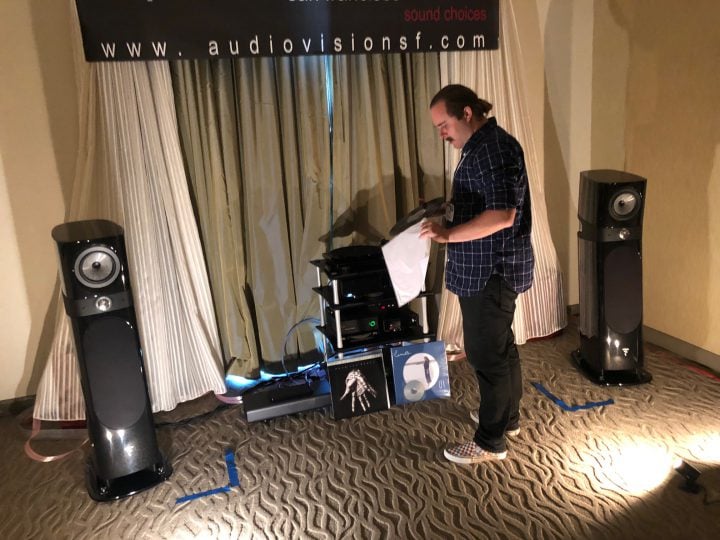
Next up was the room of local dealer Audio Vision SF, a company I know and respect. The Focal/Naim/Rega/etc. system was pleasant and dynamic, but lacked a little grit, for my taste. Many would find that a good thing. The sound was excellent— just wasn’t quite my cuppa. Different strokes, YMMV, and so on.

The Marchand/Bernhagen-Porter room was interesting for both the amps and the speakers. Marchand is well-known for electronic crossover kits, so it was a bit of a surprise to see an SET amp with a single 805 output tube and solid-state front end. The Bernhagen-Porter speakers were seen last year as well, the product of a partnership between a musician and a cabinet maker. The big speakers were beautifully made, and the built-in powered sub allowed the 20-watt Marchand amp to drive them to significant volume. The products from both these companies are certainly worth watching.

It was easy to anthropomorphize the four-legged Marchand amps.

For many years, David Cope gave superb demos for Audio Note. Now he runs an import company, Old Forge Audio, and his room was the third of my keepers. The system wasn’t huge or overwhelming, but every component was distinctive in design, and the overall sound was far bigger and more dynamic than you’d expect, given the small size of the speakers. The brands are likely not familiar to you yet, but I suspect that they will be.

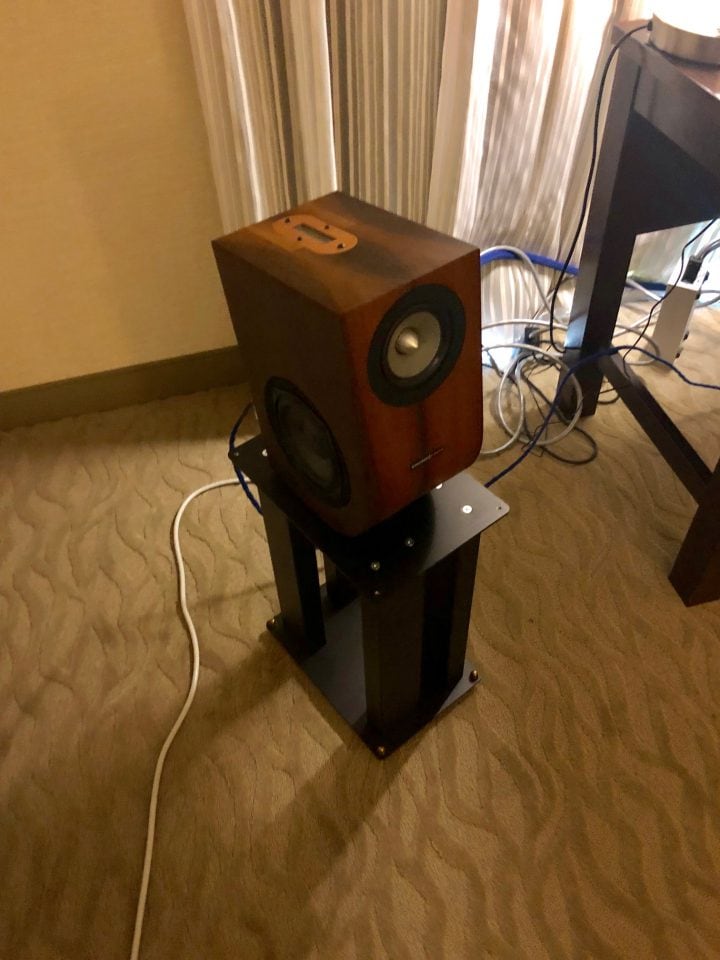
I was smitten with the quirky looks and excellent build of all the products. The Wand turntable from New Zealand has a 14″ laminated platter and a carbon fiber arm; the Pure Audio electronics are also from NZ, and are Class A solid-state. The tiny but powerful SoundKaos Vox 3f Compact standmount speakers are from Switzerland, and pack a front-facing wideband driver, back-to-back side-mounted woofers, and a top-mounted RAAL ribbon tweeter into a small, curvilinear cabinet. Great stuff—but likely not for everyone. To me, that’s a plus.

The Wand table and arm.
Pure Audio electronics.

The unusual SoundKaos speakers.

Exogal digital gear was featured in two rooms: one with a full set of Exogal electronics and Ryan speakers, the second with an Ion DAC feeding a tube amp from McGary Audio and Salk speakers. I was so busy blabbing with buddy Jeff Haagenstad of Exogal that I forgot to get pics of the Ryan room—and had to rely upon Jeff for those. Oops. Streaming Qobuz, the sound was well-defined and dynamic.

Compact and unobtrusive---the Exogal Comet DAC and Ion PowerDAC.
 

The Ryan R620s and their brethren have been seen and heard at many shows. They’re excellent.

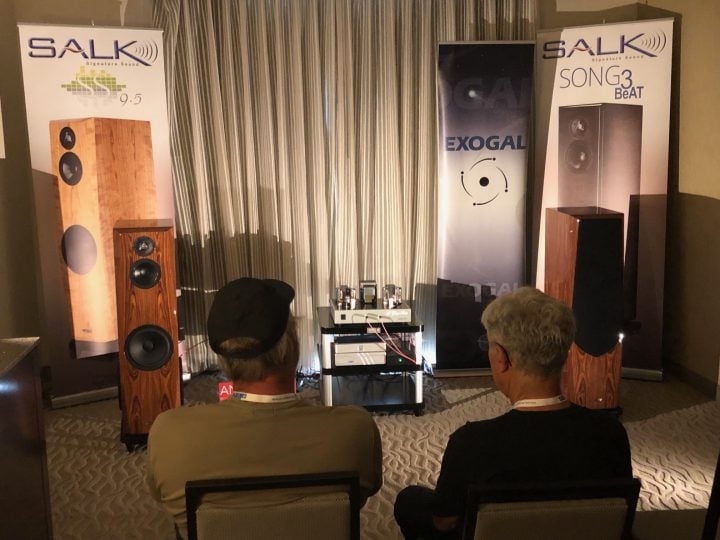
The last of my four favorites was the Exogal/McGary/Salk room. The McGary tube amp brought to mind an updated Dynaco Stereo 70, and provided a little air and sweetening to the definition of the Exogal gear, and paired well with the full-range Salk speakers. The sound was involving and dynamic, and sucked in a lot of listeners besides me. I don’t think Jim Salk has ever made a bad speaker; the build quality is always impeccable, with lots of finish options, and the sound quality just keeps improving. The SS 9.5 speakers looked pretty conventional, but with dual passive radiators and an open-backed midrange, produced effortless bass and a huge soundstage. Very nice indeed.

 I half-jokingly said to Audio Note’s Peter Qvortrup, “You need to make some different-looking gear!” The reason for that is, well, if you stick your head into an AN exhibit room, you’ll be hit with a strong sense of deja vu. The gear probably changes from time to time, but it’s awfully hard to tell. Few brands produce strongly-held love/hate responses as Audio Note; this time, I found the sound pleasant, but not terribly involving.

Peter Qvortrup—so far this year I’ve run into him in Tampa, Munich, and now, Oakland. Axpona? I forget.


The last room of the show was that of Voxativ. Known for fullrange drivers, field-coils, rear-loaded horns, and other retro-nuevo tech, this year Holger Adler showed something curiously…modern.

But with a Voxativ twist.

The Hagen system shown consisted of a small, standmounted single driver speaker—very Voxativ. The twist was “Das Absolut Box”, a small component that provided lossless streaming, amplification, a DAC, and custom DSP for the speaker. Add a phone or computer and Qobuz, and you’re good to go. Cost for the system, minus stands? $7,900. In this world, that’s pretty cheap.

The sound wasn’t as big or as effortless as the bigger Voxativ speakers, but I give them full props for trying something new, and likely to reach a broader audience.

Voxativ's Holger Adler.

The Voxativ Hagens mit Das Absolut Box.

The life of an audio show organizer isn’t an easy one. Every show I’ve ever attended has been the target of complaints from exhibitors or attendees. At Axpona, some complained the show was too big; at CAS, some complained that the show was too small.

At 20 rooms, CAS ain’t huge. But the variety of exhibitors, allied with the ability to actually spend time talking with them in a relaxed, congenial atmosphere, sets CAS apart from other shows. Add in proximity to some Bay area delights, a pleasant venue, great weather—and I look forward to the 2020 show.

After-show antics: Knucklehead brothers from different mothers non-exhibitor Gordon Burwell (Burwell & Son speakers) and exhibitor Jeff Haagenstad (Exogal) on a chilly night in Alameda.
On the grounds of the show. A small touch, perhaps, but one of many that make CAS a pleasant experience.

More from Issue 40

View All Articles in Issue 40

Search Copper Magazine

#234 A Life in High-End Audio: The Roy Hall Interview, Part One by Frank Doris Sep 07, 2026 #234 Jason Greenlaw Offers His Personal Perspective on Jazz Guitar in Vantage Point by Frank Doris Sep 07, 2026 #234 Transcendent Phoenix: Lucina Yue Brings the Ancient Konghou Into Modern Times by Frank Doris Sep 07, 2026 #234 We Must All Follow Our Bliss by B. Jan Montana Sep 07, 2026 #234 How to Play in a Rock Band, 27: Leveling Up by Frank Doris Sep 07, 2026 #234 Ross Valory: Traveling Into New Musical Territory With All of the Above by Ray Chelstowski Sep 07, 2026 #234 Singer/Songwriter John David Schrader: On the Need to Create by Joe Caplan Sep 07, 2026 #234 The People Who Make Audio Happen: More From T.H.E. Show SoCal 2026 by Harris Fogel Sep 07, 2026 #234 The Vinyl Beat Digs Into the Gadget Box by Rudy Radelic Sep 07, 2026 #234 The Rolling Stones: Foreign Tongues Spoken Loud by Wayne Robins Sep 07, 2026 #234 Musical Moments by Rich Isaacs Sep 07, 2026 #234 Rags for Solo Piano and a Dog: David Chesky's Ragtime Music for the Modern Age by Frankly Speaking Sep 07, 2026 #234 HIGH END 2026, Vienna: Here to Stay by Carsten Barnbeck Sep 07, 2026 #234 From The Audiophile’s Guide: The Two Main Types of Loudpeakers – Box and Panel by Paul McGowan Sep 07, 2026 #234 Letting it Slide by Frank Doris Sep 07, 2026 #234 PS Audio in the News by PS Audio Staff Sep 07, 2026 #234 Long Playing by Peter Xeni Sep 07, 2026 #234 La Mer by B. Jan Montana Sep 07, 2026 #233 A Report From The Total Hi-Fi Experience Show SoCal 2026 by B. Jan Montana Aug 03, 2026 #233 Bluegrass Meets Country, Folk, Jazz and More in All That We Carried by The Squid City Slingers by Frank Doris Aug 03, 2026 #233 Corey Glover and One Tribe Nation: A Variegated Musical Collective by Ray Chelstowski Aug 03, 2026 #233 Excursions with Clive: The Late Clive Davis, A Personal History by Wayne Robins Aug 03, 2026 #233 AI, Art, and Music: A Conversation With Synthography Art by Joe Caplan Aug 03, 2026 #233 New American Symphonies: A Rediscovered Gem and a Vital Contemporary Work by Frank Doris Aug 03, 2026 #233 The Vinyl Beat: Genesis, the Dave Clark Five, Antonio Carlos Jobim and More by Rudy Radelic Aug 03, 2026 #233 How to Play in a Rock Band, 26: When It's Time to Record Your Music by Frank Doris Aug 03, 2026 #233 More From T.H.E. Show 2026, and the People Who Made it Happen by Harris Fogel Aug 03, 2026 #233 Underappreciated Artists, Part Three: Icehouse by Rich Isaacs Aug 03, 2026 #233 The Surprisingly Rich and Varied Music of Somalia by Steve Kindig Aug 03, 2026 #233 A Remarkable Discographic Legacy: The LP Recordings of the Basel Symphony Orchestra by Stephan Haberthür Aug 03, 2026 #233 From The Audiophile’s Guide: The Importance of Loudspeakers by Paul McGowan Aug 03, 2026 #233 From Swimming Pool to New Listening Room: A Conversation with Norman Varney of AV RoomService by Gilles Laferrière Aug 03, 2026 #233 PS Audio in the News by PS Audio Staff Aug 03, 2026 #233 Audio Jewelry by Peter Xeni Aug 03, 2026 #233 Enrich Your Life by Frank Doris Aug 03, 2026 #233 The Searcher by James Schrimpf Aug 03, 2026 #232 What came first: Art or Music? A Conversation With Artist Jose Acosta by Joe Caplan Jul 06, 2026 #232 Blow By Blow: The Jeff Beck Story: An Insightful Book About a Guitar Icon by Ray Chelstowski Jul 06, 2026 #232 Creed Over Camaraderie? by B. Jan Montana Jul 06, 2026 #232 Chronicles of a Sound Pilgrim at the 2026 Montreal Audiofest by Hugues Morin Jul 06, 2026 #232 The Vinyl Beat: Summer Grooves by Rudy Radelic Jul 06, 2026 #232 Hibbing Hillbilly Dylan's Acoustic Rock by Wayne Robins Jul 06, 2026 #232 Quad Quads and Plasmatronics Tweeters: An Extraordinary System Comes to Life by Frank Doris Jul 06, 2026 #232 In Praise of Live Music, Once Again by Ted Shafran Jul 06, 2026 #232 Allnic Audio’s L-9000 Preamplifier: Design and Engineering Innovation by Howard Kneller Jul 06, 2026 #232 “Best Of” Lists and Rage Bait: Enough Already by Frank Doris Jul 06, 2026 #232 Quick Takes: Bud Shank, Paulo Almeida, Jakob Dreyer, Tim Eriksen and Peter Irvine by Frank Doris Jul 06, 2026

The California Audio Show Part 2

The California Audio Show Part 2

Part 1 of my report on the California Audio Show appeared in Copper #91. That article gave an overview of the show, and described the exhibit rooms on the first floor. This concluding piece will go through the remaining rooms of the show, located on the second floor of Building V at the Hilton Oakland Airport.

Here’s how the rooms were laid out:

One of the benefits of this show is that one can see and hear products that are rarely, if ever, present at other shows. Other than Ray Kimber’s giant demos at RMAF some years ago, I don’t recall ever encountering Sound Labs at a show.

Now, I am familiar with the big Sound Lab ‘stats, as a client had an enormous 3-floor system which utilized more Sound Lab speakers than could be found anywhere outside of the factory. The clarity and precision of the speakers was impressive, as was the impact of the bass—unusual for a ‘stat.

So: I was happy to see the Sound Labs demonstrated by dealer Ultimate Audio. Two things were quickly apparent to me: the speaker was far too large for the standard hotel room, and the edginess of the Bricasti electronics that I mentioned in Part 1—shall we say, cut through the morning fog from the Bay. I appreciate the effort, but this combo was not for me.

Also Sprach Zarathustra, anyone?

I’d previously mentioned that there were four rooms (I initially said three, but I can’t count) in which I would and did happily stay and just listen for pleasure. In Part 1 I mentioned the Marutani Consulting room with big MartinLogans, Doshi electronics, and tape playback. The second of the four rooms was the Zesto/Joseph audio room, in which the always-affable George and Carolyn Counnas from Zesto played records on a Merrill-Williams turntable through all-Zesto tube gear and the latest Joseph Audio Perspective2 Graphene speakers.

If there was anything missing from the sound, it may have been bombastic, THX-style bass. To me, that’s not a loss. This was a lifelike, sweet-sounding system, one I could easily live with.

George and Carolyn, Zesto.
Focus on the Zesto gear, with the Josephs cut off....
 

Well, you can see one of the Joseph speakers here. Apparently, I was having too much fun—my photos are even worse than usual. Mea culpa.

Next up was the room of local dealer Audio Vision SF, a company I know and respect. The Focal/Naim/Rega/etc. system was pleasant and dynamic, but lacked a little grit, for my taste. Many would find that a good thing. The sound was excellent— just wasn’t quite my cuppa. Different strokes, YMMV, and so on.
The Marchand/Bernhagen-Porter room was interesting for both the amps and the speakers. Marchand is well-known for electronic crossover kits, so it was a bit of a surprise to see an SET amp with a single 805 output tube and solid-state front end. The Bernhagen-Porter speakers were seen last year as well, the product of a partnership between a musician and a cabinet maker. The big speakers were beautifully made, and the built-in powered sub allowed the 20-watt Marchand amp to drive them to significant volume. The products from both these companies are certainly worth watching.

It was easy to anthropomorphize the four-legged Marchand amps.

For many years, David Cope gave superb demos for Audio Note. Now he runs an import company, Old Forge Audio, and his room was the third of my keepers. The system wasn’t huge or overwhelming, but every component was distinctive in design, and the overall sound was far bigger and more dynamic than you’d expect, given the small size of the speakers. The brands are likely not familiar to you yet, but I suspect that they will be.

I was smitten with the quirky looks and excellent build of all the products. The Wand turntable from New Zealand has a 14″ laminated platter and a carbon fiber arm; the Pure Audio electronics are also from NZ, and are Class A solid-state. The tiny but powerful SoundKaos Vox 3f Compact standmount speakers are from Switzerland, and pack a front-facing wideband driver, back-to-back side-mounted woofers, and a top-mounted RAAL ribbon tweeter into a small, curvilinear cabinet. Great stuff—but likely not for everyone. To me, that’s a plus.

The Wand table and arm.
Pure Audio electronics.

The unusual SoundKaos speakers.

Exogal digital gear was featured in two rooms: one with a full set of Exogal electronics and Ryan speakers, the second with an Ion DAC feeding a tube amp from McGary Audio and Salk speakers. I was so busy blabbing with buddy Jeff Haagenstad of Exogal that I forgot to get pics of the Ryan room—and had to rely upon Jeff for those. Oops. Streaming Qobuz, the sound was well-defined and dynamic.

Compact and unobtrusive---the Exogal Comet DAC and Ion PowerDAC.
 

The Ryan R620s and their brethren have been seen and heard at many shows. They’re excellent.

The last of my four favorites was the Exogal/McGary/Salk room. The McGary tube amp brought to mind an updated Dynaco Stereo 70, and provided a little air and sweetening to the definition of the Exogal gear, and paired well with the full-range Salk speakers. The sound was involving and dynamic, and sucked in a lot of listeners besides me. I don’t think Jim Salk has ever made a bad speaker; the build quality is always impeccable, with lots of finish options, and the sound quality just keeps improving. The SS 9.5 speakers looked pretty conventional, but with dual passive radiators and an open-backed midrange, produced effortless bass and a huge soundstage. Very nice indeed.

 I half-jokingly said to Audio Note’s Peter Qvortrup, “You need to make some different-looking gear!” The reason for that is, well, if you stick your head into an AN exhibit room, you’ll be hit with a strong sense of deja vu. The gear probably changes from time to time, but it’s awfully hard to tell. Few brands produce strongly-held love/hate responses as Audio Note; this time, I found the sound pleasant, but not terribly involving.

Peter Qvortrup—so far this year I’ve run into him in Tampa, Munich, and now, Oakland. Axpona? I forget.


The last room of the show was that of Voxativ. Known for fullrange drivers, field-coils, rear-loaded horns, and other retro-nuevo tech, this year Holger Adler showed something curiously…modern.

But with a Voxativ twist.

The Hagen system shown consisted of a small, standmounted single driver speaker—very Voxativ. The twist was “Das Absolut Box”, a small component that provided lossless streaming, amplification, a DAC, and custom DSP for the speaker. Add a phone or computer and Qobuz, and you’re good to go. Cost for the system, minus stands? $7,900. In this world, that’s pretty cheap.

The sound wasn’t as big or as effortless as the bigger Voxativ speakers, but I give them full props for trying something new, and likely to reach a broader audience.

Voxativ's Holger Adler.

The Voxativ Hagens mit Das Absolut Box.

The life of an audio show organizer isn’t an easy one. Every show I’ve ever attended has been the target of complaints from exhibitors or attendees. At Axpona, some complained the show was too big; at CAS, some complained that the show was too small.

At 20 rooms, CAS ain’t huge. But the variety of exhibitors, allied with the ability to actually spend time talking with them in a relaxed, congenial atmosphere, sets CAS apart from other shows. Add in proximity to some Bay area delights, a pleasant venue, great weather—and I look forward to the 2020 show.

After-show antics: Knucklehead brothers from different mothers non-exhibitor Gordon Burwell (Burwell & Son speakers) and exhibitor Jeff Haagenstad (Exogal) on a chilly night in Alameda.
On the grounds of the show. A small touch, perhaps, but one of many that make CAS a pleasant experience.

0 comments

Leave a comment

0 Comments

Your avatar

Loading comments...

🗑️ Delete Comment

Enter moderator password to delete this comment:

✏️ Edit Comment

Enter your email to verify ownership: