Ouch. Those words from years ago still sting in my memory. When a crime had been committed in the McGowan household I was the first suspect (usually for good reason) and the procedure was to immediately ground
me as the first step in any crime investigation, with worse measures soon to follow, depending on the severity of the crime and the fate of the judge and jury (my father).
Each of our homes, apartments, condos, are grounded to one point through the home's electrical system. You may have seen something similar to this picture in your backyard.
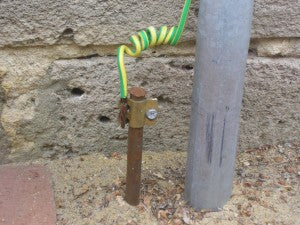
A metal rod driven into the earth with a wire attached to it. This, or something like this, is the lowest electrical point in your home's AC system. Grounds like these are installed mostly for safety and are required by law in nearly every country.
Power coming into your home is typically fed by two, or three wires from a transformer on the utility pole. These wires haven't any connection to ground. Heres what the system looks likje.

Not everything in our homes uses ground and - and this is important to understand - ground is not used to conduct electricity. Don't try this at home, but you could disconnect ground from Earth and little in your home would change, everything functioning as it should. All the power your home uses runs through the two or three incoming AC wires, not ground.
Ground is included mostly as a safety valve for us humans and a sink for unwanted noise for our audio equipment. Problem is, when we use ground to lower noise in our audio system–as in
yesterday's black hole example–the hole we're sending our noise to is more gray than black. In other words, in a crowded community of homes and buildings, all that noise we're throwing into Earth becomes the equivalent of a toxic waste dump. And to make matters worse, ground's effectiveness changes with the weather; worse in summer, better in the wetter months of winter and spring.
For now, let's start understanding how we deal with grounds inside the equipment we own, then we'll move on to more
grounded subjects. (I couldn't
resist the double puns here).


0 comments