
 Note how the balanced version has two conductors. The triangle image on the right side represents our transformer. + is one end of the transformer wire, - the other. Now, imagine this pair of wires is a cable running perhaps 50 feet in your room. Along its path it sits close by radiating hum and noise producers: your cell phone, a power transformer, the TV, an air conditioner, an open AC circuit and so forth. What happens? The two wires act as antenna for these noise sources, picking up their radiated 'junk' equally on both wires. Aha!!
Do you see it? If both wires pick up the same noise radiated from any source, regardless of what it is, guess what happens? Nothing. Nada. A big fat zippo. Why? Recall that our transformer will only pass that that is different between the two wires. If what is on the two wires is identical, nothing passes through.
Thus, noises common to both conductors are rejected in what is known as Common Mode Rejection (CMR) and typically listed in a device as CMRR (Common Mode Rejection Ratio) which tells us how effective it is in doing so.
Tomorrow it gets super easy because I'll show you how we then make the audio different so it passes, while the noise does not. Reread this page till you really get it. You'll then know more than most any Audiophile I know.
Really.
Note how the balanced version has two conductors. The triangle image on the right side represents our transformer. + is one end of the transformer wire, - the other. Now, imagine this pair of wires is a cable running perhaps 50 feet in your room. Along its path it sits close by radiating hum and noise producers: your cell phone, a power transformer, the TV, an air conditioner, an open AC circuit and so forth. What happens? The two wires act as antenna for these noise sources, picking up their radiated 'junk' equally on both wires. Aha!!
Do you see it? If both wires pick up the same noise radiated from any source, regardless of what it is, guess what happens? Nothing. Nada. A big fat zippo. Why? Recall that our transformer will only pass that that is different between the two wires. If what is on the two wires is identical, nothing passes through.
Thus, noises common to both conductors are rejected in what is known as Common Mode Rejection (CMR) and typically listed in a device as CMRR (Common Mode Rejection Ratio) which tells us how effective it is in doing so.
Tomorrow it gets super easy because I'll show you how we then make the audio different so it passes, while the noise does not. Reread this page till you really get it. You'll then know more than most any Audiophile I know.
Really.
Getting rid of noise
In yesterday's post I explained an input transformer would accept any audio signal that wasn't the same. Today we'll find out why that makes a difference to noise.
One thing I should mention up front: a modern stereo with a balanced input does not use a transformer. Yet noise reduction, every bit as effective as if it had one, perhaps better, is achieved. I will explain how later, but for now, let's stay with the transformer as the input device so we can understand how noise is eliminated, while musical signals are preserved.
Our transformer example has two inputs: each just one end of a long, coiled wire. If the identical audio signal is applied to both ends of the transformer's wire, at the same time, nothing happens. In the same way, if you place two identical weights, one on each side of a balance beam scale, nothing happens. The reason nothing happens is because there's no difference between the two. Two cars traveling identical speeds appear to be standing still, relative to each other. Step on the brakes of one and the other zooms forward. It's the difference that makes the difference.
Now, remember our drawing of the balanced interconnect cable?
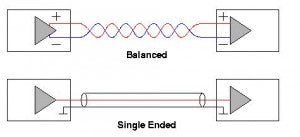 Note how the balanced version has two conductors. The triangle image on the right side represents our transformer. + is one end of the transformer wire, - the other. Now, imagine this pair of wires is a cable running perhaps 50 feet in your room. Along its path it sits close by radiating hum and noise producers: your cell phone, a power transformer, the TV, an air conditioner, an open AC circuit and so forth. What happens? The two wires act as antenna for these noise sources, picking up their radiated 'junk' equally on both wires. Aha!!
Do you see it? If both wires pick up the same noise radiated from any source, regardless of what it is, guess what happens? Nothing. Nada. A big fat zippo. Why? Recall that our transformer will only pass that that is different between the two wires. If what is on the two wires is identical, nothing passes through.
Thus, noises common to both conductors are rejected in what is known as Common Mode Rejection (CMR) and typically listed in a device as CMRR (Common Mode Rejection Ratio) which tells us how effective it is in doing so.
Tomorrow it gets super easy because I'll show you how we then make the audio different so it passes, while the noise does not. Reread this page till you really get it. You'll then know more than most any Audiophile I know.
Really.
Note how the balanced version has two conductors. The triangle image on the right side represents our transformer. + is one end of the transformer wire, - the other. Now, imagine this pair of wires is a cable running perhaps 50 feet in your room. Along its path it sits close by radiating hum and noise producers: your cell phone, a power transformer, the TV, an air conditioner, an open AC circuit and so forth. What happens? The two wires act as antenna for these noise sources, picking up their radiated 'junk' equally on both wires. Aha!!
Do you see it? If both wires pick up the same noise radiated from any source, regardless of what it is, guess what happens? Nothing. Nada. A big fat zippo. Why? Recall that our transformer will only pass that that is different between the two wires. If what is on the two wires is identical, nothing passes through.
Thus, noises common to both conductors are rejected in what is known as Common Mode Rejection (CMR) and typically listed in a device as CMRR (Common Mode Rejection Ratio) which tells us how effective it is in doing so.
Tomorrow it gets super easy because I'll show you how we then make the audio different so it passes, while the noise does not. Reread this page till you really get it. You'll then know more than most any Audiophile I know.
Really.
Note how the balanced version has two conductors. The triangle image on the right side represents our transformer. + is one end of the transformer wire, - the other. Now, imagine this pair of wires is a cable running perhaps 50 feet in your room. Along its path it sits close by radiating hum and noise producers: your cell phone, a power transformer, the TV, an air conditioner, an open AC circuit and so forth. What happens? The two wires act as antenna for these noise sources, picking up their radiated 'junk' equally on both wires. Aha!!
Do you see it? If both wires pick up the same noise radiated from any source, regardless of what it is, guess what happens? Nothing. Nada. A big fat zippo. Why? Recall that our transformer will only pass that that is different between the two wires. If what is on the two wires is identical, nothing passes through.
Thus, noises common to both conductors are rejected in what is known as Common Mode Rejection (CMR) and typically listed in a device as CMRR (Common Mode Rejection Ratio) which tells us how effective it is in doing so.
Tomorrow it gets super easy because I'll show you how we then make the audio different so it passes, while the noise does not. Reread this page till you really get it. You'll then know more than most any Audiophile I know.
Really.

0 comments