COPPER

A PS Audio Publication

Issue 160 • Free Online Magazine

Issue 160 Disciples of Sound

The Handcuffs: This Band Just Might Save Rock And Roll

The Handcuffs: This Band Just Might Save Rock And Roll

The lead single off of The Kinks’ 1978 album Misfits was “Rock ‘N’ Roll Fantasy.” In the song Ray Davies sings, “The King is dead, rock is done. You might be through, but I’ve just begun.” There isn’t a more fitting rock lyric to describe the singular mission of The Handcuffs, a Chicago-based band that celebrates the very essence of what the Kinks at that moment were trying to champion.

Led by drummer Brad Elvis and vocalist/rhythm guitarist Chloe F. Orwell, The Handcuffs are a band that might just bring rock back to its rightful place within our collective cultural conscience. They are about to release their fourth studio album, Burn the Rails. There they explore the sonic territory forged by acts like T-Rex, Spiders from Mars-era David Bowie, Mott the Hoople, Roxy Music, and early Blondie. Their read on this rich moment in rock is completely modern and makes a big, bold splashy statement within each of its thirteen tracks.

Elvis and Orwell met in Big Hello, their first band together, which released three indie-label records and toured from coast to coast. When that band dissolved, the duo decided to explore new territory with music that aligned more with their influences and broad range of musical tastes. The Handcuffs began as primarily a studio project, in which Elvis and Orwell wrote and recorded most of the material. But during that process, they realized that they missed the live band experience, and completed their lineup with bassist Emily Togni, lead guitarist Jeffrey Kmieciak, and keyboardist Alison Hinderliter. Together they deliver electrifying, high-energy live performances, and have received rave reviews from outlets like the Chicago Sun-Times. Here they are doing Eno’s “Needles in the Camel’s Eye”:


The new album was tracked at Kingsize Sound Labs in Chicago with producer/engineer Mike Hagler (Wilco, Neko Case, Billy Bragg, Mavis Staples, My Morning Jacket) and is being released by Pravda Records on June 3, with a 12-inch vinyl LP to arrive later this year. We had a chance to catch up with Elvis and Orwell and talk not just about the new record, but why the glam rock through early new wave musical period is so important, and why their take on it just might ignite a renewed interest in the power, persuasiveness, and possibilities that rock and roll has always presented.

Ray Chelstowski: I’ve read that you have other musical influences that are less gritty, raw, and glam. Why did you choose to explore this genre with this record?

Brad Elvis: Just listen to it! This sound probably started in 1969, or slightly before that. But in the 1970s it was like we all grew up. It was like rock and roll did away with the politeness of the ’60s. It all just kept evolving.

Chloe F. Orwell: Truth be told, the instrumentation in that music can be found in our band. I just felt like we could do this.

RC: How did you begin to work with producer Mike Hagler? His background producing My Morning Jacket and Neko Case seems much different than what your vision for this record and band has been.

BE: Years ago, we actually went to his studio and we weren’t that thrilled with the results we got from the person we worked with, who is no longer there. When you find a producer who “gets” what you’re doing, they almost become another band member. Sometimes, though, when you arrive at a studio you can see that the person at the board doesn’t get what you are all really about. Fast forward a few years later to a show we were doing here in Chicago and Mike was there. He told us that he had heard that we hadn’t been happy with our experience at his studio, and [he] wanted to make things right. So that night with him we found a place and a person that we totally get along with.

CFO: After that show where we connected, we ended up talking to him until the wee hours of the morning. We just hit it off as people. It was this insane, magical thing. We sort of evolve with each album and he’s evolved with us. He also became one of our very best friends, like family.

RC: What’s the creative process like for you? Brad’s drums sit so front and center that it seems like they were an important part of the initial thinking on every song.

BE: I think that having played with so many bands over the years on so many albums that I’ve developed a distinct drumming style. So, there’s that. And I’m mindful of the drum hooks that I grew up with from Hal Blaine, or Keith Moon, or Charlie Watts or Ginger Baker. They all had drum hooks that stood out. But we start out with a (guitar) riff and build around it.
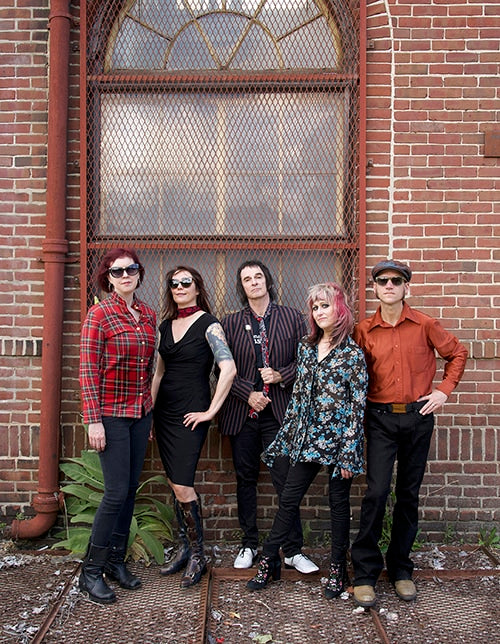
 

The Handcuffs. Courtesy of Catherine Gass.

The Handcuffs. Courtesy of Catherine Gass.


CFO: We are constantly finding random sounds from things like driving around Chicago and hearing car horns that we think might make a really cool riff. Then we’ll come home and write a song. We really do get inspired by our environment.

RC: There is a drum kit featured on your website that has the two floor toms. Is that the setup you used on this record?

CFO: He has about a dozen kits. Lately he has been playing vintage Ludwig drums. It’s basically a four- to five-piece kit. He writes songs, not necessarily as a drummer, but his songs always find a way for the drums to serve the song’s purpose. He knows how to maximize the minimum and plays in that old-school way. It’s always first for the song and not just about himself as a drummer.

RC: The record is a full-out rock ride. It never slows down, not for a moment.

CFO: For this record we were inspired by that old-school album-oriented rock where when you listen to something like a Mott the Hoople album, you hear it all flow together. That’s what we wanted to do.

RC: You open and close the record with instrumentals. What was the thinking behind that approach to the tracking?

BE: It’s almost like a little live intro thing. The opener is called “Grapefruit” and at the time that’s what I was eating for breakfast. It was almost like, “how do you start your day?” It kind of represents the vibe of the entire album and then we move on. It’s got the drums and a hook and a beat and riffs. Then at the end of the album we move into “Tobogganing,” which is a cool kind of psychedelic jam out kind of thing.

RC: How did you get Mott the Hoople keyboardist Morgan Fisher to contribute to the record?

CFO: We went to the Mott the Hoople reunion show in 2019, and I wrote a review on Facebook. It was just a quick review of the show and it went viral. A magazine asked to publish it so I cleaned it up and Morgan Fisher saw it and loved the review. He contacted me through Facebook, we became friends, and he told us that he’d love to play on one of our records. So, we picked two tracks and the rest is history.

?list=PLBAA253A5576DAF94


RC: Do you intend to cover any music from the glam rock era when you take this album to the stage?

BE: We usually throw a few songs into the mix. Right now, we are doing Brian Eno’s “Needles in the Camel’s Eye”; we’ve done “Vicious” by Lou Reed, so yes, we’ll throw in a few songs and of course make them our own.

RC: The Handcuffs could easily be considered a female act. Was that your intent when rounding out the group?

CFO: Not at all. We didn’t decide to weight the band in any way, it just happened. Emily (Togni) our bass player was the first and longest-standing member of the band. Alison (Hinderliter) our keyboardist was in a couple of well-known bands, including one that a friend of ours fronted. When he moved to Los Angeles we said, “oh good! Now we can poach Alison!” And then our guitarist Jeff (Kmieciak) came on a few years ago through Alison. So, it wasn’t a planned thing. It was about whether we get along with them and they fit.

RC: This record seems to have come at just the right time. When you were making it you probably didn’t think it could save rock, but did you think that it could at least spark wider interest in that great moment of 1970s glam rock?

CFO: I just want to say “yes, yes, yes” to all of that. We do like all kinds of music. We’re not music snobs. A good song is a good song. We just want rock and roll to be understood for being [the reason] why all of this other music is around.

Header image courtesy of Christy Bassman.

More from Issue 160

View All Articles in Issue 160

Search Copper Magazine

#231 Piano Prodigy Jude Kofie Releases His Debut Album On Octave Records by Frank Doris Jun 01, 2026 #231 Underappreciated Artists, Part Two: City Boy by Rich Isaacs Jun 01, 2026 #231 Music and the Art of Creation: Talking With Saxophonist Rob Scheps by Joe Caplan Jun 01, 2026 #231 How to Play in a Rock Band, 24: Further Adventures at the 2026 Montauk Music Festival by Frank Doris Jun 01, 2026 #231 Courtney Barnett: Creature of Habit by Wayne Robins Jun 01, 2026 #231 Angine de Poitrine: Interstellar Guitar Rock Saviors Headed for Late-Night TV Pop Stardom? by Mark Lepage Jun 01, 2026 #231 My Impressions of AXPONA 2026, Part One by Frank Doris Jun 01, 2026 #231 2026 La Jolla Concours d'Elegance: Another Aesthetic Feast by B. Jan Montana Jun 01, 2026 #231 Country Music Icon Jo Dee Messina’s Bridges: A New Beginning by Ray Chelstowski Jun 01, 2026 #231 The Luxury Dispatch Hosts a Video Podcast With Ken Kessler by Ken Kessler Jun 01, 2026 #231 The Vinyl Beat: Tracking in the Motor City by Rudy Radelic Jun 01, 2026 #231 Lots of Fun With DSP: The Ferrum Audio WANDLA DAC and Its Tube Mode by Frank Doris Jun 01, 2026 #231 From The Audiophile's Guide: Digital Source Components and Streaming Audio by Paul McGowan Jun 01, 2026 #231 Onkyo’s Monster M-510 power amplifier by The Staff at Just Audio Jun 01, 2026 #231 PS Audio in the News by PS Audio Staff Jun 01, 2026 #231 Naming Convention by Peter Xeni Jun 01, 2026 #231 Les Invisibles by Frank Doris Jun 01, 2026 #231 Wildlife Scene by James Schrimpf Jun 01, 2026 #230 Camaraderie by B. Jan Montana May 04, 2026 #230 AXPONA 2026: A Family Gathering by Paul McGowan May 04, 2026 #230 Pianist Ryan Benthall Explores Jazz Realms and Far Beyond With Divine Sky by Frank Doris May 04, 2026 #230 The Vinyl Beat in AXPONA-Land by Rudy Radelic May 04, 2026 #230 Teddy Thompson’s Musical Growth Deepens With Never Be the Same by Ray Chelstowski May 04, 2026 #230 More Fun in the Sun: Florida Audio Expo, Part Two by Frank Doris May 04, 2026 #230 CanJam NYC 2026 Show Report: Heady Sound, Part Two by Frank Doris and Harris Fogel May 04, 2026 #230 Sonic Youth On Murray Street by Wayne Robins May 04, 2026 #230 Graffeo Coffee: A Symphony of Sensory Experience by Joe Caplan May 04, 2026 #230 The Saul Authority: The Story of Hi-Fi Pioneer Saul Marantz by Olivier Meunier-Plante May 04, 2026 #230 How to Play in a Rock Band, 23: Encounters With Famous Musicians, Part Two by Frank Doris May 04, 2026 #230 An Outlier in the Rack: A Vintage BIC Beam Box by The Staff at Just Audio May 04, 2026 #230 PS Audio in the News by PS Audio Staff May 04, 2026 #230 A Cautionary Tale by Rich Isaacs May 04, 2026 #230 Reel-to-Reel Roots, Part 33 (Revised): Ken Kessler Reports On the 2026 (British) AudioJumble by Ken Kessler May 04, 2026 #230 Text Messaging by Frank Doris May 04, 2026 #230 The Audiophile Rat Race by Peter Xeni May 04, 2026 #230 On the Rocks by Rich Isaacs May 04, 2026 #229 The Earliest Stars of Country Music, Part Three by Jeff Weiner Apr 06, 2026 #229 The Healing Power of Music and Sound at the Omega Institute by Joe Caplan Apr 06, 2026 #229 CanJam NYC 2026 Show Report: Heady Sound, Part One by Frank Doris Apr 06, 2026 #229 Florida Audio Expo 2026: Warming Up to High-End Audio, Part One by Frank Doris Apr 06, 2026 #229 Quick Takes: Anne Bisson, Sam Morrison, The Velvet Underground, and the Stooges by Frank Doris Apr 06, 2026 #229 The Vinyl Beat: New Arrivals, and Old Audio Show Demo Scores to Settle by Rudy Radelic Apr 06, 2026 #229 Harvard Gets a High-End Audio Education by Frank Doris Apr 06, 2026 #229 No Country for Old Knees by B. Jan Montana Apr 06, 2026 #229 How To Play in A Rock Band, 22: Encounters With Famous Musicians, Part 1 by Frank Doris Apr 06, 2026 #229 The Soulful Grooves of Guinea-Bissau by Steve Kindig Apr 06, 2026 #229 Four-Hand Piano Performance at Its Finest by Stephan Haberthür Apr 06, 2026

The Handcuffs: This Band Just Might Save Rock And Roll

The Handcuffs: This Band Just Might Save Rock And Roll

The lead single off of The Kinks’ 1978 album Misfits was “Rock ‘N’ Roll Fantasy.” In the song Ray Davies sings, “The King is dead, rock is done. You might be through, but I’ve just begun.” There isn’t a more fitting rock lyric to describe the singular mission of The Handcuffs, a Chicago-based band that celebrates the very essence of what the Kinks at that moment were trying to champion.

Led by drummer Brad Elvis and vocalist/rhythm guitarist Chloe F. Orwell, The Handcuffs are a band that might just bring rock back to its rightful place within our collective cultural conscience. They are about to release their fourth studio album, Burn the Rails. There they explore the sonic territory forged by acts like T-Rex, Spiders from Mars-era David Bowie, Mott the Hoople, Roxy Music, and early Blondie. Their read on this rich moment in rock is completely modern and makes a big, bold splashy statement within each of its thirteen tracks.

Elvis and Orwell met in Big Hello, their first band together, which released three indie-label records and toured from coast to coast. When that band dissolved, the duo decided to explore new territory with music that aligned more with their influences and broad range of musical tastes. The Handcuffs began as primarily a studio project, in which Elvis and Orwell wrote and recorded most of the material. But during that process, they realized that they missed the live band experience, and completed their lineup with bassist Emily Togni, lead guitarist Jeffrey Kmieciak, and keyboardist Alison Hinderliter. Together they deliver electrifying, high-energy live performances, and have received rave reviews from outlets like the Chicago Sun-Times. Here they are doing Eno’s “Needles in the Camel’s Eye”:


The new album was tracked at Kingsize Sound Labs in Chicago with producer/engineer Mike Hagler (Wilco, Neko Case, Billy Bragg, Mavis Staples, My Morning Jacket) and is being released by Pravda Records on June 3, with a 12-inch vinyl LP to arrive later this year. We had a chance to catch up with Elvis and Orwell and talk not just about the new record, but why the glam rock through early new wave musical period is so important, and why their take on it just might ignite a renewed interest in the power, persuasiveness, and possibilities that rock and roll has always presented.

Ray Chelstowski: I’ve read that you have other musical influences that are less gritty, raw, and glam. Why did you choose to explore this genre with this record?

Brad Elvis: Just listen to it! This sound probably started in 1969, or slightly before that. But in the 1970s it was like we all grew up. It was like rock and roll did away with the politeness of the ’60s. It all just kept evolving.

Chloe F. Orwell: Truth be told, the instrumentation in that music can be found in our band. I just felt like we could do this.

RC: How did you begin to work with producer Mike Hagler? His background producing My Morning Jacket and Neko Case seems much different than what your vision for this record and band has been.

BE: Years ago, we actually went to his studio and we weren’t that thrilled with the results we got from the person we worked with, who is no longer there. When you find a producer who “gets” what you’re doing, they almost become another band member. Sometimes, though, when you arrive at a studio you can see that the person at the board doesn’t get what you are all really about. Fast forward a few years later to a show we were doing here in Chicago and Mike was there. He told us that he had heard that we hadn’t been happy with our experience at his studio, and [he] wanted to make things right. So that night with him we found a place and a person that we totally get along with.

CFO: After that show where we connected, we ended up talking to him until the wee hours of the morning. We just hit it off as people. It was this insane, magical thing. We sort of evolve with each album and he’s evolved with us. He also became one of our very best friends, like family.

RC: What’s the creative process like for you? Brad’s drums sit so front and center that it seems like they were an important part of the initial thinking on every song.

BE: I think that having played with so many bands over the years on so many albums that I’ve developed a distinct drumming style. So, there’s that. And I’m mindful of the drum hooks that I grew up with from Hal Blaine, or Keith Moon, or Charlie Watts or Ginger Baker. They all had drum hooks that stood out. But we start out with a (guitar) riff and build around it.


The Handcuffs. Courtesy of Catherine Gass.

The Handcuffs. Courtesy of Catherine Gass.


CFO: We are constantly finding random sounds from things like driving around Chicago and hearing car horns that we think might make a really cool riff. Then we’ll come home and write a song. We really do get inspired by our environment.

RC: There is a drum kit featured on your website that has the two floor toms. Is that the setup you used on this record?

CFO: He has about a dozen kits. Lately he has been playing vintage Ludwig drums. It’s basically a four- to five-piece kit. He writes songs, not necessarily as a drummer, but his songs always find a way for the drums to serve the song’s purpose. He knows how to maximize the minimum and plays in that old-school way. It’s always first for the song and not just about himself as a drummer.

RC: The record is a full-out rock ride. It never slows down, not for a moment.

CFO: For this record we were inspired by that old-school album-oriented rock where when you listen to something like a Mott the Hoople album, you hear it all flow together. That’s what we wanted to do.

RC: You open and close the record with instrumentals. What was the thinking behind that approach to the tracking?

BE: It’s almost like a little live intro thing. The opener is called “Grapefruit” and at the time that’s what I was eating for breakfast. It was almost like, “how do you start your day?” It kind of represents the vibe of the entire album and then we move on. It’s got the drums and a hook and a beat and riffs. Then at the end of the album we move into “Tobogganing,” which is a cool kind of psychedelic jam out kind of thing.

RC: How did you get Mott the Hoople keyboardist Morgan Fisher to contribute to the record?

CFO: We went to the Mott the Hoople reunion show in 2019, and I wrote a review on Facebook. It was just a quick review of the show and it went viral. A magazine asked to publish it so I cleaned it up and Morgan Fisher saw it and loved the review. He contacted me through Facebook, we became friends, and he told us that he’d love to play on one of our records. So, we picked two tracks and the rest is history.

?list=PLBAA253A5576DAF94


RC: Do you intend to cover any music from the glam rock era when you take this album to the stage?

BE: We usually throw a few songs into the mix. Right now, we are doing Brian Eno’s “Needles in the Camel’s Eye”; we’ve done “Vicious” by Lou Reed, so yes, we’ll throw in a few songs and of course make them our own.

RC: The Handcuffs could easily be considered a female act. Was that your intent when rounding out the group?

CFO: Not at all. We didn’t decide to weight the band in any way, it just happened. Emily (Togni) our bass player was the first and longest-standing member of the band. Alison (Hinderliter) our keyboardist was in a couple of well-known bands, including one that a friend of ours fronted. When he moved to Los Angeles we said, “oh good! Now we can poach Alison!” And then our guitarist Jeff (Kmieciak) came on a few years ago through Alison. So, it wasn’t a planned thing. It was about whether we get along with them and they fit.

RC: This record seems to have come at just the right time. When you were making it you probably didn’t think it could save rock, but did you think that it could at least spark wider interest in that great moment of 1970s glam rock?

CFO: I just want to say “yes, yes, yes” to all of that. We do like all kinds of music. We’re not music snobs. A good song is a good song. We just want rock and roll to be understood for being [the reason] why all of this other music is around.

Header image courtesy of Christy Bassman.

0 comments

Leave a comment

0 Comments

Your avatar

Loading comments...

🗑️ Delete Comment

Enter moderator password to delete this comment:

✏️ Edit Comment

Enter your email to verify ownership: