COPPER

A PS Audio Publication

Issue 137 • Free Online Magazine

Issue 137 SPEAKER STORIES

Sub Missive

Sub Missive

Optimizing the bass response of an audio system is well worth the effort, as most audiophiles will attest to. It requires an initial investment of a little time and effort, but will yield countless hours of enhanced audio satisfaction and hi-fi pleasure.

It has been noted that the bass frequencies in a reproduced piece of music can constitute approximately 30 percent of the overall audible spectrum. Now, if I was driving down the road at a moderate speed, taking the bends comfortably and making good progress and my passenger leaned over and yanked on the steering wheel for just one per cent of the journey, that would be enough to drive me crazy. If they did that 30 percent of the time, I know I wouldn’t be thinking sweet thoughts about them and I would be seriously doubting the likelihood of safely arriving at my destination.

This may be an extreme analogy, but one that makes the point obvious. Sometimes the control of your vehicle is taken from you in ways that are less perceivable, but have a compound effect: examples could be wrong tire pressures, or incorrect wheel balancing or alignment. They may not hinder your driving pleasure to the point that you just don’t want to bother with the trip, but, once these issues have been remedied, you never want to go back to driving the less-well-maintained Jaguar.

Monitor Audio Silver W-12 subwoofer.

Managing our bass in our hi-fi systems can be similar. We may have a great “vehicle” – our speakers – but without tuning our bass we are likely missing out on the smooth pleasure cruise.

I have been as guilty of this as anyone. In my attempts to improve my system’s bass I started researching what some of the professionals were saying on the matter. In one interview with Andrew Jones, eminent speaker designer for ELAC and previously Pioneer and others, he related a concept that appealed to me. He was saying that to obtain a properly immersive sonic experience with enough bass produced using full-range floorstanding speakers, you would need a minimum of seven of them to get the desired effect. This was very interesting to me because at the time, I was already running a quadraphonic floorstanding tower system with a single 8-inch bass driver in each speaker cabinet. Would I need more towers?

It seemed like I was on the right track, but as much as I would have loved to populate the room with more speakers, there was no way I could accommodate seven or more in my room and get away with it. However, according to Jones this was what would be required to eradicate any nulls in the room’s bass response. But I already had plenty of bass drivers in my setup. What to do?

Given that the room itself can account for about 50 percent of the system’s sonic behavior, since it has areas of bass cancellation and reinforcement and influences the reflected and absorbed sound so much, then it seems to make practical sense to take active steps to claw back more control of our audio once we have set it free to roam around the room.

Additionally, sometimes the shortcomings of our hi-fi systems are hard to notice at first, but once they have been remedied, there’s no going back. To name one important example, let’s talk about dealing with the dips in our in-room bass-frequency response.

I was semi-resigned to the fact that I could EQ my speakers with a suitably gradual ramped bass slope and make do with that. After all, the bass was sufficiently loud enough and even complimentary to the resultant sounds in my music. Surely then, I didn’t need a subwoofer, right?

However, I should tell you that I have some absolutely excellent friends, and one of them, in a typically self-deprecating manner, gifted me a new subwoofer as what he called “a belated wedding present.” What a guy! Thank you, Laurence.

I then came to appreciate the many considerations and benefits from using a dedicated subwoofer, or multiple subs. In fact, studies have shown that using multiple subwoofers can be more beneficial than using just one, but many if not most of us don’t have the room and/or budget.
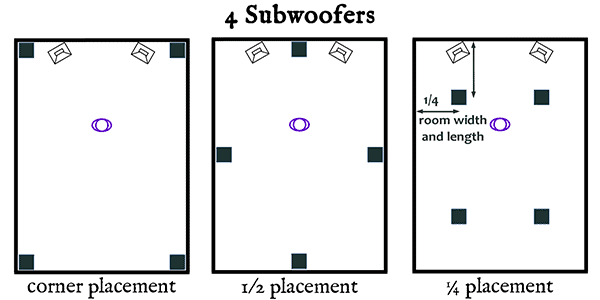
Placement options for a four-subwoofer setup. From the GIK Acoustics website. Placement options for a four-subwoofer setup. From the GIK Acoustics website.


One, the sub has been specifically designed from the ground up to handle only bass frequencies, with good bass extension and without struggling to do so. Two, the subwoofer typically has a built-in power amplifier that is optimized to the driver. Three, a subwoofer can be placed very specifically in the room. Four, it has dedicated controls for gain (volume) crossover frequency and phase. Five, in a home theatre system it specifically reproduces the LFE (low-frequency effects) channel, which can result in a cleaner overall sound. But most of all, a dedicated subwoofer can provide an omnipresent and enveloping low-frequency effect, and when properly dialed in, can magically disappear in its support of a more realistic soundstage. For those who don’t think they need a subwoofer in their stereo audio system, consider the fact that with certain speakers and rooms it may in fact revolutionize an already good-sounding system into something awesome.

Rear panel of a Klipsch Model R-112SW subwoofer.

When you think about the bass amplifiers used in a recording of a band you enjoy listening to, or if you’ve seen them live, likely the bass player was either using a cabinet with a 15- or 18-inch speaker, or multiple 10-, 12-, and 15-inch drivers. That’s a lot of moving air. And live, the bass guitar is also run through the PA system. That’s really a lot of moving air. Then we have the drummer’s kick drum and tom toms and maybe low frequencies from the synth players. Many if not most speakers just simply do not reproduce the bass frequencies at anywhere near 20 Hz, generally considered the lowest frequency of human hearing. Orchestral music also has a lot of low-frequency content.

In the same way that the musicians and engineers who created the music have controlled what bass you hear on a recording, you too can control the bass response in your room. With a good quality subwoofer or multiple subs, you can use the controls they are equipped with and take back control of the steering wheel in your musical journey.

In a coming issue, we’ll give tips on setting up and placing subwoofers in the effort to maximize your listening pleasure. You may be surprised at how simple it can be to get greatly improved results without spending much time or money. Becoming submissive to the merits of bass management can be empowering.

Header image: The REL T/9i, subwoofer royalty!

More from Issue 137

View All Articles in Issue 137

Search Copper Magazine

#225 Capital Audiofest 2025: Must-See Stereo, Part One by Frank Doris Dec 01, 2025 #225 Otis Taylor and the Electrics Delivers a Powerful Set of Hypnotic Modern Blues by Frank Doris Dec 01, 2025 #225 A Christmas Miracle by B. Jan Montana Dec 01, 2025 #225 T.H.E. Show New York 2025, Part Two: Plenty to See, Hear, and Enjoy by Frank Doris Dec 01, 2025 #225 Underappreciated Artists, Part One: Martin Briley by Rich Isaacs Dec 01, 2025 #225 Rock and Roll is Here to Stay by Wayne Robins Dec 01, 2025 #225 A Lifetime of Holiday Record (and CD) Listening by Rudy Radelic Dec 01, 2025 #225 Little Feat: Not Saying Goodbye, Not Yet by Ray Chelstowski Dec 01, 2025 #225 How to Play in a Rock Band, Part 18: Dealing With Burnout by Frank Doris Dec 01, 2025 #225 The People Who Make Audio Happen: CanJam SoCal 2025 by Harris Fogel Dec 01, 2025 #225 Chicago’s Sonic Sanctuaries: Four Hi‑Fi Listening Bars Channeling the Jazz‑Kissa Spirit by Olivier Meunier-Plante Dec 01, 2025 #225 From The Audiophile’s Guide: Controlling Bass Frequencies Through Membrane Absorbers (and How to Build Your Own) by Paul McGowan Dec 01, 2025 #225 Your Editor’s Tips for Attending Audio Shows by Frank Doris Dec 01, 2025 #225 PS Audio in the News by Frank Doris Dec 01, 2025 #225 Back to My Reel-to-Reel Roots, Part 24 by Ken Kessler Dec 01, 2025 #225 Holiday Music by Frank Doris Dec 01, 2025 #225 Puppy Prognostication by Peter Xeni Dec 01, 2025 #225 How to Post Comments on Copper by Frank Doris Dec 01, 2025 #225 Living Color by Rudy Radelic Dec 01, 2025 #224 T.H.E. Show New York 2025, Part One: A New Beginning by Frank Doris Nov 03, 2025 #224 Fool’s Leap of Faith is the Extraordinary Octave Records Debut from Singer/Songwriter Tyler Burba and Visit by Frank Doris Nov 03, 2025 #224 The Beatles’ “Aeolian Cadences.” What? by Wayne Robins Nov 03, 2025 #224 Persona Non Grata by B. Jan Montana Nov 03, 2025 #224 Talking With Recording Engineer Barry Diament of Soundkeeper Recordings, Part Two by Frank Doris Nov 03, 2025 #224 B Sides, B Movies, and Beware of Zombies by Rudy Radelic Nov 03, 2025 #224 The Burn-In Chronicles: 1,000 Hours to Sonic Salvation by Olivier Meunier-Plante Nov 03, 2025 #224 A Conversation With Mat Weisfeld of VPI Industries by Joe Caplan Nov 03, 2025 #224 Blues-Rocker Kenny Wayne Shepherd Celebrates 30 Years of Ledbetter Heights by Ray Chelstowski Nov 03, 2025 #224 Playing in a Rock Band, 17: When Good Gigs Go Bad, Part Two by Frank Doris Nov 03, 2025 #224 From The Audiophile’s Guide: Dealing with Odd-Shaped Rooms by Paul McGowan Nov 03, 2025 #224 TEAC’s TN-3B-SE Turntable Plays Bob Dylan by Howard Kneller Nov 03, 2025 #224 PS Audio in the News by Frank Doris Nov 03, 2025 #224 Lost in Translation by Peter Xeni Nov 03, 2025 #224 Reel-to-Reel Roots, Part 23: Better Than Rice Krispies by Ken Kessler Nov 03, 2025 #224 I Bring Joy! by Frank Doris Nov 03, 2025 #224 Screen Test by Rich Isaacs Nov 03, 2025 #224 How to Post Comments on Copper by Frank Doris Nov 03, 2025 #132 Dr. Patrick Gleeson: The Interview, Part Two by Rich Isaacs Oct 07, 2025 #223 World Fusion Meets Flamenco in Gratitude from Steve Mullins and Rim of the Well by Frank Doris Oct 06, 2025 #223 Judging Albums by Their Covers by Rich Isaacs Oct 06, 2025 #223 Recent Arrivals and 12-inch Royalty by Rudy Radelic Oct 06, 2025 #223 Summer of Creem, Part Two by Wayne Robins Oct 06, 2025 #223 Recording Engineer Barry Diament of Soundkeeper Recordings: Striving for Natural Sound by Frank Doris Oct 06, 2025 #223 Tea on the Terrace by B. Jan Montana Oct 06, 2025 #223 How Good Can Car Audio Get? by Joe Caplan Oct 06, 2025 #223 The Advantages of a Dedicated Listening Room by Paul McGowan Oct 06, 2025 #223 1! 2! 3! 4! Surrounded by the Ramones in Dolby Atmos! by Frank Doris Oct 06, 2025

Sub Missive

Sub Missive

Optimizing the bass response of an audio system is well worth the effort, as most audiophiles will attest to. It requires an initial investment of a little time and effort, but will yield countless hours of enhanced audio satisfaction and hi-fi pleasure.

It has been noted that the bass frequencies in a reproduced piece of music can constitute approximately 30 percent of the overall audible spectrum. Now, if I was driving down the road at a moderate speed, taking the bends comfortably and making good progress and my passenger leaned over and yanked on the steering wheel for just one per cent of the journey, that would be enough to drive me crazy. If they did that 30 percent of the time, I know I wouldn’t be thinking sweet thoughts about them and I would be seriously doubting the likelihood of safely arriving at my destination.

This may be an extreme analogy, but one that makes the point obvious. Sometimes the control of your vehicle is taken from you in ways that are less perceivable, but have a compound effect: examples could be wrong tire pressures, or incorrect wheel balancing or alignment. They may not hinder your driving pleasure to the point that you just don’t want to bother with the trip, but, once these issues have been remedied, you never want to go back to driving the less-well-maintained Jaguar.

Monitor Audio Silver W-12 subwoofer.

Managing our bass in our hi-fi systems can be similar. We may have a great “vehicle” – our speakers – but without tuning our bass we are likely missing out on the smooth pleasure cruise.

I have been as guilty of this as anyone. In my attempts to improve my system’s bass I started researching what some of the professionals were saying on the matter. In one interview with Andrew Jones, eminent speaker designer for ELAC and previously Pioneer and others, he related a concept that appealed to me. He was saying that to obtain a properly immersive sonic experience with enough bass produced using full-range floorstanding speakers, you would need a minimum of seven of them to get the desired effect. This was very interesting to me because at the time, I was already running a quadraphonic floorstanding tower system with a single 8-inch bass driver in each speaker cabinet. Would I need more towers?

It seemed like I was on the right track, but as much as I would have loved to populate the room with more speakers, there was no way I could accommodate seven or more in my room and get away with it. However, according to Jones this was what would be required to eradicate any nulls in the room’s bass response. But I already had plenty of bass drivers in my setup. What to do?

Given that the room itself can account for about 50 percent of the system’s sonic behavior, since it has areas of bass cancellation and reinforcement and influences the reflected and absorbed sound so much, then it seems to make practical sense to take active steps to claw back more control of our audio once we have set it free to roam around the room.

Additionally, sometimes the shortcomings of our hi-fi systems are hard to notice at first, but once they have been remedied, there’s no going back. To name one important example, let’s talk about dealing with the dips in our in-room bass-frequency response.

I was semi-resigned to the fact that I could EQ my speakers with a suitably gradual ramped bass slope and make do with that. After all, the bass was sufficiently loud enough and even complimentary to the resultant sounds in my music. Surely then, I didn’t need a subwoofer, right?

However, I should tell you that I have some absolutely excellent friends, and one of them, in a typically self-deprecating manner, gifted me a new subwoofer as what he called “a belated wedding present.” What a guy! Thank you, Laurence.

I then came to appreciate the many considerations and benefits from using a dedicated subwoofer, or multiple subs. In fact, studies have shown that using multiple subwoofers can be more beneficial than using just one, but many if not most of us don’t have the room and/or budget.

Placement options for a four-subwoofer setup. From the GIK Acoustics website. Placement options for a four-subwoofer setup. From the GIK Acoustics website.


One, the sub has been specifically designed from the ground up to handle only bass frequencies, with good bass extension and without struggling to do so. Two, the subwoofer typically has a built-in power amplifier that is optimized to the driver. Three, a subwoofer can be placed very specifically in the room. Four, it has dedicated controls for gain (volume) crossover frequency and phase. Five, in a home theatre system it specifically reproduces the LFE (low-frequency effects) channel, which can result in a cleaner overall sound. But most of all, a dedicated subwoofer can provide an omnipresent and enveloping low-frequency effect, and when properly dialed in, can magically disappear in its support of a more realistic soundstage. For those who don’t think they need a subwoofer in their stereo audio system, consider the fact that with certain speakers and rooms it may in fact revolutionize an already good-sounding system into something awesome.

Rear panel of a Klipsch Model R-112SW subwoofer.

When you think about the bass amplifiers used in a recording of a band you enjoy listening to, or if you’ve seen them live, likely the bass player was either using a cabinet with a 15- or 18-inch speaker, or multiple 10-, 12-, and 15-inch drivers. That’s a lot of moving air. And live, the bass guitar is also run through the PA system. That’s really a lot of moving air. Then we have the drummer’s kick drum and tom toms and maybe low frequencies from the synth players. Many if not most speakers just simply do not reproduce the bass frequencies at anywhere near 20 Hz, generally considered the lowest frequency of human hearing. Orchestral music also has a lot of low-frequency content.

In the same way that the musicians and engineers who created the music have controlled what bass you hear on a recording, you too can control the bass response in your room. With a good quality subwoofer or multiple subs, you can use the controls they are equipped with and take back control of the steering wheel in your musical journey.

In a coming issue, we’ll give tips on setting up and placing subwoofers in the effort to maximize your listening pleasure. You may be surprised at how simple it can be to get greatly improved results without spending much time or money. Becoming submissive to the merits of bass management can be empowering.

Header image: The REL T/9i, subwoofer royalty!

0 comments

Leave a comment

0 Comments

Your avatar

Loading comments...

🗑️ Delete Comment

Enter moderator password to delete this comment: