COPPER

A PS Audio Publication

Issue 200 • Free Online Magazine

Issue 200 Wayne's Words

Quantum Criminals: The Ace Steely Dan Book

Quantum Criminals: The Ace Steely Dan Book

"Mr. Steely Dan" and his Cohorts, In Words and Paintings

Quantum Criminals is the first book I've seen that really captures the galactic picture and microscopic fussiness, the words and music, and the unsettling but intoxicating vibe of Steely Dan. Written by Alex Pappademas with paintings by Joan LeMay, it is published by the University of Texas Press in Austin.

Unlike previous books, such as Brian Sweet's The Complete Guide to the Music of Steely Dan, Pappademas creates inventive stories about almost-always louche, cryptic characters invented by Walter Becker and Donald Fagen. The subtitle, less elegant than the perfect title, sets the scene: Ramblers, Wild Gamblers, and Other Sole Survivors from the Songs of Steely Dan.

The book is a full words-and-art collaboration. LeMay, a New York-based artist, provides more than 100 vivid "portraits" of until-now unseen of Steely Dan characters, her eye and hand guided by an imagination of names we could only hear before: The El Supremo, Buzz, Pepe, The Babylon Sisters, Mr. Whatever, Babs and Clean Willie, the Fella in the White Tuxedo, character actors and occasional stars and hired extras who appear in Steely Dan's mind-movies. She also draws portraits of the numerous musicians in Steely Dan songs: In portraits of Fagen and Becker, her easter egg is adding their birth flowers to the background.

These "people" are the secret sauce of the songs of Steely Dan, beginning with "Jack" of their first hit, "Do It Again," to "Gaslighting Abbie" and "Cousin Dupree" on the 2000 release, Two Against Nature. Pappademas even conflates a fusion of Fagen and Becker, known as "Mr. Steely Dan," which rolls off the tongue, and the page, like the antihero in a Cowboy Bebop spinoff.


Donald Fagen (left) birth flower carnation, Walter Becker, birth flower violet. Painting by Joan LeMay, from her book with Alex Pappademas, Quantum Criminals. Courtesy of Joan LeMay.

Many Steely Dan characters can be boiled down to three types: drug users, both recreational and bottoming out; old guys who have inappropriate obsessions with younger women; and degenerates along a wide spectrum, from unlucky schmucks to predatory pedophiles. I had forgotten the menacing figure of the child abuser "Mr. LaPage" in the superficially lovely "Everyone's Gone to the Movies," from The Royal Scam (1974). He shows the kids porn movies, exhorts them to play a new game, and not tell their parents.

Some of the characters are historical figures. Napoleon, for example, from the title song of Pretzel Logic, though LeMay resists the temptation to depict "Napoleon in rags." "King Richard/King John" from the song "Kings" from the debut album Can't Buy a Thrill features a LeMay portrait on the facing page of Richard Nixon wearing a kind of Mardi Gras crown, almost a joker. Turn the page, and there is a similar "posed" portrait of John F. Kennedy, more regal. They could be, Pappademas suggests, references to Richard the Lionheart (died, 1199 CE), succeeded by his brother, John, of Robin Hood legend. Or 20th century American politics and fate and the butterfly effect. The author concludes: "But really it's about some guys from the past drinking in a bar and also how it maybe doesn't matter who the president is, in what might be Steely Dan's opinion." And he is probably right, as he often is, with broad knowledge and excellent instincts about the cryptic kickers these songs may be about.

The chapter "Chino and Daddy Gee" introduces the reader to the foundational people and places of Steely Dan's Bard College and its characters, appearing on songs such as "My Old School," "Reelin' in the Years," and "Razor Boy," aka, "the Bard College Cinematic Universe." Pappademas arrests our attention when he writes about the sneering, asshole-ish protagonist in "Reelin' in the Years" when he drops the notion that "Bob Dylan wrote his version of this song and called it "'Like a Rolling Stone'." Of course, "Like a Rolling Stone" preceded Steely Dan by a number of years...it came out in 1965, when Fagen and Becker would have been freshmen...but it's much more interesting to write it the way Alex does, because time travel is one of Mr. Steely Dan's talents. His interest in science-fiction is such that he takes a concept from pulp sci-fi magazines called "hang-ups" (such a perfect word for hung-up Mr. Dan!), which are words that are made up but sound good and advance the plot without much explication. I wish that Pappademas gave a nod to the joke within a joke of calling future Nixon henchman G. Gordon Liddy "Daddy Gee"; hippie-hating Liddy led the infamous drug raid on the Bard campus in May 1969. "Daddy Gee" was also the name of the hip R&B saxman heard and name-checked on Gary "U.S." Bonds' "A Quarter to Three."

The song "Bad Sneakers" gets a long, knowing exposition, which it deserves. "As exiles making art in Los Angeles, Donald and Walter have joined a club that includes Igor Stravinsky, Fritz Lang, Thomas Mann, and Billy Wilder, and also the Beastie Boys, who like Steely Dan are great New Yorkers who enjoy supplying snappy answers to stupid questions . . ." Pappademas does a very slight detour into the greatness of the Beasties' exile on Sunset album, Paul's Boutique, which doesn't come out until 1989, whereas "Bad Sneakers" was released in 1975 on Mr. Steely Dan album 004, Katy Lied. But that's OK, because Pappademas understands that Señor Steely was about time travel. It's my theory that they collapsed after the torments of making Gaucho because all those mixes were ripping a hole in the time/space continuum and Fagen was beginning to morph into another dimension.

"Bad Sneakers" is an early admission of how much they miss New York "stompin' down the avenue by Radio City," which they will return to after album 007 to record Aja. Alex writes, "By the time they return to New York, they will know L.A. well enough to capture what is seductive and ridiculous about it mercilessly and accurately in songs like "Aja" and "Glamour Profession."

But in "Bad Sneakers," they sneer at an L.A. type in a white tuxedo, but know the joke is on psychic bums like them: "Do you think I don't see/The ditch out in the valley that they're digging just for me." Pappademas describes it as: "An inescapable doom . . . like the Grim Reaper smiling and leaning on a luggage cart at baggage claim with MR. DAN scribbled on a shirt cardboard. To Encino, my good man."

There is a great chapter about the avant-garde mezzo-soprano Cathy Berberian, featured real-person in "Your Gold Teeth," wonderfully painted by LeMay, wearing a shawl of many colors. LeMay is not too literal though. She resists painting Berberian with gold teeth. Pappademas goes deep into this Massachusetts' native's history as "the tenth oscillator" of Radio Milan, Italy's electronic music facility in 1955, because she can make sounds with her voice beyond the capability of the nine other state-of-the-art machines. That she became a frequent collaborator with John Cage seems destined. “Your Gold Teeth” is a cool but lesser-known pop song, in which "even Cathy Berberian knows there's one roulade she can't sing," one of the lasting enigmas of their catalog, but which Pappademas explains, as far as anyone could, with credibility and brio.

There is a very short chapter about Lady Bayside, the heroine/heroin of "The Boston Rag." Pappademas, who lives in Los Angeles, takes Walter's word for it about the peculiar character of Bayside, not far at all from Becker’s native Forest Hills, Queens. But he gets great mileage from writing about New York Post columnist Andrea Peyser, a Bayside native Pappademas describes as "the most exciting writer in the Post's reactionary Electric Mayhem Band, in the sense that you never knew when she'd come out swinging at some generally uncontroversial person like Tilda Swinton in print, or call Christine Amanpour a 'CNN war slut.'"
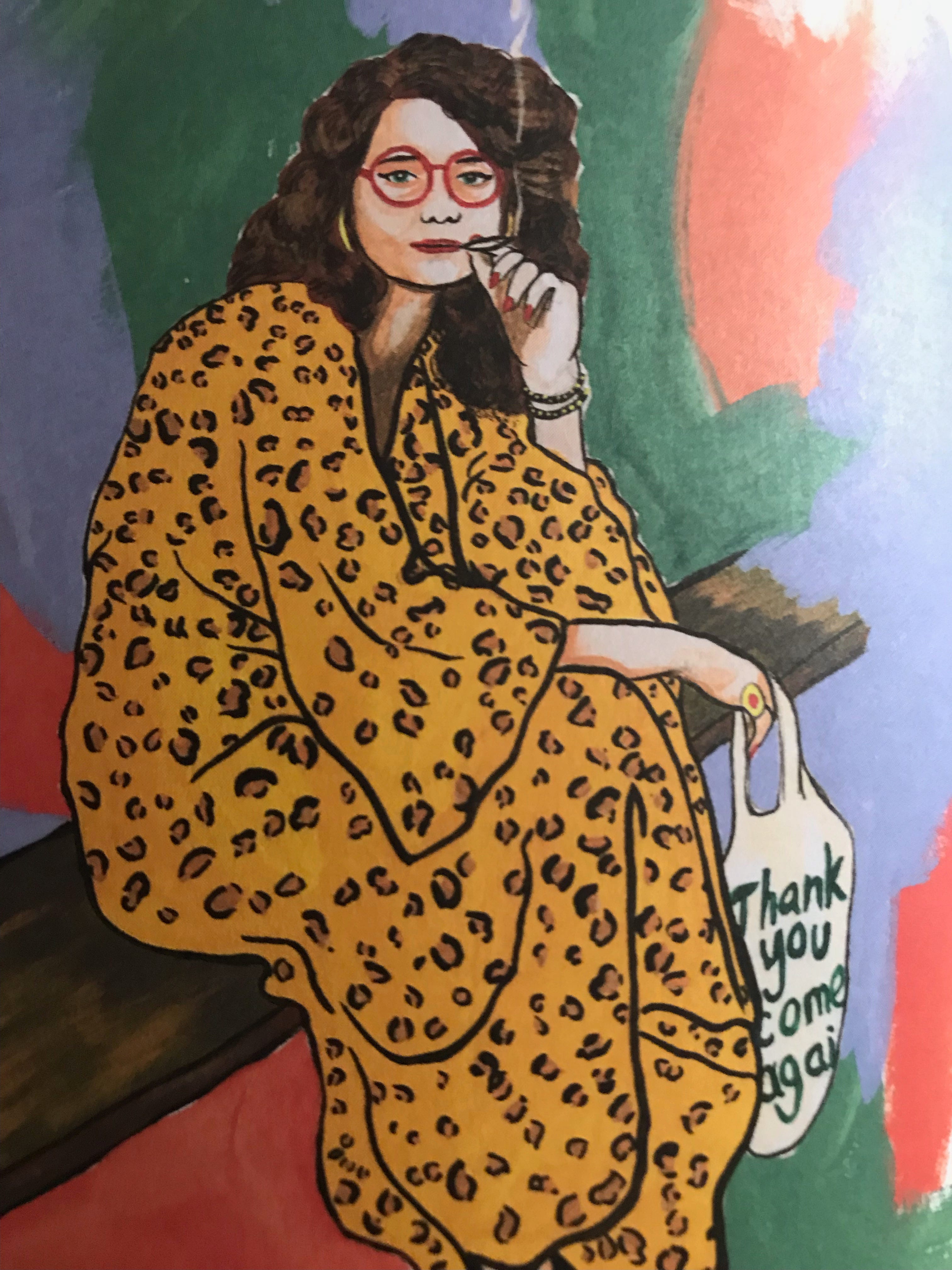


Lady Bayside, by Joan LeMay. I knew this girl. She had a pack of Marlboro filled with joints and cigarettes. She had a pill case with seconal, tuinal, placidyl. Courtesy of Joan LeMay.

Since the last time I wrote about Countdown to Ecstasy, I got some unexpected deep throat stuff from a personal source very close to Walter Becker, who told me I was wrong when I made what was to me the obvious connection of the line in "The Boston Rag," "so I pointed my car down Seventh Avenue." I thought was related to the large number of Baysiders who worked in the city's garment district. The Seventh Avenue in the song is actually about obscure, barely used even by locals because there's not much there, Seventh Avenue in Whitestone, adjacent to Bayside, where there was an after-hours drug pad called The Playroom: "Lonnie swept the playroom" for stray pills, "and swallowed up all he found." (I always heard it as "swallowed a lot of downs," and I wouldn't be too wrong. Whitestone, in those days home to cops, firemen, teachers and other civil servants then required to live in the city limits, was also where the electric kool-aid garage band the Fleshtones were formed in 1976, and where the frenetic, stuck-in-a-labyrinth, drug-addled nature of its teenage denizens made Bayside's messed up teens seem like Quakers. The "oldtimers" I see at Whitestone, Bayside, and Ozarks-like College Point 12-step meetings seem to have known each other from local basement dive bars from 50 years ago, and some of them are barely older than 60.

Through the prism of these characters, Pappademas places the songs in context in which these persons of interest, imagined unindicted co-conspiractors appear. He does so with extraordinary courage and leaps of faith. Pappademas writes with the free-associative velocity of Lester Bangs, the curiosity of John Jeremiah Sullivan, and the authority of David Foster Wallace, exploring and interpreting worlds we did not know we were welcome to.

The shrewd portrait of "Doctor Wu" contains a giveaway that Pappademas may have overlooked. The references to Biscayne Bay and the south Florida of the time, which was the promised land for Jews from Queens and Long Island, Cuban emigres, CIA agents, and gangsters, would soon be filled with so many cocaine criminals that Miami would render Port-Au-Prince, where one would get a "Haitian Divorce," placid by comparison. Our character seeking "Doctor Wu" needs drugs, of course, but there is a line early in the song about having "spent the last piastre I could borrow." The piastre was a currency used in the Middle East in the Ottoman Empire, but was also the currency of Vietnam under French Colonial rule. I always tagged Dr. Wu as the guy who gave or sold smack to American GIs during the Vietnam War, which was ongoing during the first three Steely Dan albums. US troops left Saigon (now Ho Chi Minh City) ending the Vietnam War April 30, 1975, just two months after the release of Katy Lied on March 1, 1975. BTW, referenced twice in the book, the lyricist Jerry Leiber of the songwriting team Leiber and Stoller is spelled Lieber both times.

In addition to his Cinerama vision of Steely Dan's world, Pappademas is such a close listener that he can find momentous happenings in five-second bites or less. He cites Victor Feldman's five-second marimba riff as a key propellant under the line "they don't give a f*ck about anybody else" in "Show Biz Kids."

He also cites the precise deployment of Michael McDonald's voice in later Steely Dan songs. McDonald had left no-longer-touring Steely Dan in 1974 (with guitarist Jeff Baxter) to become the new voice of the hard-touring Doobie Brothers and establish a solo career. But, Pappademas writes, "he also comes back for Steely Dan sessions any time they need a voice that sounds like crushed diamonds mixed with silt." On "Peg" (from Aja), it's McDonald who sings that one syllable (my ital) title in "stacked harmony." On another lesser-known track from that album, "I Got the News," McDonald sings two words: "Broadway Duchess." But to the author, they are essential, for that is "when the clavinets kick in and the drums step up in the mix and the whole song becomes a moving sidewalk for McDonald's voice to dance across." But only those two words: "Donald sings everything up to that point, but "'Broadway duchess' is a part of the melody that requires a pinch-hitter."

What of the line between inspiration and madness that defines all we love and yet sometimes feel uneasy about Steely Dan's relentless search for the perfect sound? That would probably be the case with Gaucho. The opening track, "Babylon Sisters," earned Fagen and producer Gary Katz a plaque from the studio engineers for having mixed that song 250 times, and it didn't end there. "Donald proceeded to mix the song 28 more times."

Pappademas gets a surfeit of information about Aja from the long-running Making of...Classic Albums series. There is the now (in)famous story of the guitar solo in "Peg" that Jay Graydon nailed after so many other quite brilliant and famous guitarists did not: Robben Ford, Rick Derringer, even their frequent guitar man Elliott Randall, who performed Mr. Steely Dan's career-making solo in "Reelin' in the Years." Listening to the playbacks of the failed solos in the documentary, Fagen and Becker are merciless. But, Pappademas writes:

"The solos are the most famously overdetermined parts of Steely Dan's songs, but they also tend to be the emotional crux of each song. They are the one moment in a Steely Dan song where the deeper feeling of the song is allowed to break free of its tightly composed and arranged frame, the one time a player is permitted to step outside the contraints of the track, breaking through the conceit of anonymized slickness this band used to such brilliant rhetorical effect . . . They liked articulation, an eloquence derived from speech – they wanted soloists who could create that sense of a moment of abandon while still turning a phrase. . .There are artists who don't work this way, but none of them have made 'Peg.'"

Many others might write books about Steely Dan, some flippant, some dry, some scholarly, some with razzle but no dazzle, or vice versa. But none of them will have created Quantum Criminals, which literally paints the most vivid, gorgeous portrait, in words and pictures, that I have seen.


This article originally appeared in Wayne Robins’ Substack and is used here by permission. Wayne’s Words columnist Wayne Robins teaches at St. John’s University in Queens, and writes the Critical Conditions Substack, https://waynerobins.substack.com/.

More from Issue 200

View All Articles in Issue 200

Search Copper Magazine

#231 Piano Prodigy Jude Kofie Releases His Debut Album On Octave Records by Frank Doris Jun 01, 2026 #231 Underappreciated Artists, Part Two: City Boy by Rich Isaacs Jun 01, 2026 #231 Music and the Art of Creation: Talking With Saxophonist Rob Scheps by Joe Caplan Jun 01, 2026 #231 How to Play in a Rock Band, 24: Further Adventures at the 2026 Montauk Music Festival by Frank Doris Jun 01, 2026 #231 Courtney Barnett: Creature of Habit by Wayne Robins Jun 01, 2026 #231 Angine de Poitrine: Interstellar Guitar Rock Saviors Headed for Late-Night TV Pop Stardom? by Mark Lepage Jun 01, 2026 #231 My Impressions of AXPONA 2026, Part One by Frank Doris Jun 01, 2026 #231 2026 La Jolla Concours d'Elegance: Another Aesthetic Feast by B. Jan Montana Jun 01, 2026 #231 Country Music Icon Jo Dee Messina’s Bridges: A New Beginning by Ray Chelstowski Jun 01, 2026 #231 The Luxury Dispatch Hosts a Video Podcast With Ken Kessler by Ken Kessler Jun 01, 2026 #231 The Vinyl Beat: Tracking in the Motor City by Rudy Radelic Jun 01, 2026 #231 Lots of Fun With DSP: The Ferrum Audio WANDLA DAC and Its Tube Mode by Frank Doris Jun 01, 2026 #231 From The Audiophile's Guide: Digital Source Components and Streaming Audio by Paul McGowan Jun 01, 2026 #231 Onkyo’s Monster M-510 power amplifier by The Staff at Just Audio Jun 01, 2026 #231 PS Audio in the News by PS Audio Staff Jun 01, 2026 #231 Naming Convention by Peter Xeni Jun 01, 2026 #231 Les Invisibles by Frank Doris Jun 01, 2026 #231 Wildlife Scene by James Schrimpf Jun 01, 2026 #230 Camaraderie by B. Jan Montana May 04, 2026 #230 AXPONA 2026: A Family Gathering by Paul McGowan May 04, 2026 #230 Pianist Ryan Benthall Explores Jazz Realms and Far Beyond With Divine Sky by Frank Doris May 04, 2026 #230 The Vinyl Beat in AXPONA-Land by Rudy Radelic May 04, 2026 #230 Teddy Thompson’s Musical Growth Deepens With Never Be the Same by Ray Chelstowski May 04, 2026 #230 More Fun in the Sun: Florida Audio Expo, Part Two by Frank Doris May 04, 2026 #230 CanJam NYC 2026 Show Report: Heady Sound, Part Two by Frank Doris and Harris Fogel May 04, 2026 #230 Sonic Youth On Murray Street by Wayne Robins May 04, 2026 #230 Graffeo Coffee: A Symphony of Sensory Experience by Joe Caplan May 04, 2026 #230 The Saul Authority: The Story of Hi-Fi Pioneer Saul Marantz by Olivier Meunier-Plante May 04, 2026 #230 How to Play in a Rock Band, 23: Encounters With Famous Musicians, Part Two by Frank Doris May 04, 2026 #230 An Outlier in the Rack: A Vintage BIC Beam Box by The Staff at Just Audio May 04, 2026 #230 PS Audio in the News by PS Audio Staff May 04, 2026 #230 A Cautionary Tale by Rich Isaacs May 04, 2026 #230 Reel-to-Reel Roots, Part 33 (Revised): Ken Kessler Reports On the 2026 (British) AudioJumble by Ken Kessler May 04, 2026 #230 Text Messaging by Frank Doris May 04, 2026 #230 The Audiophile Rat Race by Peter Xeni May 04, 2026 #230 On the Rocks by Rich Isaacs May 04, 2026 #229 The Earliest Stars of Country Music, Part Three by Jeff Weiner Apr 06, 2026 #229 The Healing Power of Music and Sound at the Omega Institute by Joe Caplan Apr 06, 2026 #229 CanJam NYC 2026 Show Report: Heady Sound, Part One by Frank Doris Apr 06, 2026 #229 Florida Audio Expo 2026: Warming Up to High-End Audio, Part One by Frank Doris Apr 06, 2026 #229 Quick Takes: Anne Bisson, Sam Morrison, The Velvet Underground, and the Stooges by Frank Doris Apr 06, 2026 #229 The Vinyl Beat: New Arrivals, and Old Audio Show Demo Scores to Settle by Rudy Radelic Apr 06, 2026 #229 Harvard Gets a High-End Audio Education by Frank Doris Apr 06, 2026 #229 No Country for Old Knees by B. Jan Montana Apr 06, 2026 #229 How To Play in A Rock Band, 22: Encounters With Famous Musicians, Part 1 by Frank Doris Apr 06, 2026 #229 The Soulful Grooves of Guinea-Bissau by Steve Kindig Apr 06, 2026 #229 Four-Hand Piano Performance at Its Finest by Stephan Haberthür Apr 06, 2026

Quantum Criminals: The Ace Steely Dan Book

<em>Quantum Criminals:</em> The Ace Steely Dan Book

"Mr. Steely Dan" and his Cohorts, In Words and Paintings

Quantum Criminals is the first book I've seen that really captures the galactic picture and microscopic fussiness, the words and music, and the unsettling but intoxicating vibe of Steely Dan. Written by Alex Pappademas with paintings by Joan LeMay, it is published by the University of Texas Press in Austin.

Unlike previous books, such as Brian Sweet's The Complete Guide to the Music of Steely Dan, Pappademas creates inventive stories about almost-always louche, cryptic characters invented by Walter Becker and Donald Fagen. The subtitle, less elegant than the perfect title, sets the scene: Ramblers, Wild Gamblers, and Other Sole Survivors from the Songs of Steely Dan.

The book is a full words-and-art collaboration. LeMay, a New York-based artist, provides more than 100 vivid "portraits" of until-now unseen of Steely Dan characters, her eye and hand guided by an imagination of names we could only hear before: The El Supremo, Buzz, Pepe, The Babylon Sisters, Mr. Whatever, Babs and Clean Willie, the Fella in the White Tuxedo, character actors and occasional stars and hired extras who appear in Steely Dan's mind-movies. She also draws portraits of the numerous musicians in Steely Dan songs: In portraits of Fagen and Becker, her easter egg is adding their birth flowers to the background.

These "people" are the secret sauce of the songs of Steely Dan, beginning with "Jack" of their first hit, "Do It Again," to "Gaslighting Abbie" and "Cousin Dupree" on the 2000 release, Two Against Nature. Pappademas even conflates a fusion of Fagen and Becker, known as "Mr. Steely Dan," which rolls off the tongue, and the page, like the antihero in a Cowboy Bebop spinoff.


Donald Fagen (left) birth flower carnation, Walter Becker, birth flower violet. Painting by Joan LeMay, from her book with Alex Pappademas, Quantum Criminals. Courtesy of Joan LeMay.

Many Steely Dan characters can be boiled down to three types: drug users, both recreational and bottoming out; old guys who have inappropriate obsessions with younger women; and degenerates along a wide spectrum, from unlucky schmucks to predatory pedophiles. I had forgotten the menacing figure of the child abuser "Mr. LaPage" in the superficially lovely "Everyone's Gone to the Movies," from The Royal Scam (1974). He shows the kids porn movies, exhorts them to play a new game, and not tell their parents.

Some of the characters are historical figures. Napoleon, for example, from the title song of Pretzel Logic, though LeMay resists the temptation to depict "Napoleon in rags." "King Richard/King John" from the song "Kings" from the debut album Can't Buy a Thrill features a LeMay portrait on the facing page of Richard Nixon wearing a kind of Mardi Gras crown, almost a joker. Turn the page, and there is a similar "posed" portrait of John F. Kennedy, more regal. They could be, Pappademas suggests, references to Richard the Lionheart (died, 1199 CE), succeeded by his brother, John, of Robin Hood legend. Or 20th century American politics and fate and the butterfly effect. The author concludes: "But really it's about some guys from the past drinking in a bar and also how it maybe doesn't matter who the president is, in what might be Steely Dan's opinion." And he is probably right, as he often is, with broad knowledge and excellent instincts about the cryptic kickers these songs may be about.

The chapter "Chino and Daddy Gee" introduces the reader to the foundational people and places of Steely Dan's Bard College and its characters, appearing on songs such as "My Old School," "Reelin' in the Years," and "Razor Boy," aka, "the Bard College Cinematic Universe." Pappademas arrests our attention when he writes about the sneering, asshole-ish protagonist in "Reelin' in the Years" when he drops the notion that "Bob Dylan wrote his version of this song and called it "'Like a Rolling Stone'." Of course, "Like a Rolling Stone" preceded Steely Dan by a number of years...it came out in 1965, when Fagen and Becker would have been freshmen...but it's much more interesting to write it the way Alex does, because time travel is one of Mr. Steely Dan's talents. His interest in science-fiction is such that he takes a concept from pulp sci-fi magazines called "hang-ups" (such a perfect word for hung-up Mr. Dan!), which are words that are made up but sound good and advance the plot without much explication. I wish that Pappademas gave a nod to the joke within a joke of calling future Nixon henchman G. Gordon Liddy "Daddy Gee"; hippie-hating Liddy led the infamous drug raid on the Bard campus in May 1969. "Daddy Gee" was also the name of the hip R&B saxman heard and name-checked on Gary "U.S." Bonds' "A Quarter to Three."

The song "Bad Sneakers" gets a long, knowing exposition, which it deserves. "As exiles making art in Los Angeles, Donald and Walter have joined a club that includes Igor Stravinsky, Fritz Lang, Thomas Mann, and Billy Wilder, and also the Beastie Boys, who like Steely Dan are great New Yorkers who enjoy supplying snappy answers to stupid questions . . ." Pappademas does a very slight detour into the greatness of the Beasties' exile on Sunset album, Paul's Boutique, which doesn't come out until 1989, whereas "Bad Sneakers" was released in 1975 on Mr. Steely Dan album 004, Katy Lied. But that's OK, because Pappademas understands that Señor Steely was about time travel. It's my theory that they collapsed after the torments of making Gaucho because all those mixes were ripping a hole in the time/space continuum and Fagen was beginning to morph into another dimension.

"Bad Sneakers" is an early admission of how much they miss New York "stompin' down the avenue by Radio City," which they will return to after album 007 to record Aja. Alex writes, "By the time they return to New York, they will know L.A. well enough to capture what is seductive and ridiculous about it mercilessly and accurately in songs like "Aja" and "Glamour Profession."

But in "Bad Sneakers," they sneer at an L.A. type in a white tuxedo, but know the joke is on psychic bums like them: "Do you think I don't see/The ditch out in the valley that they're digging just for me." Pappademas describes it as: "An inescapable doom . . . like the Grim Reaper smiling and leaning on a luggage cart at baggage claim with MR. DAN scribbled on a shirt cardboard. To Encino, my good man."

There is a great chapter about the avant-garde mezzo-soprano Cathy Berberian, featured real-person in "Your Gold Teeth," wonderfully painted by LeMay, wearing a shawl of many colors. LeMay is not too literal though. She resists painting Berberian with gold teeth. Pappademas goes deep into this Massachusetts' native's history as "the tenth oscillator" of Radio Milan, Italy's electronic music facility in 1955, because she can make sounds with her voice beyond the capability of the nine other state-of-the-art machines. That she became a frequent collaborator with John Cage seems destined. “Your Gold Teeth” is a cool but lesser-known pop song, in which "even Cathy Berberian knows there's one roulade she can't sing," one of the lasting enigmas of their catalog, but which Pappademas explains, as far as anyone could, with credibility and brio.

There is a very short chapter about Lady Bayside, the heroine/heroin of "The Boston Rag." Pappademas, who lives in Los Angeles, takes Walter's word for it about the peculiar character of Bayside, not far at all from Becker’s native Forest Hills, Queens. But he gets great mileage from writing about New York Post columnist Andrea Peyser, a Bayside native Pappademas describes as "the most exciting writer in the Post's reactionary Electric Mayhem Band, in the sense that you never knew when she'd come out swinging at some generally uncontroversial person like Tilda Swinton in print, or call Christine Amanpour a 'CNN war slut.'"


Lady Bayside, by Joan LeMay. I knew this girl. She had a pack of Marlboro filled with joints and cigarettes. She had a pill case with seconal, tuinal, placidyl. Courtesy of Joan LeMay.

Since the last time I wrote about Countdown to Ecstasy, I got some unexpected deep throat stuff from a personal source very close to Walter Becker, who told me I was wrong when I made what was to me the obvious connection of the line in "The Boston Rag," "so I pointed my car down Seventh Avenue." I thought was related to the large number of Baysiders who worked in the city's garment district. The Seventh Avenue in the song is actually about obscure, barely used even by locals because there's not much there, Seventh Avenue in Whitestone, adjacent to Bayside, where there was an after-hours drug pad called The Playroom: "Lonnie swept the playroom" for stray pills, "and swallowed up all he found." (I always heard it as "swallowed a lot of downs," and I wouldn't be too wrong. Whitestone, in those days home to cops, firemen, teachers and other civil servants then required to live in the city limits, was also where the electric kool-aid garage band the Fleshtones were formed in 1976, and where the frenetic, stuck-in-a-labyrinth, drug-addled nature of its teenage denizens made Bayside's messed up teens seem like Quakers. The "oldtimers" I see at Whitestone, Bayside, and Ozarks-like College Point 12-step meetings seem to have known each other from local basement dive bars from 50 years ago, and some of them are barely older than 60.

Through the prism of these characters, Pappademas places the songs in context in which these persons of interest, imagined unindicted co-conspiractors appear. He does so with extraordinary courage and leaps of faith. Pappademas writes with the free-associative velocity of Lester Bangs, the curiosity of John Jeremiah Sullivan, and the authority of David Foster Wallace, exploring and interpreting worlds we did not know we were welcome to.

The shrewd portrait of "Doctor Wu" contains a giveaway that Pappademas may have overlooked. The references to Biscayne Bay and the south Florida of the time, which was the promised land for Jews from Queens and Long Island, Cuban emigres, CIA agents, and gangsters, would soon be filled with so many cocaine criminals that Miami would render Port-Au-Prince, where one would get a "Haitian Divorce," placid by comparison. Our character seeking "Doctor Wu" needs drugs, of course, but there is a line early in the song about having "spent the last piastre I could borrow." The piastre was a currency used in the Middle East in the Ottoman Empire, but was also the currency of Vietnam under French Colonial rule. I always tagged Dr. Wu as the guy who gave or sold smack to American GIs during the Vietnam War, which was ongoing during the first three Steely Dan albums. US troops left Saigon (now Ho Chi Minh City) ending the Vietnam War April 30, 1975, just two months after the release of Katy Lied on March 1, 1975. BTW, referenced twice in the book, the lyricist Jerry Leiber of the songwriting team Leiber and Stoller is spelled Lieber both times.

In addition to his Cinerama vision of Steely Dan's world, Pappademas is such a close listener that he can find momentous happenings in five-second bites or less. He cites Victor Feldman's five-second marimba riff as a key propellant under the line "they don't give a f*ck about anybody else" in "Show Biz Kids."

He also cites the precise deployment of Michael McDonald's voice in later Steely Dan songs. McDonald had left no-longer-touring Steely Dan in 1974 (with guitarist Jeff Baxter) to become the new voice of the hard-touring Doobie Brothers and establish a solo career. But, Pappademas writes, "he also comes back for Steely Dan sessions any time they need a voice that sounds like crushed diamonds mixed with silt." On "Peg" (from Aja), it's McDonald who sings that one syllable (my ital) title in "stacked harmony." On another lesser-known track from that album, "I Got the News," McDonald sings two words: "Broadway Duchess." But to the author, they are essential, for that is "when the clavinets kick in and the drums step up in the mix and the whole song becomes a moving sidewalk for McDonald's voice to dance across." But only those two words: "Donald sings everything up to that point, but "'Broadway duchess' is a part of the melody that requires a pinch-hitter."

What of the line between inspiration and madness that defines all we love and yet sometimes feel uneasy about Steely Dan's relentless search for the perfect sound? That would probably be the case with Gaucho. The opening track, "Babylon Sisters," earned Fagen and producer Gary Katz a plaque from the studio engineers for having mixed that song 250 times, and it didn't end there. "Donald proceeded to mix the song 28 more times."

Pappademas gets a surfeit of information about Aja from the long-running Making of...Classic Albums series. There is the now (in)famous story of the guitar solo in "Peg" that Jay Graydon nailed after so many other quite brilliant and famous guitarists did not: Robben Ford, Rick Derringer, even their frequent guitar man Elliott Randall, who performed Mr. Steely Dan's career-making solo in "Reelin' in the Years." Listening to the playbacks of the failed solos in the documentary, Fagen and Becker are merciless. But, Pappademas writes:

"The solos are the most famously overdetermined parts of Steely Dan's songs, but they also tend to be the emotional crux of each song. They are the one moment in a Steely Dan song where the deeper feeling of the song is allowed to break free of its tightly composed and arranged frame, the one time a player is permitted to step outside the contraints of the track, breaking through the conceit of anonymized slickness this band used to such brilliant rhetorical effect . . . They liked articulation, an eloquence derived from speech – they wanted soloists who could create that sense of a moment of abandon while still turning a phrase. . .There are artists who don't work this way, but none of them have made 'Peg.'"

Many others might write books about Steely Dan, some flippant, some dry, some scholarly, some with razzle but no dazzle, or vice versa. But none of them will have created Quantum Criminals, which literally paints the most vivid, gorgeous portrait, in words and pictures, that I have seen.


This article originally appeared in Wayne Robins’ Substack and is used here by permission. Wayne’s Words columnist Wayne Robins teaches at St. John’s University in Queens, and writes the Critical Conditions Substack, https://waynerobins.substack.com/.

0 comments

Leave a comment

0 Comments

Your avatar

Loading comments...

🗑️ Delete Comment

Enter moderator password to delete this comment:

✏️ Edit Comment

Enter your email to verify ownership: