COPPER

A PS Audio Publication

Issue 160 • Free Online Magazine

Issue 160 New Vistas

Pilgrimage to Sturgis, Part 18

Pilgrimage to Sturgis, Part 18


The roads in the Black Hills are scenic and twisty, but during bike week, they are also crowded and slow. Sometimes it feels like spending a week in Walmart – interesting but claustrophobic. By comparison, getting my motorcycle back on I-90 felt like riding a horse on the open range. The BMW R90S is a thoroughbred sired for the autobahn; it needs to stretch its legs. It relishes trotting at 90 MPH. There’s something about punching through the air at speed while the big sky country scrolls by that makes everything feel right with the world.

I thought back to the night before. Melody’s dad had closed the saloon as soon as the doctors staggered to their cabins. He was pleased the bar had done well, and credited me with bringing in much of the day’s income. Melody smiled. She wandered back with me to my cabin. Although we were both exhausted, we spent the evening cherishing each other.

After breakfast the next morning, I took my leave of the family and thanked them for the hospitality. Melody urged me to return on Friday for another visit to the Bhagwan, and I told her I’d like that. The doctors didn’t make an appearance before I hit the road.

As I rolled by Wall Drug near the Badlands, I couldn’t help but remember fondly the luminous afternoon I’d spent there with Melody. It’s only been an hour and already I’m missing her, I thought to myself. She wouldn’t be a bad catch for a guy like me. She has an excellent role model in her parents, which the psychologist said was important, she identifies with the philosophy of Bhagwan, which we share in common, she’s delightful company, and she’s cute. What’s not to like?

I remembered the Bhagwan’s Ten Commandments his assistant had given us, and wondered where they went. I hadn’t even read them yet. Did I remember to take them out of my jeans before Melody’s mother washed them? I felt both hip pockets and there weren’t any pulpy lumps. They must be in my luggage somewhere.

My mind wandered to thoughts about what the psychologist said regarding making a woman feel as cherished as she did when she was a little girl bouncing on her father’s knee. I couldn’t remember ever trying to make my ex-wife feel that way: it had never even occurred to me. She was a grown person with adult responsibilities; why would I want to make her feel like a child? I was holding down two jobs in an effort to get the mortgage paid before we’d even had any children. Once they appeared, there’d be plenty to worry about other than finances.

My childhood was dominated with financial worries. We didn’t just live on the wrong side of the tracks, we lived directly across from the switchyard. My mother’s laundry was always covered in carbon specks from the steam locomotives upwind. I developed bronchitis from the pollution. I remember going to the store with my mother to buy a week’s groceries with only $8. Were it not for corn flakes, pancakes and pasta, we’d have starved. I was dying to take piano lessons in third grade, but didn’t even ask because I knew we couldn’t afford it. Our activities were always curbed by a lack of money. Our family car was a rusted-out wreck. I was determined not to subject my kids to any of that.

As the miles rolled on, I was struck by a disturbing thought. Maybe it wasn’t my ex-wife’s lack of foresight and strategizing that caused our divorce; maybe it was my poverty phobia? I remembered the psychologist’s words about seeking a mate with similar backgrounds. Her dad was an electrical engineer, they lived in a nice part of town and he drove a Buick Electra 225 – which was akin to a private jet in our eyes. She’d never experienced poverty!

I passed a billboard with a large image of a building which looked like something from a Moroccan travel poster. Why advertise a vacation to Morocco in the middle of the Great Plains? A few miles later, another billboard with the same image read, “Visit the Mitchell Corn Palace.” When I came to a road sign which read, “Mitchell – 24 Miles,” I knew where I’d stop for lunch.

I pulled into a mom and pop service station on the edge of town with an attached restaurant/convenience store. After gassing up, I sat down at the counter and asked the waitress, “is the corn palace worth the trouble?”

“It’s a block down the street!” she spoke, in a manner that implied, “you idiot.”

“It’s worth a visit,” a rancher two stools over said. “It was built in the 1890s to draw settlers into town, but when every other town in the area did the same thing, it ceased to be very effective. Now that it’s the only one left, it draws tourists because it’s interesting. The entire exterior is covered in grains and grain products like corn husks. Every year, it gets a new and different exterior, so tourists keep coming back. Inside there is a big auditorium. Johnny Cash and the Beach Boys have played there. These concerts draw big crowds.”

I thanked the rancher, paid the waitress, and rode a block down Main Street. Mitchell is a town much like a thousand other unremarkable towns on the Plains. The Corn Palace wasn’t hard to find as it dominated the downtown area. I parked across the street and admired the agricultural murals. They were really creative. A plaque noted that each year, a different artist is invited to decorate the building.
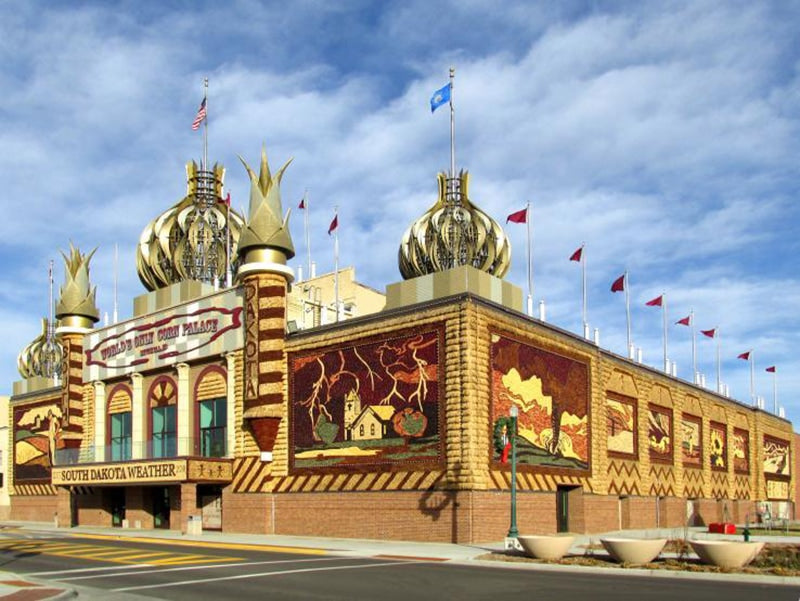
 

Mitchell Corn Palace. From Travel South Dakota.com.

Mitchell Corn Palace. From Travel South Dakota.com.


Just as I got on my bike to head out, a Harley pulled up. It was painted in John Deere colors with yellow wheels, green bodywork, and John Deere stickers on the tank and saddlebags.

“That’s hilarious,” I blurted out laughing. “Who paints their bike in tractor colors?”

“You laughing at my bike?” the rider responded.

“Yah, it’s great. How’d you ever get the idea to do that?”

He smirked and said, “My wife, she hates Harleys and once told me it rides like a tractor. So, I painted it like a tractor. Now I’m a rock star.”

“She likes the bike now?”

“Hell no, she still hates it, but I’m a rock star with farmers and ranchers. Every time I stop in a town like this, somebody says, ‘I didn’t know John Deere made motorcycles!’ I’ve heard it so many times, I’ve started making up stories to answer the inevitable questions.”

“Like what?”

“Well, my favorite one goes like this,” he continued; “John Deere in Australia commissioned 12 Sportsters to herd sheep in the outback. They figured the ranchers would love them as they would be cheaper and faster than horses. Turns out the bikes were too heavy and kept getting bogged down in the loose sand, so Harley took them back and sold them in their Australian dealerships. I bought it from a Californian who rode it all over Australia and New Zealand and imported it to the States. When it broke down in Sturgis, I bought it cheap and trucked it home.”

“What a great tale!” I laughed, “and they buy that?”

“It gets better,” he smirked. “Then I tell them there are only three known examples left in existence; two are in museums and this is the only one still on the road.”

“Check this out, Mabel,” I parodied, “this is the only bike like it still on the road!”

“Exactly.”

“Well, that’s a terrific tale,” I chuckled. “Do you mind if I take a photo?”

He stood behind the bike, posed like Crocodile Dundee, and when he was ready, snarled, “Awl Rat Mite.”

I thanked him and as I rode away, determined that one day I’d paint one of my bikes like his. Two decades later, I did.
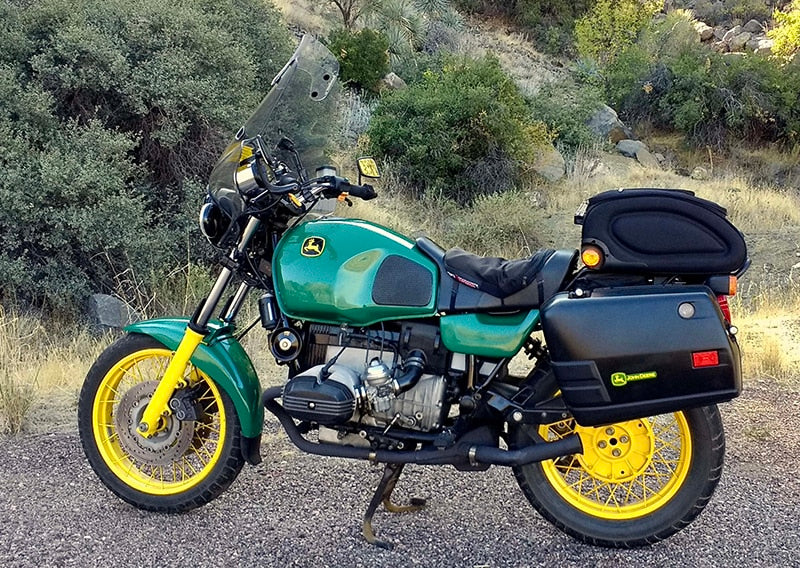
 

The author's "John Deere" motorcycle, as featured in Issue 154's Parting Shot.

The author’s “John Deere” motorcycle, as featured in Issue 154’s Parting Shot.


A couple of highway patrol cruisers were parked in the mom and pop gas station, facing the road. The occupants were talking to each other through rolled-down windows. I rode by at the speed limit, but we all knew that once I hit the highway, the speed limit would be little more than a suggestion. I waved and they waved back. Somehow, we were brothers of the road.

I had no problems with police, the bike, or the weather the rest of the way down I-90. The I-36 junction popped up surprisingly fast and I turned north to Minneapolis. I called Chip for directions at the edge of town. He sounded happy that I’d made it. It was barely five pm and there was lots of light left. After some quick calculations, I learned that I’d covered the 577 miles from South Dakota to Minnesota in under eight hours, including stops. Most bikers get some satisfaction from making good time.

I was more concerned about nightfall. I hate riding in the dark because it’s so much harder to see road obstacles. A friend once experienced a major crash during an early ride to work. He hit a step ladder which had probably fallen off a truck. If he’d been in his car, it would have been little more than a bump. On his bike, it was a week in the ICU.

Chip lived in an older neighborhood full of narrow, two-story brick buildings closely spaced together and covered in soot. An alley ran alongside his house and it was lined on both sides with probably 30 Harleys. Half of the renegades poured out of Chip’s two-car garage to greet me as I pulled up. I was delighted to recognize most of them: Gimp, Tina, Spider, KP, Chip, and of course, the delightful Candy. We shared handshakes and hugs. Spider handed me a beer. I was made to feel like the Prodigal Son.


Previous installments appeared in Issues 143144145146147148149150151152153154155156157158 and 159.

Editor’s Note: we are aware that “gimp” can have a derogatory meaning and mean no insult to anyone disabled. In the story, the person with that nickname doesn’t consider it as such, and we present the story in that context.

Header image: taken at the Needles Highway in the Black Hills of South Dakota. Courtesy of Wikimedia Commons/Runner1928.

More from Issue 160

View All Articles in Issue 160

Search Copper Magazine

#227 Seth Lewis Gets in the Groove With Take a Look Around: a Tribute to the Meters by Frank Doris Feb 02, 2026 #227 Passport to Sound: May Anwar’s Audio Learning Experience for Young People by Frank Doris Feb 02, 2026 #227 Conjectures on Cosmic Consciousness by B. Jan Montana Feb 02, 2026 #227 The Big Takeover Turns 45 by Wayne Robins Feb 02, 2026 #227 Music and Chocolate: On the Sensory Connection by Joe Caplan Feb 02, 2026 #227 Singer/Songwriter Chris Berardo: Getting Wilder All the Time by Ray Chelstowski Feb 02, 2026 #227 The Earliest Stars of Country Music, Part One by Jeff Weiner Feb 02, 2026 #227 The Vinyl Beat Goes Down to Tijuana (By Way of Los Angeles), Part Two by Rudy Radelic Feb 02, 2026 #227 How to Play in a Rock Band, 20: On the Road With Blood, Sweat & Tears’ Guitarist Gabe Cummins by Frank Doris Feb 02, 2026 #227 From The Audiophile’s Guide: Audio Specs and Measuring by Paul McGowan Feb 02, 2026 #227 Our Brain is Always Listening by Peter Trübner Feb 02, 2026 #227 PS Audio in the News by PS Audio Staff Feb 02, 2026 #227 The Listening Chair: Sleek Style and Sound From the Luxman L3 by Howard Kneller Feb 02, 2026 #227 The Los Angeles and Orange County Audio Society Celebrates Its 32nd Anniversary, Honoring David and Sheryl Lee Wilson and Bernie Grundman by Harris Fogel Feb 02, 2026 #227 Back to My Reel-to-Reel Roots, Part 26: Half Full – Not Half Empty, Redux by Ken Kessler Feb 02, 2026 #227 That's What Puzzles Us... by Frank Doris Feb 02, 2026 #227 Record-Breaking by Peter Xeni Feb 02, 2026 #227 The Long and Winding Road by B. Jan Montana Feb 02, 2026 #226 JJ Murphy’s Sleep Paralysis is a Genre-Bending Musical Journey Through Jazz, Fusion and More by Frank Doris Jan 05, 2026 #226 Stewardship by Consent by B. Jan Montana Jan 05, 2026 #226 Food, Music, and Sensory Experience: An Interview With Professor Jonathan Zearfoss of the Culinary Institute of America by Joe Caplan Jan 05, 2026 #226 Studio Confidential: A Who’s Who of Recording Engineers Tell Their Stories by Frank Doris Jan 05, 2026 #226 Pilot Radio is Reborn, 50 Years Later: Talking With CEO Barak Epstein by Frank Doris Jan 05, 2026 #226 The Vinyl Beat Goes Down to Tijuana (By Way of Los Angeles), Part One by Rudy Radelic Jan 05, 2026 #226 Capital Audiofest 2025: Must-See Stereo, Part Two by Frank Doris Jan 05, 2026 #226 My Morning Jacket’s Carl Broemel and Tyler Ramsey Collaborate on Their Acoustic Guitar Album, Celestun by Ray Chelstowski Jan 05, 2026 #226 The People Who Make Audio Happen: CanJam SoCal 2025, Part Two by Harris Fogel Jan 05, 2026 #226 How to Play in a Rock Band, 19: Touring Can Make You Crazy, Part One by Frank Doris Jan 05, 2026 #226 Linda Ronstadt Goes Bigger by Wayne Robins Jan 05, 2026 #226 From The Audiophile’s Guide: Active Room Correction and Digital Signal Processing by Paul McGowan Jan 05, 2026 #226 PS Audio in the News by Frank Doris Jan 05, 2026 #226 Back to My Reel-to-Reel Roots, Part 25: Half-Full, Not Empty by Ken Kessler Jan 05, 2026 #226 Happy New Year! by Frank Doris Jan 05, 2026 #226 Turn It Down! by Peter Xeni Jan 05, 2026 #226 Ghost Riders by James Schrimpf Jan 05, 2026 #226 A Factory Tour of Audio Manufacturer German Physiks by Markus "Marsu" Manthey Jan 04, 2026 #225 Capital Audiofest 2025: Must-See Stereo, Part One by Frank Doris Dec 01, 2025 #225 Otis Taylor and the Electrics Delivers a Powerful Set of Hypnotic Modern Blues by Frank Doris Dec 01, 2025 #225 A Christmas Miracle by B. Jan Montana Dec 01, 2025 #225 T.H.E. Show New York 2025, Part Two: Plenty to See, Hear, and Enjoy by Frank Doris Dec 01, 2025 #225 Underappreciated Artists, Part One: Martin Briley by Rich Isaacs Dec 01, 2025 #225 Rock and Roll is Here to Stay by Wayne Robins Dec 01, 2025 #225 A Lifetime of Holiday Record (and CD) Listening by Rudy Radelic Dec 01, 2025 #225 Little Feat: Not Saying Goodbye, Not Yet by Ray Chelstowski Dec 01, 2025 #225 How to Play in a Rock Band, Part 18: Dealing With Burnout by Frank Doris Dec 01, 2025 #225 The People Who Make Audio Happen: CanJam SoCal 2025 by Harris Fogel Dec 01, 2025 #225 Chicago’s Sonic Sanctuaries: Four Hi‑Fi Listening Bars Channeling the Jazz‑Kissa Spirit by Olivier Meunier-Plante Dec 01, 2025

Pilgrimage to Sturgis, Part 18

Pilgrimage to Sturgis, Part 18


The roads in the Black Hills are scenic and twisty, but during bike week, they are also crowded and slow. Sometimes it feels like spending a week in Walmart – interesting but claustrophobic. By comparison, getting my motorcycle back on I-90 felt like riding a horse on the open range. The BMW R90S is a thoroughbred sired for the autobahn; it needs to stretch its legs. It relishes trotting at 90 MPH. There’s something about punching through the air at speed while the big sky country scrolls by that makes everything feel right with the world.

I thought back to the night before. Melody’s dad had closed the saloon as soon as the doctors staggered to their cabins. He was pleased the bar had done well, and credited me with bringing in much of the day’s income. Melody smiled. She wandered back with me to my cabin. Although we were both exhausted, we spent the evening cherishing each other.

After breakfast the next morning, I took my leave of the family and thanked them for the hospitality. Melody urged me to return on Friday for another visit to the Bhagwan, and I told her I’d like that. The doctors didn’t make an appearance before I hit the road.

As I rolled by Wall Drug near the Badlands, I couldn’t help but remember fondly the luminous afternoon I’d spent there with Melody. It’s only been an hour and already I’m missing her, I thought to myself. She wouldn’t be a bad catch for a guy like me. She has an excellent role model in her parents, which the psychologist said was important, she identifies with the philosophy of Bhagwan, which we share in common, she’s delightful company, and she’s cute. What’s not to like?

I remembered the Bhagwan’s Ten Commandments his assistant had given us, and wondered where they went. I hadn’t even read them yet. Did I remember to take them out of my jeans before Melody’s mother washed them? I felt both hip pockets and there weren’t any pulpy lumps. They must be in my luggage somewhere.

My mind wandered to thoughts about what the psychologist said regarding making a woman feel as cherished as she did when she was a little girl bouncing on her father’s knee. I couldn’t remember ever trying to make my ex-wife feel that way: it had never even occurred to me. She was a grown person with adult responsibilities; why would I want to make her feel like a child? I was holding down two jobs in an effort to get the mortgage paid before we’d even had any children. Once they appeared, there’d be plenty to worry about other than finances.

My childhood was dominated with financial worries. We didn’t just live on the wrong side of the tracks, we lived directly across from the switchyard. My mother’s laundry was always covered in carbon specks from the steam locomotives upwind. I developed bronchitis from the pollution. I remember going to the store with my mother to buy a week’s groceries with only $8. Were it not for corn flakes, pancakes and pasta, we’d have starved. I was dying to take piano lessons in third grade, but didn’t even ask because I knew we couldn’t afford it. Our activities were always curbed by a lack of money. Our family car was a rusted-out wreck. I was determined not to subject my kids to any of that.

As the miles rolled on, I was struck by a disturbing thought. Maybe it wasn’t my ex-wife’s lack of foresight and strategizing that caused our divorce; maybe it was my poverty phobia? I remembered the psychologist’s words about seeking a mate with similar backgrounds. Her dad was an electrical engineer, they lived in a nice part of town and he drove a Buick Electra 225 – which was akin to a private jet in our eyes. She’d never experienced poverty!

I passed a billboard with a large image of a building which looked like something from a Moroccan travel poster. Why advertise a vacation to Morocco in the middle of the Great Plains? A few miles later, another billboard with the same image read, “Visit the Mitchell Corn Palace.” When I came to a road sign which read, “Mitchell – 24 Miles,” I knew where I’d stop for lunch.

I pulled into a mom and pop service station on the edge of town with an attached restaurant/convenience store. After gassing up, I sat down at the counter and asked the waitress, “is the corn palace worth the trouble?”

“It’s a block down the street!” she spoke, in a manner that implied, “you idiot.”

“It’s worth a visit,” a rancher two stools over said. “It was built in the 1890s to draw settlers into town, but when every other town in the area did the same thing, it ceased to be very effective. Now that it’s the only one left, it draws tourists because it’s interesting. The entire exterior is covered in grains and grain products like corn husks. Every year, it gets a new and different exterior, so tourists keep coming back. Inside there is a big auditorium. Johnny Cash and the Beach Boys have played there. These concerts draw big crowds.”

I thanked the rancher, paid the waitress, and rode a block down Main Street. Mitchell is a town much like a thousand other unremarkable towns on the Plains. The Corn Palace wasn’t hard to find as it dominated the downtown area. I parked across the street and admired the agricultural murals. They were really creative. A plaque noted that each year, a different artist is invited to decorate the building.


Mitchell Corn Palace. From Travel South Dakota.com.

Mitchell Corn Palace. From Travel South Dakota.com.


Just as I got on my bike to head out, a Harley pulled up. It was painted in John Deere colors with yellow wheels, green bodywork, and John Deere stickers on the tank and saddlebags.

“That’s hilarious,” I blurted out laughing. “Who paints their bike in tractor colors?”

“You laughing at my bike?” the rider responded.

“Yah, it’s great. How’d you ever get the idea to do that?”

He smirked and said, “My wife, she hates Harleys and once told me it rides like a tractor. So, I painted it like a tractor. Now I’m a rock star.”

“She likes the bike now?”

“Hell no, she still hates it, but I’m a rock star with farmers and ranchers. Every time I stop in a town like this, somebody says, ‘I didn’t know John Deere made motorcycles!’ I’ve heard it so many times, I’ve started making up stories to answer the inevitable questions.”

“Like what?”

“Well, my favorite one goes like this,” he continued; “John Deere in Australia commissioned 12 Sportsters to herd sheep in the outback. They figured the ranchers would love them as they would be cheaper and faster than horses. Turns out the bikes were too heavy and kept getting bogged down in the loose sand, so Harley took them back and sold them in their Australian dealerships. I bought it from a Californian who rode it all over Australia and New Zealand and imported it to the States. When it broke down in Sturgis, I bought it cheap and trucked it home.”

“What a great tale!” I laughed, “and they buy that?”

“It gets better,” he smirked. “Then I tell them there are only three known examples left in existence; two are in museums and this is the only one still on the road.”

“Check this out, Mabel,” I parodied, “this is the only bike like it still on the road!”

“Exactly.”

“Well, that’s a terrific tale,” I chuckled. “Do you mind if I take a photo?”

He stood behind the bike, posed like Crocodile Dundee, and when he was ready, snarled, “Awl Rat Mite.”

I thanked him and as I rode away, determined that one day I’d paint one of my bikes like his. Two decades later, I did.


The author's "John Deere" motorcycle, as featured in Issue 154's Parting Shot.

The author’s “John Deere” motorcycle, as featured in Issue 154’s Parting Shot.


A couple of highway patrol cruisers were parked in the mom and pop gas station, facing the road. The occupants were talking to each other through rolled-down windows. I rode by at the speed limit, but we all knew that once I hit the highway, the speed limit would be little more than a suggestion. I waved and they waved back. Somehow, we were brothers of the road.

I had no problems with police, the bike, or the weather the rest of the way down I-90. The I-36 junction popped up surprisingly fast and I turned north to Minneapolis. I called Chip for directions at the edge of town. He sounded happy that I’d made it. It was barely five pm and there was lots of light left. After some quick calculations, I learned that I’d covered the 577 miles from South Dakota to Minnesota in under eight hours, including stops. Most bikers get some satisfaction from making good time.

I was more concerned about nightfall. I hate riding in the dark because it’s so much harder to see road obstacles. A friend once experienced a major crash during an early ride to work. He hit a step ladder which had probably fallen off a truck. If he’d been in his car, it would have been little more than a bump. On his bike, it was a week in the ICU.

Chip lived in an older neighborhood full of narrow, two-story brick buildings closely spaced together and covered in soot. An alley ran alongside his house and it was lined on both sides with probably 30 Harleys. Half of the renegades poured out of Chip’s two-car garage to greet me as I pulled up. I was delighted to recognize most of them: Gimp, Tina, Spider, KP, Chip, and of course, the delightful Candy. We shared handshakes and hugs. Spider handed me a beer. I was made to feel like the Prodigal Son.


Previous installments appeared in Issues 143144145146147148149150151152153154155156157158 and 159.

Editor’s Note: we are aware that “gimp” can have a derogatory meaning and mean no insult to anyone disabled. In the story, the person with that nickname doesn’t consider it as such, and we present the story in that context.

Header image: taken at the Needles Highway in the Black Hills of South Dakota. Courtesy of Wikimedia Commons/Runner1928.

0 comments

Leave a comment

0 Comments

Your avatar

Loading comments...

🗑️ Delete Comment

Enter moderator password to delete this comment:

✏️ Edit Comment

Enter your email to verify ownership: