COPPER

A PS Audio Publication

Issue 35 • Free Online Magazine

Issue 35 FEATURED

Montana Goes to the LA Audio Show

Montana Goes to the LA Audio Show

The LAX Sheraton (shown above with my good friend Jim Lindstrom, whose enthusiasm for audio knows no bounds) was a good choice as venue for the LA Audio Show (LAAS, held June 2-4).  It was also chosen by Stereophile magazine to host an audio show around 2006, and at the time, exhibitors commented that the rooms in this hotel  offered better acoustics than those at most audio show venues.  It has lots of wide open spaces and lots of windows, so one doesn’t get the claustrophobic feeling that characterized some hotels in Las Vegas.  The restaurants seemed to offer something for everyone, even with a limited menu. I missed the variety offered by the food trucks at last year’s THE Show in Irvine, but not the lengthy lines that accompanied them.

Also important for attendees is the number of hotels adjacent to the Sheraton, which made it possible to walk to and from the LAAS.  In Irvine, most of the hotels were too far away for that. The Sheraton is located in a safe, pleasant area of town conducive to strolls in the area. I expected airplane noise to be an issue in the exhibitors rooms, but that turned out to be an unwarranted concern.

“The Magic Bus” by Jon Whitledge has been a standard feature of THE Show-Newport, and was parked outside the Sheraton for LAAS.  This iteration of the Bus featured gear from Sony, and was the ultimate van system for the neighbor from hell (or his kid).  It was loud, louder and too loud.  The entire van was dedicated to the audio system, which makes it useless for serious dating — the priority of my generation when I was the neighbor’s kid from hell.  I’m sure the sound was as good as possible in any vehicle with tin sides, but I couldn’t get past the acoustics.

No room for make-out sessions here.

The airy, light-filled lobby was a pleasant place to be.

The venue for the seminars was comfortable, spacious and airy—probably not a concern until one attends a seminar.  This subject of this seminar was music streaming, which seems to have a far brighter future than the resurgence of album sales — if the numbers presented here are to be believed.

Isn’t that Bob Stuart in the audience?

Bob Levi is a mover and a shaker.  He was one of the founding fathers of the CNN network, produced the Emmy Awards 8 times, and was involved in THE Show’s move from Las Vegas to LA. Bob  is President of the LA/Orange County Audio Society (LAOCAS) and is one of the driving forces behind the first LA Audio Show (LAAS), along with the overworked Executive Director, Marine Presson.

Beauty and the Bob.

The Headphone Emporium was always a busy place, with a terrific variety of products to suit every headphone enthusiast. After four or five auditions of unfamiliar music, my ears wore out and I headed back to the LAOCAS hospitality room — to join a bunch of other worn-out ears over a Scotch.

No shortage of choices here.

Once in the exhibit rooms, speakers show a lot more variety than electronics—most of which are just metal boxes, after all.  Audiophiles would be a lot happier if all recording studios were required to use equipment as clean and neutral as that from Sanders Sound Systems. These electrostats are very directional, requiring listeners to sit one behind each other in a single column.  The designer of these speakers, Roger Sanders, claims that the more omni-directional speakers are, the more they lose resolution.  Having heard them many times, I agree.  The listening experience with these speakers is as intimate as headphones, but without the inside-the-head location of the musicians.  A great bargain for about $15,000, including the amp.

Transparent sound. Literally.

Speaking of studio monitors, these JBL model 4367 home speakers are the passive-crossover, home versions of one of their professional studio monitors.  If you feel that an important feature distinguishing live from reproduced music is dynamics, you’d agree that these speakers sound as close to live as possible.  Of course, like all speakers, that involves trade-offs, but it’s hard to beat the resources of a long established company with a full engineering team that does its own, original acoustic research. Very impressive sound for $15,000.

You can always recognize a JBL semi-pro speaker, can’t you?

Revel is another Harman company, like JBL; the Revel Salon, at about $20,000, may be the most refined audiophile speaker on the market.  It helps to drive them with the power and finesse of gear from Mark Levinson—yet another Harman company.  This room was one of the best attended at the show.

Note the ML turntable, that company’s first ever—designed in partnership with VPI.

Nola speakers have garnered many favorable reviews over the years, but this latest speaker system, at $23,000, is the best product I’ve heard from the venerable founder, Carl Marchisotto (left).  They were very dynamic and clean, perhaps due to the use of fewer drivers (though they lacked the bottom octave).  Or perhaps it was the contribution made by Josh from Deja Vu Audio in La Jolla, CA — the ancient Western Electric amplifiers.  We’ve come a long way baby (maybe)?

NOLA plus WE? Huh.

Speaker engineer Kevin Malmgren of Evolution Acoustics showed his latest creation.  The drivers took six years to design and feature a one inch excursion. These speakers produced a huge sound which belied their size, and the cabinetry is exquisite.  Price to be determined.

Kevin looks a little Godzilla-ish next to those speakers, no?

Designer Andrew Jones’ demos of new models are always a show highlight, and his new $5000 giant killers from ELAC  rival many much more expensive speakers at the show.  I know it’s a cliche, but everyone seemed to agree that these could easily be our desert island speakers for eternity.  I have no idea how Andrew does it, time after time.

What, no Andrew Jones??

Designer Peter Noerbaek of PBN Audio showed another $5000 pair of speakers, which feature all Danish Scan Speak drivers — no cheap Asian knock-offs here. These paper drivers with soft dome tweeters make some of the most non-fatiguing sounds on the planet, but not at the cost of resolution.  They could also be part of my desert island system, but I think they would match better with one of Peter’s own solid state amplifiers than the excellent tube amps shown here.  Bet he’d make a package deal! PBN also showed some of the most attractive turntables I’ve seen, based upon vintage Denon motor units.
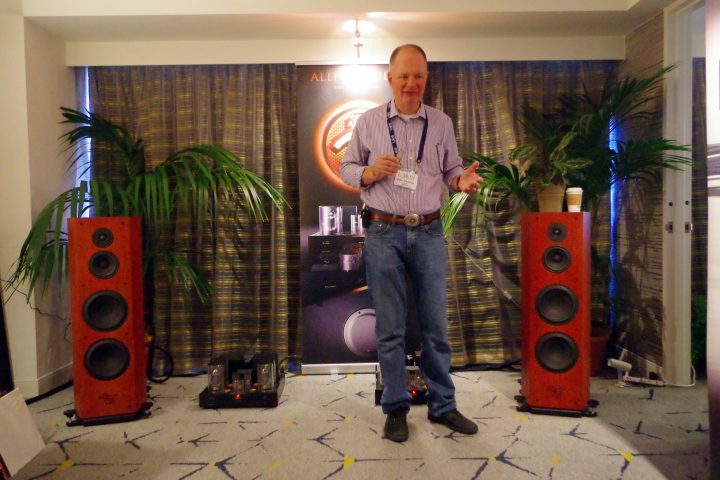
A Dane using Danish drivers. What are the odds?

Speaking of drivers, I always find rooms like that of Madisound Speaker Components fascinating because I’m interested in what it takes to create great audio.  Drivers lodged in boxes all pretty much look the same, but lying on a table, huge differences soon become apparent in motor structure and basket construction.  That doesn’t tell the whole story, but it goes a long way.  Madisound sells some of the best drivers on the market. Shown is Gary Gill assessing them.

So many choices….

When the Vapor Audio Nimbus speakers were introduced several years ago, they listed at about $7500.  That must have been the introductory price, because now they sell for $23,000.  That’s still low for the sound they produce, which is nothing short of outstanding.  They also have a fascinating visual presence — talk about a complicated cabinet.  Over and over again, I heard regrets from attendees who wish they’d bought them the first time they heard them.  These speakers use some of the very best and most expensive drivers a manufacturer can buy.  Ryan Scott, the principal of the company, told me that he’s continually back-ordered.

Not the usual 6-sided box.

For some folks, audio is a business.  For others, it’s a passion. How do you distinguish? One way is to wander the empty halls and listen for music long after the show has officially closed.We found Zu Audio CEO Sean Casey spinning discs and serving beverages and pizza well into the night. His smaller speakers are very easy to drive, dynamic, and one of the best recommendations for budding audiophiles on a budget…and they are created by a true enthusiast.
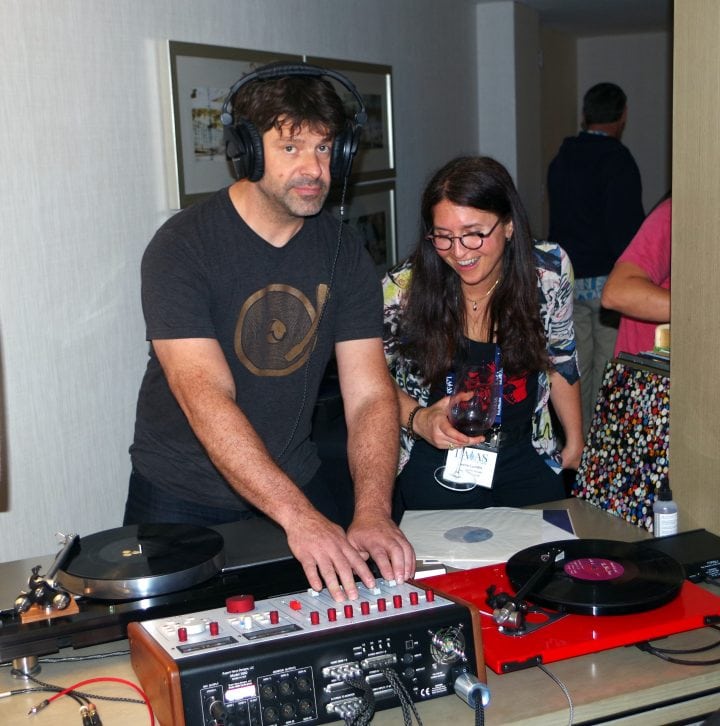
Now this looks more like it!

Finally,it’s tough to beat the sound of a symphony orchestra. …….or the thrill of a big band.  The BBB band, which played the first evening, was mesmerizing — far too tight for a group of amateurs who get together occasionally to play for kicks.  I found out later that these were all studio musicians, many of them employed in the entertainment industry, who get together occasionally to play for kicks.  What a treat!  Drummer Bernie Dresel, the leader of the band, was just outstanding.

Try finding an audio system that can properly reproduce this!

The first LA Audio Show was a noble effort, and it’ll be interesting to see how things settle out in the California audio show world, where there are presently three contenders.

More from Issue 35

View All Articles in Issue 35

Search Copper Magazine

#226 JJ Murphy’s Sleep Paralysis is a Genre-Bending Musical Journey Through Jazz, Fusion and More by Frank Doris Jan 05, 2026 #226 Stewardship by Consent by B. Jan Montana Jan 05, 2026 #226 Food, Music, and Sensory Experience: An Interview With Professor Jonathan Zearfoss of the Culinary Institute of America by Joe Caplan Jan 05, 2026 #226 Studio Confidential: A Who’s Who of Recording Engineers Tell Their Stories by Frank Doris Jan 05, 2026 #226 Pilot Radio is Reborn, 50 Years Later: Talking With CEO Barak Epstein by Frank Doris Jan 05, 2026 #226 The Vinyl Beat Goes Down to Tijuana (By Way of Los Angeles), Part One by Rudy Radelic Jan 05, 2026 #226 Capital Audiofest 2025: Must-See Stereo, Part Two by Frank Doris Jan 05, 2026 #226 My Morning Jacket’s Carl Broemel and Tyler Ramsey Collaborate on Their Acoustic Guitar Album, Celestun by Ray Chelstowski Jan 05, 2026 #226 The People Who Make Audio Happen: CanJam SoCal 2025, Part Two by Harris Fogel Jan 05, 2026 #226 How to Play in a Rock Band, 19: Touring Can Make You Crazy, Part One by Frank Doris Jan 05, 2026 #226 Linda Ronstadt Goes Bigger by Wayne Robins Jan 05, 2026 #226 From The Audiophile’s Guide: Active Room Correction and Digital Signal Processing by Paul McGowan Jan 05, 2026 #226 PS Audio in the News by Frank Doris Jan 05, 2026 #226 Back to My Reel-to-Reel Roots, Part 25: Half-Full, Not Empty by Ken Kessler Jan 05, 2026 #226 Happy New Year! by Frank Doris Jan 05, 2026 #226 Turn It Down! by Peter Xeni Jan 05, 2026 #226 Ghost Riders by James Schrimpf Jan 05, 2026 #226 A Factory Tour of Audio Manufacturer German Physiks by Markus "Marsu" Manthey Jan 04, 2026 #225 Capital Audiofest 2025: Must-See Stereo, Part One by Frank Doris Dec 01, 2025 #225 Otis Taylor and the Electrics Delivers a Powerful Set of Hypnotic Modern Blues by Frank Doris Dec 01, 2025 #225 A Christmas Miracle by B. Jan Montana Dec 01, 2025 #225 T.H.E. Show New York 2025, Part Two: Plenty to See, Hear, and Enjoy by Frank Doris Dec 01, 2025 #225 Underappreciated Artists, Part One: Martin Briley by Rich Isaacs Dec 01, 2025 #225 Rock and Roll is Here to Stay by Wayne Robins Dec 01, 2025 #225 A Lifetime of Holiday Record (and CD) Listening by Rudy Radelic Dec 01, 2025 #225 Little Feat: Not Saying Goodbye, Not Yet by Ray Chelstowski Dec 01, 2025 #225 How to Play in a Rock Band, Part 18: Dealing With Burnout by Frank Doris Dec 01, 2025 #225 The People Who Make Audio Happen: CanJam SoCal 2025 by Harris Fogel Dec 01, 2025 #225 Chicago’s Sonic Sanctuaries: Four Hi‑Fi Listening Bars Channeling the Jazz‑Kissa Spirit by Olivier Meunier-Plante Dec 01, 2025 #225 From The Audiophile’s Guide: Controlling Bass Frequencies Through Membrane Absorbers (and How to Build Your Own) by Paul McGowan Dec 01, 2025 #225 Your Editor’s Tips for Attending Audio Shows by Frank Doris Dec 01, 2025 #225 PS Audio in the News by Frank Doris Dec 01, 2025 #225 Back to My Reel-to-Reel Roots, Part 24 by Ken Kessler Dec 01, 2025 #225 Holiday Music by Frank Doris Dec 01, 2025 #225 Puppy Prognostication by Peter Xeni Dec 01, 2025 #225 How to Post Comments on Copper by Frank Doris Dec 01, 2025 #225 Living Color by Rudy Radelic Dec 01, 2025 #224 T.H.E. Show New York 2025, Part One: A New Beginning by Frank Doris Nov 03, 2025 #224 Fool’s Leap of Faith is the Extraordinary Octave Records Debut from Singer/Songwriter Tyler Burba and Visit by Frank Doris Nov 03, 2025 #224 The Beatles’ “Aeolian Cadences.” What? by Wayne Robins Nov 03, 2025 #224 Persona Non Grata by B. Jan Montana Nov 03, 2025 #224 Talking With Recording Engineer Barry Diament of Soundkeeper Recordings, Part Two by Frank Doris Nov 03, 2025 #224 B Sides, B Movies, and Beware of Zombies by Rudy Radelic Nov 03, 2025 #224 The Burn-In Chronicles: 1,000 Hours to Sonic Salvation by Olivier Meunier-Plante Nov 03, 2025 #224 A Conversation With Mat Weisfeld of VPI Industries by Joe Caplan Nov 03, 2025 #224 Blues-Rocker Kenny Wayne Shepherd Celebrates 30 Years of Ledbetter Heights by Ray Chelstowski Nov 03, 2025 #224 Playing in a Rock Band, 17: When Good Gigs Go Bad, Part Two by Frank Doris Nov 03, 2025

Montana Goes to the LA Audio Show

Montana Goes to the LA Audio Show

The LAX Sheraton (shown above with my good friend Jim Lindstrom, whose enthusiasm for audio knows no bounds) was a good choice as venue for the LA Audio Show (LAAS, held June 2-4).  It was also chosen by Stereophile magazine to host an audio show around 2006, and at the time, exhibitors commented that the rooms in this hotel  offered better acoustics than those at most audio show venues.  It has lots of wide open spaces and lots of windows, so one doesn’t get the claustrophobic feeling that characterized some hotels in Las Vegas.  The restaurants seemed to offer something for everyone, even with a limited menu. I missed the variety offered by the food trucks at last year’s THE Show in Irvine, but not the lengthy lines that accompanied them.

Also important for attendees is the number of hotels adjacent to the Sheraton, which made it possible to walk to and from the LAAS.  In Irvine, most of the hotels were too far away for that. The Sheraton is located in a safe, pleasant area of town conducive to strolls in the area. I expected airplane noise to be an issue in the exhibitors rooms, but that turned out to be an unwarranted concern.

“The Magic Bus” by Jon Whitledge has been a standard feature of THE Show-Newport, and was parked outside the Sheraton for LAAS.  This iteration of the Bus featured gear from Sony, and was the ultimate van system for the neighbor from hell (or his kid).  It was loud, louder and too loud.  The entire van was dedicated to the audio system, which makes it useless for serious dating — the priority of my generation when I was the neighbor’s kid from hell.  I’m sure the sound was as good as possible in any vehicle with tin sides, but I couldn’t get past the acoustics.

No room for make-out sessions here.

The airy, light-filled lobby was a pleasant place to be.

The venue for the seminars was comfortable, spacious and airy—probably not a concern until one attends a seminar.  This subject of this seminar was music streaming, which seems to have a far brighter future than the resurgence of album sales — if the numbers presented here are to be believed.

Isn’t that Bob Stuart in the audience?

Bob Levi is a mover and a shaker.  He was one of the founding fathers of the CNN network, produced the Emmy Awards 8 times, and was involved in THE Show’s move from Las Vegas to LA. Bob  is President of the LA/Orange County Audio Society (LAOCAS) and is one of the driving forces behind the first LA Audio Show (LAAS), along with the overworked Executive Director, Marine Presson.

Beauty and the Bob.

The Headphone Emporium was always a busy place, with a terrific variety of products to suit every headphone enthusiast. After four or five auditions of unfamiliar music, my ears wore out and I headed back to the LAOCAS hospitality room — to join a bunch of other worn-out ears over a Scotch.

No shortage of choices here.

Once in the exhibit rooms, speakers show a lot more variety than electronics—most of which are just metal boxes, after all.  Audiophiles would be a lot happier if all recording studios were required to use equipment as clean and neutral as that from Sanders Sound Systems. These electrostats are very directional, requiring listeners to sit one behind each other in a single column.  The designer of these speakers, Roger Sanders, claims that the more omni-directional speakers are, the more they lose resolution.  Having heard them many times, I agree.  The listening experience with these speakers is as intimate as headphones, but without the inside-the-head location of the musicians.  A great bargain for about $15,000, including the amp.

Transparent sound. Literally.

Speaking of studio monitors, these JBL model 4367 home speakers are the passive-crossover, home versions of one of their professional studio monitors.  If you feel that an important feature distinguishing live from reproduced music is dynamics, you’d agree that these speakers sound as close to live as possible.  Of course, like all speakers, that involves trade-offs, but it’s hard to beat the resources of a long established company with a full engineering team that does its own, original acoustic research. Very impressive sound for $15,000.

You can always recognize a JBL semi-pro speaker, can’t you?

Revel is another Harman company, like JBL; the Revel Salon, at about $20,000, may be the most refined audiophile speaker on the market.  It helps to drive them with the power and finesse of gear from Mark Levinson—yet another Harman company.  This room was one of the best attended at the show.

Note the ML turntable, that company’s first ever—designed in partnership with VPI.

Nola speakers have garnered many favorable reviews over the years, but this latest speaker system, at $23,000, is the best product I’ve heard from the venerable founder, Carl Marchisotto (left).  They were very dynamic and clean, perhaps due to the use of fewer drivers (though they lacked the bottom octave).  Or perhaps it was the contribution made by Josh from Deja Vu Audio in La Jolla, CA — the ancient Western Electric amplifiers.  We’ve come a long way baby (maybe)?

NOLA plus WE? Huh.

Speaker engineer Kevin Malmgren of Evolution Acoustics showed his latest creation.  The drivers took six years to design and feature a one inch excursion. These speakers produced a huge sound which belied their size, and the cabinetry is exquisite.  Price to be determined.

Kevin looks a little Godzilla-ish next to those speakers, no?

Designer Andrew Jones’ demos of new models are always a show highlight, and his new $5000 giant killers from ELAC  rival many much more expensive speakers at the show.  I know it’s a cliche, but everyone seemed to agree that these could easily be our desert island speakers for eternity.  I have no idea how Andrew does it, time after time.

What, no Andrew Jones??

Designer Peter Noerbaek of PBN Audio showed another $5000 pair of speakers, which feature all Danish Scan Speak drivers — no cheap Asian knock-offs here. These paper drivers with soft dome tweeters make some of the most non-fatiguing sounds on the planet, but not at the cost of resolution.  They could also be part of my desert island system, but I think they would match better with one of Peter’s own solid state amplifiers than the excellent tube amps shown here.  Bet he’d make a package deal! PBN also showed some of the most attractive turntables I’ve seen, based upon vintage Denon motor units.

A Dane using Danish drivers. What are the odds?

Speaking of drivers, I always find rooms like that of Madisound Speaker Components fascinating because I’m interested in what it takes to create great audio.  Drivers lodged in boxes all pretty much look the same, but lying on a table, huge differences soon become apparent in motor structure and basket construction.  That doesn’t tell the whole story, but it goes a long way.  Madisound sells some of the best drivers on the market. Shown is Gary Gill assessing them.

So many choices….

When the Vapor Audio Nimbus speakers were introduced several years ago, they listed at about $7500.  That must have been the introductory price, because now they sell for $23,000.  That’s still low for the sound they produce, which is nothing short of outstanding.  They also have a fascinating visual presence — talk about a complicated cabinet.  Over and over again, I heard regrets from attendees who wish they’d bought them the first time they heard them.  These speakers use some of the very best and most expensive drivers a manufacturer can buy.  Ryan Scott, the principal of the company, told me that he’s continually back-ordered.

Not the usual 6-sided box.

For some folks, audio is a business.  For others, it’s a passion. How do you distinguish? One way is to wander the empty halls and listen for music long after the show has officially closed.We found Zu Audio CEO Sean Casey spinning discs and serving beverages and pizza well into the night. His smaller speakers are very easy to drive, dynamic, and one of the best recommendations for budding audiophiles on a budget…and they are created by a true enthusiast.

Now this looks more like it!

Finally,it’s tough to beat the sound of a symphony orchestra. …….or the thrill of a big band.  The BBB band, which played the first evening, was mesmerizing — far too tight for a group of amateurs who get together occasionally to play for kicks.  I found out later that these were all studio musicians, many of them employed in the entertainment industry, who get together occasionally to play for kicks.  What a treat!  Drummer Bernie Dresel, the leader of the band, was just outstanding.

Try finding an audio system that can properly reproduce this!

The first LA Audio Show was a noble effort, and it’ll be interesting to see how things settle out in the California audio show world, where there are presently three contenders.

0 comments

Leave a comment

0 Comments

Your avatar

Loading comments...

🗑️ Delete Comment

Enter moderator password to delete this comment: