COPPER

A PS Audio Publication

Issue 146 • Free Online Magazine

Issue 146 FROM THE SWEET SPOT

Global Groovin’ with Analog Africa

Global Groovin’ with Analog Africa

“Greetings, funky friends.”

So began a recent email announcing the latest release from one of my favorite music labels, Analog Africa. Launched in 2007, AA has so far produced 44 ear-opening reissues and compilations of rare and little-known music from the 1960s, 1970s, and 1980s. As the name suggests, the label’s catalog is mostly focused on Africa, but there are also several titles from South America.

Analog Africa is based in Frankfurt, Germany, home of the label’s founder and owner, Samy Ben Redjeb (SBR). Originally from Tunisia, SBR developed his ear for funky dance music while DJing in Dakar, Senegal. As his collection of African music grew, he found that the rawer styles he preferred weren’t always so popular with the disco crowd. Later, during a stint as a flight attendant for Lufthansa, he made about a thousand trips to various African cities, using his free time during layovers to hunt for records.

Some Western listeners have been introduced to African music from countries like Mali and Nigeria through international superstars like Salif Keita and Fela Kuti. But many other nations have deep music scenes that are still relatively unknown. AA has focused on the music of those countries, including Benin, Togo, Ghana, Cameroon, and Burkina Faso, among others.

SBR personally chooses every cut on every Analog Africa compilation. When assembling a compilation he may listen to 1,000 tracks or more in order to end up with 14 or so keepers. He gradually whittles down the number of tracks to a few dozen candidates, then listens to them again and again over the course of months, gradually discarding the ones he tires of. Once he decides on the final track selection, sequencing them for optimal flow can take several more months.
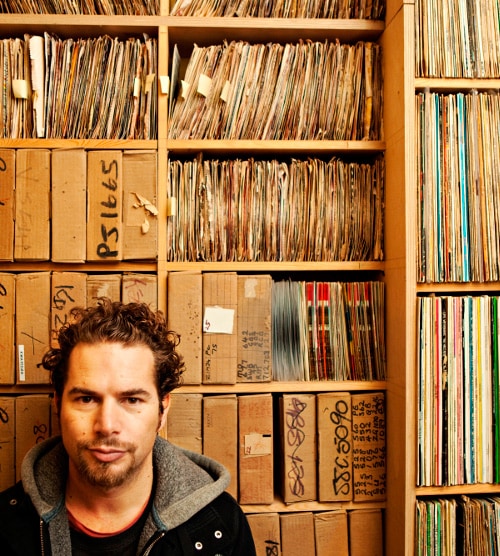
Samy Ben Redjeb.


Besides going to great lengths to gather the choicest cuts, and ensuring that these less-than-pristine sources sound their best, AA consistently provides deluxe packaging, including liner notes that may run to 40 pages or more. These booklets don’t include song lyrics, which nearly always aren’t in English. Nor will you find technical specs on the recording process or equipment used. What you will find are Samy Ben Redjeb’s personal stories of how each recording came to be, fleshed out with interviews with musicians and producers, plus loads of great photos.

With a name like Analog Africa, you’d expect the label to be vinyl-focused, but that’s not necessarily the case. The recordings are virtually all-analog, but the music is digitized prior to re-mastering. Each release is initially available as an LP, CD, or digital download (check out AA’s Bandcamp page). Some LP titles are pressed on audiophile-approved 180-gram vinyl, while others get more typical 140-gram vinyl.

Samy Ben Redjeb himself has said that the CD and vinyl versions usually sound very close, and that he sometimes prefers the CDs for their more detailed sound. I’ve only purchased CD versions so far, and played through my current DAC – the Benchmark DAC3 HGC – they sound clean, clear, and dynamic. If you’re on the fence, one reason to consider vinyl is that the format provides a bigger canvas for Analog Africa’s cool, colorful artwork.

I’d been hosting a world music radio show for a few years before I discovered Analog Africa, and when I did, it was a real revelation. I’d simply had no idea that this type of music was being made during this time period, in these places. I return to AA’s compilations often, both for radio play and for listening at home. Although it’s been decades since these tracks were originally laid down, they always sound fresh, funky, and fun!

Every Analog Africa compilation is packed with groovy tunes, but if you’re wondering where to start, I’d suggest Afro-Beat Airways. You might associate Afrobeat with the pioneer of the genre, the late Fela Kuti, but much of Afro-Beat Airways doesn’t feature his slow-burn style. The selection here, by the Togolese band Orchestre Abass, sounds like it owes as much to Bo Diddley as to Fela. What stands out to me is the raw energy that infuses this and every other cut on this compilation.

Awula Bo Fee Ene (Orchestre Abass):


AA is mainly known for its collections that feature several bands representing certain musical styles. But their catalog also includes titles showcasing a single artist or band. For Orchestre Poly-Rythmo de Cotonou, a band hailing from Cotonou, Benin, Analog Africa actually released three CDs culled from dusty cartons of vinyl and master tapes that SBR found in a warehouse. Echos Hypnotiques is volume two of the three, and probably my favorite for its consistency. This is one of the greatest African bands ever!

Mi Ve Wa Se:


Burkina Faso is a landlocked country in West Africa with a diverse music scene that draws influences from neighboring countries like Mali, Ivory Coast, and Ghana. The jangly guitar and upbeat pop energy of “Rog Mik Africa” make it a bit of an outlier in AA’s Bambara Mystic Soul compilation.

Rog Mik Africa (Orchestre CVD):


Amara Toure first made his name as the lead singer and percussionist for Le Star Band de Dakar, who helped popularize Afro-Cuban music in Senegal in the late 1950s and early 1960s. After 10 years with the Star Band, he cut records with two other Afro-Cuban groups: L’Ensemble Black & White in Cameroon, and L’Orchestre Massako in Gabon. The AA release Amara Toure collects music from his Cameroon and Gabon periods.  These atmospheric songs make for great late night listening.

Lamento Cubano (with L’Ensemble Black & White):

Here’s a link to a Spotify playlist featuring music from Analog Africa:


Header image of Samy Ben Redjeb from the Analog Africa website.

More from Issue 146

View All Articles in Issue 146

Search Copper Magazine

#225 Capital Audiofest 2025: Must-See Stereo, Part One by Frank Doris Dec 01, 2025 #225 Otis Taylor and the Electrics Delivers a Powerful Set of Hypnotic Modern Blues by Frank Doris Dec 01, 2025 #225 A Christmas Miracle by B. Jan Montana Dec 01, 2025 #225 T.H.E. Show New York 2025, Part Two: Plenty to See, Hear, and Enjoy by Frank Doris Dec 01, 2025 #225 Underappreciated Artists, Part One: Martin Briley by Rich Isaacs Dec 01, 2025 #225 Rock and Roll is Here to Stay by Wayne Robins Dec 01, 2025 #225 A Lifetime of Holiday Record (and CD) Listening by Rudy Radelic Dec 01, 2025 #225 Little Feat: Not Saying Goodbye, Not Yet by Ray Chelstowski Dec 01, 2025 #225 How to Play in a Rock Band, Part 18: Dealing With Burnout by Frank Doris Dec 01, 2025 #225 The People Who Make Audio Happen: CanJam SoCal 2025 by Harris Fogel Dec 01, 2025 #225 Chicago’s Sonic Sanctuaries: Four Hi‑Fi Listening Bars Channeling the Jazz‑Kissa Spirit by Olivier Meunier-Plante Dec 01, 2025 #225 From The Audiophile’s Guide: Controlling Bass Frequencies Through Membrane Absorbers (and How to Build Your Own) by Paul McGowan Dec 01, 2025 #225 Your Editor’s Tips for Attending Audio Shows by Frank Doris Dec 01, 2025 #225 PS Audio in the News by Frank Doris Dec 01, 2025 #225 Back to My Reel-to-Reel Roots, Part 24 by Ken Kessler Dec 01, 2025 #225 Holiday Music by Frank Doris Dec 01, 2025 #225 Puppy Prognostication by Peter Xeni Dec 01, 2025 #225 How to Post Comments on Copper by Frank Doris Dec 01, 2025 #225 Living Color by Rudy Radelic Dec 01, 2025 #224 T.H.E. Show New York 2025, Part One: A New Beginning by Frank Doris Nov 03, 2025 #224 Fool’s Leap of Faith is the Extraordinary Octave Records Debut from Singer/Songwriter Tyler Burba and Visit by Frank Doris Nov 03, 2025 #224 The Beatles’ “Aeolian Cadences.” What? by Wayne Robins Nov 03, 2025 #224 Persona Non Grata by B. Jan Montana Nov 03, 2025 #224 Talking With Recording Engineer Barry Diament of Soundkeeper Recordings, Part Two by Frank Doris Nov 03, 2025 #224 B Sides, B Movies, and Beware of Zombies by Rudy Radelic Nov 03, 2025 #224 The Burn-In Chronicles: 1,000 Hours to Sonic Salvation by Olivier Meunier-Plante Nov 03, 2025 #224 A Conversation With Mat Weisfeld of VPI Industries by Joe Caplan Nov 03, 2025 #224 Blues-Rocker Kenny Wayne Shepherd Celebrates 30 Years of Ledbetter Heights by Ray Chelstowski Nov 03, 2025 #224 Playing in a Rock Band, 17: When Good Gigs Go Bad, Part Two by Frank Doris Nov 03, 2025 #224 From The Audiophile’s Guide: Dealing with Odd-Shaped Rooms by Paul McGowan Nov 03, 2025 #224 TEAC’s TN-3B-SE Turntable Plays Bob Dylan by Howard Kneller Nov 03, 2025 #224 PS Audio in the News by Frank Doris Nov 03, 2025 #224 Lost in Translation by Peter Xeni Nov 03, 2025 #224 Reel-to-Reel Roots, Part 23: Better Than Rice Krispies by Ken Kessler Nov 03, 2025 #224 I Bring Joy! by Frank Doris Nov 03, 2025 #224 Screen Test by Rich Isaacs Nov 03, 2025 #224 How to Post Comments on Copper by Frank Doris Nov 03, 2025 #132 Dr. Patrick Gleeson: The Interview, Part Two by Rich Isaacs Oct 07, 2025 #223 World Fusion Meets Flamenco in Gratitude from Steve Mullins and Rim of the Well by Frank Doris Oct 06, 2025 #223 Judging Albums by Their Covers by Rich Isaacs Oct 06, 2025 #223 Recent Arrivals and 12-inch Royalty by Rudy Radelic Oct 06, 2025 #223 Summer of Creem, Part Two by Wayne Robins Oct 06, 2025 #223 Recording Engineer Barry Diament of Soundkeeper Recordings: Striving for Natural Sound by Frank Doris Oct 06, 2025 #223 Tea on the Terrace by B. Jan Montana Oct 06, 2025 #223 How Good Can Car Audio Get? by Joe Caplan Oct 06, 2025 #223 The Advantages of a Dedicated Listening Room by Paul McGowan Oct 06, 2025 #223 1! 2! 3! 4! Surrounded by the Ramones in Dolby Atmos! by Frank Doris Oct 06, 2025

Global Groovin’ with Analog Africa

Global Groovin’ with Analog Africa

“Greetings, funky friends.”

So began a recent email announcing the latest release from one of my favorite music labels, Analog Africa. Launched in 2007, AA has so far produced 44 ear-opening reissues and compilations of rare and little-known music from the 1960s, 1970s, and 1980s. As the name suggests, the label’s catalog is mostly focused on Africa, but there are also several titles from South America.

Analog Africa is based in Frankfurt, Germany, home of the label’s founder and owner, Samy Ben Redjeb (SBR). Originally from Tunisia, SBR developed his ear for funky dance music while DJing in Dakar, Senegal. As his collection of African music grew, he found that the rawer styles he preferred weren’t always so popular with the disco crowd. Later, during a stint as a flight attendant for Lufthansa, he made about a thousand trips to various African cities, using his free time during layovers to hunt for records.

Some Western listeners have been introduced to African music from countries like Mali and Nigeria through international superstars like Salif Keita and Fela Kuti. But many other nations have deep music scenes that are still relatively unknown. AA has focused on the music of those countries, including Benin, Togo, Ghana, Cameroon, and Burkina Faso, among others.

SBR personally chooses every cut on every Analog Africa compilation. When assembling a compilation he may listen to 1,000 tracks or more in order to end up with 14 or so keepers. He gradually whittles down the number of tracks to a few dozen candidates, then listens to them again and again over the course of months, gradually discarding the ones he tires of. Once he decides on the final track selection, sequencing them for optimal flow can take several more months.

Samy Ben Redjeb.


Besides going to great lengths to gather the choicest cuts, and ensuring that these less-than-pristine sources sound their best, AA consistently provides deluxe packaging, including liner notes that may run to 40 pages or more. These booklets don’t include song lyrics, which nearly always aren’t in English. Nor will you find technical specs on the recording process or equipment used. What you will find are Samy Ben Redjeb’s personal stories of how each recording came to be, fleshed out with interviews with musicians and producers, plus loads of great photos.

With a name like Analog Africa, you’d expect the label to be vinyl-focused, but that’s not necessarily the case. The recordings are virtually all-analog, but the music is digitized prior to re-mastering. Each release is initially available as an LP, CD, or digital download (check out AA’s Bandcamp page). Some LP titles are pressed on audiophile-approved 180-gram vinyl, while others get more typical 140-gram vinyl.

Samy Ben Redjeb himself has said that the CD and vinyl versions usually sound very close, and that he sometimes prefers the CDs for their more detailed sound. I’ve only purchased CD versions so far, and played through my current DAC – the Benchmark DAC3 HGC – they sound clean, clear, and dynamic. If you’re on the fence, one reason to consider vinyl is that the format provides a bigger canvas for Analog Africa’s cool, colorful artwork.

I’d been hosting a world music radio show for a few years before I discovered Analog Africa, and when I did, it was a real revelation. I’d simply had no idea that this type of music was being made during this time period, in these places. I return to AA’s compilations often, both for radio play and for listening at home. Although it’s been decades since these tracks were originally laid down, they always sound fresh, funky, and fun!

Every Analog Africa compilation is packed with groovy tunes, but if you’re wondering where to start, I’d suggest Afro-Beat Airways. You might associate Afrobeat with the pioneer of the genre, the late Fela Kuti, but much of Afro-Beat Airways doesn’t feature his slow-burn style. The selection here, by the Togolese band Orchestre Abass, sounds like it owes as much to Bo Diddley as to Fela. What stands out to me is the raw energy that infuses this and every other cut on this compilation.

Awula Bo Fee Ene (Orchestre Abass):


AA is mainly known for its collections that feature several bands representing certain musical styles. But their catalog also includes titles showcasing a single artist or band. For Orchestre Poly-Rythmo de Cotonou, a band hailing from Cotonou, Benin, Analog Africa actually released three CDs culled from dusty cartons of vinyl and master tapes that SBR found in a warehouse. Echos Hypnotiques is volume two of the three, and probably my favorite for its consistency. This is one of the greatest African bands ever!

Mi Ve Wa Se:


Burkina Faso is a landlocked country in West Africa with a diverse music scene that draws influences from neighboring countries like Mali, Ivory Coast, and Ghana. The jangly guitar and upbeat pop energy of “Rog Mik Africa” make it a bit of an outlier in AA’s Bambara Mystic Soul compilation.

Rog Mik Africa (Orchestre CVD):


Amara Toure first made his name as the lead singer and percussionist for Le Star Band de Dakar, who helped popularize Afro-Cuban music in Senegal in the late 1950s and early 1960s. After 10 years with the Star Band, he cut records with two other Afro-Cuban groups: L’Ensemble Black & White in Cameroon, and L’Orchestre Massako in Gabon. The AA release Amara Toure collects music from his Cameroon and Gabon periods.  These atmospheric songs make for great late night listening.

Lamento Cubano (with L’Ensemble Black & White):

Here’s a link to a Spotify playlist featuring music from Analog Africa:


Header image of Samy Ben Redjeb from the Analog Africa website.

0 comments

Leave a comment

0 Comments

Your avatar

Loading comments...

🗑️ Delete Comment

Enter moderator password to delete this comment: