COPPER

A PS Audio Publication

Issue 147 • Free Online Magazine

Issue 147 SPEAKER STORIES

Choosing New Speakers: What Information Is Helpful? Part One

Choosing New Speakers: What Information Is Helpful? Part One

Impedance. Signal to noise ratio. Driver size. Flatness of frequency response (or deviation from it). Sensitivity rating in dB. Cabinet size. Off-axis response. Power-handling capability. There are many considerations in speaker design and performance. Understanding more about all of these factors can assist us in making the best decisions regarding what speakers to buy when parting with our cash. And let’s not forget that minor little chestnut of an idea: ultimately, how good does it sound?

In this series, we’ll consider some of these factors and how they relate to real-world speaker evaluation. Seasoned audiophiles may be familiar with some or all of what we’ll be talking about, while other readers may find this information novel and enlightening.

Sound pressure level, or SPL, is literally the pressure level of a sound, which corresponds to volume, and is expressed in decibels, or dB. However, a more useful speaker specification is sensitivity, an indicator of how loudly a speaker will play at a given input of power. It’s expressed in dB and the higher the number, the louder a speaker will be when fed the same amount of power.

Typically, sensitivity is measured by driving one watt of power into an 8-ohm speaker at 2.83 volts, with the dB level measured from a distance of one meter. However, the rating by itself is only a rough indicator. Speakers are rated with an impedance spec, familiar to most of us, which is an indicator of how difficult the speaker is to drive. However, speakers don’t have the same impedance at every frequency – their stated specs are for a nominal impedance, but this can go higher or lower depending on the frequency the speaker has to reproduce.

That said, the industry standard of one watt into 8 ohms at 2.83 volts is a beneficial constant because it enables us to compare graphs of how the impedance of different speakers vary with frequency, and how their frequency response can be related. Because the impedance curves of various speakers can be so different, sometimes even within a given pair of drivers of the same model from the same manufacturer, having the consistent industry-standard “control” parameter of measuring sensitivity, gives you a baseline, and the ability to compare different speakers’ impedance and frequency response curves.

Also, some power amplifiers can handle lower impedances better than others. If an 8-ohm-nominal speaker dips to 4 ohms or lower impedance at some frequencies, your power amp or receiver may or may not be able to handle it (because it’s trying to deliver more current than it’s designed for), especially at higher volumes. Check your component’s power output specs to make sure.

That brings us to another consideration: an amplifier or receiver’s given power rating may not be particularly enlightening. The way manufacturers state their power ratings may not be consistent. You’ll see ratings like RMS power, peak (or instantaneous) power, average continuous power and others, and typically, the measurements will be taken when feeding the amp, a 1 kHz test signal, not music (with its full frequency range). However, none of these may equate to the optimal listening output you will enjoy at that power. It may not even fully reveal the actual headroom in power that the speaker system as a whole will be good for.

Historically, some manufacturers will provide the peak power rating of the speaker as its nominal power-handling rating, but won’t tell you that this is in fact just for a peak at one or a few frequencies. So, you have no clue as to the speaker’s real-world power-handling capability, or the range of volume levels and frequencies where the speaker performs at its best. I have personally experienced this with car power amp ratings being significantly exaggerated, both at peak music power output ratings and with RMS ratings. In other words, if you were provided with a wider set of information about the breadth of the bandwidth that a speaker operates at comfortably in terms of its impedance at different frequencies, and its true peak power handling capability, you’ll get a clearer idea of how well the speaker will reproduce the dynamics and pulses of your music. Many speaker manufacturers will provide an impedance-vs-frequency curve, and be forthright about their speakers’ power handling.
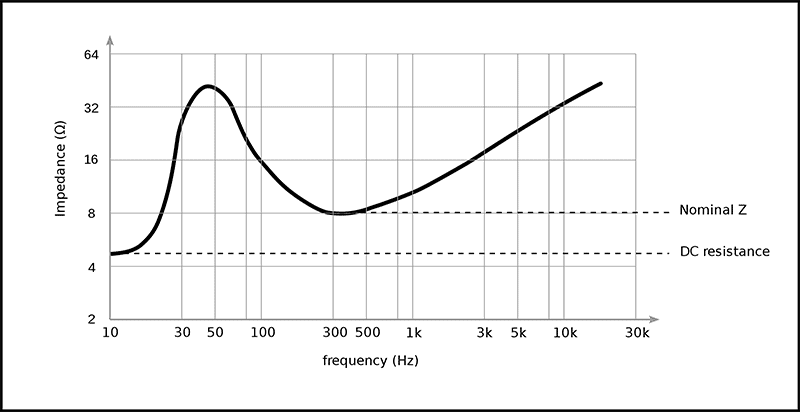
Graph showing impedance vs. frequency. Courtesy of Wikimedia Commons/Spinning Spark.

Graph showing impedance vs. frequency. Courtesy of Wikimedia Commons/Spinning Spark.


Power ratings will obviously also vary according to the physical size of the speaker driver. If you are running a ten-inch driver it will require a different amount of power for its range of excursion. Generally speaking, more power will be required to move its greater physical mass back and forth compared to a 5.25-inch driver. Also, a smaller speaker will require more power to be as perceivably loud as a larger one. As the driver’s power requirements are different, so too, the maximum ability of the mechanical pistonic action of the driver will have a great influence on its maximum power handling and its peak output.

Other factors to consider are the speaker’s size, and your listening distance. Measuring a large speaker’s output at 1 meter will not give as meaningful a specification as measuring a smaller speaker at the same distance. That’s because I’ll bet you never listen to larger speakers that close up – but you might very well listen to smaller speakers at a distance of 1 meter, or closer. And of course, the farther away you are from your speakers, the louder they’ll have to play to deliver the same perceived volume as if you were closer. Some companies will take a measurement of a larger speaker at a greater distance than one meter, and then re-calculate what the sensitivity would be at one meter at 2.83 volts for the standardized and expected specification listing.

For those of us who own receivers with built-in room correction, we often just settle for having its processor accommodate for our set up of each speaker’s distance (and possibly frequency response) from our listening chair, and don’t have to think about any of this. But, wouldn’t it be nice to know as much as possible about how a speaker performs when looking at what to buy?

Some speaker manufacturers provide a range of optimum listening distances for a particular model, and this is very insightful piece of information, particularly for those with either significantly more or less cubic volume of listening space than average. Forgive me for sounding like Captain Obvious here, but when considering your potential speaker purchase, you likely have in mind the room that you will install them in, but the manufacturer, especially for something like a portable low-cost Bluetooth speaker, may have had considerations other than room size in mind. I wonder how many of even the most hard-core audiophiles have consulted the speaker manufacturers’ information on optimal room size compatibility, even when having a bespoke music room built. Although, to be fair, some manufacturers do offer appropriate product selection tools, such as REL’s recommended subwoofer selector, which allows you to enter a speaker model and room size and then comes up with a recommended subwoofer model.

How loudly do you want to listen to your speakers? You may find that typical listening volumes of 75 to 85 dB will suit you perfectly for most occasions, with occasional forays to 88 dB, for example. So, when you audition different speakers, it may be a good idea to measure them at the volume (and distance) you will actually be listening to them for the majority of the time, while using a dB meter or even a spectrum analyzer app.

One example is a very basic but effective Google Play app called Sound Meter. It provides a dB meter readout, and a list of familiar sounds and their typical dB levels, from quiet rustling leaves at 20 dB to a normal conversation at 3 feet (60 dB) right up to rock music or a screaming child at 100dB, and beyond (a Saturn V rocket launch registered 204 dB!). The app gives you some basic bearings to steer by as you measure your room at your seating position. It provides a graph mode and also a simple but functional dial display. Although it’s not the most accurate tool in the world, it will probably suffice for the testing purposes described above. In my own experience I have found it quite consistent. There are many other Android and iPhone apps available.

The Sound Meter Level app from SOFDX.

The Sound Level Meter app from SOFDX.


This can also provide you with some consistency in your comparisons when auditioning speakers, as you of course also listen for the musicality of the stereo speakers you’re evaluating. You may surprise yourself at just how quietly you enjoy listening to a well-set-up system.

We will consider the effects of the listening room more in Part Two, as it relates to sensitivity ratings and power output.

Header image courtesy of Pixabay.com/Tomislav Jakupec.

More from Issue 147

View All Articles in Issue 147

Search Copper Magazine

#231 Piano Prodigy Jude Kofie Releases His Debut Album On Octave Records by Frank Doris Jun 01, 2026 #231 Underappreciated Artists, Part Two: City Boy by Rich Isaacs Jun 01, 2026 #231 Music and the Art of Creation: Talking With Saxophonist Rob Scheps by Joe Caplan Jun 01, 2026 #231 How to Play in a Rock Band, 24: Further Adventures at the 2026 Montauk Music Festival by Frank Doris Jun 01, 2026 #231 Courtney Barnett: Creature of Habit by Wayne Robins Jun 01, 2026 #231 Angine de Poitrine: Interstellar Guitar Rock Saviors Headed for Late-Night TV Pop Stardom? by Mark Lepage Jun 01, 2026 #231 My Impressions of AXPONA 2026, Part One by Frank Doris Jun 01, 2026 #231 2026 La Jolla Concours d'Elegance: Another Aesthetic Feast by B. Jan Montana Jun 01, 2026 #231 Country Music Icon Jo Dee Messina’s Bridges: A New Beginning by Ray Chelstowski Jun 01, 2026 #231 The Luxury Dispatch Hosts a Video Podcast With Ken Kessler by Ken Kessler Jun 01, 2026 #231 The Vinyl Beat: Tracking in the Motor City by Rudy Radelic Jun 01, 2026 #231 Lots of Fun With DSP: The Ferrum Audio WANDLA DAC and Its Tube Mode by Frank Doris Jun 01, 2026 #231 From The Audiophile's Guide: Digital Source Components and Streaming Audio by Paul McGowan Jun 01, 2026 #231 Onkyo’s Monster M-510 power amplifier by The Staff at Just Audio Jun 01, 2026 #231 PS Audio in the News by PS Audio Staff Jun 01, 2026 #231 Naming Convention by Peter Xeni Jun 01, 2026 #231 Les Invisibles by Frank Doris Jun 01, 2026 #231 Wildlife Scene by James Schrimpf Jun 01, 2026 #230 Camaraderie by B. Jan Montana May 04, 2026 #230 AXPONA 2026: A Family Gathering by Paul McGowan May 04, 2026 #230 Pianist Ryan Benthall Explores Jazz Realms and Far Beyond With Divine Sky by Frank Doris May 04, 2026 #230 The Vinyl Beat in AXPONA-Land by Rudy Radelic May 04, 2026 #230 Teddy Thompson’s Musical Growth Deepens With Never Be the Same by Ray Chelstowski May 04, 2026 #230 More Fun in the Sun: Florida Audio Expo, Part Two by Frank Doris May 04, 2026 #230 CanJam NYC 2026 Show Report: Heady Sound, Part Two by Frank Doris and Harris Fogel May 04, 2026 #230 Sonic Youth On Murray Street by Wayne Robins May 04, 2026 #230 Graffeo Coffee: A Symphony of Sensory Experience by Joe Caplan May 04, 2026 #230 The Saul Authority: The Story of Hi-Fi Pioneer Saul Marantz by Olivier Meunier-Plante May 04, 2026 #230 How to Play in a Rock Band, 23: Encounters With Famous Musicians, Part Two by Frank Doris May 04, 2026 #230 An Outlier in the Rack: A Vintage BIC Beam Box by The Staff at Just Audio May 04, 2026 #230 PS Audio in the News by PS Audio Staff May 04, 2026 #230 A Cautionary Tale by Rich Isaacs May 04, 2026 #230 Reel-to-Reel Roots, Part 33 (Revised): Ken Kessler Reports On the 2026 (British) AudioJumble by Ken Kessler May 04, 2026 #230 Text Messaging by Frank Doris May 04, 2026 #230 The Audiophile Rat Race by Peter Xeni May 04, 2026 #230 On the Rocks by Rich Isaacs May 04, 2026 #229 The Earliest Stars of Country Music, Part Three by Jeff Weiner Apr 06, 2026 #229 The Healing Power of Music and Sound at the Omega Institute by Joe Caplan Apr 06, 2026 #229 CanJam NYC 2026 Show Report: Heady Sound, Part One by Frank Doris Apr 06, 2026 #229 Florida Audio Expo 2026: Warming Up to High-End Audio, Part One by Frank Doris Apr 06, 2026 #229 Quick Takes: Anne Bisson, Sam Morrison, The Velvet Underground, and the Stooges by Frank Doris Apr 06, 2026 #229 The Vinyl Beat: New Arrivals, and Old Audio Show Demo Scores to Settle by Rudy Radelic Apr 06, 2026 #229 Harvard Gets a High-End Audio Education by Frank Doris Apr 06, 2026 #229 No Country for Old Knees by B. Jan Montana Apr 06, 2026 #229 How To Play in A Rock Band, 22: Encounters With Famous Musicians, Part 1 by Frank Doris Apr 06, 2026 #229 The Soulful Grooves of Guinea-Bissau by Steve Kindig Apr 06, 2026 #229 Four-Hand Piano Performance at Its Finest by Stephan Haberthür Apr 06, 2026

Choosing New Speakers: What Information Is Helpful? Part One

Choosing New Speakers: What Information Is Helpful? Part One

Impedance. Signal to noise ratio. Driver size. Flatness of frequency response (or deviation from it). Sensitivity rating in dB. Cabinet size. Off-axis response. Power-handling capability. There are many considerations in speaker design and performance. Understanding more about all of these factors can assist us in making the best decisions regarding what speakers to buy when parting with our cash. And let’s not forget that minor little chestnut of an idea: ultimately, how good does it sound?

In this series, we’ll consider some of these factors and how they relate to real-world speaker evaluation. Seasoned audiophiles may be familiar with some or all of what we’ll be talking about, while other readers may find this information novel and enlightening.

Sound pressure level, or SPL, is literally the pressure level of a sound, which corresponds to volume, and is expressed in decibels, or dB. However, a more useful speaker specification is sensitivity, an indicator of how loudly a speaker will play at a given input of power. It’s expressed in dB and the higher the number, the louder a speaker will be when fed the same amount of power.

Typically, sensitivity is measured by driving one watt of power into an 8-ohm speaker at 2.83 volts, with the dB level measured from a distance of one meter. However, the rating by itself is only a rough indicator. Speakers are rated with an impedance spec, familiar to most of us, which is an indicator of how difficult the speaker is to drive. However, speakers don’t have the same impedance at every frequency – their stated specs are for a nominal impedance, but this can go higher or lower depending on the frequency the speaker has to reproduce.

That said, the industry standard of one watt into 8 ohms at 2.83 volts is a beneficial constant because it enables us to compare graphs of how the impedance of different speakers vary with frequency, and how their frequency response can be related. Because the impedance curves of various speakers can be so different, sometimes even within a given pair of drivers of the same model from the same manufacturer, having the consistent industry-standard “control” parameter of measuring sensitivity, gives you a baseline, and the ability to compare different speakers’ impedance and frequency response curves.

Also, some power amplifiers can handle lower impedances better than others. If an 8-ohm-nominal speaker dips to 4 ohms or lower impedance at some frequencies, your power amp or receiver may or may not be able to handle it (because it’s trying to deliver more current than it’s designed for), especially at higher volumes. Check your component’s power output specs to make sure.

That brings us to another consideration: an amplifier or receiver’s given power rating may not be particularly enlightening. The way manufacturers state their power ratings may not be consistent. You’ll see ratings like RMS power, peak (or instantaneous) power, average continuous power and others, and typically, the measurements will be taken when feeding the amp, a 1 kHz test signal, not music (with its full frequency range). However, none of these may equate to the optimal listening output you will enjoy at that power. It may not even fully reveal the actual headroom in power that the speaker system as a whole will be good for.

Historically, some manufacturers will provide the peak power rating of the speaker as its nominal power-handling rating, but won’t tell you that this is in fact just for a peak at one or a few frequencies. So, you have no clue as to the speaker’s real-world power-handling capability, or the range of volume levels and frequencies where the speaker performs at its best. I have personally experienced this with car power amp ratings being significantly exaggerated, both at peak music power output ratings and with RMS ratings. In other words, if you were provided with a wider set of information about the breadth of the bandwidth that a speaker operates at comfortably in terms of its impedance at different frequencies, and its true peak power handling capability, you’ll get a clearer idea of how well the speaker will reproduce the dynamics and pulses of your music. Many speaker manufacturers will provide an impedance-vs-frequency curve, and be forthright about their speakers’ power handling.

Graph showing impedance vs. frequency. Courtesy of Wikimedia Commons/Spinning Spark.

Graph showing impedance vs. frequency. Courtesy of Wikimedia Commons/Spinning Spark.


Power ratings will obviously also vary according to the physical size of the speaker driver. If you are running a ten-inch driver it will require a different amount of power for its range of excursion. Generally speaking, more power will be required to move its greater physical mass back and forth compared to a 5.25-inch driver. Also, a smaller speaker will require more power to be as perceivably loud as a larger one. As the driver’s power requirements are different, so too, the maximum ability of the mechanical pistonic action of the driver will have a great influence on its maximum power handling and its peak output.

Other factors to consider are the speaker’s size, and your listening distance. Measuring a large speaker’s output at 1 meter will not give as meaningful a specification as measuring a smaller speaker at the same distance. That’s because I’ll bet you never listen to larger speakers that close up – but you might very well listen to smaller speakers at a distance of 1 meter, or closer. And of course, the farther away you are from your speakers, the louder they’ll have to play to deliver the same perceived volume as if you were closer. Some companies will take a measurement of a larger speaker at a greater distance than one meter, and then re-calculate what the sensitivity would be at one meter at 2.83 volts for the standardized and expected specification listing.

For those of us who own receivers with built-in room correction, we often just settle for having its processor accommodate for our set up of each speaker’s distance (and possibly frequency response) from our listening chair, and don’t have to think about any of this. But, wouldn’t it be nice to know as much as possible about how a speaker performs when looking at what to buy?

Some speaker manufacturers provide a range of optimum listening distances for a particular model, and this is very insightful piece of information, particularly for those with either significantly more or less cubic volume of listening space than average. Forgive me for sounding like Captain Obvious here, but when considering your potential speaker purchase, you likely have in mind the room that you will install them in, but the manufacturer, especially for something like a portable low-cost Bluetooth speaker, may have had considerations other than room size in mind. I wonder how many of even the most hard-core audiophiles have consulted the speaker manufacturers’ information on optimal room size compatibility, even when having a bespoke music room built. Although, to be fair, some manufacturers do offer appropriate product selection tools, such as REL’s recommended subwoofer selector, which allows you to enter a speaker model and room size and then comes up with a recommended subwoofer model.

How loudly do you want to listen to your speakers? You may find that typical listening volumes of 75 to 85 dB will suit you perfectly for most occasions, with occasional forays to 88 dB, for example. So, when you audition different speakers, it may be a good idea to measure them at the volume (and distance) you will actually be listening to them for the majority of the time, while using a dB meter or even a spectrum analyzer app.

One example is a very basic but effective Google Play app called Sound Meter. It provides a dB meter readout, and a list of familiar sounds and their typical dB levels, from quiet rustling leaves at 20 dB to a normal conversation at 3 feet (60 dB) right up to rock music or a screaming child at 100dB, and beyond (a Saturn V rocket launch registered 204 dB!). The app gives you some basic bearings to steer by as you measure your room at your seating position. It provides a graph mode and also a simple but functional dial display. Although it’s not the most accurate tool in the world, it will probably suffice for the testing purposes described above. In my own experience I have found it quite consistent. There are many other Android and iPhone apps available.

The Sound Meter Level app from SOFDX.

The Sound Level Meter app from SOFDX.


This can also provide you with some consistency in your comparisons when auditioning speakers, as you of course also listen for the musicality of the stereo speakers you’re evaluating. You may surprise yourself at just how quietly you enjoy listening to a well-set-up system.

We will consider the effects of the listening room more in Part Two, as it relates to sensitivity ratings and power output.

Header image courtesy of Pixabay.com/Tomislav Jakupec.

0 comments

Leave a comment

0 Comments

Your avatar

Loading comments...

🗑️ Delete Comment

Enter moderator password to delete this comment:

✏️ Edit Comment

Enter your email to verify ownership: