COPPER

A PS Audio Publication

Issue 154 • Free Online Magazine

Issue 154 Revolutions Per Minute

Around the World in 80 Lathes, Part Four

Around the World in 80 Lathes, Part Four

In previous installments (Issue 151Issue 152 and Issue 153), J.I. Agnew presented a historical overview of record-cutting lathes, and looked at some models from Neumann.)
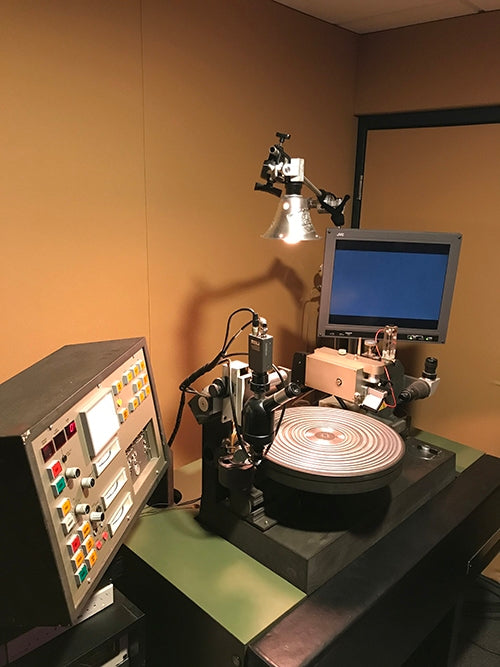
 

The Neumann VMS-80 lathe at Townsend Mastering, Orange County, CA. Courtesy of Nick Townsend at Infrasonic Sound.


While the Neumann VMS-80 and VMS-82 record-cutting lathes were endowed with plenty of automation systems, installing and setting them up was (and still is) a major challenge. First, they are heavy. Not only that, they are also very sensitive! The heavy platter must first be removed before attempting to transport the lathe from one place to another. Upon installation in a new location, first, the entire lathe needs to be leveled. Then, after the platter is reinstalled, this too needs to be leveled carefully and checked for vertical run-out. A platter with excessive run-out would make it very difficult, or entirely impossible, to maintain a stable groove depth. The groove depth is around 25 µm (0.025 mm or 0.001 inch) on average and can go as low as 12 µm (0.012 mm or 0.0005″), so the Neumann platter run-out could be adjusted to be as low as +/- 1 µm (0.001 mm or 0.000039″), measured at the outer diameter.


Crispin Murray with a partially disassembled Neumann VMS-82 lathe at Abbey Road Studios, London, UK. Courtesy of Miles Showell, freelance mastering engineer based at Abbey Road.


It is not easy to achieve such a specification, and most competing manufacturers of disk recording lathes were a bit behind in this respect. Most consumer-oriented turntables are an order of magnitude worse when it comes to platter run-out.
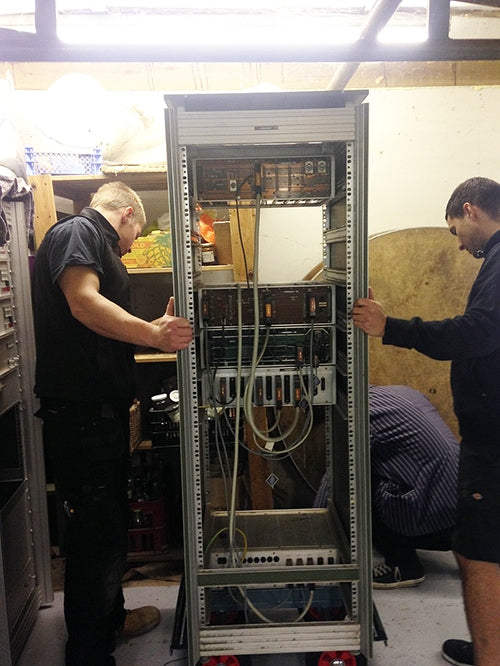
 

The cutting amplifier rack for the VMS-82, being carried in at Abbey Road Studios. Courtesy of Miles Showell.


The control systems for groove depth and pitch would then need to be calibrated with the aid of the microscope provided with the lathe.

Next up is the calibration of the cutting amplifier rack, which involves setting the signal levels for the two channels so that the cutter head would cut equally loud on the left and right channels. Then, adjusting the amount of motional feedback for each channel to achieve linear operation, and also adjusting the cutter head protection system so that it will protect the cutter head in case of overload, while also making sure that it does not come into action sooner than necessary. Other aspects of the cutting amplifier also need to be calibrated.


Partially disassembled VMS-82 lathe, in the process of being moved in at Abbey Road Studios. Courtesy of Miles Showell.


It is also imperative to ensure that the vacuum suction system for chip removal is operating reliably. (The process of cutting the groove generates chips as waste.) It is not uncommon for the suction system to get clogged halfway through a cut, or fail to pick up  the chip. When cutting lacquer, this is a hazard, because of the use of a heated stylus to cut the disk. If the chip is not effectively removed during the cutting, it will adhere to the stylus, causing more of the lacquer material to ball up there, and soon catch fire. It is worth noting that the lacquer disks used in vinyl record manufacturing are essentially a nitrocellulose lacquer formulation, which is also used, in shredded up form, as the smokeless powder that has replaced black powder in modern firearm ammunition.


The VMS-80 lathe at Townsend Mastering. The control panel is on the left, with the cutting amplifier rack under the control panel, the lathe and control electronics in the middle, and the microscope monitor on the right. Courtesy of Nick Townsend at Infrasonic Sound.


The lacquer disks are highly combustible, and the chip produced by the cutting operation is extremely easy to ignite, which is why the chip jar that collects it in a lathe’s suction system is filled with water, aiming to keep the collected chip below the surface of the water to eliminate the oxygen supply that would be needed to sustain combustion. Even the static charge produced by chips rubbing together as they collect in a jar would be enough to produce a water-shedding obituary extolling what a fantastic mastering engineer you WERE, before the chip accident…(https://www.youtube.com/watch?v=X_hqLmxvpiI)?

The recent sudden end to the activities of the Appollo/Transco lacquer production operation in Banning, CA in February, 2020 shall act as a reminder for cutting engineers worldwide to  always be on guard.


A Neumann VMS-82 lathe without the platter and suspension unit, in the process of being moved in at Abbey Road Studios, St Johns Wood, London, UK. Courtesy of Miles Showell.


With all this said, what do the VMS-80 and VMS-82 sound like? Well, for starters, we should take a scientific approach: The Analogue Productions Test Record The Ultimate Analogue Test LP was cut on a VMS-80 lathe, by Barry Wolifson at Sterling Sound. So, get out your measurement instruments and compile a test report! The FloKaSon test record, FloKaSon Reference Series: Testtone Record Vol.1 FSTD-001 was also cut on a Neumann VMS-80 by Flo Kaufmann, using a Neumann SX-74 cutter head with a modified Neumann cutting amplifier rack.

FloKaSon Reference Series: Testtone Record Vol.1 FSTD-001 (2016), cut on a Neumann VMS-80. Courtesy of Flo Kaufmann, FloKaSon, Switzerland. FloKaSon Reference Series: Testtone Record Vol.1 FSTD-001 (2016), cut on a Neumann VMS-80. Courtesy of Flo Kaufmann, FloKaSon, Switzerland.

As for real music, Miles Showell, mastering engineer at Abbey Road Studios in London, UK, recently told me that the very first master he cut, as soon as the converted-to-lacquer Neumann VMS-82 was installed and freshly calibrated, was for the 50th anniversary release of the Beatles’ Sgt. Pepper’s Lonely Hearts Club Band. By looking up the work of Miles at Abbey Road, you can find numerous other great-sounding records that showcase just how good the VMS-82 can sound in the hands of a qualified mastering engineer, when properly installed in a world-class mastering facility.


Miles Showell and Crispin Murray with the Neumann VMS-82 lathe, during the process of moving it in at Abbey Road. Courtesy of Miles Showell.


Jumping to the other side of the pond, the VMS-82 lathe at Masterdisk in Peekskill, New York, was converted to cut lacquer at some point in 2005. The work of Scott Hull, owner and chief engineer of Masterdisk, can demonstrate the equally impressive capabilities of the converted Neumann VMS-82 in the hands of a highly respected mastering engineer, using the SX-74 cutter head (just like a VMS-80 would). Scott is particularly proud of his cut for Steely Dan’s Two Against Nature album, cut last year at 33 rpm, and again this year at 45 for Acoustic Sounds. (This appears to be sold out at the present time.)

For a demonstration of the capabilities of the Neumann VMS-82 in its original capacity for cutting DMM (direct metal mastered) disks, cutting a copper coated disk, with due attention to detail, in a world-class facility and again, operated by a highly experienced cutting engineer, look no further than the work of Günter and Hendrik Pauler at Pauler Acoustics in Northeim, Germany. Their most impressive achievement to date, in my opinion, would be the DMM Dubplate Vol 1, discussed at length in Issues 147, 148 and 149.

Header image: Crispin Murray next to the VMS-82 at Abbey Road Studios. Courtesy of Miles Showell.

More from Issue 154

View All Articles in Issue 154

Search Copper Magazine

#231 Piano Prodigy Jude Kofie Releases His Debut Album On Octave Records by Frank Doris Jun 01, 2026 #231 Underappreciated Artists, Part Two: City Boy by Rich Isaacs Jun 01, 2026 #231 Music and the Art of Creation: Talking With Saxophonist Rob Scheps by Joe Caplan Jun 01, 2026 #231 How to Play in a Rock Band, 24: Further Adventures at the 2026 Montauk Music Festival by Frank Doris Jun 01, 2026 #231 Courtney Barnett: Creature of Habit by Wayne Robins Jun 01, 2026 #231 Angine de Poitrine: Interstellar Guitar Rock Saviors Headed for Late-Night TV Pop Stardom? by Mark Lepage Jun 01, 2026 #231 My Impressions of AXPONA 2026, Part One by Frank Doris Jun 01, 2026 #231 2026 La Jolla Concours d'Elegance: Another Aesthetic Feast by B. Jan Montana Jun 01, 2026 #231 Country Music Icon Jo Dee Messina’s Bridges: A New Beginning by Ray Chelstowski Jun 01, 2026 #231 The Luxury Dispatch Hosts a Video Podcast With Ken Kessler by Ken Kessler Jun 01, 2026 #231 The Vinyl Beat: Tracking in the Motor City by Rudy Radelic Jun 01, 2026 #231 Lots of Fun With DSP: The Ferrum Audio WANDLA DAC and Its Tube Mode by Frank Doris Jun 01, 2026 #231 From The Audiophile's Guide: Digital Source Components and Streaming Audio by Paul McGowan Jun 01, 2026 #231 Onkyo’s Monster M-510 power amplifier by The Staff at Just Audio Jun 01, 2026 #231 PS Audio in the News by PS Audio Staff Jun 01, 2026 #231 Naming Convention by Peter Xeni Jun 01, 2026 #231 Les Invisibles by Frank Doris Jun 01, 2026 #231 Wildlife Scene by James Schrimpf Jun 01, 2026 #230 Camaraderie by B. Jan Montana May 04, 2026 #230 AXPONA 2026: A Family Gathering by Paul McGowan May 04, 2026 #230 Pianist Ryan Benthall Explores Jazz Realms and Far Beyond With Divine Sky by Frank Doris May 04, 2026 #230 The Vinyl Beat in AXPONA-Land by Rudy Radelic May 04, 2026 #230 Teddy Thompson’s Musical Growth Deepens With Never Be the Same by Ray Chelstowski May 04, 2026 #230 More Fun in the Sun: Florida Audio Expo, Part Two by Frank Doris May 04, 2026 #230 CanJam NYC 2026 Show Report: Heady Sound, Part Two by Frank Doris and Harris Fogel May 04, 2026 #230 Sonic Youth On Murray Street by Wayne Robins May 04, 2026 #230 Graffeo Coffee: A Symphony of Sensory Experience by Joe Caplan May 04, 2026 #230 The Saul Authority: The Story of Hi-Fi Pioneer Saul Marantz by Olivier Meunier-Plante May 04, 2026 #230 How to Play in a Rock Band, 23: Encounters With Famous Musicians, Part Two by Frank Doris May 04, 2026 #230 An Outlier in the Rack: A Vintage BIC Beam Box by The Staff at Just Audio May 04, 2026 #230 PS Audio in the News by PS Audio Staff May 04, 2026 #230 A Cautionary Tale by Rich Isaacs May 04, 2026 #230 Reel-to-Reel Roots, Part 33 (Revised): Ken Kessler Reports On the 2026 (British) AudioJumble by Ken Kessler May 04, 2026 #230 Text Messaging by Frank Doris May 04, 2026 #230 The Audiophile Rat Race by Peter Xeni May 04, 2026 #230 On the Rocks by Rich Isaacs May 04, 2026 #229 The Earliest Stars of Country Music, Part Three by Jeff Weiner Apr 06, 2026 #229 The Healing Power of Music and Sound at the Omega Institute by Joe Caplan Apr 06, 2026 #229 CanJam NYC 2026 Show Report: Heady Sound, Part One by Frank Doris Apr 06, 2026 #229 Florida Audio Expo 2026: Warming Up to High-End Audio, Part One by Frank Doris Apr 06, 2026 #229 Quick Takes: Anne Bisson, Sam Morrison, The Velvet Underground, and the Stooges by Frank Doris Apr 06, 2026 #229 The Vinyl Beat: New Arrivals, and Old Audio Show Demo Scores to Settle by Rudy Radelic Apr 06, 2026 #229 Harvard Gets a High-End Audio Education by Frank Doris Apr 06, 2026 #229 No Country for Old Knees by B. Jan Montana Apr 06, 2026 #229 How To Play in A Rock Band, 22: Encounters With Famous Musicians, Part 1 by Frank Doris Apr 06, 2026 #229 The Soulful Grooves of Guinea-Bissau by Steve Kindig Apr 06, 2026 #229 Four-Hand Piano Performance at Its Finest by Stephan Haberthür Apr 06, 2026

Around the World in 80 Lathes, Part Four

Around the World in 80 Lathes, Part Four

In previous installments (Issue 151Issue 152 and Issue 153), J.I. Agnew presented a historical overview of record-cutting lathes, and looked at some models from Neumann.)


The Neumann VMS-80 lathe at Townsend Mastering, Orange County, CA. Courtesy of Nick Townsend at Infrasonic Sound.


While the Neumann VMS-80 and VMS-82 record-cutting lathes were endowed with plenty of automation systems, installing and setting them up was (and still is) a major challenge. First, they are heavy. Not only that, they are also very sensitive! The heavy platter must first be removed before attempting to transport the lathe from one place to another. Upon installation in a new location, first, the entire lathe needs to be leveled. Then, after the platter is reinstalled, this too needs to be leveled carefully and checked for vertical run-out. A platter with excessive run-out would make it very difficult, or entirely impossible, to maintain a stable groove depth. The groove depth is around 25 µm (0.025 mm or 0.001 inch) on average and can go as low as 12 µm (0.012 mm or 0.0005″), so the Neumann platter run-out could be adjusted to be as low as +/- 1 µm (0.001 mm or 0.000039″), measured at the outer diameter.


Crispin Murray with a partially disassembled Neumann VMS-82 lathe at Abbey Road Studios, London, UK. Courtesy of Miles Showell, freelance mastering engineer based at Abbey Road.


It is not easy to achieve such a specification, and most competing manufacturers of disk recording lathes were a bit behind in this respect. Most consumer-oriented turntables are an order of magnitude worse when it comes to platter run-out.


The cutting amplifier rack for the VMS-82, being carried in at Abbey Road Studios. Courtesy of Miles Showell.


The control systems for groove depth and pitch would then need to be calibrated with the aid of the microscope provided with the lathe.

Next up is the calibration of the cutting amplifier rack, which involves setting the signal levels for the two channels so that the cutter head would cut equally loud on the left and right channels. Then, adjusting the amount of motional feedback for each channel to achieve linear operation, and also adjusting the cutter head protection system so that it will protect the cutter head in case of overload, while also making sure that it does not come into action sooner than necessary. Other aspects of the cutting amplifier also need to be calibrated.


Partially disassembled VMS-82 lathe, in the process of being moved in at Abbey Road Studios. Courtesy of Miles Showell.


It is also imperative to ensure that the vacuum suction system for chip removal is operating reliably. (The process of cutting the groove generates chips as waste.) It is not uncommon for the suction system to get clogged halfway through a cut, or fail to pick up  the chip. When cutting lacquer, this is a hazard, because of the use of a heated stylus to cut the disk. If the chip is not effectively removed during the cutting, it will adhere to the stylus, causing more of the lacquer material to ball up there, and soon catch fire. It is worth noting that the lacquer disks used in vinyl record manufacturing are essentially a nitrocellulose lacquer formulation, which is also used, in shredded up form, as the smokeless powder that has replaced black powder in modern firearm ammunition.


The VMS-80 lathe at Townsend Mastering. The control panel is on the left, with the cutting amplifier rack under the control panel, the lathe and control electronics in the middle, and the microscope monitor on the right. Courtesy of Nick Townsend at Infrasonic Sound.


The lacquer disks are highly combustible, and the chip produced by the cutting operation is extremely easy to ignite, which is why the chip jar that collects it in a lathe’s suction system is filled with water, aiming to keep the collected chip below the surface of the water to eliminate the oxygen supply that would be needed to sustain combustion. Even the static charge produced by chips rubbing together as they collect in a jar would be enough to produce a water-shedding obituary extolling what a fantastic mastering engineer you WERE, before the chip accident…(https://www.youtube.com/watch?v=X_hqLmxvpiI)?

The recent sudden end to the activities of the Appollo/Transco lacquer production operation in Banning, CA in February, 2020 shall act as a reminder for cutting engineers worldwide to  always be on guard.


A Neumann VMS-82 lathe without the platter and suspension unit, in the process of being moved in at Abbey Road Studios, St Johns Wood, London, UK. Courtesy of Miles Showell.


With all this said, what do the VMS-80 and VMS-82 sound like? Well, for starters, we should take a scientific approach: The Analogue Productions Test Record The Ultimate Analogue Test LP was cut on a VMS-80 lathe, by Barry Wolifson at Sterling Sound. So, get out your measurement instruments and compile a test report! The FloKaSon test record, FloKaSon Reference Series: Testtone Record Vol.1 FSTD-001 was also cut on a Neumann VMS-80 by Flo Kaufmann, using a Neumann SX-74 cutter head with a modified Neumann cutting amplifier rack.

FloKaSon Reference Series: Testtone Record Vol.1 FSTD-001 (2016), cut on a Neumann VMS-80. Courtesy of Flo Kaufmann, FloKaSon, Switzerland. FloKaSon Reference Series: Testtone Record Vol.1 FSTD-001 (2016), cut on a Neumann VMS-80. Courtesy of Flo Kaufmann, FloKaSon, Switzerland.

As for real music, Miles Showell, mastering engineer at Abbey Road Studios in London, UK, recently told me that the very first master he cut, as soon as the converted-to-lacquer Neumann VMS-82 was installed and freshly calibrated, was for the 50th anniversary release of the Beatles’ Sgt. Pepper’s Lonely Hearts Club Band. By looking up the work of Miles at Abbey Road, you can find numerous other great-sounding records that showcase just how good the VMS-82 can sound in the hands of a qualified mastering engineer, when properly installed in a world-class mastering facility.


Miles Showell and Crispin Murray with the Neumann VMS-82 lathe, during the process of moving it in at Abbey Road. Courtesy of Miles Showell.


Jumping to the other side of the pond, the VMS-82 lathe at Masterdisk in Peekskill, New York, was converted to cut lacquer at some point in 2005. The work of Scott Hull, owner and chief engineer of Masterdisk, can demonstrate the equally impressive capabilities of the converted Neumann VMS-82 in the hands of a highly respected mastering engineer, using the SX-74 cutter head (just like a VMS-80 would). Scott is particularly proud of his cut for Steely Dan’s Two Against Nature album, cut last year at 33 rpm, and again this year at 45 for Acoustic Sounds. (This appears to be sold out at the present time.)

For a demonstration of the capabilities of the Neumann VMS-82 in its original capacity for cutting DMM (direct metal mastered) disks, cutting a copper coated disk, with due attention to detail, in a world-class facility and again, operated by a highly experienced cutting engineer, look no further than the work of Günter and Hendrik Pauler at Pauler Acoustics in Northeim, Germany. Their most impressive achievement to date, in my opinion, would be the DMM Dubplate Vol 1, discussed at length in Issues 147, 148 and 149.

Header image: Crispin Murray next to the VMS-82 at Abbey Road Studios. Courtesy of Miles Showell.

0 comments

Leave a comment

0 Comments

Your avatar

Loading comments...

🗑️ Delete Comment

Enter moderator password to delete this comment:

✏️ Edit Comment

Enter your email to verify ownership: