COPPER

A PS Audio Publication

Issue 123 • Free Online Magazine

Issue 123 INDUSTRY NEWS

AES Show Fall 2020 Highlights, Part One

AES Show Fall 2020 Highlights, Part One

The major city lockdowns across the nation because of COVID-19 have created a new paradigm for industry trade shows and conferences. Now it’s all done online using apps like Zoom and various video conferencing tech. How appropriate, then, for the Audio Engineering Society (AES) to turn to this technology for its own annual October conference this year, usually held in Manhattan’s Javits Center.

To its credit, AES has come up with some innovative ways to make the virtual conferencing experience worthwhile, such as greater flexibility in scheduling (including on-demand for some events) and offering the ability to submit questions online to the featured presenters and speakers. AES also extended the duration of the 2020 event to four weeks in October.

Here are some highlights from weeks 1 and 2. In a convention of this scope it’s impossible to cover everything, so I chose some highlights I thought would be of particular interest. Also, more information about AES can be found in the interview with AES’s Gary Gottlieb in Issue 121.

Podcasting

One of the biggest growth areas in the audio industry has come from podcasting. A microphone, an interface, and a laptop computer is theoretically all one would need to create podcast content. Well…technically yes, but since podcasts are an extension of radio, listeners expect podcast programming to contain the same level of quality audio that radio broadcasts deliver.

The opening event for AES October 2020 was a broadcasting webinar conducted by Michael Pearson-Adams of Waves Audio. The webinar included a link to Adams’ computer screen where he showcased the use of Waves’ podcast-specific plugins and how they functioned.

One of Adams’ primary demonstrations was for Waves’ Playlist Rider, a plugin specifically designed for controlling the audio outputs for podcasts in order to deliver an optimum balance for Zoom or for recording to Spotify.

Adams also covered differences between the use of Mac vs. Windows hardware, and talked about the use of the VB-audio VB-CABLE, a “virtual cable” for connecting devices (available for Windows with 2 in/outs), and explained how tonal control variations can better achieve voice separation for added clarity in podcasting.

Dan Hughley of Focusrite followed with a discussion, named the podcaster winners of Focusrite’s studio makeover competition, and offered helpful tips for improving podcasts as well as recording in general.


The AES Show Fall 2020, virtual style, Focusrite seminar.

David Bryce, head of sales for Cloud Microphones, expounded upon their Cloudlifter devices, which deliver +20 dB of clean gain for dynamic and passive ribbon mics before the signal gets to the preamp. They are exceptionally helpful in reducing the need for excess gain when used with digital audio workstations (DAW)s and preamps with inherent noise.


David Bryce explains the Cloudlifter.

Skywalker Sound Tour

A few years ago at an AES conference, I attended a high-resolution audio symposium moderated by Grammy Award-winning producer/engineer Chuck Ainlay. However, I was unprepared for the awestruck reverence he displayed for the guest speaker: Leslie Ann Jones of Skywalker Sound. Apparently, many other audio industry luminaries share Ainlay’s sentiments. One of the most eclectic producer/engineers in the music industry, Leslie Ann Jones has worked on music of all genres from classical to punk, as well as film and television scores, video games, and music for staged ballet and other live events. She is a multiple Grammy Award winner. Copper interviewed her in-depth in Issues 82 and 83.

As Director of Music Recording and Scoring at Skywalker Sound, she was the ideal person to kick off the AES virtual studio tour series, 7 Audio Wonders of the World. As narrator and host, she led a walkthrough of the entire Skywalker Studio facility. Starting with the cavernous Tom Holman-designed scoring room, Jones demonstrated how the room can accommodate an entire orchestra or any smaller ensemble. Equipped with moveable acoustic panels, the room can physically change its reverberation depth and echo characteristics as needed. The extremely low noise floor in the recording chain results from using a simple signal chain of microphones fed directly into Neve or Air Montserrat preamps, and then out to the control room, all wired with high-purity-copper cabling.


Engineer/producer and AES Fellow Leslie Ann Jones guides a virtual tour of Skywalker Sound.

The isolation booths are spacious with excellent line of sight and large soundproof glass panels.  The booths do double duty as storage spaces for the guitar amp collection, synthesizers, and vintage Fender Rhodes and Hammond organ keyboards. Another booth stores a Bluthner 9-foot concert grand piano and a third holds a Yamaha F35 9-foot grand.

The main control room houses a 72-channel Neve 88R console, a Bowers & Wilkins 5.1 surround-sound speaker system with subwoofers, and Neumann KH 310 overhead speaker arrays for use in immersive sound mixing. The “machine room: contains an Avid Pro Tools desk for digital recording, a pair of Studer A827 24-track 2-inch analog tape decks along with two sets of Pro Tools HDX audio interfaces.

Skywalker Sound has additional rooms for different aspects of film post-production mixing, dubbing, and for smaller television or documentary projects. These rooms are equipped with Meyer Sound theater speakers set up for Dolby Atmos surround sound. (See our interviews with John Meyer of Meyer Sound in Issues 99, 100 and 101.)


A scoring room for immersive audio at Skywalker Sound.

The tour concluded with a brief Q&A with Leslie Ann Jones and Academy Award-winning sound engineer Lora Hirschberg (Inception, The Dark Knight). They answered questions on the editing and dubbing process, microphone choices on orchestral and other projects, removing unwanted reverberation from recordings, the use of remote ADR (automatic dialogue replacement) packages during the COVID-19 lockdowns, and mixing for Dolby Atmos.

Hirschberg stressed that because film sound mixes are so specialized, with dialogue, effects and music all handled by separate engineers, it was crucial to consider the needs of everyone involved and not back the client into a corner by adding too many effects to a track, which then would not be able to be removed later by the person in charge of the overall sound mix.
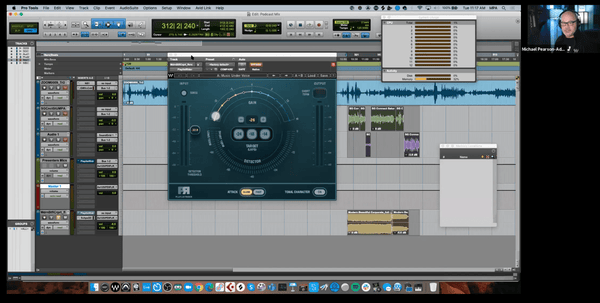

Processing for online audio from Waves Audio.

Audio Production Education in the COVID-19 Era

One of the biggest institutional casualties of the pandemic has been our schools. Unlike standard academic courses which can successfully transition to Zoom or other online remote platforms, courses like audio production that require hands-on access to equipment have suffered precipitously. In the interim, innovative teachers and university IT departments have developed several novel workaround solutions.

A roundtable discussion addressed this. It included Blair Likala of University of North Texas, Scott Burgess from University of Colorado, Denver, Scott Wynne of Appalachian State University in North Carolina, and New Jersey high school teacher Mark Beckett.

For schools that have allowed limited numbers of students to attend in person, supplies of personal protective equipment and Clorox wipes are mandatory. One teacher noted that in the past they’ve encouraged students to get hands-on experience with the gear, but COVID-19 has forced a 180-degree reversal policy of “touch only with gloves,” if at all.

For schools compelled by their respective states to make all of their classes virtual, some challenges cited are:

  • Dealing with IT networks that are inadequate to handle the new communications requirements;
  • Obtaining software licenses for each student to download Logic, Pro Tools, or other software required for course work;
  • Accommodating students with laptops and computers that are insufficient to run the production software concurrently with Zoom.

The teachers were unanimous in their praise for students’ individual initiatives in getting audio production experience through work-at-home projects, interning at professional studios, assisting in houses of worship, and finding work at other venues. They also remarked that since navigating these challenges was unfamiliar territory, participating in social media groups with other audio professionals and educators was one of the best resources for obtaining tips that would apply to a teacher’s particular obstacles.

Automotive Audio Product Development

Car audio system design is a highly specialized area, with demands that exceed the normal parameters of acoustics, electronics and physics compared to designing for a fixed space. Vehicle audio has to deal with engine rumbling, wind-noise considerations at increasing velocity, limited space for installing speakers, and the variables of sound reflection and absorption for the different materials used in car interiors.

In the Automotive Audio Seminar, the first speaker was Dr. Samara Mohanady, chief acoustic developer for IAV GmbH in Munich, Germany. She noted that due to the many variables inherent in different vehicle designs, a significant portion of her work involves the creation of digital models to replicate the measurements gathered from anechoic vs. car cabin measurements, as well as acoustic coupling differences, different air pressure levels and the aforementioned effects of interior construction materials. Host Roger Shively of JJR Acoustics did a good job of keeping the discussion from getting too deeply into scientific jargon and staying grounded in real life examples.


Roger Shively of JJR Acoustics giving a presentation on automotive audio.

As Dr. Mohanady’s specialty field is active noise control (ANC), her computer simulations are the result of painstaking multi-in/multi-out (MIMO) testing, which utilizes binaural and other dual-mic arrays to record sound from every conceivable area within an automobile model interior both in motion and when still. Learning about the elements that affect audio system quality was a revelation to me. They took far more parameters into consideration than the earlier days of car audio design, when a car had a single speaker connected to an AM/FM radio with an exterior telescopic antenna!

Steve Hutt of Equity Sound Investments spoke about how customers are demanding better sound from car audio systems, which often will not sound as good as a car buyer might expect. He echoed Dr. Mohanady’s reliance on the cost-effectiveness of using computer simulations rather than building multiple prototypes that are destined to become unacceptable anyway once auditioned.

Hutt stated that woofers were the prime component for establishing interior sound pressure level (SPL) ranges, with tweeters chosen more for their coverage area. Other autosound design considerations include power compression, dealing with resonances, designing around vehicle doors and taking cost and warranty into consideration.

In summary, this was a comprehensive and informative symposium on an important commercial segment of the audio industry that is often an afterthought amongst audiophiles.

Product Supply Chain Issues and Alternatives

US tariffs imposed on Chinese goods has caused most US electronics companies that rely on Chinese factories for mass production to reassess their supply chains and explore alternatives, or at least backup options.

The panel, “Exploring and Expanding Options for Audio Sourcing” included Scott Leslie (host, PD Squared), Mike Klasco (Menlo Scientific), Tony Tran (Soundcorp/Vietnam), Mark Thomsen (SB Acoustics/Indonesia), and David Lindberg (DB Entertainment/Hong Kong).

The panel mentioned how several large electronic companies, such as Apple and Google, have already transitioned some supply chain items from China to Thailand, Vietnam, and Malaysia. They cited how Taiwan and Malaysia were popular manufacturing regions back in the 1990s but were undercut by China’s superior quality control and price savings. The current trade situation has made other Asian manufacturing regions once again worthy of inquiry. Some tips and observations mentioned included:

  • The large shift to Vietnam, Thailand, Indonesia and Malaysia could spill over to Laos, Myanmar, Philippines, Cambodia and other nearby regions that might offer more attractive deals for less-complicated mass production products.
  • Factories located in Special Economic Zones would be able to avoid the import and export fees that need to be factored into total net manufacturing costs.
  • Vietnam was prospectively safer than Taiwan because of Chinese Communist Party invasion threats upon the latter.
  • SMT (surface mount technology, i.e., mounting components directly onto printed circuit boards) has already developed to a professional level of sophistication in Malaysia, the Philippines and Thailand. Medical devices such as hearing aids are regularly sourced from these regions.
  • While lower labor and shipping costs in other countries may offer attractive options, components often still have to be sourced from China, so researching a prospective factory’s access to these parts is crucial. Due to cost and QC issues in parts manufacture, China is the only place in the world that makes many electronic parts for mass production that are aimed at a retail or semi-pro market.
  • To avoid headaches, preference should be given to Southeast Asian factories who are already subcontractors to the Chinese factories that may have formerly manufactured a product.

The symposium concluded with “Understanding Your Supply Chain: A Global Perspective,” highlighting contrasting experiences in dealing with OEM manufacturing in China. Larry Fishman of Fishman Transducers (makers of acoustic guitar pickups and other products) explained the details of assuring intellectual property rights protection and accurate financial accountability when dealing with a Chinese factory, how trademark and patent litigation in China differed from the US, and how his relationships have been positive overall.


Dan Digne of loudspeaker and amplifier manufacturer MISCO hosts a seminar on global supply chain considerations.

Offering another viewpoint, Nick Huffman of Clarasonic had a decidedly negative experience when manufacturing his high-performance speaker cones in China. He was able to purchase an entire factory in Thailand for the equivalent cost of one year of manufacturing in China. His overall experience in Thailand from a cooperation and employee lifestyle perspective has been very positive by comparison. Overall, this seminar was a fascinating insight into the challenges faced by US audio companies who have expanded to the point where mass production necessitates considering overseas manufacturing contractors.

With many more product showcases and other events on the schedule, AES October 2020 will be chock full of more exciting and interesting topics, so stay tuned for Part Two of this report in the next issue.

More from Issue 123

View All Articles in Issue 123

Search Copper Magazine

#231 Piano Prodigy Jude Kofie Releases His Debut Album On Octave Records by Frank Doris Jun 01, 2026 #231 Underappreciated Artists, Part Two: City Boy by Rich Isaacs Jun 01, 2026 #231 Music and the Art of Creation: Talking With Saxophonist Rob Scheps by Joe Caplan Jun 01, 2026 #231 How to Play in a Rock Band, 24: Further Adventures at the 2026 Montauk Music Festival by Frank Doris Jun 01, 2026 #231 Courtney Barnett: Creature of Habit by Wayne Robins Jun 01, 2026 #231 Angine de Poitrine: Interstellar Guitar Rock Saviors Headed for Late-Night TV Pop Stardom? by Mark Lepage Jun 01, 2026 #231 My Impressions of AXPONA 2026, Part One by Frank Doris Jun 01, 2026 #231 2026 La Jolla Concours d'Elegance: Another Aesthetic Feast by B. Jan Montana Jun 01, 2026 #231 Country Music Icon Jo Dee Messina’s Bridges: A New Beginning by Ray Chelstowski Jun 01, 2026 #231 The Luxury Dispatch Hosts a Video Podcast With Ken Kessler by Ken Kessler Jun 01, 2026 #231 The Vinyl Beat: Tracking in the Motor City by Rudy Radelic Jun 01, 2026 #231 Lots of Fun With DSP: The Ferrum Audio WANDLA DAC and Its Tube Mode by Frank Doris Jun 01, 2026 #231 From The Audiophile's Guide: Digital Source Components and Streaming Audio by Paul McGowan Jun 01, 2026 #231 Onkyo’s Monster M-510 power amplifier by The Staff at Just Audio Jun 01, 2026 #231 PS Audio in the News by PS Audio Staff Jun 01, 2026 #231 Naming Convention by Peter Xeni Jun 01, 2026 #231 Les Invisibles by Frank Doris Jun 01, 2026 #231 Wildlife Scene by James Schrimpf Jun 01, 2026 #230 Camaraderie by B. Jan Montana May 04, 2026 #230 AXPONA 2026: A Family Gathering by Paul McGowan May 04, 2026 #230 Pianist Ryan Benthall Explores Jazz Realms and Far Beyond With Divine Sky by Frank Doris May 04, 2026 #230 The Vinyl Beat in AXPONA-Land by Rudy Radelic May 04, 2026 #230 Teddy Thompson’s Musical Growth Deepens With Never Be the Same by Ray Chelstowski May 04, 2026 #230 More Fun in the Sun: Florida Audio Expo, Part Two by Frank Doris May 04, 2026 #230 CanJam NYC 2026 Show Report: Heady Sound, Part Two by Frank Doris and Harris Fogel May 04, 2026 #230 Sonic Youth On Murray Street by Wayne Robins May 04, 2026 #230 Graffeo Coffee: A Symphony of Sensory Experience by Joe Caplan May 04, 2026 #230 The Saul Authority: The Story of Hi-Fi Pioneer Saul Marantz by Olivier Meunier-Plante May 04, 2026 #230 How to Play in a Rock Band, 23: Encounters With Famous Musicians, Part Two by Frank Doris May 04, 2026 #230 An Outlier in the Rack: A Vintage BIC Beam Box by The Staff at Just Audio May 04, 2026 #230 PS Audio in the News by PS Audio Staff May 04, 2026 #230 A Cautionary Tale by Rich Isaacs May 04, 2026 #230 Reel-to-Reel Roots, Part 33 (Revised): Ken Kessler Reports On the 2026 (British) AudioJumble by Ken Kessler May 04, 2026 #230 Text Messaging by Frank Doris May 04, 2026 #230 The Audiophile Rat Race by Peter Xeni May 04, 2026 #230 On the Rocks by Rich Isaacs May 04, 2026 #229 The Earliest Stars of Country Music, Part Three by Jeff Weiner Apr 06, 2026 #229 The Healing Power of Music and Sound at the Omega Institute by Joe Caplan Apr 06, 2026 #229 CanJam NYC 2026 Show Report: Heady Sound, Part One by Frank Doris Apr 06, 2026 #229 Florida Audio Expo 2026: Warming Up to High-End Audio, Part One by Frank Doris Apr 06, 2026 #229 Quick Takes: Anne Bisson, Sam Morrison, The Velvet Underground, and the Stooges by Frank Doris Apr 06, 2026 #229 The Vinyl Beat: New Arrivals, and Old Audio Show Demo Scores to Settle by Rudy Radelic Apr 06, 2026 #229 Harvard Gets a High-End Audio Education by Frank Doris Apr 06, 2026 #229 No Country for Old Knees by B. Jan Montana Apr 06, 2026 #229 How To Play in A Rock Band, 22: Encounters With Famous Musicians, Part 1 by Frank Doris Apr 06, 2026 #229 The Soulful Grooves of Guinea-Bissau by Steve Kindig Apr 06, 2026 #229 Four-Hand Piano Performance at Its Finest by Stephan Haberthür Apr 06, 2026

AES Show Fall 2020 Highlights, Part One

AES Show Fall 2020 Highlights, Part One

The major city lockdowns across the nation because of COVID-19 have created a new paradigm for industry trade shows and conferences. Now it’s all done online using apps like Zoom and various video conferencing tech. How appropriate, then, for the Audio Engineering Society (AES) to turn to this technology for its own annual October conference this year, usually held in Manhattan’s Javits Center.

To its credit, AES has come up with some innovative ways to make the virtual conferencing experience worthwhile, such as greater flexibility in scheduling (including on-demand for some events) and offering the ability to submit questions online to the featured presenters and speakers. AES also extended the duration of the 2020 event to four weeks in October.

Here are some highlights from weeks 1 and 2. In a convention of this scope it’s impossible to cover everything, so I chose some highlights I thought would be of particular interest. Also, more information about AES can be found in the interview with AES’s Gary Gottlieb in Issue 121.

Podcasting

One of the biggest growth areas in the audio industry has come from podcasting. A microphone, an interface, and a laptop computer is theoretically all one would need to create podcast content. Well…technically yes, but since podcasts are an extension of radio, listeners expect podcast programming to contain the same level of quality audio that radio broadcasts deliver.

The opening event for AES October 2020 was a broadcasting webinar conducted by Michael Pearson-Adams of Waves Audio. The webinar included a link to Adams’ computer screen where he showcased the use of Waves’ podcast-specific plugins and how they functioned.

One of Adams’ primary demonstrations was for Waves’ Playlist Rider, a plugin specifically designed for controlling the audio outputs for podcasts in order to deliver an optimum balance for Zoom or for recording to Spotify.

Adams also covered differences between the use of Mac vs. Windows hardware, and talked about the use of the VB-audio VB-CABLE, a “virtual cable” for connecting devices (available for Windows with 2 in/outs), and explained how tonal control variations can better achieve voice separation for added clarity in podcasting.

Dan Hughley of Focusrite followed with a discussion, named the podcaster winners of Focusrite’s studio makeover competition, and offered helpful tips for improving podcasts as well as recording in general.


The AES Show Fall 2020, virtual style, Focusrite seminar.

David Bryce, head of sales for Cloud Microphones, expounded upon their Cloudlifter devices, which deliver +20 dB of clean gain for dynamic and passive ribbon mics before the signal gets to the preamp. They are exceptionally helpful in reducing the need for excess gain when used with digital audio workstations (DAW)s and preamps with inherent noise.


David Bryce explains the Cloudlifter.

Skywalker Sound Tour

A few years ago at an AES conference, I attended a high-resolution audio symposium moderated by Grammy Award-winning producer/engineer Chuck Ainlay. However, I was unprepared for the awestruck reverence he displayed for the guest speaker: Leslie Ann Jones of Skywalker Sound. Apparently, many other audio industry luminaries share Ainlay’s sentiments. One of the most eclectic producer/engineers in the music industry, Leslie Ann Jones has worked on music of all genres from classical to punk, as well as film and television scores, video games, and music for staged ballet and other live events. She is a multiple Grammy Award winner. Copper interviewed her in-depth in Issues 82 and 83.

As Director of Music Recording and Scoring at Skywalker Sound, she was the ideal person to kick off the AES virtual studio tour series, 7 Audio Wonders of the World. As narrator and host, she led a walkthrough of the entire Skywalker Studio facility. Starting with the cavernous Tom Holman-designed scoring room, Jones demonstrated how the room can accommodate an entire orchestra or any smaller ensemble. Equipped with moveable acoustic panels, the room can physically change its reverberation depth and echo characteristics as needed. The extremely low noise floor in the recording chain results from using a simple signal chain of microphones fed directly into Neve or Air Montserrat preamps, and then out to the control room, all wired with high-purity-copper cabling.


Engineer/producer and AES Fellow Leslie Ann Jones guides a virtual tour of Skywalker Sound.

The isolation booths are spacious with excellent line of sight and large soundproof glass panels.  The booths do double duty as storage spaces for the guitar amp collection, synthesizers, and vintage Fender Rhodes and Hammond organ keyboards. Another booth stores a Bluthner 9-foot concert grand piano and a third holds a Yamaha F35 9-foot grand.

The main control room houses a 72-channel Neve 88R console, a Bowers & Wilkins 5.1 surround-sound speaker system with subwoofers, and Neumann KH 310 overhead speaker arrays for use in immersive sound mixing. The “machine room: contains an Avid Pro Tools desk for digital recording, a pair of Studer A827 24-track 2-inch analog tape decks along with two sets of Pro Tools HDX audio interfaces.

Skywalker Sound has additional rooms for different aspects of film post-production mixing, dubbing, and for smaller television or documentary projects. These rooms are equipped with Meyer Sound theater speakers set up for Dolby Atmos surround sound. (See our interviews with John Meyer of Meyer Sound in Issues 99, 100 and 101.)


A scoring room for immersive audio at Skywalker Sound.

The tour concluded with a brief Q&A with Leslie Ann Jones and Academy Award-winning sound engineer Lora Hirschberg (Inception, The Dark Knight). They answered questions on the editing and dubbing process, microphone choices on orchestral and other projects, removing unwanted reverberation from recordings, the use of remote ADR (automatic dialogue replacement) packages during the COVID-19 lockdowns, and mixing for Dolby Atmos.

Hirschberg stressed that because film sound mixes are so specialized, with dialogue, effects and music all handled by separate engineers, it was crucial to consider the needs of everyone involved and not back the client into a corner by adding too many effects to a track, which then would not be able to be removed later by the person in charge of the overall sound mix.


Processing for online audio from Waves Audio.

Audio Production Education in the COVID-19 Era

One of the biggest institutional casualties of the pandemic has been our schools. Unlike standard academic courses which can successfully transition to Zoom or other online remote platforms, courses like audio production that require hands-on access to equipment have suffered precipitously. In the interim, innovative teachers and university IT departments have developed several novel workaround solutions.

A roundtable discussion addressed this. It included Blair Likala of University of North Texas, Scott Burgess from University of Colorado, Denver, Scott Wynne of Appalachian State University in North Carolina, and New Jersey high school teacher Mark Beckett.

For schools that have allowed limited numbers of students to attend in person, supplies of personal protective equipment and Clorox wipes are mandatory. One teacher noted that in the past they’ve encouraged students to get hands-on experience with the gear, but COVID-19 has forced a 180-degree reversal policy of “touch only with gloves,” if at all.

For schools compelled by their respective states to make all of their classes virtual, some challenges cited are:

  • Dealing with IT networks that are inadequate to handle the new communications requirements;
  • Obtaining software licenses for each student to download Logic, Pro Tools, or other software required for course work;
  • Accommodating students with laptops and computers that are insufficient to run the production software concurrently with Zoom.

The teachers were unanimous in their praise for students’ individual initiatives in getting audio production experience through work-at-home projects, interning at professional studios, assisting in houses of worship, and finding work at other venues. They also remarked that since navigating these challenges was unfamiliar territory, participating in social media groups with other audio professionals and educators was one of the best resources for obtaining tips that would apply to a teacher’s particular obstacles.

Automotive Audio Product Development

Car audio system design is a highly specialized area, with demands that exceed the normal parameters of acoustics, electronics and physics compared to designing for a fixed space. Vehicle audio has to deal with engine rumbling, wind-noise considerations at increasing velocity, limited space for installing speakers, and the variables of sound reflection and absorption for the different materials used in car interiors.

In the Automotive Audio Seminar, the first speaker was Dr. Samara Mohanady, chief acoustic developer for IAV GmbH in Munich, Germany. She noted that due to the many variables inherent in different vehicle designs, a significant portion of her work involves the creation of digital models to replicate the measurements gathered from anechoic vs. car cabin measurements, as well as acoustic coupling differences, different air pressure levels and the aforementioned effects of interior construction materials. Host Roger Shively of JJR Acoustics did a good job of keeping the discussion from getting too deeply into scientific jargon and staying grounded in real life examples.


Roger Shively of JJR Acoustics giving a presentation on automotive audio.

As Dr. Mohanady’s specialty field is active noise control (ANC), her computer simulations are the result of painstaking multi-in/multi-out (MIMO) testing, which utilizes binaural and other dual-mic arrays to record sound from every conceivable area within an automobile model interior both in motion and when still. Learning about the elements that affect audio system quality was a revelation to me. They took far more parameters into consideration than the earlier days of car audio design, when a car had a single speaker connected to an AM/FM radio with an exterior telescopic antenna!

Steve Hutt of Equity Sound Investments spoke about how customers are demanding better sound from car audio systems, which often will not sound as good as a car buyer might expect. He echoed Dr. Mohanady’s reliance on the cost-effectiveness of using computer simulations rather than building multiple prototypes that are destined to become unacceptable anyway once auditioned.

Hutt stated that woofers were the prime component for establishing interior sound pressure level (SPL) ranges, with tweeters chosen more for their coverage area. Other autosound design considerations include power compression, dealing with resonances, designing around vehicle doors and taking cost and warranty into consideration.

In summary, this was a comprehensive and informative symposium on an important commercial segment of the audio industry that is often an afterthought amongst audiophiles.

Product Supply Chain Issues and Alternatives

US tariffs imposed on Chinese goods has caused most US electronics companies that rely on Chinese factories for mass production to reassess their supply chains and explore alternatives, or at least backup options.

The panel, “Exploring and Expanding Options for Audio Sourcing” included Scott Leslie (host, PD Squared), Mike Klasco (Menlo Scientific), Tony Tran (Soundcorp/Vietnam), Mark Thomsen (SB Acoustics/Indonesia), and David Lindberg (DB Entertainment/Hong Kong).

The panel mentioned how several large electronic companies, such as Apple and Google, have already transitioned some supply chain items from China to Thailand, Vietnam, and Malaysia. They cited how Taiwan and Malaysia were popular manufacturing regions back in the 1990s but were undercut by China’s superior quality control and price savings. The current trade situation has made other Asian manufacturing regions once again worthy of inquiry. Some tips and observations mentioned included:

  • The large shift to Vietnam, Thailand, Indonesia and Malaysia could spill over to Laos, Myanmar, Philippines, Cambodia and other nearby regions that might offer more attractive deals for less-complicated mass production products.
  • Factories located in Special Economic Zones would be able to avoid the import and export fees that need to be factored into total net manufacturing costs.
  • Vietnam was prospectively safer than Taiwan because of Chinese Communist Party invasion threats upon the latter.
  • SMT (surface mount technology, i.e., mounting components directly onto printed circuit boards) has already developed to a professional level of sophistication in Malaysia, the Philippines and Thailand. Medical devices such as hearing aids are regularly sourced from these regions.
  • While lower labor and shipping costs in other countries may offer attractive options, components often still have to be sourced from China, so researching a prospective factory’s access to these parts is crucial. Due to cost and QC issues in parts manufacture, China is the only place in the world that makes many electronic parts for mass production that are aimed at a retail or semi-pro market.
  • To avoid headaches, preference should be given to Southeast Asian factories who are already subcontractors to the Chinese factories that may have formerly manufactured a product.

The symposium concluded with “Understanding Your Supply Chain: A Global Perspective,” highlighting contrasting experiences in dealing with OEM manufacturing in China. Larry Fishman of Fishman Transducers (makers of acoustic guitar pickups and other products) explained the details of assuring intellectual property rights protection and accurate financial accountability when dealing with a Chinese factory, how trademark and patent litigation in China differed from the US, and how his relationships have been positive overall.


Dan Digne of loudspeaker and amplifier manufacturer MISCO hosts a seminar on global supply chain considerations.

Offering another viewpoint, Nick Huffman of Clarasonic had a decidedly negative experience when manufacturing his high-performance speaker cones in China. He was able to purchase an entire factory in Thailand for the equivalent cost of one year of manufacturing in China. His overall experience in Thailand from a cooperation and employee lifestyle perspective has been very positive by comparison. Overall, this seminar was a fascinating insight into the challenges faced by US audio companies who have expanded to the point where mass production necessitates considering overseas manufacturing contractors.

With many more product showcases and other events on the schedule, AES October 2020 will be chock full of more exciting and interesting topics, so stay tuned for Part Two of this report in the next issue.

0 comments

Leave a comment

0 Comments

Your avatar

Loading comments...

🗑️ Delete Comment

Enter moderator password to delete this comment:

✏️ Edit Comment

Enter your email to verify ownership: