COPPER

A PS Audio Publication

Issue 93 • Free Online Magazine

Issue 93 IN MY ROOM

A Turntable of my Own, Part 4

A Turntable of my Own, Part 4

Copper #90 , #91, and #92---Ed.> You are looking at the main aluminum plate that will support the entire table. It is resting on the aluminum plate that was previously bonded to the Minus K platform. In order to prevent this plate from accidentally moving once the entire table is assembled, a 1/8" thick sheet of high durometer rubber was bonded to the Minus K top plate, separating it from the plinth you are now viewing. In order to prevent the plate you are seeing in this picture from moving by an accidental bump, it has been semi-permanently attached to the 1/8” rubber sheet with four 3” diameter circles of two faced tape (one in each of the four corners). We are now ready to begin the final assembly of the turntable. Note two of the four hold down bolts in the corners of the top plate. These bolts are used to firmly attach this plate to the bottom frame supporting the Minus K. This will prevent any accidental movement until the table is fully assembled. At that time, these hold down bolts will be removed, and the table will be free to float. We have placed the 1 ½” thick triangular aluminum support plate on which the main fiberglass plinth is resting. We are now ready to place the 3 drive motor assemblies. Note the brass isolation point and cup, many of which will be used throughout the design of the table.

You are looking at the 3 VPI TNT drive units I will be using to power the platter. I might mention that I had the 3 VPI aluminum chassis’ stripped of the hammer tone powder coating and then brushed and anodized to match all of my Krell gear.

Billy Crystal once said “it’s better to look good than feel good." The anodized blocks will not increase the performance of the table but they certainly do add a lot to the overall aesthetics of the turntable.

Here we see the anodized VPI chassis blocks being firmly secured to the aluminum sub-plates that were machined, anodized, and filled with the epoxy/lead matrix. Here we see the table with the platter and one of the three drive motors in place. The parts have all been covered with a removable, protective plastic film. This will prevent any accidental damage to the anodized aluminum parts. You are looking at the entire table, minus the arms, properly positioned on the Minus K isolator. You will notice the extensive use of the brass points and cups for vibration isolation. Also note the Sutherland Time Line puck placed on the center spindle of the platter. It will be used to set the speed of all three motor drives powering the main platter. It was my original intention to use a Roadrunner tachometer to indicate when the proper speed has been attained but I decided to eliminate it and simply use the Time Line.

This picture depicts all three drive motors in place, along with the two Kuzma Air lines and single Kuzma four point tonearm installed.

I might call to your attention the extensive use of the two-colored anodizing done on all the aluminum plates, etc. Due to the fact that I have an extensive amount of Krell electronics throughout my system, I called my very good friends at Krell and asked if they would be willing to have all my aluminum pieces, parts, plates, etc. sent to them to be brushed and anodized to match all my Krell gear. They were more than happy to do so and the results are visually stunning.

[And that’s the conclusion of Ken’s story of the build of his amazing turntable. I’m grateful that Ken took the time to document the process, and was willing to share it with Copper readers. There is one more element to add to this story, and that’s told by Ken himself— in an extraordinary video his son produced. Link to the video is below, and I hope you’ll take six minutes and watch it. Our best wishes to Ken and his whole family.–-Ed.]

More from Issue 93

View All Articles in Issue 93

Search Copper Magazine

#226 JJ Murphy’s Sleep Paralysis is a Genre-Bending Musical Journey Through Jazz, Fusion and More by Frank Doris Jan 05, 2026 #226 Stewardship by Consent by B. Jan Montana Jan 05, 2026 #226 Food, Music, and Sensory Experience: An Interview With Professor Jonathan Zearfoss of the Culinary Institute of America by Joe Caplan Jan 05, 2026 #226 Studio Confidential: A Who’s Who of Recording Engineers Tell Their Stories by Frank Doris Jan 05, 2026 #226 Pilot Radio is Reborn, 50 Years Later: Talking With CEO Barak Epstein by Frank Doris Jan 05, 2026 #226 The Vinyl Beat Goes Down to Tijuana (By Way of Los Angeles), Part One by Rudy Radelic Jan 05, 2026 #226 Capital Audiofest 2025: Must-See Stereo, Part Two by Frank Doris Jan 05, 2026 #226 My Morning Jacket’s Carl Broemel and Tyler Ramsey Collaborate on Their Acoustic Guitar Album, Celestun by Ray Chelstowski Jan 05, 2026 #226 The People Who Make Audio Happen: CanJam SoCal 2025, Part Two by Harris Fogel Jan 05, 2026 #226 How to Play in a Rock Band, 19: Touring Can Make You Crazy, Part One by Frank Doris Jan 05, 2026 #226 Linda Ronstadt Goes Bigger by Wayne Robins Jan 05, 2026 #226 From The Audiophile’s Guide: Active Room Correction and Digital Signal Processing by Paul McGowan Jan 05, 2026 #226 PS Audio in the News by Frank Doris Jan 05, 2026 #226 Back to My Reel-to-Reel Roots, Part 25: Half-Full, Not Empty by Ken Kessler Jan 05, 2026 #226 Happy New Year! by Frank Doris Jan 05, 2026 #226 Turn It Down! by Peter Xeni Jan 05, 2026 #226 Ghost Riders by James Schrimpf Jan 05, 2026 #226 A Factory Tour of Audio Manufacturer German Physiks by Markus "Marsu" Manthey Jan 04, 2026 #225 Capital Audiofest 2025: Must-See Stereo, Part One by Frank Doris Dec 01, 2025 #225 Otis Taylor and the Electrics Delivers a Powerful Set of Hypnotic Modern Blues by Frank Doris Dec 01, 2025 #225 A Christmas Miracle by B. Jan Montana Dec 01, 2025 #225 T.H.E. Show New York 2025, Part Two: Plenty to See, Hear, and Enjoy by Frank Doris Dec 01, 2025 #225 Underappreciated Artists, Part One: Martin Briley by Rich Isaacs Dec 01, 2025 #225 Rock and Roll is Here to Stay by Wayne Robins Dec 01, 2025 #225 A Lifetime of Holiday Record (and CD) Listening by Rudy Radelic Dec 01, 2025 #225 Little Feat: Not Saying Goodbye, Not Yet by Ray Chelstowski Dec 01, 2025 #225 How to Play in a Rock Band, Part 18: Dealing With Burnout by Frank Doris Dec 01, 2025 #225 The People Who Make Audio Happen: CanJam SoCal 2025 by Harris Fogel Dec 01, 2025 #225 Chicago’s Sonic Sanctuaries: Four Hi‑Fi Listening Bars Channeling the Jazz‑Kissa Spirit by Olivier Meunier-Plante Dec 01, 2025 #225 From The Audiophile’s Guide: Controlling Bass Frequencies Through Membrane Absorbers (and How to Build Your Own) by Paul McGowan Dec 01, 2025 #225 Your Editor’s Tips for Attending Audio Shows by Frank Doris Dec 01, 2025 #225 PS Audio in the News by Frank Doris Dec 01, 2025 #225 Back to My Reel-to-Reel Roots, Part 24 by Ken Kessler Dec 01, 2025 #225 Holiday Music by Frank Doris Dec 01, 2025 #225 Puppy Prognostication by Peter Xeni Dec 01, 2025 #225 How to Post Comments on Copper by Frank Doris Dec 01, 2025 #225 Living Color by Rudy Radelic Dec 01, 2025 #224 T.H.E. Show New York 2025, Part One: A New Beginning by Frank Doris Nov 03, 2025 #224 Fool’s Leap of Faith is the Extraordinary Octave Records Debut from Singer/Songwriter Tyler Burba and Visit by Frank Doris Nov 03, 2025 #224 The Beatles’ “Aeolian Cadences.” What? by Wayne Robins Nov 03, 2025 #224 Persona Non Grata by B. Jan Montana Nov 03, 2025 #224 Talking With Recording Engineer Barry Diament of Soundkeeper Recordings, Part Two by Frank Doris Nov 03, 2025 #224 B Sides, B Movies, and Beware of Zombies by Rudy Radelic Nov 03, 2025 #224 The Burn-In Chronicles: 1,000 Hours to Sonic Salvation by Olivier Meunier-Plante Nov 03, 2025 #224 A Conversation With Mat Weisfeld of VPI Industries by Joe Caplan Nov 03, 2025 #224 Blues-Rocker Kenny Wayne Shepherd Celebrates 30 Years of Ledbetter Heights by Ray Chelstowski Nov 03, 2025 #224 Playing in a Rock Band, 17: When Good Gigs Go Bad, Part Two by Frank Doris Nov 03, 2025

A Turntable of my Own, Part 4

A Turntable of my Own, Part 4

Copper #90 , #91, and #92---Ed.> You are looking at the main aluminum plate that will support the entire table. It is resting on the aluminum plate that was previously bonded to the Minus K platform. In order to prevent this plate from accidentally moving once the entire table is assembled, a 1/8" thick sheet of high durometer rubber was bonded to the Minus K top plate, separating it from the plinth you are now viewing. In order to prevent the plate you are seeing in this picture from moving by an accidental bump, it has been semi-permanently attached to the 1/8” rubber sheet with four 3” diameter circles of two faced tape (one in each of the four corners). We are now ready to begin the final assembly of the turntable. Note two of the four hold down bolts in the corners of the top plate. These bolts are used to firmly attach this plate to the bottom frame supporting the Minus K. This will prevent any accidental movement until the table is fully assembled. At that time, these hold down bolts will be removed, and the table will be free to float. We have placed the 1 ½” thick triangular aluminum support plate on which the main fiberglass plinth is resting. We are now ready to place the 3 drive motor assemblies. Note the brass isolation point and cup, many of which will be used throughout the design of the table.

You are looking at the 3 VPI TNT drive units I will be using to power the platter. I might mention that I had the 3 VPI aluminum chassis’ stripped of the hammer tone powder coating and then brushed and anodized to match all of my Krell gear.

Billy Crystal once said “it’s better to look good than feel good." The anodized blocks will not increase the performance of the table but they certainly do add a lot to the overall aesthetics of the turntable.

Here we see the anodized VPI chassis blocks being firmly secured to the aluminum sub-plates that were machined, anodized, and filled with the epoxy/lead matrix. Here we see the table with the platter and one of the three drive motors in place. The parts have all been covered with a removable, protective plastic film. This will prevent any accidental damage to the anodized aluminum parts. You are looking at the entire table, minus the arms, properly positioned on the Minus K isolator. You will notice the extensive use of the brass points and cups for vibration isolation. Also note the Sutherland Time Line puck placed on the center spindle of the platter. It will be used to set the speed of all three motor drives powering the main platter. It was my original intention to use a Roadrunner tachometer to indicate when the proper speed has been attained but I decided to eliminate it and simply use the Time Line.
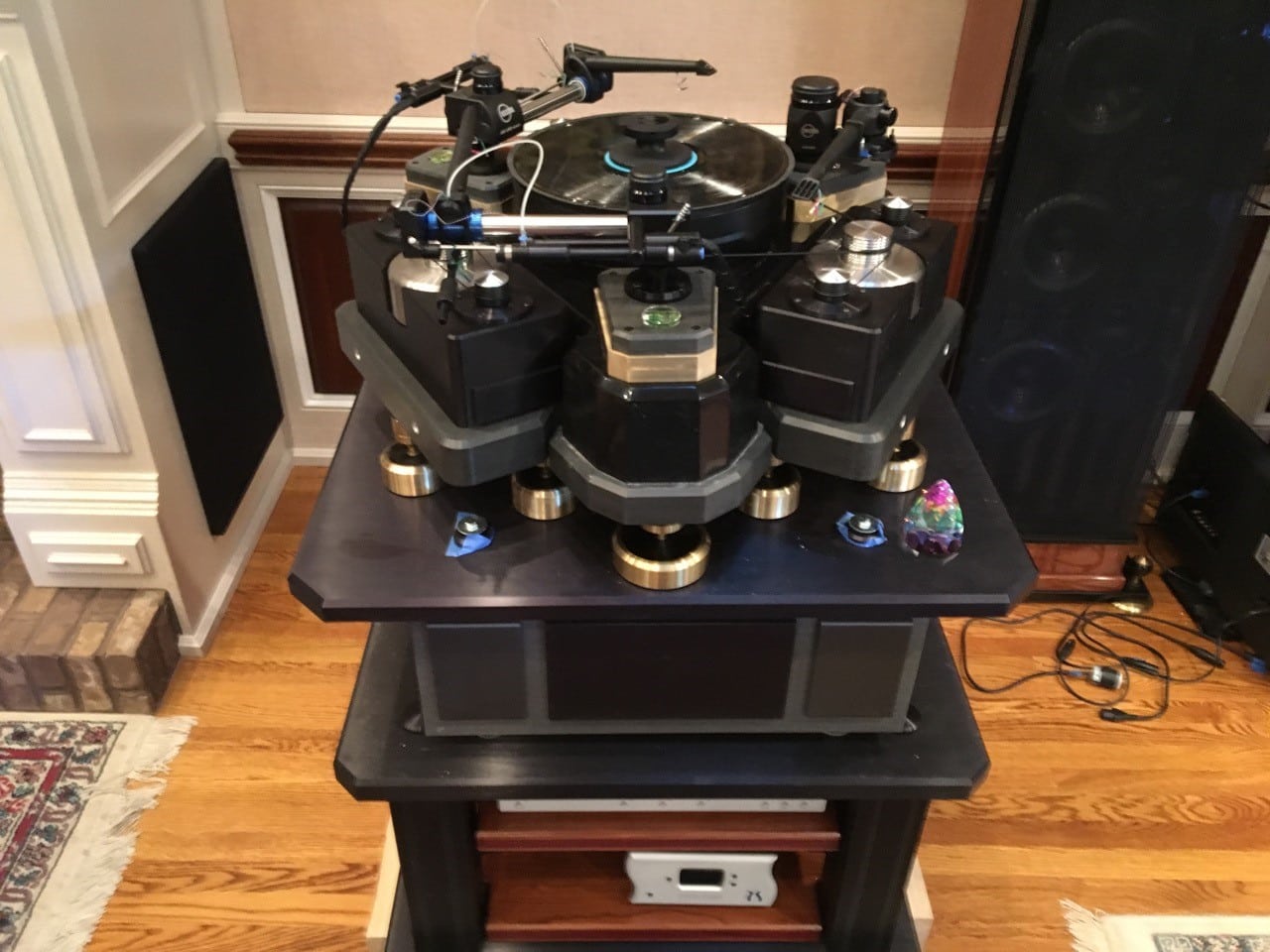
This picture depicts all three drive motors in place, along with the two Kuzma Air lines and single Kuzma four point tonearm installed.

I might call to your attention the extensive use of the two-colored anodizing done on all the aluminum plates, etc. Due to the fact that I have an extensive amount of Krell electronics throughout my system, I called my very good friends at Krell and asked if they would be willing to have all my aluminum pieces, parts, plates, etc. sent to them to be brushed and anodized to match all my Krell gear. They were more than happy to do so and the results are visually stunning.

[And that’s the conclusion of Ken’s story of the build of his amazing turntable. I’m grateful that Ken took the time to document the process, and was willing to share it with Copper readers. There is one more element to add to this story, and that’s told by Ken himself— in an extraordinary video his son produced. Link to the video is below, and I hope you’ll take six minutes and watch it. Our best wishes to Ken and his whole family.–-Ed.]

0 comments

Leave a comment

0 Comments

Your avatar

Loading comments...

🗑️ Delete Comment

Enter moderator password to delete this comment: