Couldn't resist the headline opportunity. Actually pots, the volume kind, have been legal since they were first developed, though some would suggest they ought to be banned for the damage they do to sound quality.
Like everything in audio, quality matters. Pots never
make something sound good. Better quality only offers the potential of
less bad. Let's take a look at some of the variations. Pictured here are two extremes. A Penny and Giles potentiometer which will set you back several hundred dollars, and a cheesy one that costs less than a dollar.

Simply inserting one for the other will have noticeable sonic differences. Few audio manufacturers can afford a couple of hundred dollars in their bills of materials, and they actually don't need to. Penny and Giles are used in the recording industry on older analog consoles, rarely on hifi equipment. Instead, there are a number of lower cost alternatives that sound equally good.
At the heart of these volume controls is a simple resistor, stretched out and contacted with a tensioned piece of metal known as the "wiper". The wiper is what slides across the resistive element and
picks off a
part of the resistor. Here's what a pot looks like inside and how it works.
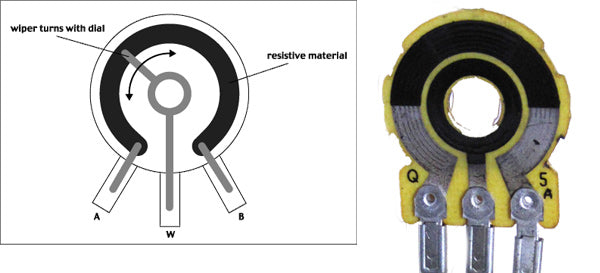
Looking at the diagram, A is where the original signal is placed. B is connected to ground. W (the wiper) is the output of the pot that feeds the next stage or even directly a power amplifier.
When you turn the volume knob on your system up and down, the wiper rubs against different sections of the resistor. Closer to one end of the resistive element (A) there is no resistance, thus we get full volume. At the opposite end (B) there is much resistance, and the volume is decreased until we get all the way to ground and there is zero.


0 comments