COPPER

A PS Audio Publication

Issue 163 • Free Online Magazine

Issue 163 Disciples of Sound

The Muffs’ Ronnie Barnett: Really Really Happy Again

The Muffs’ Ronnie Barnett: Really Really Happy Again

You probably know the Muffs from their 1995 cover of the song “Kids in America,” originally done by Kim Wilde in 1982. It added a bit of roar to the Clueless soundtrack, and the song continues to ramp up crowds at sports stadiums across the country. But this band’s legacy is much more than that. Rock trios led by women on guitar were rare when the Muffs were founded, and somehow are as rare today. That’s surprising because the energy, attitude, and conviction that bands like the Muffs delivered sit at the center of the female-focused perspective evident in every aspect of this important band’s body of work.


The Muffs were formed in 1991, and in many ways owned the Los Angeles post-punk scene. Led by singer/guitarist Kim Shattuck and backed by Ronnie Barnett on bass (article header image) and Roy McDonald on drums (right, header image), the band released four full-length studio albums in the 1990s, as well as numerous singles including “Lucky Guy” and “Sad Tomorrow.” After a long hiatus beginning in 1999, the band released a fifth album in 2004 but effectively disbanded thereafter. Almost a decade later, the three core members of the band reunited and started performing again. Their sixth album, Whoop Dee Doo, was released in 2014.

Sadly, Kim Shattuck died on October 2, 2019, following a two-year battle with ALS. On that same day, the Muffs confirmed that they had disbanded. Shortly after, the Muffs released their seventh and final album, No Holiday.

The Muffs have just reissued Really Really Happy on Omnivore Recordings. It’s the 2004 album that, according to the liner notes, kicked off the second phase of the Muffs’ career.” Omnivore states, “After eight years and four albums, The Muffs had been writing, recording and touring nonstop. After a break, the group was ready to do it all again, and were approached by…Charlotte Caffey (the Go-Go’s) and Anna Waronker, who had just started their own label, Five Foot Two Records. The album arrived to rave reviews.” Omnivore has reissued a greatly-expanded version of the album with 22 bonus tracks, including 16 of Kim Shattuck’s original demos. It’s a comprehensive second look at one of the band’s most pivotal albums.

 

The Muffs: Ronnie Barnett, Kim Shattuck and Roy McDonald. Courtesy of Kristen Shattuck.

The Muffs: Ronnie Barnett, Kim Shattuck and Roy McDonald. Courtesy of Kristen Shattuck.


The Muffs remind us of the joy in the naughtiness, smugness, reverence, appreciation, and wonder that one song can hold all on its own.

We caught up with Ronnie Barnett and asked him about how this reissue came about, and why the Muffs have always been a band for the ages.


Ray Chelstowski: When you were growing up, who was your favorite band?

Ronnie Barnett: Well, that would have to be KISS. I became aware of them when I was 10, which is when I started to go through rock magazines. I have older brothers, so before that, I would look through their Alice Cooper and Black Sabbath records. But KISS was the first record that I bought, with money that I borrowed from my uncle. I went down to Kmart and bought Dressed to Kill and subsequently became a KISS maniac. In fact, they were the first concert that I got to go to, that I asked to go to in 1976 when I was 11.

RC: The Muffs had an unconventional career, didn’t they?

RB: We had this kind of working mid-level career for 27 years. We kind of had a hit with “Kids in America” but it wasn’t really a single. But it is a song I can point to, and most everyone has heard it. It gets played in places like sports arenas. So, our career is very interesting in that way. Maybe if we’d had a big hit we wouldn’t have lasted. Or if we’d been big like Alanis Morissette and had to travel hard for a year, maybe that would have killed us too like it did to so many other bands. Yeah, I feel lucky looking back that we were able to work, fill clubs, and have people that love the band see us.

RC: Were there bands that you looked at over the years, admired, and wondered whether your career would have been different if your sound was a bit more commercial like theirs?

RB: The funny thing about us, and I’ll be speaking here for Kim as well, we didn’t look at things like that. There are a lot of things that we could have done to play the game when we were on a major label. We didn’t. We never hired any trendy person to mix or produce our records. All of our records are either produced or co-produced by Kim. She was just so locked into what she liked. I wouldn’t call it narrow. She wanted to make the kind of music that she wanted to hear. This may sound weird, but we admired groups like the Pixies [who] came up later, that were original, did their own thing and did well because of it. Not because they were trying to bend or adhere to some commercial sound. We were just lucky enough in our major-label experience to work with people who got us and pretty much let us do what we wanted to do, for better or worse.

RC: As punk-driven as your music is, there is an underlying pop sensibility to it.

RB: You’re right. Underneath all of the “punkiness” and screams are pop songs. Kim’s favorite bands were groups like Gerry and the Pacemakers and Herman’s Hermits. There’s a lot of Merseybeat in there. And yeah, she did love good melodies. Almost every song of ours has a melody, which is why we were able to play punk festivals, power-pop festivals, and garage festivals. I used to say that we could really open for anyone.


RC: There’s a great irony about this album’s name, because you don’t look “Really Really Happy” in the cover photo!

RB: Oh, I can’t stand that cover, but that’s another subject. But when we were doing this reissue, the only thig the Kim’s husband Kevin said was to keep the artwork intact because she worked hard on it. You learn [that] in a band with a strong personality that you should just yield to them and let them pick the photo!

RC: This record is brighter-sounding from a musical standpoint than your previous work. What helped shape that newer sound?

RB: We had made three records on the major label with $200,000 budgets. We then signed to Fat Records for our album Alert Today, Alive Tomorrow that came out in 1999, and we actually had a good budget for that one as well. It was still made in a real studio. That’s how we did it in the 1990s, right? You paid $1,000 a day and recorded in a room next to Eric Clapton. We did that. Then when it came to [Really Really Happy], we did it at Kim’s. Today everyone has home recording equipment. But at the time it was rather new. We basically recorded this album in Kim’s apartment. We did the drums in a real studio but everything else was recorded at her place. I love your description about this record sounding “brighter.” I hadn’t heard it since it came out. Its 17 songs but it’s also like 44 minutes. There’s a lot of really good songs on here that I’d forgotten about.
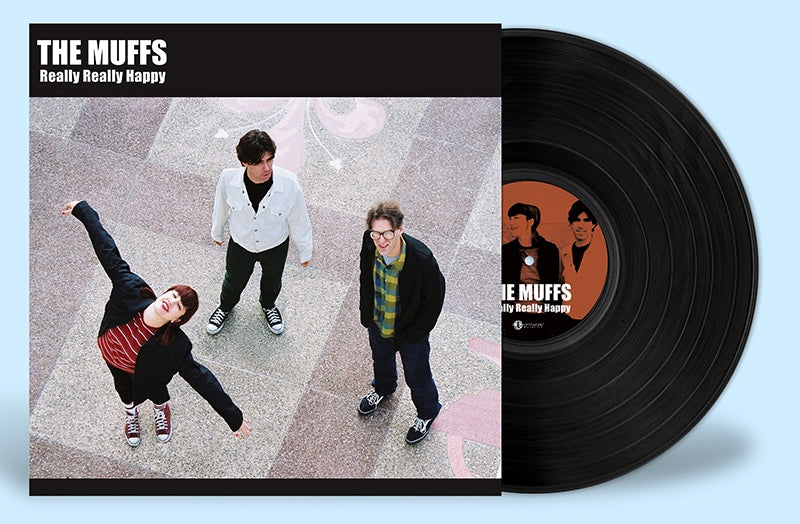
 

The Muffs, Really Really Happy, LP version.

The Muffs, Really Really Happy, LP version.


RC: Some of the bonus tracks sound like they should have belonged on the original tracking. How did you decide what got cut?

RB: When you are sequencing a record, sometimes you lose a strong song, and it hurts. But for some reason it just doesn’t seem to fit anywhere. In terms of the bonus tracks, two of them were from a Japanese version of the CD and two were from a Spanish version of the CD.

RC: The demo tracks are backed by a full band. Did you and Roy play on those?

RB: No. That’s [Kim]. The drum parts were manipulated from other drum tracks that Roy had recorded. Her demos were always good, but these are the most fully-realized demos she would ever do. What I think is that it was a test run for the real recording. If you listen to the arrangements, the demos are not very dissimilar to the final album. They don’t have the feel of the band, but it does prove how great a songwriter she was.


RC: You have influenced a number of popular artists. What is the biggest compliment you have ever received by an established artist?

RB: One of the highest compliments that we ever received was from Dee Dee Ramone. He appeared out of the blue in Amsterdam, came backstage, and told us that our records got him through rehab. That’s one of the highest compliments that you could ever receive. Then, Ronnie Spector played here in L.A. at the Viper Room in 1996 or 1997 and she requested us to open. I remember at sound check we finally met her and [we] asked her how she discovered us. She said, “Well I was talking to Joey [Ramone] and he said, “if you’re playing L.A. you have to have the Muffs open.” So, even more respect from the Ramones. How are you going to beat that? When Kim passed away, Elvis Costello praised her songwriting in a written statement. If Kim had been around to hear Elvis Costello praising her songwriting she would have been really humbled.

RC: You say that you are retired, but do you ever feel a responsibility to this music and keeping it alive and to the band’s legacy?

RB: First off I do consider myself retired. I was not [even] supposed to be in a band. I played in bands in high school and then gave it up until I wound up in my girlfriend’s band. As a friend once pointed out, I didn’t play bass in The Muffs. I was in the Muffs and played bass. I’ve done some other things along the way but that was my band. That’s said, I do try to keep our legacy afloat by doing these reissues, taking care to make them good, and writing good historical stuff for the booklets. And just keeping these things in print. Most still are. The Warner Brothers records have never gone out of print, which I am very proud of.

Header image of Ronnie Barnett courtesy of the Muffs PR.

More from Issue 163

View All Articles in Issue 163

Search Copper Magazine

#225 Capital Audiofest 2025: Must-See Stereo, Part One by Frank Doris Dec 01, 2025 #225 Otis Taylor and the Electrics Delivers a Powerful Set of Hypnotic Modern Blues by Frank Doris Dec 01, 2025 #225 A Christmas Miracle by B. Jan Montana Dec 01, 2025 #225 T.H.E. Show New York 2025, Part Two: Plenty to See, Hear, and Enjoy by Frank Doris Dec 01, 2025 #225 Underappreciated Artists, Part One: Martin Briley by Rich Isaacs Dec 01, 2025 #225 Rock and Roll is Here to Stay by Wayne Robins Dec 01, 2025 #225 A Lifetime of Holiday Record (and CD) Listening by Rudy Radelic Dec 01, 2025 #225 Little Feat: Not Saying Goodbye, Not Yet by Ray Chelstowski Dec 01, 2025 #225 How to Play in a Rock Band, Part 18: Dealing With Burnout by Frank Doris Dec 01, 2025 #225 The People Who Make Audio Happen: CanJam SoCal 2025 by Harris Fogel Dec 01, 2025 #225 Chicago’s Sonic Sanctuaries: Four Hi‑Fi Listening Bars Channeling the Jazz‑Kissa Spirit by Olivier Meunier-Plante Dec 01, 2025 #225 From The Audiophile’s Guide: Controlling Bass Frequencies Through Membrane Absorbers (and How to Build Your Own) by Paul McGowan Dec 01, 2025 #225 Your Editor’s Tips for Attending Audio Shows by Frank Doris Dec 01, 2025 #225 PS Audio in the News by Frank Doris Dec 01, 2025 #225 Back to My Reel-to-Reel Roots, Part 24 by Ken Kessler Dec 01, 2025 #225 Holiday Music by Frank Doris Dec 01, 2025 #225 Puppy Prognostication by Peter Xeni Dec 01, 2025 #225 How to Post Comments on Copper by Frank Doris Dec 01, 2025 #225 Living Color by Rudy Radelic Dec 01, 2025 #224 T.H.E. Show New York 2025, Part One: A New Beginning by Frank Doris Nov 03, 2025 #224 Fool’s Leap of Faith is the Extraordinary Octave Records Debut from Singer/Songwriter Tyler Burba and Visit by Frank Doris Nov 03, 2025 #224 The Beatles’ “Aeolian Cadences.” What? by Wayne Robins Nov 03, 2025 #224 Persona Non Grata by B. Jan Montana Nov 03, 2025 #224 Talking With Recording Engineer Barry Diament of Soundkeeper Recordings, Part Two by Frank Doris Nov 03, 2025 #224 B Sides, B Movies, and Beware of Zombies by Rudy Radelic Nov 03, 2025 #224 The Burn-In Chronicles: 1,000 Hours to Sonic Salvation by Olivier Meunier-Plante Nov 03, 2025 #224 A Conversation With Mat Weisfeld of VPI Industries by Joe Caplan Nov 03, 2025 #224 Blues-Rocker Kenny Wayne Shepherd Celebrates 30 Years of Ledbetter Heights by Ray Chelstowski Nov 03, 2025 #224 Playing in a Rock Band, 17: When Good Gigs Go Bad, Part Two by Frank Doris Nov 03, 2025 #224 From The Audiophile’s Guide: Dealing with Odd-Shaped Rooms by Paul McGowan Nov 03, 2025 #224 TEAC’s TN-3B-SE Turntable Plays Bob Dylan by Howard Kneller Nov 03, 2025 #224 PS Audio in the News by Frank Doris Nov 03, 2025 #224 Lost in Translation by Peter Xeni Nov 03, 2025 #224 Reel-to-Reel Roots, Part 23: Better Than Rice Krispies by Ken Kessler Nov 03, 2025 #224 I Bring Joy! by Frank Doris Nov 03, 2025 #224 Screen Test by Rich Isaacs Nov 03, 2025 #224 How to Post Comments on Copper by Frank Doris Nov 03, 2025 #132 Dr. Patrick Gleeson: The Interview, Part Two by Rich Isaacs Oct 07, 2025 #223 World Fusion Meets Flamenco in Gratitude from Steve Mullins and Rim of the Well by Frank Doris Oct 06, 2025 #223 Judging Albums by Their Covers by Rich Isaacs Oct 06, 2025 #223 Recent Arrivals and 12-inch Royalty by Rudy Radelic Oct 06, 2025 #223 Summer of Creem, Part Two by Wayne Robins Oct 06, 2025 #223 Recording Engineer Barry Diament of Soundkeeper Recordings: Striving for Natural Sound by Frank Doris Oct 06, 2025 #223 Tea on the Terrace by B. Jan Montana Oct 06, 2025 #223 How Good Can Car Audio Get? by Joe Caplan Oct 06, 2025 #223 The Advantages of a Dedicated Listening Room by Paul McGowan Oct 06, 2025 #223 1! 2! 3! 4! Surrounded by the Ramones in Dolby Atmos! by Frank Doris Oct 06, 2025

The Muffs’ Ronnie Barnett: Really Really Happy Again

The Muffs’ Ronnie Barnett: Really Really Happy Again

You probably know the Muffs from their 1995 cover of the song “Kids in America,” originally done by Kim Wilde in 1982. It added a bit of roar to the Clueless soundtrack, and the song continues to ramp up crowds at sports stadiums across the country. But this band’s legacy is much more than that. Rock trios led by women on guitar were rare when the Muffs were founded, and somehow are as rare today. That’s surprising because the energy, attitude, and conviction that bands like the Muffs delivered sit at the center of the female-focused perspective evident in every aspect of this important band’s body of work.


The Muffs were formed in 1991, and in many ways owned the Los Angeles post-punk scene. Led by singer/guitarist Kim Shattuck and backed by Ronnie Barnett on bass (article header image) and Roy McDonald on drums (right, header image), the band released four full-length studio albums in the 1990s, as well as numerous singles including “Lucky Guy” and “Sad Tomorrow.” After a long hiatus beginning in 1999, the band released a fifth album in 2004 but effectively disbanded thereafter. Almost a decade later, the three core members of the band reunited and started performing again. Their sixth album, Whoop Dee Doo, was released in 2014.

Sadly, Kim Shattuck died on October 2, 2019, following a two-year battle with ALS. On that same day, the Muffs confirmed that they had disbanded. Shortly after, the Muffs released their seventh and final album, No Holiday.

The Muffs have just reissued Really Really Happy on Omnivore Recordings. It’s the 2004 album that, according to the liner notes, kicked off the second phase of the Muffs’ career.” Omnivore states, “After eight years and four albums, The Muffs had been writing, recording and touring nonstop. After a break, the group was ready to do it all again, and were approached by…Charlotte Caffey (the Go-Go’s) and Anna Waronker, who had just started their own label, Five Foot Two Records. The album arrived to rave reviews.” Omnivore has reissued a greatly-expanded version of the album with 22 bonus tracks, including 16 of Kim Shattuck’s original demos. It’s a comprehensive second look at one of the band’s most pivotal albums.


The Muffs: Ronnie Barnett, Kim Shattuck and Roy McDonald. Courtesy of Kristen Shattuck.

The Muffs: Ronnie Barnett, Kim Shattuck and Roy McDonald. Courtesy of Kristen Shattuck.


The Muffs remind us of the joy in the naughtiness, smugness, reverence, appreciation, and wonder that one song can hold all on its own.

We caught up with Ronnie Barnett and asked him about how this reissue came about, and why the Muffs have always been a band for the ages.


Ray Chelstowski: When you were growing up, who was your favorite band?

Ronnie Barnett: Well, that would have to be KISS. I became aware of them when I was 10, which is when I started to go through rock magazines. I have older brothers, so before that, I would look through their Alice Cooper and Black Sabbath records. But KISS was the first record that I bought, with money that I borrowed from my uncle. I went down to Kmart and bought Dressed to Kill and subsequently became a KISS maniac. In fact, they were the first concert that I got to go to, that I asked to go to in 1976 when I was 11.

RC: The Muffs had an unconventional career, didn’t they?

RB: We had this kind of working mid-level career for 27 years. We kind of had a hit with “Kids in America” but it wasn’t really a single. But it is a song I can point to, and most everyone has heard it. It gets played in places like sports arenas. So, our career is very interesting in that way. Maybe if we’d had a big hit we wouldn’t have lasted. Or if we’d been big like Alanis Morissette and had to travel hard for a year, maybe that would have killed us too like it did to so many other bands. Yeah, I feel lucky looking back that we were able to work, fill clubs, and have people that love the band see us.

RC: Were there bands that you looked at over the years, admired, and wondered whether your career would have been different if your sound was a bit more commercial like theirs?

RB: The funny thing about us, and I’ll be speaking here for Kim as well, we didn’t look at things like that. There are a lot of things that we could have done to play the game when we were on a major label. We didn’t. We never hired any trendy person to mix or produce our records. All of our records are either produced or co-produced by Kim. She was just so locked into what she liked. I wouldn’t call it narrow. She wanted to make the kind of music that she wanted to hear. This may sound weird, but we admired groups like the Pixies [who] came up later, that were original, did their own thing and did well because of it. Not because they were trying to bend or adhere to some commercial sound. We were just lucky enough in our major-label experience to work with people who got us and pretty much let us do what we wanted to do, for better or worse.

RC: As punk-driven as your music is, there is an underlying pop sensibility to it.

RB: You’re right. Underneath all of the “punkiness” and screams are pop songs. Kim’s favorite bands were groups like Gerry and the Pacemakers and Herman’s Hermits. There’s a lot of Merseybeat in there. And yeah, she did love good melodies. Almost every song of ours has a melody, which is why we were able to play punk festivals, power-pop festivals, and garage festivals. I used to say that we could really open for anyone.


RC: There’s a great irony about this album’s name, because you don’t look “Really Really Happy” in the cover photo!

RB: Oh, I can’t stand that cover, but that’s another subject. But when we were doing this reissue, the only thig the Kim’s husband Kevin said was to keep the artwork intact because she worked hard on it. You learn [that] in a band with a strong personality that you should just yield to them and let them pick the photo!

RC: This record is brighter-sounding from a musical standpoint than your previous work. What helped shape that newer sound?

RB: We had made three records on the major label with $200,000 budgets. We then signed to Fat Records for our album Alert Today, Alive Tomorrow that came out in 1999, and we actually had a good budget for that one as well. It was still made in a real studio. That’s how we did it in the 1990s, right? You paid $1,000 a day and recorded in a room next to Eric Clapton. We did that. Then when it came to [Really Really Happy], we did it at Kim’s. Today everyone has home recording equipment. But at the time it was rather new. We basically recorded this album in Kim’s apartment. We did the drums in a real studio but everything else was recorded at her place. I love your description about this record sounding “brighter.” I hadn’t heard it since it came out. Its 17 songs but it’s also like 44 minutes. There’s a lot of really good songs on here that I’d forgotten about.


The Muffs, Really Really Happy, LP version.

The Muffs, Really Really Happy, LP version.


RC: Some of the bonus tracks sound like they should have belonged on the original tracking. How did you decide what got cut?

RB: When you are sequencing a record, sometimes you lose a strong song, and it hurts. But for some reason it just doesn’t seem to fit anywhere. In terms of the bonus tracks, two of them were from a Japanese version of the CD and two were from a Spanish version of the CD.

RC: The demo tracks are backed by a full band. Did you and Roy play on those?

RB: No. That’s [Kim]. The drum parts were manipulated from other drum tracks that Roy had recorded. Her demos were always good, but these are the most fully-realized demos she would ever do. What I think is that it was a test run for the real recording. If you listen to the arrangements, the demos are not very dissimilar to the final album. They don’t have the feel of the band, but it does prove how great a songwriter she was.


RC: You have influenced a number of popular artists. What is the biggest compliment you have ever received by an established artist?

RB: One of the highest compliments that we ever received was from Dee Dee Ramone. He appeared out of the blue in Amsterdam, came backstage, and told us that our records got him through rehab. That’s one of the highest compliments that you could ever receive. Then, Ronnie Spector played here in L.A. at the Viper Room in 1996 or 1997 and she requested us to open. I remember at sound check we finally met her and [we] asked her how she discovered us. She said, “Well I was talking to Joey [Ramone] and he said, “if you’re playing L.A. you have to have the Muffs open.” So, even more respect from the Ramones. How are you going to beat that? When Kim passed away, Elvis Costello praised her songwriting in a written statement. If Kim had been around to hear Elvis Costello praising her songwriting she would have been really humbled.

RC: You say that you are retired, but do you ever feel a responsibility to this music and keeping it alive and to the band’s legacy?

RB: First off I do consider myself retired. I was not [even] supposed to be in a band. I played in bands in high school and then gave it up until I wound up in my girlfriend’s band. As a friend once pointed out, I didn’t play bass in The Muffs. I was in the Muffs and played bass. I’ve done some other things along the way but that was my band. That’s said, I do try to keep our legacy afloat by doing these reissues, taking care to make them good, and writing good historical stuff for the booklets. And just keeping these things in print. Most still are. The Warner Brothers records have never gone out of print, which I am very proud of.

Header image of Ronnie Barnett courtesy of the Muffs PR.

0 comments

Leave a comment

0 Comments

Your avatar

Loading comments...

🗑️ Delete Comment

Enter moderator password to delete this comment: