COPPER

A PS Audio Publication

Issue 179 • Free Online Magazine

Issue 179 From the Sweet Spot

The Many Sides of David Chesky

The Many Sides of David Chesky

Located in the former Time Warner Building, now The Deutsche Bank Center, is Dizzy’s Club. Along with Rose Hall and The Appel Room, the three venues comprise Jazz at Lincoln Center under the leadership of artistic director, Wynton Marsalis. Sound in the well-appointed space is finely tuned, and every one of the 140 seats at Dizzy’s has a clear view of the stage set against a sparkling backdrop of the New York City skyline,

On a stormy night in December, David Chesky played the grand piano, Peter Washington plucked an upright bass, and Billy Drummond was behind the drums, performing selections from Chesky’s new high-resolution digital record, The Great European Songbook, available from The Audiophile Society. The set list was as follows:

Beethoven's Waldstein Sonata

Bach's Prelude No. 2

Bach's Fugue No. 2

Beethoven's “Für Elise”

Bach's Prelude No. 6

Bach's Solfeggietto

Bach's Wachet Auf, ruft uns die Stimme

Beethoven's “Ode to Joy” from the 9th Symphony (David's daughter Paloma sang that one)

Tchaikovsky's “Waltz of the Flowers” from The Nutcracker

David Chesky, The Great American Songbook, album cover.

The trio’s performance was a fantastic integration of European and American traditions as the jazz band swung through these classical pieces with freshness and flair and an excellent drum solo – something we could use more of in Bach pieces. I knew that David Chesky was involved with jazz and owned a record company, but I was unaware of his background in classical music and the breadth of his work in composition, recording, and technology.

Like many children of his day, taking piano lessons was a given – David started at the age of five. In 1974, at age 17, he moved from Miami to begin his music career in New York while studying with classical composer David Del Tredici and jazz pianist John Lewis of the Modern Jazz Quartet. A few years later he made an album with Michael Brecker, Randy Brecker, and Bob James.

Chesky didn’t stop at jazz. He plays and composes everything: concertos, operas, rags, Latin, folk, symphonies, piano solos, choral, and spiritual music. A lifetime of soaking up the city’s rhythms, including African drum beats and hip-hop, provides the heartbeat that fuels Chesky’s brand of “urban music.” It all flows from the sophisticated brain of a classical composer with the cool hair of a rock star ─ except rock is the one genre he doesn’t play. In addition to his vast repertoire and three Grammy award nominations, Chesky is also an innovator in the world of high-resolution recording.

In 1978 Chesky and his brother Norman founded Chesky Records, a label dedicated to producing audiophile-grade reissues as well as original recordings made in three-dimensional sound. Their binaural recordings employ a dummy head with microphones in its ears to capture the spatial imprint of ambient spaces like churches, bringing the listener closer to the instruments and musicians.

In 2008, the Chesky brothers started HDtracks, a high-resolution download store of recordings from 96 kHz/24-bit to 192 kHz/24-bit across all genres. These sample rates are much higher than a streaming MP3 or a standard CD at 44 kHz/16-bit resolution. Chesky's latest project is The Audiophile Society, which offers music in their 3D Mega-Dimensional Sound recordings of high-res PCM (in WAV, FLAC, ALAC, AIFF formats) and DSD (Direct Stream Digital) downloads with separate mixes for speakers and headphones.

How do digital files compare to vinyl? It’s a question complicated by many factors, including how an album was recorded, mastered, and pressed. What is lost in the tactile analog experience is gained in sonic consistency free of equipment variables such as the cartridge, turntable, and phono preamp. This quality of music is worth buying because learning, performing, and recording music is never free.
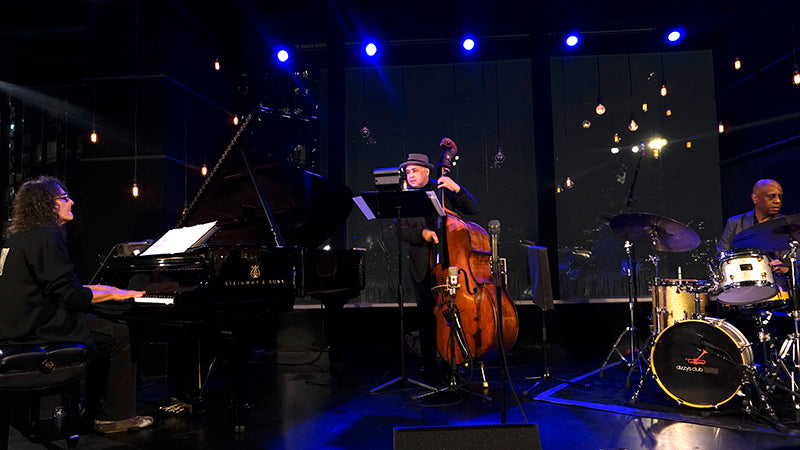
David Chesky, Peter Washington and Billy Drummond at Lincoln Center.

Although Chesky is forging ahead into the digital world, he is concerned about securing the future of American music. He wants there to be viable careers for young artists, so Chesky pursues a Leonard Bernstein-like dedication to introducing children to classical music through his compositions Classical Cats: A Children’s Introduction to the Orchestra, as well as The Zephyrtine: A Ballet Story, and the anti-war opera The Mice War. If kids don’t play instruments, join orchestras, and learn to compose, then who will buy music, attend concerts, and foster the next generation of musicians?

Chesky’s blog further addresses his concern for the fate of modern classical music in particular. "From 1900 – 1960 we have added to the standard repertoire Strauss, Mahler, Stravinsky, Bartok, Ravel, Fauré, Holst, Honegger, Berg, Rachmaninov, Janacek, Webern, Sibelius, Saint-Saens, Elgar, Vaughn Williams, Schoenberg, Debussy, Gershwin, Prokofiev, Ives, Shostakovich, and all the Diaghilev Ballets Russes works...Now, what has been added to the standard repertoire from 1960 until 2020?"

There are certainly current and modern composers like Chesky, Phillip Glass, Leonard Bernstein, and several more listed by the historic classical New York radio station WQXR, Terrence Blanchard, Jennifer Higdon, Jessie Montgomery, Eric Whitacre, Caroline Shaw, John Williams, and John Corigliano. Music is being composed, but Chesky seems to be asking if we will still rely on long-gone European composers instead of creating what he calls indigenous music. Judging by the state of modern attention spans, I cannot imagine live entertainment 20 years hence.

Chesky continues: "Do we have less-talented composers these days or did the first half of the 20th century by luck produce all these? Or did they have leaders in the classical industry with a vision that was the catalyst to create these masterpieces? It seems like today, concert halls now sell history as their business models." However, some concert halls are attempting to attract wider audiences.

This past holiday season, the New York Philharmonic featured John Williams’ score to Harry Potter and the Chamber of Secrets as the movie was projected behind the orchestra. I suppose that was part of their children’s programming. So maybe the classical music industry is headed towards multi-media, franchise-related, merchandise-driven extravaganzas. Without a foundation in classical music or ownership of our indigenous music, then it’s unlikely that Tchaikovsky, Bach, and Beethoven will make the cut in the future, let alone modern composers like Chesky.

I was fortunate to suffer through many fruitless years of piano lessons and, despite protests, my parents dragged me to Lincoln Center. I also had an uncle who owned Klipschorns and played dense Russian symphonies that shook his house in New Jersey and made me appreciate the vastness and complexity of opera and the philharmonic. I was lucky to know an audiophile who enjoyed that music and also knew that it should sound much better than WQXR coming through a radio speaker. In a world of constant super-sensory entertainment, perhaps 3D high-resolution digital music is the best way to attract new fans to jazz, classical, and modern original compositions. Just play any of Chesky’s immersive recordings, and everyone in the room will be captivated by a wall of sound with incredibly lifelike detail.
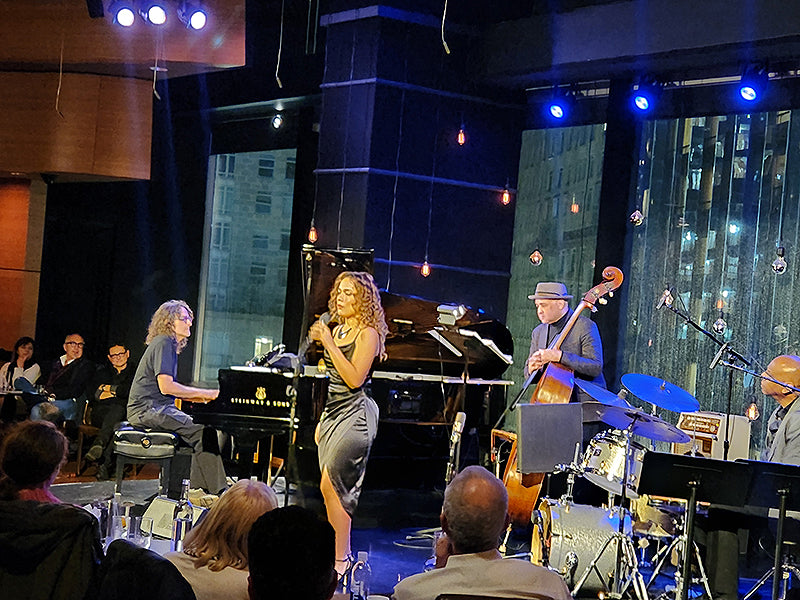
Paloma Chesky singing with the band at Lincoln Center. Paloma Chesky singing with the band at Lincoln Center.

Old-fashioned vinyl listeners (like me) with outdated computers and tube amps might not be set up to play DSD files, but I am able to download PCM WAV-format music that is compatible with a basic Windows Music Player. All you need is a DAC and a cable from your computer. Then arrange yourself and your speakers in an equilateral triangle to experience the massive soundstage in David Chesky’s latest recordings from The Audiophile Society. Take a look at their selection and stream some samples (a free sampler is available at this link). If you prefer headphones, as noted, these downloads also include special headphone mixes. No special equipment is required – the tracks play on standard 2-channel stereo gear.

As Chesky says, “When you hear our new Audiophile Society recordings on speakers, you should feel like you are in the space with the musicians…You should experience a sense of height and a wider and deeper soundstage. It should be a more enveloping realistic experience.”

Here's David and the band in a previous Lincoln Center concert:

As a special offer to Copper readers, you can get a coupon for 50 percent off your first purchase. To receive the offer, sign up for The Audiophile Society’s newsletter at www.theaudiophilesociety.com and enter code COPPER. The 50 percent off coupon offer is good for 60 days and you can share it with friends. You’ll also be able to download a free music sampler by signing up.

More from Issue 179

View All Articles in Issue 179

Search Copper Magazine

#234 A Life in High-End Audio: The Roy Hall Interview, Part One by Frank Doris Sep 07, 2026 #234 Jason Greenlaw Offers His Personal Perspective on Jazz Guitar in Vantage Point by Frank Doris Sep 07, 2026 #234 Transcendent Phoenix: Lucina Yue Brings the Ancient Konghou Into Modern Times by Frank Doris Sep 07, 2026 #234 We Must All Follow Our Bliss by B. Jan Montana Sep 07, 2026 #234 How to Play in a Rock Band, 27: Leveling Up by Frank Doris Sep 07, 2026 #234 Ross Valory: Traveling Into New Musical Territory With All of the Above by Ray Chelstowski Sep 07, 2026 #234 Singer/Songwriter John David Schrader: On the Need to Create by Joe Caplan Sep 07, 2026 #234 The People Who Make Audio Happen: More From T.H.E. Show SoCal 2026 by Harris Fogel Sep 07, 2026 #234 The Vinyl Beat Digs Into the Gadget Box by Rudy Radelic Sep 07, 2026 #234 The Rolling Stones: Foreign Tongues Spoken Loud by Wayne Robins Sep 07, 2026 #234 Musical Moments by Rich Isaacs Sep 07, 2026 #234 Rags for Solo Piano and a Dog: David Chesky's Ragtime Music for the Modern Age by Frankly Speaking Sep 07, 2026 #234 HIGH END 2026, Vienna: Here to Stay by Carsten Barnbeck Sep 07, 2026 #234 From The Audiophile’s Guide: The Two Main Types of Loudpeakers – Box and Panel by Paul McGowan Sep 07, 2026 #234 Letting it Slide by Frank Doris Sep 07, 2026 #234 PS Audio in the News by PS Audio Staff Sep 07, 2026 #234 Long Playing by Peter Xeni Sep 07, 2026 #234 La Mer by B. Jan Montana Sep 07, 2026 #233 A Report From The Total Hi-Fi Experience Show SoCal 2026 by B. Jan Montana Aug 03, 2026 #233 Bluegrass Meets Country, Folk, Jazz and More in All That We Carried by The Squid City Slingers by Frank Doris Aug 03, 2026 #233 Corey Glover and One Tribe Nation: A Variegated Musical Collective by Ray Chelstowski Aug 03, 2026 #233 Excursions with Clive: The Late Clive Davis, A Personal History by Wayne Robins Aug 03, 2026 #233 AI, Art, and Music: A Conversation With Synthography Art by Joe Caplan Aug 03, 2026 #233 New American Symphonies: A Rediscovered Gem and a Vital Contemporary Work by Frank Doris Aug 03, 2026 #233 The Vinyl Beat: Genesis, the Dave Clark Five, Antonio Carlos Jobim and More by Rudy Radelic Aug 03, 2026 #233 How to Play in a Rock Band, 26: When It's Time to Record Your Music by Frank Doris Aug 03, 2026 #233 More From T.H.E. Show 2026, and the People Who Made it Happen by Harris Fogel Aug 03, 2026 #233 Underappreciated Artists, Part Three: Icehouse by Rich Isaacs Aug 03, 2026 #233 The Surprisingly Rich and Varied Music of Somalia by Steve Kindig Aug 03, 2026 #233 A Remarkable Discographic Legacy: The LP Recordings of the Basel Symphony Orchestra by Stephan Haberthür Aug 03, 2026 #233 From The Audiophile’s Guide: The Importance of Loudspeakers by Paul McGowan Aug 03, 2026 #233 From Swimming Pool to New Listening Room: A Conversation with Norman Varney of AV RoomService by Gilles Laferrière Aug 03, 2026 #233 PS Audio in the News by PS Audio Staff Aug 03, 2026 #233 Audio Jewelry by Peter Xeni Aug 03, 2026 #233 Enrich Your Life by Frank Doris Aug 03, 2026 #233 The Searcher by James Schrimpf Aug 03, 2026 #232 What came first: Art or Music? A Conversation With Artist Jose Acosta by Joe Caplan Jul 06, 2026 #232 Blow By Blow: The Jeff Beck Story: An Insightful Book About a Guitar Icon by Ray Chelstowski Jul 06, 2026 #232 Creed Over Camaraderie? by B. Jan Montana Jul 06, 2026 #232 Chronicles of a Sound Pilgrim at the 2026 Montreal Audiofest by Hugues Morin Jul 06, 2026 #232 The Vinyl Beat: Summer Grooves by Rudy Radelic Jul 06, 2026 #232 Hibbing Hillbilly Dylan's Acoustic Rock by Wayne Robins Jul 06, 2026 #232 Quad Quads and Plasmatronics Tweeters: An Extraordinary System Comes to Life by Frank Doris Jul 06, 2026 #232 In Praise of Live Music, Once Again by Ted Shafran Jul 06, 2026 #232 Allnic Audio’s L-9000 Preamplifier: Design and Engineering Innovation by Howard Kneller Jul 06, 2026 #232 “Best Of” Lists and Rage Bait: Enough Already by Frank Doris Jul 06, 2026 #232 Quick Takes: Bud Shank, Paulo Almeida, Jakob Dreyer, Tim Eriksen and Peter Irvine by Frank Doris Jul 06, 2026

The Many Sides of David Chesky

The Many Sides of David Chesky

Located in the former Time Warner Building, now The Deutsche Bank Center, is Dizzy’s Club. Along with Rose Hall and The Appel Room, the three venues comprise Jazz at Lincoln Center under the leadership of artistic director, Wynton Marsalis. Sound in the well-appointed space is finely tuned, and every one of the 140 seats at Dizzy’s has a clear view of the stage set against a sparkling backdrop of the New York City skyline,

On a stormy night in December, David Chesky played the grand piano, Peter Washington plucked an upright bass, and Billy Drummond was behind the drums, performing selections from Chesky’s new high-resolution digital record, The Great European Songbook, available from The Audiophile Society. The set list was as follows:

Beethoven's Waldstein Sonata

Bach's Prelude No. 2

Bach's Fugue No. 2

Beethoven's “Für Elise”

Bach's Prelude No. 6

Bach's Solfeggietto

Bach's Wachet Auf, ruft uns die Stimme

Beethoven's “Ode to Joy” from the 9th Symphony (David's daughter Paloma sang that one)

Tchaikovsky's “Waltz of the Flowers” from The Nutcracker

David Chesky, The Great American Songbook, album cover.

The trio’s performance was a fantastic integration of European and American traditions as the jazz band swung through these classical pieces with freshness and flair and an excellent drum solo – something we could use more of in Bach pieces. I knew that David Chesky was involved with jazz and owned a record company, but I was unaware of his background in classical music and the breadth of his work in composition, recording, and technology.

Like many children of his day, taking piano lessons was a given – David started at the age of five. In 1974, at age 17, he moved from Miami to begin his music career in New York while studying with classical composer David Del Tredici and jazz pianist John Lewis of the Modern Jazz Quartet. A few years later he made an album with Michael Brecker, Randy Brecker, and Bob James.

Chesky didn’t stop at jazz. He plays and composes everything: concertos, operas, rags, Latin, folk, symphonies, piano solos, choral, and spiritual music. A lifetime of soaking up the city’s rhythms, including African drum beats and hip-hop, provides the heartbeat that fuels Chesky’s brand of “urban music.” It all flows from the sophisticated brain of a classical composer with the cool hair of a rock star ─ except rock is the one genre he doesn’t play. In addition to his vast repertoire and three Grammy award nominations, Chesky is also an innovator in the world of high-resolution recording.

In 1978 Chesky and his brother Norman founded Chesky Records, a label dedicated to producing audiophile-grade reissues as well as original recordings made in three-dimensional sound. Their binaural recordings employ a dummy head with microphones in its ears to capture the spatial imprint of ambient spaces like churches, bringing the listener closer to the instruments and musicians.

In 2008, the Chesky brothers started HDtracks, a high-resolution download store of recordings from 96 kHz/24-bit to 192 kHz/24-bit across all genres. These sample rates are much higher than a streaming MP3 or a standard CD at 44 kHz/16-bit resolution. Chesky's latest project is The Audiophile Society, which offers music in their 3D Mega-Dimensional Sound recordings of high-res PCM (in WAV, FLAC, ALAC, AIFF formats) and DSD (Direct Stream Digital) downloads with separate mixes for speakers and headphones.

How do digital files compare to vinyl? It’s a question complicated by many factors, including how an album was recorded, mastered, and pressed. What is lost in the tactile analog experience is gained in sonic consistency free of equipment variables such as the cartridge, turntable, and phono preamp. This quality of music is worth buying because learning, performing, and recording music is never free.

David Chesky, Peter Washington and Billy Drummond at Lincoln Center.

Although Chesky is forging ahead into the digital world, he is concerned about securing the future of American music. He wants there to be viable careers for young artists, so Chesky pursues a Leonard Bernstein-like dedication to introducing children to classical music through his compositions Classical Cats: A Children’s Introduction to the Orchestra, as well as The Zephyrtine: A Ballet Story, and the anti-war opera The Mice War. If kids don’t play instruments, join orchestras, and learn to compose, then who will buy music, attend concerts, and foster the next generation of musicians?

Chesky’s blog further addresses his concern for the fate of modern classical music in particular. "From 1900 – 1960 we have added to the standard repertoire Strauss, Mahler, Stravinsky, Bartok, Ravel, Fauré, Holst, Honegger, Berg, Rachmaninov, Janacek, Webern, Sibelius, Saint-Saens, Elgar, Vaughn Williams, Schoenberg, Debussy, Gershwin, Prokofiev, Ives, Shostakovich, and all the Diaghilev Ballets Russes works...Now, what has been added to the standard repertoire from 1960 until 2020?"

There are certainly current and modern composers like Chesky, Phillip Glass, Leonard Bernstein, and several more listed by the historic classical New York radio station WQXR, Terrence Blanchard, Jennifer Higdon, Jessie Montgomery, Eric Whitacre, Caroline Shaw, John Williams, and John Corigliano. Music is being composed, but Chesky seems to be asking if we will still rely on long-gone European composers instead of creating what he calls indigenous music. Judging by the state of modern attention spans, I cannot imagine live entertainment 20 years hence.

Chesky continues: "Do we have less-talented composers these days or did the first half of the 20th century by luck produce all these? Or did they have leaders in the classical industry with a vision that was the catalyst to create these masterpieces? It seems like today, concert halls now sell history as their business models." However, some concert halls are attempting to attract wider audiences.

This past holiday season, the New York Philharmonic featured John Williams’ score to Harry Potter and the Chamber of Secrets as the movie was projected behind the orchestra. I suppose that was part of their children’s programming. So maybe the classical music industry is headed towards multi-media, franchise-related, merchandise-driven extravaganzas. Without a foundation in classical music or ownership of our indigenous music, then it’s unlikely that Tchaikovsky, Bach, and Beethoven will make the cut in the future, let alone modern composers like Chesky.

I was fortunate to suffer through many fruitless years of piano lessons and, despite protests, my parents dragged me to Lincoln Center. I also had an uncle who owned Klipschorns and played dense Russian symphonies that shook his house in New Jersey and made me appreciate the vastness and complexity of opera and the philharmonic. I was lucky to know an audiophile who enjoyed that music and also knew that it should sound much better than WQXR coming through a radio speaker. In a world of constant super-sensory entertainment, perhaps 3D high-resolution digital music is the best way to attract new fans to jazz, classical, and modern original compositions. Just play any of Chesky’s immersive recordings, and everyone in the room will be captivated by a wall of sound with incredibly lifelike detail.

Paloma Chesky singing with the band at Lincoln Center. Paloma Chesky singing with the band at Lincoln Center.

Old-fashioned vinyl listeners (like me) with outdated computers and tube amps might not be set up to play DSD files, but I am able to download PCM WAV-format music that is compatible with a basic Windows Music Player. All you need is a DAC and a cable from your computer. Then arrange yourself and your speakers in an equilateral triangle to experience the massive soundstage in David Chesky’s latest recordings from The Audiophile Society. Take a look at their selection and stream some samples (a free sampler is available at this link). If you prefer headphones, as noted, these downloads also include special headphone mixes. No special equipment is required – the tracks play on standard 2-channel stereo gear.

As Chesky says, “When you hear our new Audiophile Society recordings on speakers, you should feel like you are in the space with the musicians…You should experience a sense of height and a wider and deeper soundstage. It should be a more enveloping realistic experience.”

Here's David and the band in a previous Lincoln Center concert:

As a special offer to Copper readers, you can get a coupon for 50 percent off your first purchase. To receive the offer, sign up for The Audiophile Society’s newsletter at www.theaudiophilesociety.com and enter code COPPER. The 50 percent off coupon offer is good for 60 days and you can share it with friends. You’ll also be able to download a free music sampler by signing up.

0 comments

Leave a comment

0 Comments

Your avatar

Loading comments...

🗑️ Delete Comment

Enter moderator password to delete this comment:

✏️ Edit Comment

Enter your email to verify ownership: