COPPER

A PS Audio Publication

Issue 168 • Free Online Magazine

Issue 168 Deep Dive

The Evolution of In-Ear Monitors

The Evolution of In-Ear Monitors

They have become ubiquitous on concert stages from clubs and churches to theaters and stadiums. They have become so popular that some people prefer them over conventional headphones, and they have even developed a following among select audiophiles. I’m talking about in-ear monitors, a type of in-ear headphones better known colloquially as IEMs.

Similar to earbuds, IEMs are configured to better fit in the ear canal for improved isolation. They range from models designed for the rigors of professional use to mass-market products: some decent-quality IEMs made by KZ in China sell for as low as $10, while pro and audiophile-approved IEMs with custom-molded earpieces (shaped to fit a person’s ears) and wireless circuitry can run into the thousands.

A Brief History

Transistor technology, with its drastically reduced size, weight and heat, revolutionized consumer electronics beginning in the 1950s after its initial creation at Bell Labs in 1947. The 1954 Regency TR-1 was the first commercial pocket-sized transistor radio, and it came equipped with the very first predecessor of the IEM – a monophonic earphone.
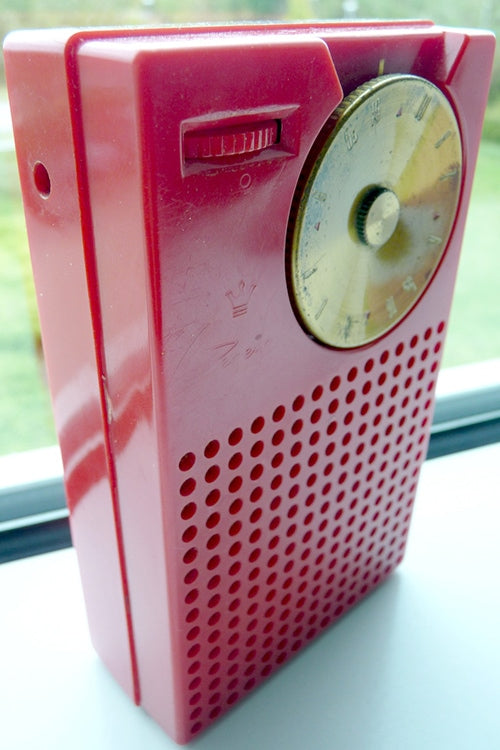
 

A Regency TR-1 transistor radio. Courtesy of Wikimedia Commons/Cmglee.

A Regency TR-1 transistor radio. Courtesy of Wikimedia Commons/Cmglee.


The limited fidelity of those early, primitive in-ear models relegated them to casual listening of radio broadcasts. The first stereo mini-headphones designed as higher-fidelity in-ears would emerge on the heels of the Sony Walkman, which debuted in Japan in 1979. The notion of using IEM technology as a monitoring system to replace wedges (angled floor speakers for on-stage monitoring) for the concert stage began its full commercial development during this same era.
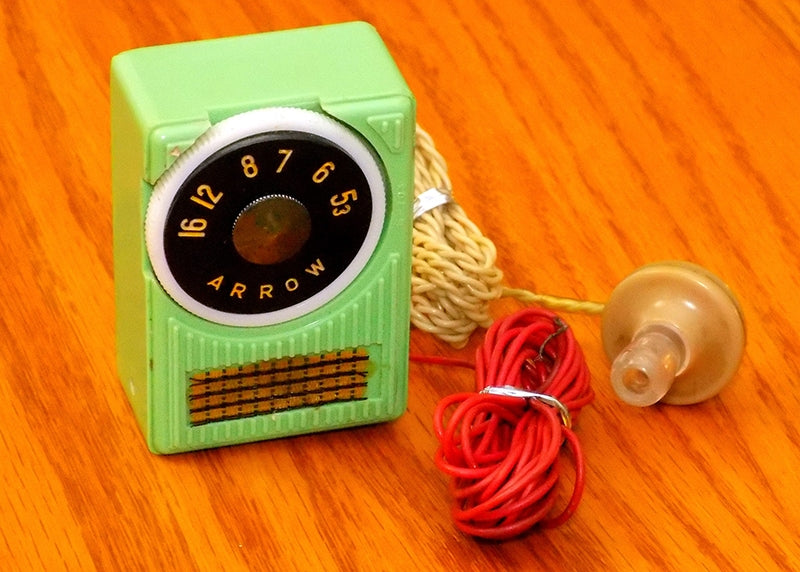
 

Circa 1950s Arrow transistor radio with earpiece. Courtesy of Wikimedia Commons/Joe Haupt.

Circa 1950s Arrow transistor radio with earpiece. Courtesy of Wikimedia Commons/Joe Haupt.


The use of wireless IEMs by professional musicians onstage was first legitimized when Stevie Wonder began using a Chrys Lindop-modified version of them in the 1980s. Lindop was Stevie Wonder’s live sound engineer. Wonder had launched Wonderland Radio and was touring with a mobile FM radio broadcast transmitter. He used a Sony FM Walkman receiver tuned to Wonderland Radio so he could monitor himself on the broadcasts. This mobile FM radio station would travel with Wonder when he was on tour and would broadcast his concerts live, along with other music. A de facto pirate Radio station, Wonderland Radio reportedly could be picked up as far as six miles away by radio listeners in Hampstead, England when Wonder performed at Wembley Stadium. Rod Stewart and Peter Gabriel also went on to use Lindop’s subsequent IEM inventions later in the 1980s.

The IEMs that Lindop had modified were based on a 1965 design by a then 13-year-old Stephen Ambrose. Ambrose had mounted tiny speakers into a clay mold that he adapted from swimming earplug designs. His devices could deliver sound into a fully-sealed ear canal, thus becoming the first genuine operational IEM. He would go on to custom-make his new IEMs for such artists as Simon and Garfunkel, Diana Ross, and Rush for the next few decades and also go on to patent several innovations, such as an IEM with built-in hearing protection against excessive sound pressure levels.

In a 2019 interview in Pro Sound Web, Ambrose noted: “The speaker was very, very low quality. But I would listen to it, and I would try to figure out how to get my voice to go through the radio so I could listen to myself and amplify it so that nobody could hear me singing – especially my father. It came with an earbud, but it needed to be transformed. I first used gum – I actually used bubble gum! Then I became much more professional and moved to the big time and used Silly Putty. After that, I hacked open a tape recorder with a mic, took the amplifier out of it, and had it power the first in-ear monitors.”

In 1984, Steve Miller began funding R&D into a truly professional commercial-level IEM, and coined the term “Ear Monitor” in 1990 with a system devised by Marty Garcia (with Lindop) at Crystal Taylor Sound, who went on to become the founder of Future Sonics, a leader in the field to this day. Todd Rundgren was also an early adopter of Garcia’s IEM designs during the 1980s, and Utopia became the first group to go wedgeless and take Garcia’s prototype Future Sonics IEMs on the road in 1985, although these units were not yet wireless. Lindop’s pioneering use of FM wireless was incorporated into designs that he and Garcia created that included cannibalized parts from Sony Walkman transducers in order to create the Future Sonics Ear Monitor.

Competitors to Future Sonics emerged in the early 1990s, such as Sensaphonics’ ProPhonic system, Circus Maximus’ C-MAX, Etymotic Research’s canalphone, and a system from Bross Audio Design’s among the more prominent ones.

In 1995, Jerry Harvey was the touring monitor engineer for Van Halen and created the first multiple-driver IEMs for drummer Alex Van Halen, who was suffering ear pains from the huge SPLs of the band’s mammoth amp and sound system. Acknowledging the inadequacy of single-driver systems to deliver the clarity and ear protection required for Van Halen, Harvey’s multiple-driver IEMs became the template for most current models. Harvey is now the owner of JH Audio.

Seeing the burgeoning market trend, the big pro audio companies would soon follow in the mid 1990s. Sennheiser and Shure launched their respective IEM designs, and are still significant players in the sector, with Shure’s SE215 Pro IEM becoming nearly an industry standard among working musicians with its $89 suggested retail price.
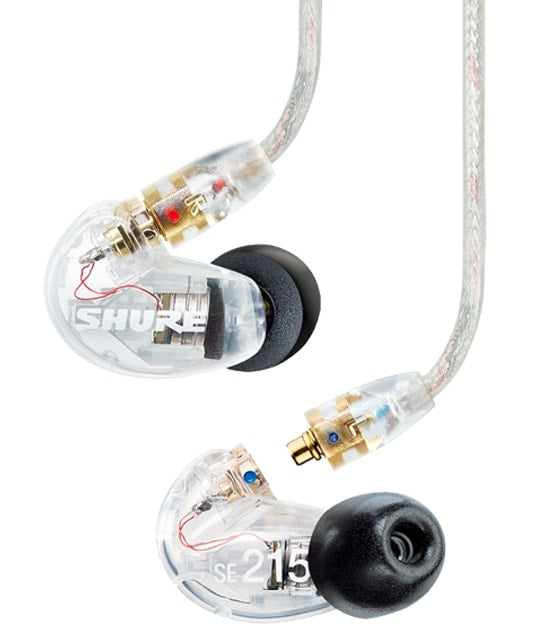
 

Shure SE215 Pro in-ear monitors.

Shure SE215 Pro in-ear monitors.


The MTV era ushered in a greater need for video, and artists like Madonna and Janet Jackson transformed concerts into multimedia events with choreography, staged lighting effects, and a greater reliance on pre-recorded tracks. IEMs became a necessity for sound monitoring due to their ability to connect wirelessly. The increased use of computers to sync pre-recorded music, lights, video, and cues for live dancers and singers required the ability to not only allow them to hear music, but also directors’ stage and camera instructions in real time. Thus, IEMs quickly proliferated throughout not only all genres within the music industry, but also to theater, dance, TV broadcasting and all other types of live events.

Today’s IEMs have now become not only an audio device but a fashion accessory, as some models sport customized artwork, precious stones, gold engraving, and other design elements.

Design

The vast majority of professional and mass-market IEMs usually incorporate balanced armature design drivers, which are derived from hearing aids technology, or dynamic drivers, which are miniature versions of the drivers found in over-ear conventional dynamic headphones. The general consensus is that dynamic drivers deliver stronger low-end response and are more robust under heavy use, while balanced armature designs, although more fragile, deliver better midrange and high-frequency response. Some models incorporate a hybrid of both designs.

Miniaturization allows for allocating different components to different frequency ranges for the maximization of headroom, and to provide virtually distortion-free performance. As a result, some professional IEMs, such as several offerings by companies like 64 Audio, may incorporate as many as 18 or even more drivers.

IEM Pros and Cons for Performing Musicians

From the musician’s perspective, there are a lot of positives in favor of using IEMs over wedges. Among those cited by those who favor IEMs:

  • The ability to customize one’s monitor mix. This is especially crucial for singers trying to stay on pitch, and for musicians to hear verbal instructions from a music director, a click track if there are pre-recorded elements that have to be performed in sync, or instruments that normally might get buried in a wedge monitor mix, like an acoustic guitar among synthesizers and distorted electric guitars.
  • Hearing protection. The isolation of IEMs and the ability to hear a monitor mix using lower SPLs greatly aids in preserving one’s hearing and in mitigating tinnitus and other afflictions related to exposure to loud volumes.
  • Mobility – wireless monitoring allows a performer the freedom to be able to hear a mix clearly from anywhere on stage, especially if dance choreography or running to different corners of a stage or even into the audience is part of the show.
  • Consistency – whether indoors or outdoors, an IEM mix is not affected by room or space acoustics, so one’s monitor mix can be uniform throughout a tour from venue to venue.
  • Singers that can easily hear themselves will undergo much less risk of vocal strain.
  • Feedback elimination – one drawback of wedges is the risk of feedback if a microphone inadvertently picks up too much sound coming from the wedges. This can result in numerous on-stage issues for a sound engineer, especially if there are multiple mics and identifying the culprit mic is not obvious.

 

Questlove using IEMs in concert. Courtesy of Wikimedia Commons/Brennan Schnell.

Questlove using IEMs in concert. Courtesy of Wikimedia Commons/Brennan Schnell.


However, not all musicians are sold on IEMs, and some for genuine artistic reasons. Guitar virtuoso Joe Satriani told Ultimate Guitar that he eschews IEMs for several reasons:

“No, I really hate that. A couple of reasons: number one – I manipulate the sustain of the guitar by proximity effect. I’ve got my amps behind me, 4 x 12 [inch speaker] cabinets, and I have monitors placed around the stage, it’s very old school. They’re really loud; if you walked on stage in the middle of a show, you’d be like, ‘Oh, my God, too much Joe.’ (laughs)

But I’m using that sort of field, creating an environment where I can turn left to right and I can get different kinds of sustain. It allows me to really hear the sound of my touch, because that’s what I’m playing with, I’m really manipulating finer elements of performance in order to convey the meaning of the song to the audience. That part of it, to me, is essential.

And also, getting positive feedback is impossible; you can’t hold your guitar up to your in-ears to do that. And the other thing is, I hate in-ears because you can’t get away from the sound. Like, if I need to hear more hi-hat I just walk over to the drums, you know what I mean? (laughs) If I’m trying to get away from the bass, I can just step back and head towards my amps. Sometimes there are parts of songs where you do need to hear somebody else really quickly, and you can’t be sending signals to the monitor guy, that doesn’t work.”

Other touring musicians cited some additional drawbacks of using IEMs:

  • A much greater reliance on a good monitor engineer for a musician to hear him or herself, and the inherent challenges for the monitoring mix engineer to deliver a good mix that will work for all musicians when they change their respective mix volume levels.
  • A sense of detachment from hearing the reactions of the audience.
  • Wireless radio issues of static, crosstalk and dropouts.
  • The loss of feeling air moving from speakers when IEMs are used for amp-less stages.

Artists who have opted to use a hybrid approach of wedges combined with IEMs include Metallica, Joe Bonamassa, and James Taylor.

Audiophile Opinions

The audiophile world has also taken to high-end earbuds and IEMs and designers such as Linsoul Audio and Campfire Audio  have incorporated planar magnetic and electrostatic technology into audiophile-marketed in-ears for more discriminating listeners. Additionally, the need for total isolation is unnecessary for listening environments outside of the performance stage. As a result, certain IEMs intended for the audiophile market will sometimes feature tiny holes or other elements that allow for outside sound to also be heard.
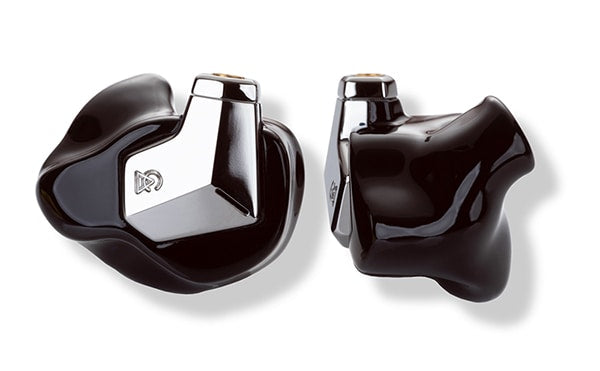
 

Campfire Audio Supermoon planar magnetic in-ear monitors.

Campfire Audio Supermoon planar magnetic in-ear monitors.


Unsurprisingly, audiophiles often demand the same level of performance from in-ear headphones and IEMs that they do from other hi-fi components — precise detail and articulation of high notes, punch-in-the-gut (so to speak) impactful bass, meticulous separation of instruments, and a hyper-realistic 3D soundstage imaging that places the listener right in the midst of the music – much in line with the current trend towards immersive audio mixes.

To that end, top-notch components, such as the internal wiring and connecting cables, the earpiece outer shell, and even the rubber tips that go into the ears are of premium quality and chosen for their sonic or electronic performance properties.

The aforementioned 64 Audio IEMs, sporting 9 drivers in each earpiece, are easily surpassed by models like audiophile IEM manufacturer Astell and Kern’s $3,500 Layla AION, a design collaboration with Jerry Harvey, which contains 12 balanced armatures in each earpiece with four crossovers in a carbon fiber housing.

IEMs and in-ear headphones are certainly here to stay, and new companies continue to push the envelope in developing better specs, ergonomics and sound quality for a market that can only continue to grow, as digital device use spreads to wearables, the internet of Things, and a host of other applications.
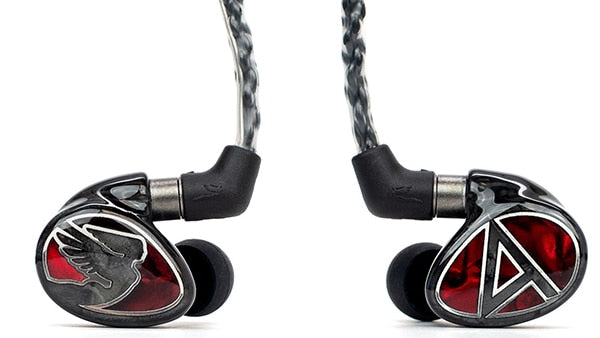
Astell and Kern Layla AION.

Astell and Kern Layla AION.


Header image: Carrie Underwood using in-ear monitors at the World Arena, Colorado Springs, Colorado. Courtesy of Wikimedia Commons/the_diet_starts_mond ay from Colorado.

More from Issue 168

View All Articles in Issue 168

Search Copper Magazine

#228 Serita’s Black Rose Duo Shakes Your Soul With a Blend of Funk, Rock, Blues and a Whole Lot More by Frank Doris Mar 02, 2026 #228 Vinyl, A Love Story by Wayne Robins Mar 02, 2026 #228 Thrill Seeker by B. Jan Montana Mar 02, 2026 #228 The Vinyl Beat: Donald Byrd, Bill Evans, Wes Montgomery, Eddie Palmieri and Frank Sinatra by Rudy Radelic Mar 02, 2026 #228 Listening to Prestige: The History of a Vitally Important Jazz Record Label by Frank Doris Mar 02, 2026 #228 How to Play in a Rock Band, 21: Touring With James Lee Stanley by Frank Doris Mar 02, 2026 #228 The NAMM 2026 Show: The Music Industry’s Premier Event by John Volanski Mar 02, 2026 #228 The Earliest Stars of Country Music, Part Two by Jeff Weiner Mar 02, 2026 #228 From The Audiophile's Guide: A Brief History of Stereophonic Sound by Paul McGowan Mar 02, 2026 #228 A Bone to Pick With Streaming Audio by Frank Doris Mar 02, 2026 #228 Blast Off With Bluesman Duke Robillard by Ray Chelstowski Mar 02, 2026 #228 A Visit to the Marten Loudspeaker Factory in Göteborg, Sweden by Ingo Schulz and Sebastian Polcyn Mar 02, 2026 #228 Pure Distortion by Peter Xeni Mar 02, 2026 #228 A Nagra Factory Tour by Markus "Marsu" Manthey Mar 02, 2026 #228 Back to My Reel-to-Reel Roots, Part 27: Noodge and Ye Shall Receive, Part Two by Ken Kessler Mar 02, 2026 #228 PS Audio in the News by PS Audio Staff Mar 02, 2026 #228 90-Degree Stereo by Frank Doris Mar 02, 2026 #228 The Keys to Art by Rich Isaacs Mar 02, 2026 #227 Seth Lewis Gets in the Groove With Take a Look Around: a Tribute to the Meters by Frank Doris Feb 02, 2026 #227 Passport to Sound: May Anwar’s Audio Learning Experience for Young People by Frank Doris Feb 02, 2026 #227 Conjectures on Cosmic Consciousness by B. Jan Montana Feb 02, 2026 #227 The Big Takeover Turns 45 by Wayne Robins Feb 02, 2026 #227 Music and Chocolate: On the Sensory Connection by Joe Caplan Feb 02, 2026 #227 Singer/Songwriter Chris Berardo: Getting Wilder All the Time by Ray Chelstowski Feb 02, 2026 #227 The Earliest Stars of Country Music, Part One by Jeff Weiner Feb 02, 2026 #227 The Vinyl Beat Goes Down to Tijuana (By Way of Los Angeles), Part Two by Rudy Radelic Feb 02, 2026 #227 How to Play in a Rock Band, 20: On the Road With Blood, Sweat & Tears’ Guitarist Gabe Cummins by Frank Doris Feb 02, 2026 #227 From The Audiophile’s Guide: Audio Specs and Measuring by Paul McGowan Feb 02, 2026 #227 Our Brain is Always Listening by Peter Trübner Feb 02, 2026 #227 PS Audio in the News by PS Audio Staff Feb 02, 2026 #227 The Listening Chair: Sleek Style and Sound From the Luxman L3 by Howard Kneller Feb 02, 2026 #227 The Los Angeles and Orange County Audio Society Celebrates Its 32nd Anniversary, Honoring David and Sheryl Lee Wilson and Bernie Grundman by Harris Fogel Feb 02, 2026 #227 Back to My Reel-to-Reel Roots, Part 26: Half Full – Not Half Empty, Redux by Ken Kessler Feb 02, 2026 #227 That's What Puzzles Us... by Frank Doris Feb 02, 2026 #227 Record-Breaking by Peter Xeni Feb 02, 2026 #227 The Long and Winding Road by B. Jan Montana Feb 02, 2026 #226 JJ Murphy’s Sleep Paralysis is a Genre-Bending Musical Journey Through Jazz, Fusion and More by Frank Doris Jan 05, 2026 #226 Stewardship by Consent by B. Jan Montana Jan 05, 2026 #226 Food, Music, and Sensory Experience: An Interview With Professor Jonathan Zearfoss of the Culinary Institute of America by Joe Caplan Jan 05, 2026 #226 Studio Confidential: A Who’s Who of Recording Engineers Tell Their Stories by Frank Doris Jan 05, 2026 #226 Pilot Radio is Reborn, 50 Years Later: Talking With CEO Barak Epstein by Frank Doris Jan 05, 2026 #226 The Vinyl Beat Goes Down to Tijuana (By Way of Los Angeles), Part One by Rudy Radelic Jan 05, 2026 #226 Capital Audiofest 2025: Must-See Stereo, Part Two by Frank Doris Jan 05, 2026 #226 My Morning Jacket’s Carl Broemel and Tyler Ramsey Collaborate on Their Acoustic Guitar Album, Celestun by Ray Chelstowski Jan 05, 2026 #226 The People Who Make Audio Happen: CanJam SoCal 2025, Part Two by Harris Fogel Jan 05, 2026 #226 How to Play in a Rock Band, 19: Touring Can Make You Crazy, Part One by Frank Doris Jan 05, 2026 #226 Linda Ronstadt Goes Bigger by Wayne Robins Jan 05, 2026

The Evolution of In-Ear Monitors

The Evolution of In-Ear Monitors

They have become ubiquitous on concert stages from clubs and churches to theaters and stadiums. They have become so popular that some people prefer them over conventional headphones, and they have even developed a following among select audiophiles. I’m talking about in-ear monitors, a type of in-ear headphones better known colloquially as IEMs.

Similar to earbuds, IEMs are configured to better fit in the ear canal for improved isolation. They range from models designed for the rigors of professional use to mass-market products: some decent-quality IEMs made by KZ in China sell for as low as $10, while pro and audiophile-approved IEMs with custom-molded earpieces (shaped to fit a person’s ears) and wireless circuitry can run into the thousands.

A Brief History

Transistor technology, with its drastically reduced size, weight and heat, revolutionized consumer electronics beginning in the 1950s after its initial creation at Bell Labs in 1947. The 1954 Regency TR-1 was the first commercial pocket-sized transistor radio, and it came equipped with the very first predecessor of the IEM – a monophonic earphone.


A Regency TR-1 transistor radio. Courtesy of Wikimedia Commons/Cmglee.

A Regency TR-1 transistor radio. Courtesy of Wikimedia Commons/Cmglee.


The limited fidelity of those early, primitive in-ear models relegated them to casual listening of radio broadcasts. The first stereo mini-headphones designed as higher-fidelity in-ears would emerge on the heels of the Sony Walkman, which debuted in Japan in 1979. The notion of using IEM technology as a monitoring system to replace wedges (angled floor speakers for on-stage monitoring) for the concert stage began its full commercial development during this same era.


Circa 1950s Arrow transistor radio with earpiece. Courtesy of Wikimedia Commons/Joe Haupt.

Circa 1950s Arrow transistor radio with earpiece. Courtesy of Wikimedia Commons/Joe Haupt.


The use of wireless IEMs by professional musicians onstage was first legitimized when Stevie Wonder began using a Chrys Lindop-modified version of them in the 1980s. Lindop was Stevie Wonder’s live sound engineer. Wonder had launched Wonderland Radio and was touring with a mobile FM radio broadcast transmitter. He used a Sony FM Walkman receiver tuned to Wonderland Radio so he could monitor himself on the broadcasts. This mobile FM radio station would travel with Wonder when he was on tour and would broadcast his concerts live, along with other music. A de facto pirate Radio station, Wonderland Radio reportedly could be picked up as far as six miles away by radio listeners in Hampstead, England when Wonder performed at Wembley Stadium. Rod Stewart and Peter Gabriel also went on to use Lindop’s subsequent IEM inventions later in the 1980s.

The IEMs that Lindop had modified were based on a 1965 design by a then 13-year-old Stephen Ambrose. Ambrose had mounted tiny speakers into a clay mold that he adapted from swimming earplug designs. His devices could deliver sound into a fully-sealed ear canal, thus becoming the first genuine operational IEM. He would go on to custom-make his new IEMs for such artists as Simon and Garfunkel, Diana Ross, and Rush for the next few decades and also go on to patent several innovations, such as an IEM with built-in hearing protection against excessive sound pressure levels.

In a 2019 interview in Pro Sound Web, Ambrose noted: “The speaker was very, very low quality. But I would listen to it, and I would try to figure out how to get my voice to go through the radio so I could listen to myself and amplify it so that nobody could hear me singing – especially my father. It came with an earbud, but it needed to be transformed. I first used gum – I actually used bubble gum! Then I became much more professional and moved to the big time and used Silly Putty. After that, I hacked open a tape recorder with a mic, took the amplifier out of it, and had it power the first in-ear monitors.”

In 1984, Steve Miller began funding R&D into a truly professional commercial-level IEM, and coined the term “Ear Monitor” in 1990 with a system devised by Marty Garcia (with Lindop) at Crystal Taylor Sound, who went on to become the founder of Future Sonics, a leader in the field to this day. Todd Rundgren was also an early adopter of Garcia’s IEM designs during the 1980s, and Utopia became the first group to go wedgeless and take Garcia’s prototype Future Sonics IEMs on the road in 1985, although these units were not yet wireless. Lindop’s pioneering use of FM wireless was incorporated into designs that he and Garcia created that included cannibalized parts from Sony Walkman transducers in order to create the Future Sonics Ear Monitor.

Competitors to Future Sonics emerged in the early 1990s, such as Sensaphonics’ ProPhonic system, Circus Maximus’ C-MAX, Etymotic Research’s canalphone, and a system from Bross Audio Design’s among the more prominent ones.

In 1995, Jerry Harvey was the touring monitor engineer for Van Halen and created the first multiple-driver IEMs for drummer Alex Van Halen, who was suffering ear pains from the huge SPLs of the band’s mammoth amp and sound system. Acknowledging the inadequacy of single-driver systems to deliver the clarity and ear protection required for Van Halen, Harvey’s multiple-driver IEMs became the template for most current models. Harvey is now the owner of JH Audio.

Seeing the burgeoning market trend, the big pro audio companies would soon follow in the mid 1990s. Sennheiser and Shure launched their respective IEM designs, and are still significant players in the sector, with Shure’s SE215 Pro IEM becoming nearly an industry standard among working musicians with its $89 suggested retail price.


Shure SE215 Pro in-ear monitors.

Shure SE215 Pro in-ear monitors.


The MTV era ushered in a greater need for video, and artists like Madonna and Janet Jackson transformed concerts into multimedia events with choreography, staged lighting effects, and a greater reliance on pre-recorded tracks. IEMs became a necessity for sound monitoring due to their ability to connect wirelessly. The increased use of computers to sync pre-recorded music, lights, video, and cues for live dancers and singers required the ability to not only allow them to hear music, but also directors’ stage and camera instructions in real time. Thus, IEMs quickly proliferated throughout not only all genres within the music industry, but also to theater, dance, TV broadcasting and all other types of live events.

Today’s IEMs have now become not only an audio device but a fashion accessory, as some models sport customized artwork, precious stones, gold engraving, and other design elements.

Design

The vast majority of professional and mass-market IEMs usually incorporate balanced armature design drivers, which are derived from hearing aids technology, or dynamic drivers, which are miniature versions of the drivers found in over-ear conventional dynamic headphones. The general consensus is that dynamic drivers deliver stronger low-end response and are more robust under heavy use, while balanced armature designs, although more fragile, deliver better midrange and high-frequency response. Some models incorporate a hybrid of both designs.

Miniaturization allows for allocating different components to different frequency ranges for the maximization of headroom, and to provide virtually distortion-free performance. As a result, some professional IEMs, such as several offerings by companies like 64 Audio, may incorporate as many as 18 or even more drivers.

IEM Pros and Cons for Performing Musicians

From the musician’s perspective, there are a lot of positives in favor of using IEMs over wedges. Among those cited by those who favor IEMs:

  • The ability to customize one’s monitor mix. This is especially crucial for singers trying to stay on pitch, and for musicians to hear verbal instructions from a music director, a click track if there are pre-recorded elements that have to be performed in sync, or instruments that normally might get buried in a wedge monitor mix, like an acoustic guitar among synthesizers and distorted electric guitars.
  • Hearing protection. The isolation of IEMs and the ability to hear a monitor mix using lower SPLs greatly aids in preserving one’s hearing and in mitigating tinnitus and other afflictions related to exposure to loud volumes.
  • Mobility – wireless monitoring allows a performer the freedom to be able to hear a mix clearly from anywhere on stage, especially if dance choreography or running to different corners of a stage or even into the audience is part of the show.
  • Consistency – whether indoors or outdoors, an IEM mix is not affected by room or space acoustics, so one’s monitor mix can be uniform throughout a tour from venue to venue.
  • Singers that can easily hear themselves will undergo much less risk of vocal strain.
  • Feedback elimination – one drawback of wedges is the risk of feedback if a microphone inadvertently picks up too much sound coming from the wedges. This can result in numerous on-stage issues for a sound engineer, especially if there are multiple mics and identifying the culprit mic is not obvious.


Questlove using IEMs in concert. Courtesy of Wikimedia Commons/Brennan Schnell.

Questlove using IEMs in concert. Courtesy of Wikimedia Commons/Brennan Schnell.


However, not all musicians are sold on IEMs, and some for genuine artistic reasons. Guitar virtuoso Joe Satriani told Ultimate Guitar that he eschews IEMs for several reasons:

“No, I really hate that. A couple of reasons: number one – I manipulate the sustain of the guitar by proximity effect. I’ve got my amps behind me, 4 x 12 [inch speaker] cabinets, and I have monitors placed around the stage, it’s very old school. They’re really loud; if you walked on stage in the middle of a show, you’d be like, ‘Oh, my God, too much Joe.’ (laughs)

But I’m using that sort of field, creating an environment where I can turn left to right and I can get different kinds of sustain. It allows me to really hear the sound of my touch, because that’s what I’m playing with, I’m really manipulating finer elements of performance in order to convey the meaning of the song to the audience. That part of it, to me, is essential.

And also, getting positive feedback is impossible; you can’t hold your guitar up to your in-ears to do that. And the other thing is, I hate in-ears because you can’t get away from the sound. Like, if I need to hear more hi-hat I just walk over to the drums, you know what I mean? (laughs) If I’m trying to get away from the bass, I can just step back and head towards my amps. Sometimes there are parts of songs where you do need to hear somebody else really quickly, and you can’t be sending signals to the monitor guy, that doesn’t work.”

Other touring musicians cited some additional drawbacks of using IEMs:

  • A much greater reliance on a good monitor engineer for a musician to hear him or herself, and the inherent challenges for the monitoring mix engineer to deliver a good mix that will work for all musicians when they change their respective mix volume levels.
  • A sense of detachment from hearing the reactions of the audience.
  • Wireless radio issues of static, crosstalk and dropouts.
  • The loss of feeling air moving from speakers when IEMs are used for amp-less stages.

Artists who have opted to use a hybrid approach of wedges combined with IEMs include Metallica, Joe Bonamassa, and James Taylor.

Audiophile Opinions

The audiophile world has also taken to high-end earbuds and IEMs and designers such as Linsoul Audio and Campfire Audio  have incorporated planar magnetic and electrostatic technology into audiophile-marketed in-ears for more discriminating listeners. Additionally, the need for total isolation is unnecessary for listening environments outside of the performance stage. As a result, certain IEMs intended for the audiophile market will sometimes feature tiny holes or other elements that allow for outside sound to also be heard.


Campfire Audio Supermoon planar magnetic in-ear monitors.

Campfire Audio Supermoon planar magnetic in-ear monitors.


Unsurprisingly, audiophiles often demand the same level of performance from in-ear headphones and IEMs that they do from other hi-fi components — precise detail and articulation of high notes, punch-in-the-gut (so to speak) impactful bass, meticulous separation of instruments, and a hyper-realistic 3D soundstage imaging that places the listener right in the midst of the music – much in line with the current trend towards immersive audio mixes.

To that end, top-notch components, such as the internal wiring and connecting cables, the earpiece outer shell, and even the rubber tips that go into the ears are of premium quality and chosen for their sonic or electronic performance properties.

The aforementioned 64 Audio IEMs, sporting 9 drivers in each earpiece, are easily surpassed by models like audiophile IEM manufacturer Astell and Kern’s $3,500 Layla AION, a design collaboration with Jerry Harvey, which contains 12 balanced armatures in each earpiece with four crossovers in a carbon fiber housing.

IEMs and in-ear headphones are certainly here to stay, and new companies continue to push the envelope in developing better specs, ergonomics and sound quality for a market that can only continue to grow, as digital device use spreads to wearables, the internet of Things, and a host of other applications.

Astell and Kern Layla AION.

Astell and Kern Layla AION.


Header image: Carrie Underwood using in-ear monitors at the World Arena, Colorado Springs, Colorado. Courtesy of Wikimedia Commons/the_diet_starts_mond ay from Colorado.

0 comments

Leave a comment

0 Comments

Your avatar

Loading comments...

🗑️ Delete Comment

Enter moderator password to delete this comment:

✏️ Edit Comment

Enter your email to verify ownership: