COPPER

A PS Audio Publication

Issue 164 • Free Online Magazine

Issue 164 Disciples of Sound

Styx: 50 Years and Still Going Strong

Styx: 50 Years and Still Going Strong

Last summer rock legends Styx came to Connecticut and headlined on a bill with REO Speedwagon, and opened a brand-new venue, the Hartford HealthCare Amphitheater in Bridgeport. It was a popular pairing of bands that’ve enjoyed a shared bill for many years. But the “first” that mattered most that night was that it was the first live show many had seen since the outbreak of COVID the year prior. The show was the appropriately named “We Are Back!” tour.

In so many ways it seems like Styx has never left us. Backed by a catalog of endless hits including “Lady,” “Come Sail Away,” “Fooling Yourself (The Angry Young Man)”, “Mr. Roboto” and others and four consecutive multi-platinum albums, Styx has remained in front of audiences across the country for 50 years. This has been largely in amphitheater settings where they have helped define their fans’ summers, and where they have left a mark that is the result of skills that seem to only sharpen with age.

Last year they released Crash of the Crown, their 17th studio album, and it was so well-received that Styx maintained a residence in Las Vegas where they hosted shows that began with a start to finish run-through of the record, and ended with a set filled with their best-known songs. Now the band has returned, and this time they are headed to Canada. It’s been years since they have crisscrossed the provinces of our northern neighbor and Styx will begin with a summer tour with REO and Loverboy), and conclude with a series of shows this autumn with Nancy Wilson of Heart.


Styx, Crash of the Crown, album cover.

Styx, Crash of the Crown, album cover.


We were able to find time in this band’s fantastically busy schedule to sit down with keyboard player and lead vocalist Lawrence Gowan, who is also a solo artist, about the tour and the band’s return to his native Canada. Lawrence joined Styx almost 25 years ago, replacing founding member Dennis DeYoung, and has become a fan favorite for his spot-on vocal talents and remarkable showmanship. The rest of the current Styx lineup includes Chuck Panozzo (bass, vocals), James “J.Y.” Young (guitar, vocals, keyboards), Tommy Shaw (guitar, vocals), Todd Sucherman (drums, percussion, vocals), Ricky Phillips (bass, vocals, guitar) and Will Evankovich (guitar, vocals)

Here’s an enlightening exchange with one of rock’s genuine “good guys,” and a walk down the memory lane of one of music’s most theatrical acts.


Ray Chelstowski: So, you must be excited about having the band return to Canada, your home. (The rest of the band is from the US.) What prompted the decision to come back?

Lawrence Gowan: Well, a couple of things. One is my whining (laughs). We haven’t played in three years and we are actually coming [to Canada] on two occasions. One is on the blockbuster summer tour with Loverboy and REO Speedwagon. Then we are headed back in the fall to Western Canada for the first time in [something] like seven years with Nancy Wilson.

RC: How do you decide who you’ll appear with on any given concert bill?

LG: There are so many ways of analyzing things like demographics that really go beyond the band’s scope of knowledge. We might think it would be good to tour with Foreigner or Boston, and then we’ll float the idea. It then goes through a kind of “the wash cycle” composed of our agents and our manager, because there are so many factors that come into play when you make a decision like that. That also includes what venues we decide to play. If the tour happens in the summer that decision’s easy. We tend to play amphitheaters because they’re outdoors. Between REO and Styx, right there you have about three hours of classic rock songs that everyone knows. We always enjoy touring with REO and for this tour we have had the most advance ticket sales of any tour we’ve ever done.  And with Loverboy on the bill, that helped sell an additional couple thousand extra tickets.

It is different as well in different regions. For example, one band may have more significance in one geographical area versus another. When we play at Sweden Rock [Festival] we’re on the bill with bands that we’d never be with elsewhere, but it works. One year before Lemmy [Kilmister] died, we were on the bill with Motörhead! That wouldn’t happen here.
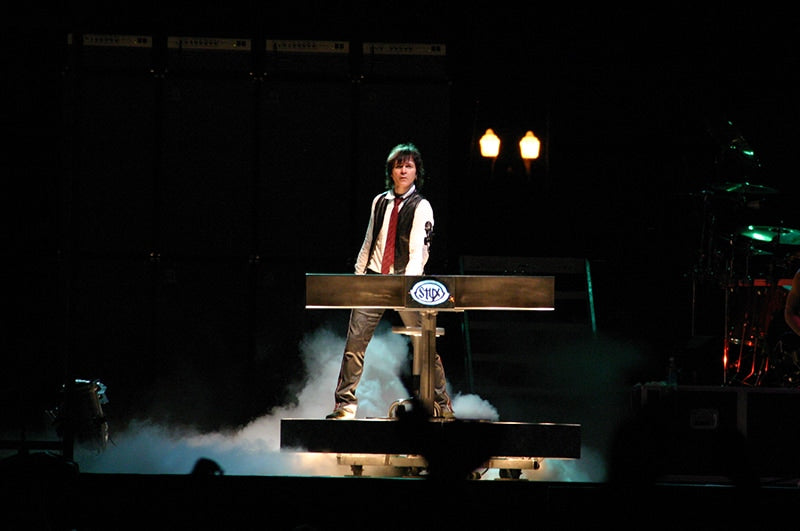
 

Lawrence Gowan, courtesy of Wikimedia Commons/jim simonson.

Lawrence Gowan, courtesy of Wikimedia Commons/jim simonson.


RC: When you return home to Canada, do you tend to go deeper into the Styx catalog, or does it then give you the opportunity to tap into more of your solo material?

LG: Yes. I love that we play “A Criminal Mind” and that people get an entirely different approach to the song when Styx plays it. But my own feeling is that to wedge more of my solo material into the set makes me a little uncomfortable. Styx has such a long legacy that stretches out beyond my solo career, and the name on the marquee is “Styx.” So, I wouldn’t want to overstay my welcome. It’s a really tough set list to crack anyway. There’s new material that we are trying to wedge in and we do it as seamlessly as we possibly can. But when you have such an embarrassment of riches when it comes to great songs to play, it creates a problem that’s great to have.


We did an album in 2017 called The Mission. When the album came out we would only play one song from that record in concert. It was the opening track of the record and it was less than two minutes long. We’d take it directly into “Blue Collar Man.” After about a month of touring, fans started asking through social media if we were going to play more songs from The Mission. They thought that it sounded so much like our classic material (which is what we intended). So, we then decided to introduce the song “Radio Silence” and we did the same thing, segueing it into songs that fans already knew, making it almost like a medley. It worked really well.

After a year we started hearing fans ask if we would do a show where we played the album in its entirety. With that, we went to Las Vegas and did a couple of nights at the Palms where we played the record in its entirety and then did a set of hits. Because of that, we started to do more shows like this in places like Boston. Then COVID hit.

Styx (L to R): Chuck Panozzo, Ricky Phillips, Todd Sucherman, Tommy Shaw, James “JY” Young, Lawrence Gowan. Courtesy of Rick Diamond.

Styx (L to R): Chuck Panozzo, Ricky Phillips, Todd Sucherman, Tommy Shaw, James “JY” Young, Lawrence Gowan. Courtesy of Rick Diamond.


RC: Your first album with the band was cut in 2003. How has the process changed since then?

LG: There a few pivotal moments in the life of the band. [One] was in 1999 when they hit a brick wall and were trying to figure out how to head out on the road with the four remaining members of the band. They addressed that by adding a new guy, me. The next was in 2003. It was a difficult period because the music industry was really in disarray at that point. The major labels were really beginning to flounder, looking to find their sea legs again. And we had the feeling that we needed to sound current but still sound like Styx, and that was a very tough balancing act. As a result, we made a much longer record than what was typical for us because with digital we were able to put everything on there. There was great enthusiasm going into it and there are some great songs that really stand out. But I think we’ve found a better way to make records now than we did back then.


RC: I continue to be amazed by how close your singing voice is to the person you replaced, Dennis DeYoung.

LG: Well, thank you for saying that, but it’s so subjective. There are people I’ve spoken to who’ve expressed exactly what you’ve said, and there are others that say the exact opposite. Our ears are all so different. I think that I’m somewhere in the middle. The most important thing when I joined the band was confirming that I could hit the notes. Did I have the same range? So, I drove to a nearby record store and I got a copy of The Grand Illusion. I came home, put it on, and realized that our ranges were pretty much identical. I got back together with the band three days later, and since then it’s never been suggested that I should try to sound like Dennis or even emulate what the records with him sounded like. I think back to when Phil Collins took over lead vocals for Peter Gabriel in Genesis. At the time I thought it was amazing how similar Phil sounded to Peter. Later on, I realized that they don’t sound alike at all. I think that the spirit of the band survived the change, the seismic shift of having someone [else] in that spot.

RC: Outside of Styx, is there any new solo material that you’ve been working on?

LG: I’ve been working on a record since 2011. But Styx has been so successful and our touring schedule is so intense that I have just been piecing it together. There just hasn’t been the time to focus on putting it all together and promoting it properly. Meanwhile, I play my solo shows whenever there’s a Styx break. But when I go back to the record I think, “man this is great! It’s got to come out soon!”

Header image: Styx (L to R): Lawrence Gowan, Chuck Panozzo, Tommy Shaw, James “JY” Young, Ricky Phillips, Todd Sucherman. Courtesy of Jason Powell.

More from Issue 164

View All Articles in Issue 164

Search Copper Magazine

#229 The Earliest Stars of Country Music, Part Three by Jeff Weiner Apr 06, 2026 #229 The Healing Power of Music and Sound at the Omega Institute by Joe Caplan Apr 06, 2026 #229 CanJam NYC 2026 Show Report: Heady Sound, Part One by Frank Doris Apr 06, 2026 #229 Florida Audio Expo 2026: Warming Up to High-End Audio, Part One by Frank Doris Apr 06, 2026 #229 Quick Takes: Anne Bisson, Sam Morrison, The Velvet Underground, and the Stooges by Frank Doris Apr 06, 2026 #229 The Vinyl Beat: New Arrivals, and Old Audio Show Demo Scores to Settle by Rudy Radelic Apr 06, 2026 #229 Harvard Gets a High-End Audio Education by Frank Doris Apr 06, 2026 #229 No Country for Old Knees by B. Jan Montana Apr 06, 2026 #229 How To Play in A Rock Band, 22: Encounters With Famous Musicians, Part 1 by Frank Doris Apr 06, 2026 #229 The Soulful Grooves of Guinea-Bissau by Steve Kindig Apr 06, 2026 #229 Four-Hand Piano Performance at Its Finest by Stephan Haberthür Apr 06, 2026 #229 The People Who Make Audio Happen: Supreme Acoustics Systems’ Las Vegas Grand Opening by Harris Fogel Apr 06, 2026 #229 Blue Öyster Cult: Tyranny and Expectations by Wayne Robins Apr 06, 2026 #229 Guitarist Rick Vito’s Cinematic New Album, Slidemaster by Ray Chelstowski Apr 06, 2026 #229 Measurements and Observational Listening by Paul McGowan Apr 06, 2026 #229 PS Audio in the News by PS Audio Staff Apr 06, 2026 #229 Back to My Reel-to-Reel Roots, Part 28: The Cassette Strikes Back by Ken Kessler Apr 06, 2026 #229 Are You Receiving Me? by Frank Doris Apr 06, 2026 #229 Hospitality by Peter Xeni Apr 06, 2026 #229 Cantina Gateway by James Schrimpf Apr 06, 2026 #228 Serita’s Black Rose Duo Shakes Your Soul With a Blend of Funk, Rock, Blues and a Whole Lot More by Frank Doris Mar 02, 2026 #228 Vinyl, A Love Story by Wayne Robins Mar 02, 2026 #228 Thrill Seeker by B. Jan Montana Mar 02, 2026 #228 The Vinyl Beat: Donald Byrd, Bill Evans, Wes Montgomery, Eddie Palmieri and Frank Sinatra by Rudy Radelic Mar 02, 2026 #228 Listening to Prestige: The History of a Vitally Important Jazz Record Label by Frank Doris Mar 02, 2026 #228 How to Play in a Rock Band, 21: Touring With James Lee Stanley by Frank Doris Mar 02, 2026 #228 The NAMM 2026 Show: The Music Industry’s Premier Event by John Volanski Mar 02, 2026 #228 The Earliest Stars of Country Music, Part Two by Jeff Weiner Mar 02, 2026 #228 From The Audiophile's Guide: A Brief History of Stereophonic Sound by Paul McGowan Mar 02, 2026 #228 A Bone to Pick With Streaming Audio by Frank Doris Mar 02, 2026 #228 Blast Off With Bluesman Duke Robillard by Ray Chelstowski Mar 02, 2026 #228 A Visit to the Marten Loudspeaker Factory in Göteborg, Sweden by Ingo Schulz and Sebastian Polcyn Mar 02, 2026 #228 Pure Distortion by Peter Xeni Mar 02, 2026 #228 A Nagra Factory Tour by Markus "Marsu" Manthey Mar 02, 2026 #228 Back to My Reel-to-Reel Roots, Part 27: Noodge and Ye Shall Receive, Part Two by Ken Kessler Mar 02, 2026 #228 PS Audio in the News by PS Audio Staff Mar 02, 2026 #228 90-Degree Stereo by Frank Doris Mar 02, 2026 #228 The Keys to Art by Rich Isaacs Mar 02, 2026 #227 Seth Lewis Gets in the Groove With Take a Look Around: a Tribute to the Meters by Frank Doris Feb 02, 2026 #227 Passport to Sound: May Anwar’s Audio Learning Experience for Young People by Frank Doris Feb 02, 2026 #227 Conjectures on Cosmic Consciousness by B. Jan Montana Feb 02, 2026 #227 The Big Takeover Turns 45 by Wayne Robins Feb 02, 2026 #227 Music and Chocolate: On the Sensory Connection by Joe Caplan Feb 02, 2026 #227 Singer/Songwriter Chris Berardo: Getting Wilder All the Time by Ray Chelstowski Feb 02, 2026 #227 The Earliest Stars of Country Music, Part One by Jeff Weiner Feb 02, 2026 #227 The Vinyl Beat Goes Down to Tijuana (By Way of Los Angeles), Part Two by Rudy Radelic Feb 02, 2026 #227 How to Play in a Rock Band, 20: On the Road With Blood, Sweat & Tears’ Guitarist Gabe Cummins by Frank Doris Feb 02, 2026

Styx: 50 Years and Still Going Strong

Styx: 50 Years and Still Going Strong

Last summer rock legends Styx came to Connecticut and headlined on a bill with REO Speedwagon, and opened a brand-new venue, the Hartford HealthCare Amphitheater in Bridgeport. It was a popular pairing of bands that’ve enjoyed a shared bill for many years. But the “first” that mattered most that night was that it was the first live show many had seen since the outbreak of COVID the year prior. The show was the appropriately named “We Are Back!” tour.

In so many ways it seems like Styx has never left us. Backed by a catalog of endless hits including “Lady,” “Come Sail Away,” “Fooling Yourself (The Angry Young Man)”, “Mr. Roboto” and others and four consecutive multi-platinum albums, Styx has remained in front of audiences across the country for 50 years. This has been largely in amphitheater settings where they have helped define their fans’ summers, and where they have left a mark that is the result of skills that seem to only sharpen with age.

Last year they released Crash of the Crown, their 17th studio album, and it was so well-received that Styx maintained a residence in Las Vegas where they hosted shows that began with a start to finish run-through of the record, and ended with a set filled with their best-known songs. Now the band has returned, and this time they are headed to Canada. It’s been years since they have crisscrossed the provinces of our northern neighbor and Styx will begin with a summer tour with REO and Loverboy), and conclude with a series of shows this autumn with Nancy Wilson of Heart.


Styx, Crash of the Crown, album cover.

Styx, Crash of the Crown, album cover.


We were able to find time in this band’s fantastically busy schedule to sit down with keyboard player and lead vocalist Lawrence Gowan, who is also a solo artist, about the tour and the band’s return to his native Canada. Lawrence joined Styx almost 25 years ago, replacing founding member Dennis DeYoung, and has become a fan favorite for his spot-on vocal talents and remarkable showmanship. The rest of the current Styx lineup includes Chuck Panozzo (bass, vocals), James “J.Y.” Young (guitar, vocals, keyboards), Tommy Shaw (guitar, vocals), Todd Sucherman (drums, percussion, vocals), Ricky Phillips (bass, vocals, guitar) and Will Evankovich (guitar, vocals)

Here’s an enlightening exchange with one of rock’s genuine “good guys,” and a walk down the memory lane of one of music’s most theatrical acts.


Ray Chelstowski: So, you must be excited about having the band return to Canada, your home. (The rest of the band is from the US.) What prompted the decision to come back?

Lawrence Gowan: Well, a couple of things. One is my whining (laughs). We haven’t played in three years and we are actually coming [to Canada] on two occasions. One is on the blockbuster summer tour with Loverboy and REO Speedwagon. Then we are headed back in the fall to Western Canada for the first time in [something] like seven years with Nancy Wilson.

RC: How do you decide who you’ll appear with on any given concert bill?

LG: There are so many ways of analyzing things like demographics that really go beyond the band’s scope of knowledge. We might think it would be good to tour with Foreigner or Boston, and then we’ll float the idea. It then goes through a kind of “the wash cycle” composed of our agents and our manager, because there are so many factors that come into play when you make a decision like that. That also includes what venues we decide to play. If the tour happens in the summer that decision’s easy. We tend to play amphitheaters because they’re outdoors. Between REO and Styx, right there you have about three hours of classic rock songs that everyone knows. We always enjoy touring with REO and for this tour we have had the most advance ticket sales of any tour we’ve ever done.  And with Loverboy on the bill, that helped sell an additional couple thousand extra tickets.

It is different as well in different regions. For example, one band may have more significance in one geographical area versus another. When we play at Sweden Rock [Festival] we’re on the bill with bands that we’d never be with elsewhere, but it works. One year before Lemmy [Kilmister] died, we were on the bill with Motörhead! That wouldn’t happen here.


Lawrence Gowan, courtesy of Wikimedia Commons/jim simonson.

Lawrence Gowan, courtesy of Wikimedia Commons/jim simonson.


RC: When you return home to Canada, do you tend to go deeper into the Styx catalog, or does it then give you the opportunity to tap into more of your solo material?

LG: Yes. I love that we play “A Criminal Mind” and that people get an entirely different approach to the song when Styx plays it. But my own feeling is that to wedge more of my solo material into the set makes me a little uncomfortable. Styx has such a long legacy that stretches out beyond my solo career, and the name on the marquee is “Styx.” So, I wouldn’t want to overstay my welcome. It’s a really tough set list to crack anyway. There’s new material that we are trying to wedge in and we do it as seamlessly as we possibly can. But when you have such an embarrassment of riches when it comes to great songs to play, it creates a problem that’s great to have.


We did an album in 2017 called The Mission. When the album came out we would only play one song from that record in concert. It was the opening track of the record and it was less than two minutes long. We’d take it directly into “Blue Collar Man.” After about a month of touring, fans started asking through social media if we were going to play more songs from The Mission. They thought that it sounded so much like our classic material (which is what we intended). So, we then decided to introduce the song “Radio Silence” and we did the same thing, segueing it into songs that fans already knew, making it almost like a medley. It worked really well.

After a year we started hearing fans ask if we would do a show where we played the album in its entirety. With that, we went to Las Vegas and did a couple of nights at the Palms where we played the record in its entirety and then did a set of hits. Because of that, we started to do more shows like this in places like Boston. Then COVID hit.

Styx (L to R): Chuck Panozzo, Ricky Phillips, Todd Sucherman, Tommy Shaw, James “JY” Young, Lawrence Gowan. Courtesy of Rick Diamond.

Styx (L to R): Chuck Panozzo, Ricky Phillips, Todd Sucherman, Tommy Shaw, James “JY” Young, Lawrence Gowan. Courtesy of Rick Diamond.


RC: Your first album with the band was cut in 2003. How has the process changed since then?

LG: There a few pivotal moments in the life of the band. [One] was in 1999 when they hit a brick wall and were trying to figure out how to head out on the road with the four remaining members of the band. They addressed that by adding a new guy, me. The next was in 2003. It was a difficult period because the music industry was really in disarray at that point. The major labels were really beginning to flounder, looking to find their sea legs again. And we had the feeling that we needed to sound current but still sound like Styx, and that was a very tough balancing act. As a result, we made a much longer record than what was typical for us because with digital we were able to put everything on there. There was great enthusiasm going into it and there are some great songs that really stand out. But I think we’ve found a better way to make records now than we did back then.


RC: I continue to be amazed by how close your singing voice is to the person you replaced, Dennis DeYoung.

LG: Well, thank you for saying that, but it’s so subjective. There are people I’ve spoken to who’ve expressed exactly what you’ve said, and there are others that say the exact opposite. Our ears are all so different. I think that I’m somewhere in the middle. The most important thing when I joined the band was confirming that I could hit the notes. Did I have the same range? So, I drove to a nearby record store and I got a copy of The Grand Illusion. I came home, put it on, and realized that our ranges were pretty much identical. I got back together with the band three days later, and since then it’s never been suggested that I should try to sound like Dennis or even emulate what the records with him sounded like. I think back to when Phil Collins took over lead vocals for Peter Gabriel in Genesis. At the time I thought it was amazing how similar Phil sounded to Peter. Later on, I realized that they don’t sound alike at all. I think that the spirit of the band survived the change, the seismic shift of having someone [else] in that spot.

RC: Outside of Styx, is there any new solo material that you’ve been working on?

LG: I’ve been working on a record since 2011. But Styx has been so successful and our touring schedule is so intense that I have just been piecing it together. There just hasn’t been the time to focus on putting it all together and promoting it properly. Meanwhile, I play my solo shows whenever there’s a Styx break. But when I go back to the record I think, “man this is great! It’s got to come out soon!”

Header image: Styx (L to R): Lawrence Gowan, Chuck Panozzo, Tommy Shaw, James “JY” Young, Ricky Phillips, Todd Sucherman. Courtesy of Jason Powell.

0 comments

Leave a comment

0 Comments

Your avatar

Loading comments...

🗑️ Delete Comment

Enter moderator password to delete this comment:

✏️ Edit Comment

Enter your email to verify ownership: