Copper Magazine · Issue 145 · A free PS Audio publication
Issue 145 NEW VISTAS

Pilgrimage to Sturgis, Part Three

Pilgrimage to Sturgis, Part Three


Part One and Part Two of this series appeared in Issue 143 and Issue 144.

I felt emancipated as I pulled into the highway and away from the renegades. I’d miss Candy and Chip, especially Candy, but I was not going to be the guest of a group that travels on stolen credit cards. The likelihood of ending up as the guests of the local constabulary were too great.

The bank thermometer hit 105 degrees as I pulled into the dusty town of Sundance, Wyoming. No wonder the Sundance Kid was so eager to exploit opportunities elsewhere.  I headed for the first watering hole without saloon doors, because air conditioned businesses have glass doors. The place was packed with farmers and ranchers. The only seat available was at the bar next to a tall, flamboyant cowboy with a handlebar mustache. He wore a stained Stetson,  denim shirt and jeans, tan cowboy boots, and a matching holster carrying a revolver.

The cowboy soon struck up a conversation, asking where I’d been and where I was going. His voice carried throughout the bar. I told him about my adventures with the renegades, and he listened intently. To my surprise, his name was Roy Disney – same name as the brother of the famous entertainment mogul, but no relation, he explained. His family had owned a ranch in the area for generations and everyone seemed to know him.

When I asked about the famous Sundance Kid, his countenance darkened. Apparently, The Kid had stolen a horse and saddle from his family’s ranch. The Disneys were homesteaders at the time, and this loss caused major hardship. Roy added that if his great grandfather had been wearing a revolver, the Sundance Kid would never have lived a life of crime.

“Seems many citizens wear guns in Sundance. There must be a lot of rattlesnakes ’round here.” I commented facetiously,

“Let me tell you something,” he leaned in as if sharing a secret, “there’s a lot of rattlesnakes everywhere. I’d feel much safer if I could also wear my revolver in cities like Chicago, St. Louis, and Baltimore. These gun-free zones are the most dangerous places in America.” I nodded my head.

He was a good-hearted guy with lots of stories to share. But after a couple of hours, I became antsy to leave. Then Roy ordered another round. “This is my last one, Roy, I want to get back on the road before the sun goes down.”

When I finished the beer, he followed me out of the bar, still spinning yarns. Thankfully, the temperature had dropped with the sun. I donned my helmet and jacket. Then Roy surprised me. He removed a bolo tie from around his neck and handed it over. He explained that it was crafted by a Kiowa ranch hand. It featured elk ivories, rattlesnake rattles, and eagle claws. “This is the Kiowa St. Christopher’s medal,” he explained, “safe travels.” I was touched by this gesture. I gave him a hug, got on the bike, and pulled out. The Kiowa amulet hangs on my wall to this day.

It didn’t take long to reach my destination for the night, Devils Tower. It has a campground nearby. I set up my tent next to a Boy Scout troop. The Scouts surrounded my bike and had a million questions. Although I was whacked, I patiently explained every part of the machine and as much BMW history as I could remember. They were respectful, and good listeners. One of the Scout leaders came over and invited me to share dinner. Their school bus reminded me of the renegades’ gear hauler, except it was in good nick, carried a mobile kitchen, and served great food.

I slept like a gorged walrus.

The next morning, one of the Scouts shook my tent with coffee in hand. I looked over at the Scoutmaster and he waved me over for breakfast. As I’d woken to the smell of his sizzling bacon, I had no power to resist.

The kids were all excited about going on a hayride! After breakfast and clean-up – in which everyone participated – a local farmer chugged into view on a tractor-powered hay wagon. The kids begged me to join them, but I had other plans. The Scoutmaster came over and suggested I do the ride. “It’s worth the time,” he nodded, so I relented.

The fluted, basalt columns characterizing Devils Tower reach almost 1,000 feet above the prairie. It was featured in the movie Close Encounters of the Third Kind with Richard Dreyfuss.  It’s a long way around the monument, with no road, so I was happy to circumnavigate the base in the comfort of the hay wagon. The farmer recited a running documentary. Most of the kids’ questions centered on the movie and its stars. The farmer explained that the movie company rented some of his land and buildings during filming, and that Richard Dreyfuss, the star, thrilled the locals by spending time with them and sharing stories. Of course, the Scouts wanted to hear every one of them.
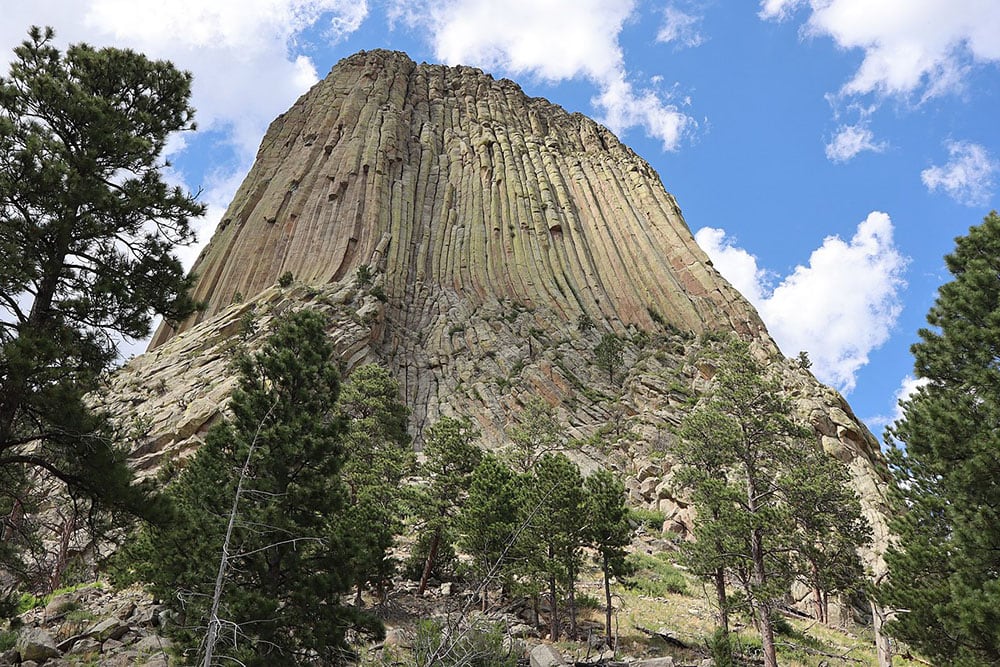
Devils Tower, Wyoming. Courtesy of Wikipedia/Jonathunder.

Devils Tower, Wyoming. Courtesy of Wikipedia/Jonathunder.


Once around the monument, the farmer took us on a tour of his farm. It was a beautiful place with groves of native trees set in rolling, golden fields bisected by a running creek –  crossed by a World War II surplus Bailey bridge. We stopped at the farmhouse to see the rancher’s collection of Native artifacts. I showed him my Kiowa bolo. “Keep that out of sight,” he suggested. “It’s illegal to possess eagle claws outside the reservation.”

His wife prepared a barbecue lunch for everyone, which was much appreciated and enjoyed. The package for the entire troop was only $100, so I surreptitiously paid the farmer before the Scoutmaster could object.

We got back to the campsite just as the day got too warm. As I packed up, some of the kids swore they’d get a bike just like mine when they grew up. The Scoutmaster heartily shook my hand. What comes around, goes around, I told him.

It was mid-afternoon by the time I hit the highway for the ride to Spearfish City Campground – another hot ride – where I planned to set up camp for the evening.

In the 1970s, we were allowed to camp at Sturgis City Park, which is near all the action and had a great swimming hole. There was a hippie-style celebration around the swimming hole every day, but by the early eighties, it got too wild. On one occasion, an occupied tent was run over by an out-of-control chopper. On another, the forks were blown off a Japanese bike with dynamite. The city fathers decided they’d had enough and closed the park during the Sturgis Motorcycle Rally bike week. There’s always some jerk who ruins it for everyone.

The following year, an enterprising lawyer established the Buffalo Chip Campground in the middle of a farmer’s field nearby, but with no trees, no creek, and no swimming hole. He hired dancing girls from the big city to replace the hippie chicks at the swimming hole. A festival of life was turned into a for-profit circus. I camped there once and that was enough.


Buffalo Chip Campground, South Dakota.

Buffalo Chip Campground, South Dakota. Courtesy of sturgismotorcyclerally.com.


The City Park in Spearfish is just as scenic as the one in Sturgis, with an added advantage. It’s within staggering distance of the local downtown area.

Most of the best campsites were taken by the time I arrived, but I found a spot in the fork of two dusty roads. It had less shade than I preferred, but there was lots of space and it featured two picnic tables rather than one. I set up my tent and spent the rest of the day enjoying the downtown saloon culture.

It was well after midnight by the time I staggered back. I had a hard time locating my campsite. That’s because I was looking for the wrong thing. Instead of seeking a large site with a single tent, I should have been looking for a community of tents surrounded by hogs and an ugly yellow school bus.

The renegades had found me.

Header image courtesy of sturgismotorcyclerally.com.

More from Issue 145

View All Articles in Issue 145

Search Copper Magazine

Favorites From T.H.E. Show SoCal 2026 by Cam Martin Oct 05, 2026 #235 Singer/Songwriter John David Schrader: On the Need to Create, Part Two by Joe Caplan Oct 05, 2026 #235 A Life in High-End Audio: The Roy Hall Interview, Part Two by Frank Doris Oct 05, 2026 #235 Grammy-Winning Producer, Songwriter, and Guitarist John Leventhal Goes Instrumental With National Drift by Ray Chelstowski Oct 05, 2026 #235 From Swimming Pool to New Listening Room—to Founding an Accidental Audio Company by Gilles Laferrière Oct 05, 2026 #235 The Vinyl Beat’s Size Matters Edition by Rudy Radelic Oct 05, 2026 #235 The Sublime Complexities of Nature by B. Jan Montana Oct 05, 2026 #235 How to Play In a Rock Band, 28: Growing Older and Dealing With It by Frank Doris Oct 05, 2026 #235 Young Rascals: From Bar Band to Stardom by Wayne Robins Oct 05, 2026 #235 Duncan Sheik: In Memoriam by Ray Chelstowski Oct 05, 2026 #235 From The Listening Chair: The Meze Audio 105 Silva Headphones by Howard Kneller Oct 05, 2026 #235 Checking Out Some NOLA Loudspeakers – and Some Thoughts About Audio Writing by Frank Doris Oct 05, 2026 #235 The Kanazawa Phonograph Museum: Music from a Time Capsule by Sebastian Polcyn Oct 05, 2026 #235 PS Audio in the News by PS Audio Staff Oct 05, 2026 #235 From The Audiophile’s Guide: Making the Most Critical Choice by Paul McGowan Oct 05, 2026 #235 Evolutionary Growth by Frank Doris Oct 05, 2026 #235 Speed Racer by Peter Xeni Oct 05, 2026 #235 Happy Halloween! by James Schrimpf Oct 05, 2026 #234 A Life in High-End Audio: The Roy Hall Interview, Part One by Frank Doris Sep 07, 2026 #234 Jason Greenlaw Offers His Personal Perspective on Jazz Guitar in Vantage Point by Frank Doris Sep 07, 2026 #234 Transcendent Phoenix: Lucina Yue Brings the Ancient Konghou Into Modern Times by Frank Doris Sep 07, 2026 #234 We Must All Follow Our Bliss by B. Jan Montana Sep 07, 2026 #234 How to Play in a Rock Band, 27: Leveling Up by Frank Doris Sep 07, 2026 #234 Ross Valory: Traveling Into New Musical Territory With All of the Above by Ray Chelstowski Sep 07, 2026 #234 Singer/Songwriter John David Schrader: On the Need to Create by Joe Caplan Sep 07, 2026 #234 The People Who Make Audio Happen: More From T.H.E. Show SoCal 2026 by Harris Fogel Sep 07, 2026 #234 The Vinyl Beat Digs Into the Gadget Box by Rudy Radelic Sep 07, 2026 #234 The Rolling Stones: Foreign Tongues Spoken Loud by Wayne Robins Sep 07, 2026 #234 Musical Moments by Rich Isaacs Sep 07, 2026 #234 Rags for Solo Piano and a Dog: David Chesky's Ragtime Music for the Modern Age by Frankly Speaking Sep 07, 2026 #234 HIGH END 2026, Vienna: Here to Stay by Carsten Barnbeck Sep 07, 2026 #234 From The Audiophile’s Guide: The Two Main Types of Loudpeakers – Box and Panel by Paul McGowan Sep 07, 2026 #234 Letting it Slide by Frank Doris Sep 07, 2026 #234 PS Audio in the News by PS Audio Staff Sep 07, 2026 #234 Long Playing by Peter Xeni Sep 07, 2026 #234 La Mer by B. Jan Montana Sep 07, 2026 #233 A Report From The Total Hi-Fi Experience Show SoCal 2026 by B. Jan Montana Aug 03, 2026 #233 Bluegrass Meets Country, Folk, Jazz and More in All That We Carried by The Squid City Slingers by Frank Doris Aug 03, 2026 #233 Corey Glover and One Tribe Nation: A Variegated Musical Collective by Ray Chelstowski Aug 03, 2026 #233 Excursions with Clive: The Late Clive Davis, A Personal History by Wayne Robins Aug 03, 2026 #233 AI, Art, and Music: A Conversation With Synthography Art by Joe Caplan Aug 03, 2026 #233 New American Symphonies: A Rediscovered Gem and a Vital Contemporary Work by Frank Doris Aug 03, 2026 #233 The Vinyl Beat: Genesis, the Dave Clark Five, Antonio Carlos Jobim and More by Rudy Radelic Aug 03, 2026 #233 How to Play in a Rock Band, 26: When It's Time to Record Your Music by Frank Doris Aug 03, 2026 #233 More From T.H.E. Show 2026, and the People Who Made it Happen by Harris Fogel Aug 03, 2026 #233 Underappreciated Artists, Part Three: Icehouse by Rich Isaacs Aug 03, 2026 #233 The Surprisingly Rich and Varied Music of Somalia by Steve Kindig Aug 03, 2026

Pilgrimage to Sturgis, Part Three

Pilgrimage to Sturgis, Part Three


Part One and Part Two of this series appeared in Issue 143 and Issue 144.

I felt emancipated as I pulled into the highway and away from the renegades. I’d miss Candy and Chip, especially Candy, but I was not going to be the guest of a group that travels on stolen credit cards. The likelihood of ending up as the guests of the local constabulary were too great.

The bank thermometer hit 105 degrees as I pulled into the dusty town of Sundance, Wyoming. No wonder the Sundance Kid was so eager to exploit opportunities elsewhere.  I headed for the first watering hole without saloon doors, because air conditioned businesses have glass doors. The place was packed with farmers and ranchers. The only seat available was at the bar next to a tall, flamboyant cowboy with a handlebar mustache. He wore a stained Stetson,  denim shirt and jeans, tan cowboy boots, and a matching holster carrying a revolver.

The cowboy soon struck up a conversation, asking where I’d been and where I was going. His voice carried throughout the bar. I told him about my adventures with the renegades, and he listened intently. To my surprise, his name was Roy Disney – same name as the brother of the famous entertainment mogul, but no relation, he explained. His family had owned a ranch in the area for generations and everyone seemed to know him.

When I asked about the famous Sundance Kid, his countenance darkened. Apparently, The Kid had stolen a horse and saddle from his family’s ranch. The Disneys were homesteaders at the time, and this loss caused major hardship. Roy added that if his great grandfather had been wearing a revolver, the Sundance Kid would never have lived a life of crime.

“Seems many citizens wear guns in Sundance. There must be a lot of rattlesnakes ’round here.” I commented facetiously,

“Let me tell you something,” he leaned in as if sharing a secret, “there’s a lot of rattlesnakes everywhere. I’d feel much safer if I could also wear my revolver in cities like Chicago, St. Louis, and Baltimore. These gun-free zones are the most dangerous places in America.” I nodded my head.

He was a good-hearted guy with lots of stories to share. But after a couple of hours, I became antsy to leave. Then Roy ordered another round. “This is my last one, Roy, I want to get back on the road before the sun goes down.”

When I finished the beer, he followed me out of the bar, still spinning yarns. Thankfully, the temperature had dropped with the sun. I donned my helmet and jacket. Then Roy surprised me. He removed a bolo tie from around his neck and handed it over. He explained that it was crafted by a Kiowa ranch hand. It featured elk ivories, rattlesnake rattles, and eagle claws. “This is the Kiowa St. Christopher’s medal,” he explained, “safe travels.” I was touched by this gesture. I gave him a hug, got on the bike, and pulled out. The Kiowa amulet hangs on my wall to this day.

It didn’t take long to reach my destination for the night, Devils Tower. It has a campground nearby. I set up my tent next to a Boy Scout troop. The Scouts surrounded my bike and had a million questions. Although I was whacked, I patiently explained every part of the machine and as much BMW history as I could remember. They were respectful, and good listeners. One of the Scout leaders came over and invited me to share dinner. Their school bus reminded me of the renegades’ gear hauler, except it was in good nick, carried a mobile kitchen, and served great food.

I slept like a gorged walrus.

The next morning, one of the Scouts shook my tent with coffee in hand. I looked over at the Scoutmaster and he waved me over for breakfast. As I’d woken to the smell of his sizzling bacon, I had no power to resist.

The kids were all excited about going on a hayride! After breakfast and clean-up – in which everyone participated – a local farmer chugged into view on a tractor-powered hay wagon. The kids begged me to join them, but I had other plans. The Scoutmaster came over and suggested I do the ride. “It’s worth the time,” he nodded, so I relented.

The fluted, basalt columns characterizing Devils Tower reach almost 1,000 feet above the prairie. It was featured in the movie Close Encounters of the Third Kind with Richard Dreyfuss.  It’s a long way around the monument, with no road, so I was happy to circumnavigate the base in the comfort of the hay wagon. The farmer recited a running documentary. Most of the kids’ questions centered on the movie and its stars. The farmer explained that the movie company rented some of his land and buildings during filming, and that Richard Dreyfuss, the star, thrilled the locals by spending time with them and sharing stories. Of course, the Scouts wanted to hear every one of them.

Devils Tower, Wyoming. Courtesy of Wikipedia/Jonathunder.

Devils Tower, Wyoming. Courtesy of Wikipedia/Jonathunder.


Once around the monument, the farmer took us on a tour of his farm. It was a beautiful place with groves of native trees set in rolling, golden fields bisected by a running creek –  crossed by a World War II surplus Bailey bridge. We stopped at the farmhouse to see the rancher’s collection of Native artifacts. I showed him my Kiowa bolo. “Keep that out of sight,” he suggested. “It’s illegal to possess eagle claws outside the reservation.”

His wife prepared a barbecue lunch for everyone, which was much appreciated and enjoyed. The package for the entire troop was only $100, so I surreptitiously paid the farmer before the Scoutmaster could object.

We got back to the campsite just as the day got too warm. As I packed up, some of the kids swore they’d get a bike just like mine when they grew up. The Scoutmaster heartily shook my hand. What comes around, goes around, I told him.

It was mid-afternoon by the time I hit the highway for the ride to Spearfish City Campground – another hot ride – where I planned to set up camp for the evening.

In the 1970s, we were allowed to camp at Sturgis City Park, which is near all the action and had a great swimming hole. There was a hippie-style celebration around the swimming hole every day, but by the early eighties, it got too wild. On one occasion, an occupied tent was run over by an out-of-control chopper. On another, the forks were blown off a Japanese bike with dynamite. The city fathers decided they’d had enough and closed the park during the Sturgis Motorcycle Rally bike week. There’s always some jerk who ruins it for everyone.

The following year, an enterprising lawyer established the Buffalo Chip Campground in the middle of a farmer’s field nearby, but with no trees, no creek, and no swimming hole. He hired dancing girls from the big city to replace the hippie chicks at the swimming hole. A festival of life was turned into a for-profit circus. I camped there once and that was enough.


Buffalo Chip Campground, South Dakota.

Buffalo Chip Campground, South Dakota. Courtesy of sturgismotorcyclerally.com.


The City Park in Spearfish is just as scenic as the one in Sturgis, with an added advantage. It’s within staggering distance of the local downtown area.

Most of the best campsites were taken by the time I arrived, but I found a spot in the fork of two dusty roads. It had less shade than I preferred, but there was lots of space and it featured two picnic tables rather than one. I set up my tent and spent the rest of the day enjoying the downtown saloon culture.

It was well after midnight by the time I staggered back. I had a hard time locating my campsite. That’s because I was looking for the wrong thing. Instead of seeking a large site with a single tent, I should have been looking for a community of tents surrounded by hogs and an ugly yellow school bus.

The renegades had found me.

Header image courtesy of sturgismotorcyclerally.com.

0 comments

Leave a comment

0 Comments

Your avatar

Loading comments...

🗑️ Delete Comment

Enter moderator password to delete this comment:

✏️ Edit Comment

Enter your email to verify ownership: