COPPER

A PS Audio Publication

Issue 161 • Free Online Magazine

Issue 161 Speaker Stories

More Speaker Setup Tips From Audio Advice's Scott Newnam

More Speaker Setup Tips From Audio Advice's Scott Newnam

In Issue 160 we covered the useful Home Theater Designer loudspeaker setup software developed by Audio Advice, an audio/video retailer and systems integrator with showrooms in Raleigh and Charlotte, North Carolina. This free online interactive utility makes it easy to determine the optimum speaker placement for a stereo or surround system.

The user enters the room size and information like the number of speakers, the size of the video display, the number of seats in the room and other factors, and Home Theater Designer then provides 3-D visualizations and recommended speaker setup distances and measurements. The “virtual room” display changes as you enter information, and you can even grab objects in the room with your mouse and they’ll move, and the measurements will be updated in real time.

Our interview with Audio Advice CEO Scott Newnam continues here.

Russ Welton: Most Copper readers won’t realize that Audio Advice is the fastest-growing audio consumer electronics company in the US. Where have you experienced your greatest growth?

Scott Newnam: We are generally seeing relatively consistent growth across all product categories in the audio and home theater spaces.

 

Scott Newnam of Audio Advice.

Scott Newnam of Audio Advice.


RW: Do you recall your first hi-fi system?

SN: I had a JVC full rack and tower speaker system when I was in college, which I bought from Circuit City.

RW: What is your personal favorite format for music listening and why?

SN: I use Roon to stream high-resolution music in my office where I have my two-channel system. However, I am now really starting to enjoy music mastered in Dolby Atmos in my home theater. If you love music and have not heard good Atmos tracks yet, it is definitely worth trying.

RW: How important is a good stereo setup when building upon it into a home theater?

SN: I use my home theater room for both stereo listening and movies. Obviously when you do this, you really want your stereo speakers and setup to be as good as possible. Then you fill out the rest of the system from there.
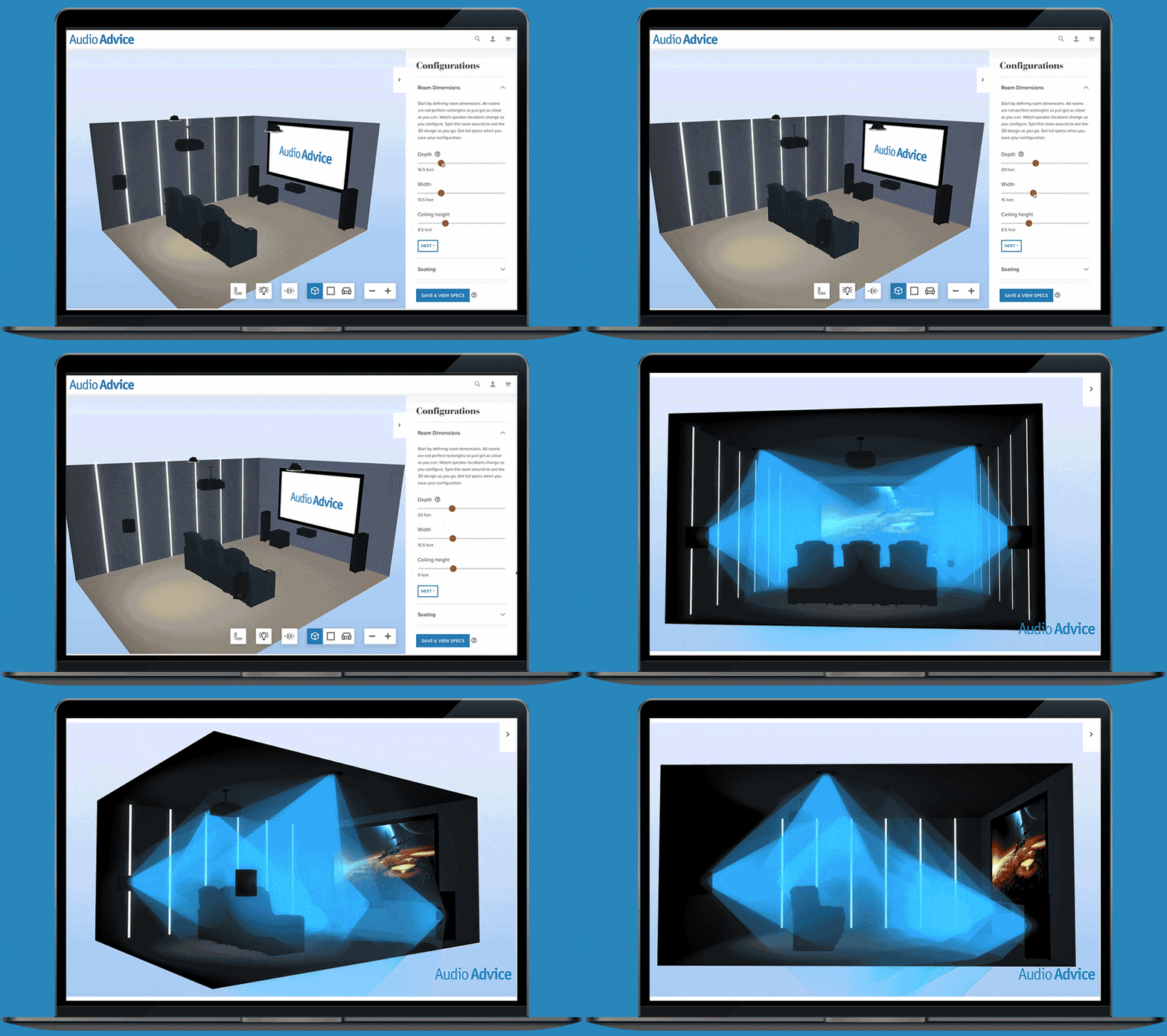
 

Demo of Audio Advice's Home Theater Designer software.

Demo of Audio Advice’s Home Theater Designer software.


RW: When do you feel is it better to run stereo speakers full-range plus a subwoofer – let’s say in a 2.1 or 2.2+ configuration – compared to having the speakers crossed over and letting the sub handle most of the low frequencies? Is it only if you’re using super-low-extension main speakers?

SN: There are multiple theories on this. Ultimately you want to accurately reproduce the sound intended by the engineers. In my living room system, I have two bookshelf speakers that I play full range, taking advantage of their natural bass rolloff, and then I have matching subs hidden below them that augment low bass and even subsonic frequencies. It works great in that system. However, in my theater room I have full tower speakers, but I use the surround-sound processor to [determine] the crossover [point] to the subs, for the ideal blending of the subs and the mains. In this situation, crossing over leads to a much better-blended stereo experience. In most systems, if your preamp can [perform bass management of] the crossover [point] between the subs and the main towers, I feel you are generally better off doing it that way versus running full-range to your left and right plus a subwoofer.

RW: What are some of your best suggestions for adequate/appropriate cable length runs when using multiple subwoofers? Also, what are your feelings about Wi-Fi-controlled subs?

SN: If you have good cable, most lengths are not an issue. However, if you really want super-high performance, Wi-Fi-controlled subs can create a challenge. Getting all of your subwoofers time- and phase-aligned makes a massive difference in the audio experience. Wi-Fi not only adds delay, but the delay also can vary over time. If you put four subs in a room and the two in the back are Wi-Fi-enabled, you will have to add substantial delay to everything else to account for the Wi-Fi delay [to the rear subwoofers]. But you cannot account for the real-time variances of the Wi-Fi delay. So wire your subs if you can.

RW: Are the delay implications of DSP-equipped subwoofers more difficult to manage in small rooms than non-DSP subs?

SN: For most DSP-equipped subs, the perceptible delay is relatively constant. If you are using a 2-channel system that has no ability to delay the main speakers, then DSP-equipped subs can be an issue for time alignment. If, however, you have delay or distance-adjustment capability in your processor, then you can adjust for the delay in the subs by making the distance setting longer.

RW: How would you advise adjusting DSP delay in milliseconds according to room size? Is one foot per millisecond usually correct for each discrete channel?

SN: For the average person, adding one foot of extra distance in your processor settings for each millisecond of delay is a good solution. However, if you really want to nail it or you don’t know the exact delay of your DSP, then you can search for “Audio Advice subwoofer calibration” on YouTube, where I show you how to do it.

RW: What do you foresee as the next biggest development in object-oriented sound modeling for the future? (Object-oriented sound mixing enables sound sources to be placed in a virtual listening space.)

SN: Right now, specifications like Dolby Atmos provide relatively wide ranges of speaker placement. Obviously, when movies are mastered, the engineers know exactly where they want the car to zoom through the room. So, I expect we will continue to see more speakers used in systems and a tightening of specification ranges so that what the listeners experience is closer and closer to the original vision.

RW: Do you have any advice for accommodating wildly differing source material if your stereo is also part of your home theater? E.g., different movies, or live music Blu-ray or DVD discs, or music files.

SN: Increasingly, really good preamp/processors allow you to set up different speaker profiles in their calibration settings. So, for instance, I have a profile for movie watching that has room-calibrated all of my speakers across a handful of seats for when my family is watching a movie. However, I have a second profile that uses just my front left and right speakers crossed over to my subs and is calibrated across just our main two listening seats. This second profile provides a much superior stereo listening experience than listening using the first profile in stereo, both because the microphone calibration measurement positions were tighter around the primary listening seats, and because the equalization and phase alignment was done using just those speakers.
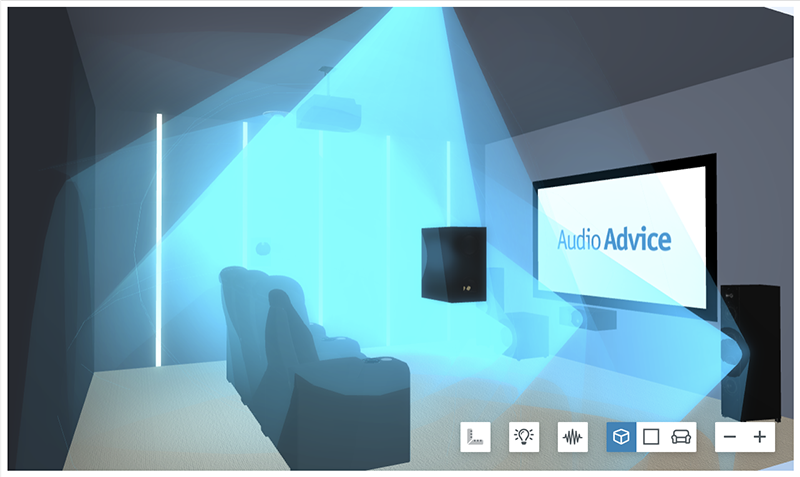
 

Home Theater Designer software showing speaker dispersion, side view.

Home Theater Designer software showing speaker dispersion, side view.


RW: Tell us about how your Home Theater Designer software has been built with the different surround sound and immersive audio specs factored in.

SN: We looked at all of the major standards, such as Dolby, Auro 3-D, and DTS:X, and attempted to design the tool to achieve the best outcome across them. We also went one step further, which was to help users find the optimal positioning within those standards. So, for instance, if you are using Home Theater Designer and you remove your side speakers, you will see the rear speakers push out wider within the specification ranges to create a more immersive experience. Add the side speakers back and you’ll see the rears move tighter and away from the surrounds, to achieve optimal 3D immersion.

RW: What question do audiophiles very rarely consider that they should?

SN: As audiophiles we often get too caught up in the specifications and measurements. Ultimately, what we want is fabulous sound. As we get older, we might need an increasingly less-flat response curve from our system to achieve the perceived sound that was intended and that we enjoy. So, don’t be afraid to test adjustments that might theoretically produce slightly too much bass or high frequencies if the end result sounds better to you.

More from Issue 161

View All Articles in Issue 161

Search Copper Magazine

#232 What came first: Art or Music? A Conversation With Artist Jose Acosta by Joe Caplan Jul 06, 2026 #232 Blow By Blow: The Jeff Beck Story: An Insightful Book About a Guitar Icon by Ray Chelstowski Jul 06, 2026 #232 Creed Over Camaraderie? by B. Jan Montana Jul 06, 2026 #232 Chronicles of a Sound Pilgrim at the 2026 Montreal Audiofest by Hugues Morin Jul 06, 2026 #232 The Vinyl Beat: Summer Grooves by Rudy Radelic Jul 06, 2026 #232 Hibbing Hillbilly Dylan's Acoustic Rock by Wayne Robins Jul 06, 2026 #232 Quad Quads and Plasmatronics Tweeters: An Extraordinary System Comes to Life by Frank Doris Jul 06, 2026 #232 In Praise of Live Music, Once Again by Ted Shafran Jul 06, 2026 #232 Allnic Audio’s L-9000 Preamplifier: Design and Engineering Innovation by Howard Kneller Jul 06, 2026 #232 “Best Of” Lists and Rage Bait: Enough Already by Frank Doris Jul 06, 2026 #232 Quick Takes: Bud Shank, Paulo Almeida, Jakob Dreyer, Tim Eriksen and Peter Irvine by Frank Doris Jul 06, 2026 #232 My Impressions of AXPONA 2026, Part 2 by Frank Doris Jul 06, 2026 #232 How to Play in a Rock Band, 25: Encounters With Famous Musicians, Part Three by Frank Doris Jul 06, 2026 #232 Budgets, and Systems From Small to Outrageous by Paul McGowan Jul 06, 2026 #232 PS Audio in the News by PS Audio Staff Jul 06, 2026 #232 Hand It Over by Frank Doris Jul 06, 2026 #232 Difference of Opinion by Peter Xeni Jul 06, 2026 #232 Wabi-sabi Tree by James Schrimpf Jul 06, 2026 #231 Piano Prodigy Jude Kofie Releases His Debut Album On Octave Records by Frank Doris Jun 01, 2026 #231 Underappreciated Artists, Part Two: City Boy by Rich Isaacs Jun 01, 2026 #231 Music and the Art of Creation: Talking With Saxophonist Rob Scheps by Joe Caplan Jun 01, 2026 #231 How to Play in a Rock Band, 24: Further Adventures at the 2026 Montauk Music Festival by Frank Doris Jun 01, 2026 #231 Courtney Barnett: Creature of Habit by Wayne Robins Jun 01, 2026 #231 Angine de Poitrine: Interstellar Guitar Rock Saviors Headed for Late-Night TV Pop Stardom? by Mark Lepage Jun 01, 2026 #231 My Impressions of AXPONA 2026, Part One by Frank Doris Jun 01, 2026 #231 2026 La Jolla Concours d'Elegance: Another Aesthetic Feast by B. Jan Montana Jun 01, 2026 #231 Country Music Icon Jo Dee Messina’s Bridges: A New Beginning by Ray Chelstowski Jun 01, 2026 #231 The Luxury Dispatch Hosts a Video Podcast With Ken Kessler by Ken Kessler Jun 01, 2026 #231 The Vinyl Beat: Tracking in the Motor City by Rudy Radelic Jun 01, 2026 #231 Lots of Fun With DSP: The Ferrum Audio WANDLA DAC and Its Tube Mode by Frank Doris Jun 01, 2026 #231 From The Audiophile's Guide: Digital Source Components and Streaming Audio by Paul McGowan Jun 01, 2026 #231 Onkyo’s Monster M-510 power amplifier by The Staff at Just Audio Jun 01, 2026 #231 PS Audio in the News by PS Audio Staff Jun 01, 2026 #231 Naming Convention by Peter Xeni Jun 01, 2026 #231 Les Invisibles by Frank Doris Jun 01, 2026 #231 Wildlife Scene by James Schrimpf Jun 01, 2026 #230 Camaraderie by B. Jan Montana May 04, 2026 #230 AXPONA 2026: A Family Gathering by Paul McGowan May 04, 2026 #230 Pianist Ryan Benthall Explores Jazz Realms and Far Beyond With Divine Sky by Frank Doris May 04, 2026 #230 The Vinyl Beat in AXPONA-Land by Rudy Radelic May 04, 2026 #230 Teddy Thompson’s Musical Growth Deepens With Never Be the Same by Ray Chelstowski May 04, 2026 #230 More Fun in the Sun: Florida Audio Expo, Part Two by Frank Doris May 04, 2026 #230 CanJam NYC 2026 Show Report: Heady Sound, Part Two by Frank Doris and Harris Fogel May 04, 2026 #230 Sonic Youth On Murray Street by Wayne Robins May 04, 2026 #230 Graffeo Coffee: A Symphony of Sensory Experience by Joe Caplan May 04, 2026 #230 The Saul Authority: The Story of Hi-Fi Pioneer Saul Marantz by Olivier Meunier-Plante May 04, 2026 #230 How to Play in a Rock Band, 23: Encounters With Famous Musicians, Part Two by Frank Doris May 04, 2026

More Speaker Setup Tips From Audio Advice's Scott Newnam

More Speaker Setup Tips From Audio Advice's Scott Newnam

In Issue 160 we covered the useful Home Theater Designer loudspeaker setup software developed by Audio Advice, an audio/video retailer and systems integrator with showrooms in Raleigh and Charlotte, North Carolina. This free online interactive utility makes it easy to determine the optimum speaker placement for a stereo or surround system.

The user enters the room size and information like the number of speakers, the size of the video display, the number of seats in the room and other factors, and Home Theater Designer then provides 3-D visualizations and recommended speaker setup distances and measurements. The “virtual room” display changes as you enter information, and you can even grab objects in the room with your mouse and they’ll move, and the measurements will be updated in real time.

Our interview with Audio Advice CEO Scott Newnam continues here.

Russ Welton: Most Copper readers won’t realize that Audio Advice is the fastest-growing audio consumer electronics company in the US. Where have you experienced your greatest growth?

Scott Newnam: We are generally seeing relatively consistent growth across all product categories in the audio and home theater spaces.


Scott Newnam of Audio Advice.

Scott Newnam of Audio Advice.


RW: Do you recall your first hi-fi system?

SN: I had a JVC full rack and tower speaker system when I was in college, which I bought from Circuit City.

RW: What is your personal favorite format for music listening and why?

SN: I use Roon to stream high-resolution music in my office where I have my two-channel system. However, I am now really starting to enjoy music mastered in Dolby Atmos in my home theater. If you love music and have not heard good Atmos tracks yet, it is definitely worth trying.

RW: How important is a good stereo setup when building upon it into a home theater?

SN: I use my home theater room for both stereo listening and movies. Obviously when you do this, you really want your stereo speakers and setup to be as good as possible. Then you fill out the rest of the system from there.


Demo of Audio Advice's Home Theater Designer software.

Demo of Audio Advice’s Home Theater Designer software.


RW: When do you feel is it better to run stereo speakers full-range plus a subwoofer – let’s say in a 2.1 or 2.2+ configuration – compared to having the speakers crossed over and letting the sub handle most of the low frequencies? Is it only if you’re using super-low-extension main speakers?

SN: There are multiple theories on this. Ultimately you want to accurately reproduce the sound intended by the engineers. In my living room system, I have two bookshelf speakers that I play full range, taking advantage of their natural bass rolloff, and then I have matching subs hidden below them that augment low bass and even subsonic frequencies. It works great in that system. However, in my theater room I have full tower speakers, but I use the surround-sound processor to [determine] the crossover [point] to the subs, for the ideal blending of the subs and the mains. In this situation, crossing over leads to a much better-blended stereo experience. In most systems, if your preamp can [perform bass management of] the crossover [point] between the subs and the main towers, I feel you are generally better off doing it that way versus running full-range to your left and right plus a subwoofer.

RW: What are some of your best suggestions for adequate/appropriate cable length runs when using multiple subwoofers? Also, what are your feelings about Wi-Fi-controlled subs?

SN: If you have good cable, most lengths are not an issue. However, if you really want super-high performance, Wi-Fi-controlled subs can create a challenge. Getting all of your subwoofers time- and phase-aligned makes a massive difference in the audio experience. Wi-Fi not only adds delay, but the delay also can vary over time. If you put four subs in a room and the two in the back are Wi-Fi-enabled, you will have to add substantial delay to everything else to account for the Wi-Fi delay [to the rear subwoofers]. But you cannot account for the real-time variances of the Wi-Fi delay. So wire your subs if you can.

RW: Are the delay implications of DSP-equipped subwoofers more difficult to manage in small rooms than non-DSP subs?

SN: For most DSP-equipped subs, the perceptible delay is relatively constant. If you are using a 2-channel system that has no ability to delay the main speakers, then DSP-equipped subs can be an issue for time alignment. If, however, you have delay or distance-adjustment capability in your processor, then you can adjust for the delay in the subs by making the distance setting longer.

RW: How would you advise adjusting DSP delay in milliseconds according to room size? Is one foot per millisecond usually correct for each discrete channel?

SN: For the average person, adding one foot of extra distance in your processor settings for each millisecond of delay is a good solution. However, if you really want to nail it or you don’t know the exact delay of your DSP, then you can search for “Audio Advice subwoofer calibration” on YouTube, where I show you how to do it.

RW: What do you foresee as the next biggest development in object-oriented sound modeling for the future? (Object-oriented sound mixing enables sound sources to be placed in a virtual listening space.)

SN: Right now, specifications like Dolby Atmos provide relatively wide ranges of speaker placement. Obviously, when movies are mastered, the engineers know exactly where they want the car to zoom through the room. So, I expect we will continue to see more speakers used in systems and a tightening of specification ranges so that what the listeners experience is closer and closer to the original vision.

RW: Do you have any advice for accommodating wildly differing source material if your stereo is also part of your home theater? E.g., different movies, or live music Blu-ray or DVD discs, or music files.

SN: Increasingly, really good preamp/processors allow you to set up different speaker profiles in their calibration settings. So, for instance, I have a profile for movie watching that has room-calibrated all of my speakers across a handful of seats for when my family is watching a movie. However, I have a second profile that uses just my front left and right speakers crossed over to my subs and is calibrated across just our main two listening seats. This second profile provides a much superior stereo listening experience than listening using the first profile in stereo, both because the microphone calibration measurement positions were tighter around the primary listening seats, and because the equalization and phase alignment was done using just those speakers.


Home Theater Designer software showing speaker dispersion, side view.

Home Theater Designer software showing speaker dispersion, side view.


RW: Tell us about how your Home Theater Designer software has been built with the different surround sound and immersive audio specs factored in.

SN: We looked at all of the major standards, such as Dolby, Auro 3-D, and DTS:X, and attempted to design the tool to achieve the best outcome across them. We also went one step further, which was to help users find the optimal positioning within those standards. So, for instance, if you are using Home Theater Designer and you remove your side speakers, you will see the rear speakers push out wider within the specification ranges to create a more immersive experience. Add the side speakers back and you’ll see the rears move tighter and away from the surrounds, to achieve optimal 3D immersion.

RW: What question do audiophiles very rarely consider that they should?

SN: As audiophiles we often get too caught up in the specifications and measurements. Ultimately, what we want is fabulous sound. As we get older, we might need an increasingly less-flat response curve from our system to achieve the perceived sound that was intended and that we enjoy. So, don’t be afraid to test adjustments that might theoretically produce slightly too much bass or high frequencies if the end result sounds better to you.

0 comments

Leave a comment

0 Comments

Your avatar

Loading comments...

🗑️ Delete Comment

Enter moderator password to delete this comment:

✏️ Edit Comment

Enter your email to verify ownership: