COPPER

A PS Audio Publication

Issue 147 • Free Online Magazine

Issue 147 TO BE DETERMINED

King Crimson - Red (40th Anniversary Steven Wilson Remix/Remaster)

King Crimson - Red (40th Anniversary Steven Wilson Remix/Remaster)

I know, I’m pretty much late to the party with regard to the Steven Wilson remix/remasters of classic rock and prog titles, many of which have been out for a decade or longer. But having discovered my first few (mostly Yes albums) late last year and early this year, I’ve been on the hunt in an attempt to try and track down as many of his titles as I can find that really interest me. Lately that focus has been on Wilson’s 40th Anniversary reissues of prog masters King Crimson, and this issue, I’m talking about my experience with just one of them that’s near and dear to me, 1974’s landmark album, Red.

In my article in Copper Issue 138, where I rambled on about my love for the band Yes, I mentioned that back in the day I’d recently gotten an el-cheapo car cassette player for my ’69 Volkswagen station wagon, and had started picking up $3 cassettes at the local Turtles’ Records and Tapes – which had a pretty vast selection of tapes that were only a few years old for not too much cash. I didn’t have an abundant supply of tapes at the time, but in 1976 dollars, $3 was about half what I was then paying for LP’s, so the price seemed very reasonable! My only real working knowledge of King Crimson was their seminal debut record, In The Court of the Crimson King. But when I saw a $3 cassette copy of Red on the table at Turtles, I thought the cover looked really cool, so how could I possibly go wrong? The pink molded cassette that I’d previously bought for Yes’ Close To The Edge was cool, but the cassette for Red was even pinker, which I thought was very hip.

The off-brand car cassette player I’d picked up at the local Western Auto for $60 (rather a lot in 1976 dollars) probably only output 10 watts at 10 percent distortion. Playing into the super-low-fi stock Volkswagen speakers, it could barely output a decent level of sound without any distortion, but it was enough to let me know that I was definitely digging the sounds of Fripp, Bruford, Wetton, and company. My home system at the time was a JC Penney MCS setup (made by Panasonic) that was a customer return I’d bought for pennies on the dollar at a local JCP distribution and liquidation center. It only put out about 20 watts at 0.5 percent distortion, but at least at home, my 18-year-old self was getting a bit more of the musical picture. Hearing “Starless” for the first time was mind-blowing; it’s definitely among the greatest twelve-minute cacophonies of sound in all of progressive rock!
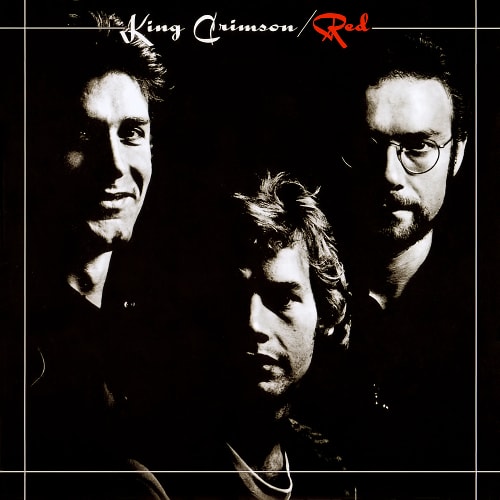
King Crimson, Red, album cover.


When King Crimson’s Red was released on October 6, 1974, Robert Fripp had already made public the news of the band’s demise in an interview in New Musical Express in England, where Fripp told the magazine that King Crimson was “over for ever and ever.” And the public’s reception to the new album was chilly, to say the least, with Red only reaching No. 45 on the British charts for one week, then unceremoniously dropping off for good. Fripp was burned out musically, and Red’s poor chart performance further fueled his disdain for the band. In a 1979 interview with Jean-Gilles Blum that appeared in Best, Fripp stated, “I decided it was time to stop…I was becoming more and more frustrated. Crimson had stopped evolving both in a commercial and musical sense. This reflected a lack of strength in the music. If our music had been incredibly good, we would undoubtedly have had a huge success. Such was not the case.”

At the point when King Crimson convened in London’s Olympic Studios in July of 1974, the band was already breaking apart. One day prior to the beginning of the sessions, Fripp uncharacteristically took a day trip into the countryside, which he has said opened his eyes to everything he’d been missing in life. Earlier in the year, in January and February, Crimson had recorded Starless and Bible Black (which commercially was also coolly received), then immediately launched a European tour. The band followed that with an American tour, then back to Britain for rehearsals of material for the upcoming album, and straight back to America for another leg of the tour. Violinist David Cross hung around to lay down the basic tracks in the studio for “Starless,” and then split – he didn’t even hang around for the cover photo shoot, which only featured the trio of Fripp, Wetton, and Bruford. The only other track to feature David Cross, “Providence,” was a live improvisation recorded in concert a few weeks earlier and then edited for the LP (I didn’t know that until I got this set). For most of the sessions, King Crimson was indeed a trio, and only weeks after the conclusion of the recording, the group had disbanded. Fripp threw several options out to Wetton and Bruford, all of which included Fripp taking at least a year off, and all were ultimately rejected. King Crimson appeared to be over, at least this version; in actuality, the band would simply remain dormant for almost seven years.

While Fripp’s lack of enthusiasm for Red and that particular incarnation of King Crimson was clearly evident (he has even commented that at the time, he didn’t know where the album was going musically), that wasn’t necessarily the case with everyone in the band. In Will Romano’s prog rock opus, Mountains Come Out Of The Sky, John Wetton commented about the album sessions: “Bill Bruford and myself knew exactly where it was going. We took the front seat on it, and pushed for that very up-front…in-your-face guitar [sound]. Yeah, definitely. We did that. You can hear it from the first track. This band is not f*cking about.” Bruford and Wetton were still very musically driven to continue post-Crimson, and both worked on a number of side projects over the next few years. The two of them eventually came together with Allan Holdsworth and Eddie Jobson to form what many consider to be the first prog supergroup, UK. All while Fripp’s “permanent” sabbatical from music continued through the late seventies.

But despite Red’s initial poor sales, fans soon warmed to the album, and critics have since waxed poetically about the record, with many listing it among the very best progressive rock albums ever, and some even listing it among the best albums of the decade. Pitchfork ranked Red  No. 72 on their best albums of the Seventies list, stating that, “For a band that was very obviously about to splinter, King Crimson’s music sounds remarkably of a single mind. On Red, they achieved a remarkable balance between bone-crushing brutality and cerebral complexity.” The album’s closing track, “Starless,” is considered by many to be the finest King Crimson song of all time. The album’s influence on future generations can’t be overstated, with even Kurt Cobain listing Red as one of his primary influences while crafting Nirvana’s guitar sound.


The Steven Wilson 40th Anniversary Remix/Remaster

The Steven Wilson remix/remaster of Red is, in my humble opinion, nothing short of miraculous when compared to the catalog releases, which all still strike me as a touch strident. That even goes for the 30th Anniversary release, which was probably the best digital version available prior to this set. As I mentioned in the intro, I’m late to the Steven Wilson King Crimson reissues, so with rare exception, the Blu-ray sets are long gone. So, my only choice ended up being the DVD-Audio/CD version. But it essentially boils down to personal preference, and in my situation: 1) there are zero differences in sound quality between the Blu-ray and DVD-Audio versions; 2) I don’t really do surround sound, so I can’t point to any advantages between either version from that angle; 3) I can play back DVD-Audio with my Yamaha universal player, and I know that not everyone can; and, 4) I’m mostly interested in ripping the 24/96 tracks to my music server, so the actual disc medium is much less important to me.

The CD disc contains the Wilson remix/remaster in 16/44.1 sound with three bonus tracks, which include trio band versions (without all the overdubs) of the title track “Red” and an instrumental of the album’s second track, “Fallen Angel.” It’s pretty amazing how different the track presents itself without John Wetton’s vocal performance! The CD concludes with the extended version of the track “Providence” (from the live compilation box set The Great Deceiver) which adds around two minutes to the total runtime. It also really changes the overall feel of the tune, which alternates between what I call “chamber prog” and full-out Fripp at his distorted metal best. Whereas the original fades out quietly, the full version rams back in at full bore one more time before reaching a conclusion. Hearing this was like, “where have you been all my life?” – it’s definitely a must-hear for Crimson fans. And the recording is so good, that for all these years, I had no idea it was sourced from a live recording until the fans roared out in approval at the end of the extended version! The sound of the entire CD is superlative, and it’s really great to have for listening in my car.


For me, the DVD-Audio disc is the real gem here; it not only provides all the previously mentioned tracks in 24/96 MLP Lossless stereo sound, but adds an additional bonus track. This is a second live tune taken from The Great Deceiver box, “A Voyage to the Center of the Cosmos,” which is another astonishingly good Crimson instrumental that I was completely unfamiliar with. Both live tunes were played by the Red-era version of the band on tour just prior to entering the recording studio. David Cross’ violin work really shines here; he proves what an integral part of the band’s sound his excellent contributions were during this iteration of King Crimson. The DVD also includes MLP Lossless 5.1 tracks for everything above except the trio version of “Red.” Most of the content is also available in 24/48 PCM stereo and DTS 5.1 tracks, and there’s also some video content (all with mono soundtracks). The four videos were taken from a French television broadcast, and the video’s not superb, but definitely watchable, while the mono sound is acceptably good. It’s just really great to be able to see some footage of Fripp and the band live!

I can only speak for the stereo content of the discs under review, but the sound quality is absolutely superb. I only paid $22 for the set, and it’s easily worth every penny. The mid-Seventies-era Crimson only recorded three albums, and that seems to have set a pattern for Fripp: his next incarnation of the band would only record three albums as well. Regardless, what amazing musical documents they all are! The 40th Anniversary remix/remaster of Red shows Steven Wilson’s craft in the studio – and King Crimson’s musical prowess – at their very best, shedding new light on this version of KC at every turn. Very highly recommended!

Discipline Global Mobile (DGM)/Panegyric, DVD Audio/CD set

Header image courtesy of Wikimedia Commons/Masahiro TAGAKI.

More from Issue 147

View All Articles in Issue 147

Search Copper Magazine

#226 JJ Murphy’s Sleep Paralysis is a Genre-Bending Musical Journey Through Jazz, Fusion and More by Frank Doris Jan 05, 2026 #226 Stewardship by Consent by B. Jan Montana Jan 05, 2026 #226 Food, Music, and Sensory Experience: An Interview With Professor Jonathan Zearfoss of the Culinary Institute of America by Joe Caplan Jan 05, 2026 #226 Studio Confidential: A Who’s Who of Recording Engineers Tell Their Stories by Frank Doris Jan 05, 2026 #226 Pilot Radio is Reborn, 50 Years Later: Talking With CEO Barak Epstein by Frank Doris Jan 05, 2026 #226 The Vinyl Beat Goes Down to Tijuana (By Way of Los Angeles), Part One by Rudy Radelic Jan 05, 2026 #226 Capital Audiofest 2025: Must-See Stereo, Part Two by Frank Doris Jan 05, 2026 #226 My Morning Jacket’s Carl Broemel and Tyler Ramsey Collaborate on Their Acoustic Guitar Album, Celestun by Ray Chelstowski Jan 05, 2026 #226 The People Who Make Audio Happen: CanJam SoCal 2025, Part Two by Harris Fogel Jan 05, 2026 #226 How to Play in a Rock Band, 19: Touring Can Make You Crazy, Part One by Frank Doris Jan 05, 2026 #226 Linda Ronstadt Goes Bigger by Wayne Robins Jan 05, 2026 #226 From The Audiophile’s Guide: Active Room Correction and Digital Signal Processing by Paul McGowan Jan 05, 2026 #226 PS Audio in the News by Frank Doris Jan 05, 2026 #226 Back to My Reel-to-Reel Roots, Part 25: Half-Full, Not Empty by Ken Kessler Jan 05, 2026 #226 Happy New Year! by Frank Doris Jan 05, 2026 #226 Turn It Down! by Peter Xeni Jan 05, 2026 #226 Ghost Riders by James Schrimpf Jan 05, 2026 #226 A Factory Tour of Audio Manufacturer German Physiks by Markus "Marsu" Manthey Jan 04, 2026 #225 Capital Audiofest 2025: Must-See Stereo, Part One by Frank Doris Dec 01, 2025 #225 Otis Taylor and the Electrics Delivers a Powerful Set of Hypnotic Modern Blues by Frank Doris Dec 01, 2025 #225 A Christmas Miracle by B. Jan Montana Dec 01, 2025 #225 T.H.E. Show New York 2025, Part Two: Plenty to See, Hear, and Enjoy by Frank Doris Dec 01, 2025 #225 Underappreciated Artists, Part One: Martin Briley by Rich Isaacs Dec 01, 2025 #225 Rock and Roll is Here to Stay by Wayne Robins Dec 01, 2025 #225 A Lifetime of Holiday Record (and CD) Listening by Rudy Radelic Dec 01, 2025 #225 Little Feat: Not Saying Goodbye, Not Yet by Ray Chelstowski Dec 01, 2025 #225 How to Play in a Rock Band, Part 18: Dealing With Burnout by Frank Doris Dec 01, 2025 #225 The People Who Make Audio Happen: CanJam SoCal 2025 by Harris Fogel Dec 01, 2025 #225 Chicago’s Sonic Sanctuaries: Four Hi‑Fi Listening Bars Channeling the Jazz‑Kissa Spirit by Olivier Meunier-Plante Dec 01, 2025 #225 From The Audiophile’s Guide: Controlling Bass Frequencies Through Membrane Absorbers (and How to Build Your Own) by Paul McGowan Dec 01, 2025 #225 Your Editor’s Tips for Attending Audio Shows by Frank Doris Dec 01, 2025 #225 PS Audio in the News by Frank Doris Dec 01, 2025 #225 Back to My Reel-to-Reel Roots, Part 24 by Ken Kessler Dec 01, 2025 #225 Holiday Music by Frank Doris Dec 01, 2025 #225 Puppy Prognostication by Peter Xeni Dec 01, 2025 #225 How to Post Comments on Copper by Frank Doris Dec 01, 2025 #225 Living Color by Rudy Radelic Dec 01, 2025 #224 T.H.E. Show New York 2025, Part One: A New Beginning by Frank Doris Nov 03, 2025 #224 Fool’s Leap of Faith is the Extraordinary Octave Records Debut from Singer/Songwriter Tyler Burba and Visit by Frank Doris Nov 03, 2025 #224 The Beatles’ “Aeolian Cadences.” What? by Wayne Robins Nov 03, 2025 #224 Persona Non Grata by B. Jan Montana Nov 03, 2025 #224 Talking With Recording Engineer Barry Diament of Soundkeeper Recordings, Part Two by Frank Doris Nov 03, 2025 #224 B Sides, B Movies, and Beware of Zombies by Rudy Radelic Nov 03, 2025 #224 The Burn-In Chronicles: 1,000 Hours to Sonic Salvation by Olivier Meunier-Plante Nov 03, 2025 #224 A Conversation With Mat Weisfeld of VPI Industries by Joe Caplan Nov 03, 2025 #224 Blues-Rocker Kenny Wayne Shepherd Celebrates 30 Years of Ledbetter Heights by Ray Chelstowski Nov 03, 2025 #224 Playing in a Rock Band, 17: When Good Gigs Go Bad, Part Two by Frank Doris Nov 03, 2025

King Crimson - Red (40th Anniversary Steven Wilson Remix/Remaster)

King Crimson - Red (40th Anniversary Steven Wilson Remix/Remaster)

I know, I’m pretty much late to the party with regard to the Steven Wilson remix/remasters of classic rock and prog titles, many of which have been out for a decade or longer. But having discovered my first few (mostly Yes albums) late last year and early this year, I’ve been on the hunt in an attempt to try and track down as many of his titles as I can find that really interest me. Lately that focus has been on Wilson’s 40th Anniversary reissues of prog masters King Crimson, and this issue, I’m talking about my experience with just one of them that’s near and dear to me, 1974’s landmark album, Red.

In my article in Copper Issue 138, where I rambled on about my love for the band Yes, I mentioned that back in the day I’d recently gotten an el-cheapo car cassette player for my ’69 Volkswagen station wagon, and had started picking up $3 cassettes at the local Turtles’ Records and Tapes – which had a pretty vast selection of tapes that were only a few years old for not too much cash. I didn’t have an abundant supply of tapes at the time, but in 1976 dollars, $3 was about half what I was then paying for LP’s, so the price seemed very reasonable! My only real working knowledge of King Crimson was their seminal debut record, In The Court of the Crimson King. But when I saw a $3 cassette copy of Red on the table at Turtles, I thought the cover looked really cool, so how could I possibly go wrong? The pink molded cassette that I’d previously bought for Yes’ Close To The Edge was cool, but the cassette for Red was even pinker, which I thought was very hip.

The off-brand car cassette player I’d picked up at the local Western Auto for $60 (rather a lot in 1976 dollars) probably only output 10 watts at 10 percent distortion. Playing into the super-low-fi stock Volkswagen speakers, it could barely output a decent level of sound without any distortion, but it was enough to let me know that I was definitely digging the sounds of Fripp, Bruford, Wetton, and company. My home system at the time was a JC Penney MCS setup (made by Panasonic) that was a customer return I’d bought for pennies on the dollar at a local JCP distribution and liquidation center. It only put out about 20 watts at 0.5 percent distortion, but at least at home, my 18-year-old self was getting a bit more of the musical picture. Hearing “Starless” for the first time was mind-blowing; it’s definitely among the greatest twelve-minute cacophonies of sound in all of progressive rock!

King Crimson, Red, album cover.


When King Crimson’s Red was released on October 6, 1974, Robert Fripp had already made public the news of the band’s demise in an interview in New Musical Express in England, where Fripp told the magazine that King Crimson was “over for ever and ever.” And the public’s reception to the new album was chilly, to say the least, with Red only reaching No. 45 on the British charts for one week, then unceremoniously dropping off for good. Fripp was burned out musically, and Red’s poor chart performance further fueled his disdain for the band. In a 1979 interview with Jean-Gilles Blum that appeared in Best, Fripp stated, “I decided it was time to stop…I was becoming more and more frustrated. Crimson had stopped evolving both in a commercial and musical sense. This reflected a lack of strength in the music. If our music had been incredibly good, we would undoubtedly have had a huge success. Such was not the case.”

At the point when King Crimson convened in London’s Olympic Studios in July of 1974, the band was already breaking apart. One day prior to the beginning of the sessions, Fripp uncharacteristically took a day trip into the countryside, which he has said opened his eyes to everything he’d been missing in life. Earlier in the year, in January and February, Crimson had recorded Starless and Bible Black (which commercially was also coolly received), then immediately launched a European tour. The band followed that with an American tour, then back to Britain for rehearsals of material for the upcoming album, and straight back to America for another leg of the tour. Violinist David Cross hung around to lay down the basic tracks in the studio for “Starless,” and then split – he didn’t even hang around for the cover photo shoot, which only featured the trio of Fripp, Wetton, and Bruford. The only other track to feature David Cross, “Providence,” was a live improvisation recorded in concert a few weeks earlier and then edited for the LP (I didn’t know that until I got this set). For most of the sessions, King Crimson was indeed a trio, and only weeks after the conclusion of the recording, the group had disbanded. Fripp threw several options out to Wetton and Bruford, all of which included Fripp taking at least a year off, and all were ultimately rejected. King Crimson appeared to be over, at least this version; in actuality, the band would simply remain dormant for almost seven years.

While Fripp’s lack of enthusiasm for Red and that particular incarnation of King Crimson was clearly evident (he has even commented that at the time, he didn’t know where the album was going musically), that wasn’t necessarily the case with everyone in the band. In Will Romano’s prog rock opus, Mountains Come Out Of The Sky, John Wetton commented about the album sessions: “Bill Bruford and myself knew exactly where it was going. We took the front seat on it, and pushed for that very up-front…in-your-face guitar [sound]. Yeah, definitely. We did that. You can hear it from the first track. This band is not f*cking about.” Bruford and Wetton were still very musically driven to continue post-Crimson, and both worked on a number of side projects over the next few years. The two of them eventually came together with Allan Holdsworth and Eddie Jobson to form what many consider to be the first prog supergroup, UK. All while Fripp’s “permanent” sabbatical from music continued through the late seventies.

But despite Red’s initial poor sales, fans soon warmed to the album, and critics have since waxed poetically about the record, with many listing it among the very best progressive rock albums ever, and some even listing it among the best albums of the decade. Pitchfork ranked Red  No. 72 on their best albums of the Seventies list, stating that, “For a band that was very obviously about to splinter, King Crimson’s music sounds remarkably of a single mind. On Red, they achieved a remarkable balance between bone-crushing brutality and cerebral complexity.” The album’s closing track, “Starless,” is considered by many to be the finest King Crimson song of all time. The album’s influence on future generations can’t be overstated, with even Kurt Cobain listing Red as one of his primary influences while crafting Nirvana’s guitar sound.


The Steven Wilson 40th Anniversary Remix/Remaster

The Steven Wilson remix/remaster of Red is, in my humble opinion, nothing short of miraculous when compared to the catalog releases, which all still strike me as a touch strident. That even goes for the 30th Anniversary release, which was probably the best digital version available prior to this set. As I mentioned in the intro, I’m late to the Steven Wilson King Crimson reissues, so with rare exception, the Blu-ray sets are long gone. So, my only choice ended up being the DVD-Audio/CD version. But it essentially boils down to personal preference, and in my situation: 1) there are zero differences in sound quality between the Blu-ray and DVD-Audio versions; 2) I don’t really do surround sound, so I can’t point to any advantages between either version from that angle; 3) I can play back DVD-Audio with my Yamaha universal player, and I know that not everyone can; and, 4) I’m mostly interested in ripping the 24/96 tracks to my music server, so the actual disc medium is much less important to me.

The CD disc contains the Wilson remix/remaster in 16/44.1 sound with three bonus tracks, which include trio band versions (without all the overdubs) of the title track “Red” and an instrumental of the album’s second track, “Fallen Angel.” It’s pretty amazing how different the track presents itself without John Wetton’s vocal performance! The CD concludes with the extended version of the track “Providence” (from the live compilation box set The Great Deceiver) which adds around two minutes to the total runtime. It also really changes the overall feel of the tune, which alternates between what I call “chamber prog” and full-out Fripp at his distorted metal best. Whereas the original fades out quietly, the full version rams back in at full bore one more time before reaching a conclusion. Hearing this was like, “where have you been all my life?” – it’s definitely a must-hear for Crimson fans. And the recording is so good, that for all these years, I had no idea it was sourced from a live recording until the fans roared out in approval at the end of the extended version! The sound of the entire CD is superlative, and it’s really great to have for listening in my car.


For me, the DVD-Audio disc is the real gem here; it not only provides all the previously mentioned tracks in 24/96 MLP Lossless stereo sound, but adds an additional bonus track. This is a second live tune taken from The Great Deceiver box, “A Voyage to the Center of the Cosmos,” which is another astonishingly good Crimson instrumental that I was completely unfamiliar with. Both live tunes were played by the Red-era version of the band on tour just prior to entering the recording studio. David Cross’ violin work really shines here; he proves what an integral part of the band’s sound his excellent contributions were during this iteration of King Crimson. The DVD also includes MLP Lossless 5.1 tracks for everything above except the trio version of “Red.” Most of the content is also available in 24/48 PCM stereo and DTS 5.1 tracks, and there’s also some video content (all with mono soundtracks). The four videos were taken from a French television broadcast, and the video’s not superb, but definitely watchable, while the mono sound is acceptably good. It’s just really great to be able to see some footage of Fripp and the band live!

I can only speak for the stereo content of the discs under review, but the sound quality is absolutely superb. I only paid $22 for the set, and it’s easily worth every penny. The mid-Seventies-era Crimson only recorded three albums, and that seems to have set a pattern for Fripp: his next incarnation of the band would only record three albums as well. Regardless, what amazing musical documents they all are! The 40th Anniversary remix/remaster of Red shows Steven Wilson’s craft in the studio – and King Crimson’s musical prowess – at their very best, shedding new light on this version of KC at every turn. Very highly recommended!

Discipline Global Mobile (DGM)/Panegyric, DVD Audio/CD set

Header image courtesy of Wikimedia Commons/Masahiro TAGAKI.

0 comments

Leave a comment

0 Comments

Your avatar

Loading comments...

🗑️ Delete Comment

Enter moderator password to delete this comment: