COPPER

A PS Audio Publication

Issue 155 • Free Online Magazine

Issue 155 Featured

John Wasserman, Critic – Part One

John Wasserman, Critic – Part One

Critics and reviewers, in general, are an oft-maligned bunch, and, some would say, rightfully so. The old saying, “Those who can, do, but those who can’t, teach” sometimes gets paraphrased to demean those arbiters of taste with whom we, or the subject of the criticism, disagree. Criticism of the arts, it must be remembered, merely reflects the opinion of the critic – too often it is received (or perceived) as the Gospel. I have long thought that all reviews, whether they be of artists or items, should be preceded by the disclaimer: “The following is the subjective opinion of one person and should not be taken as a reflection of objective reality.”

Rare is the critic who entertains, edifies, and doesn’t take him or herself too seriously. The late John Wasserman was such a writer. He reported on musical performances and other cultural events with a healthy dash of humorous cynicism and irreverence. For too short a career, Wasserman regaled those of us in the Bay Area with his wit and sharp opinions that were published in the San Francisco Chronicle.

John was the kind of critic who could make you laugh even while he was skewering one of your favorite artists, something that cannot be said about his successor at the paper. (I have no love for that guy.) A now out-of-print paperback compilation of many of John’s columns for the paper, entitled Praise, Vilification, and Sexual Innuendo, was lovingly produced by his sister, Abby, after his death at the age of 40 in 1979. Abby is herself a journalist, author, and interviewer, and she elicited wonderful stories from the many musicians, comics, writers, and local celebrities whose lives intersected with John’s. The introduction is preceded by laudatory quotes about him from Jay Leno, Clint Eastwood, Herb Caen, and others. The poet Michael McClure wrote a special tribute.

Praise, Vilification, and Sexual Innuendo, book cover. Praise, Vilification, and Sexual Innuendo, book cover.
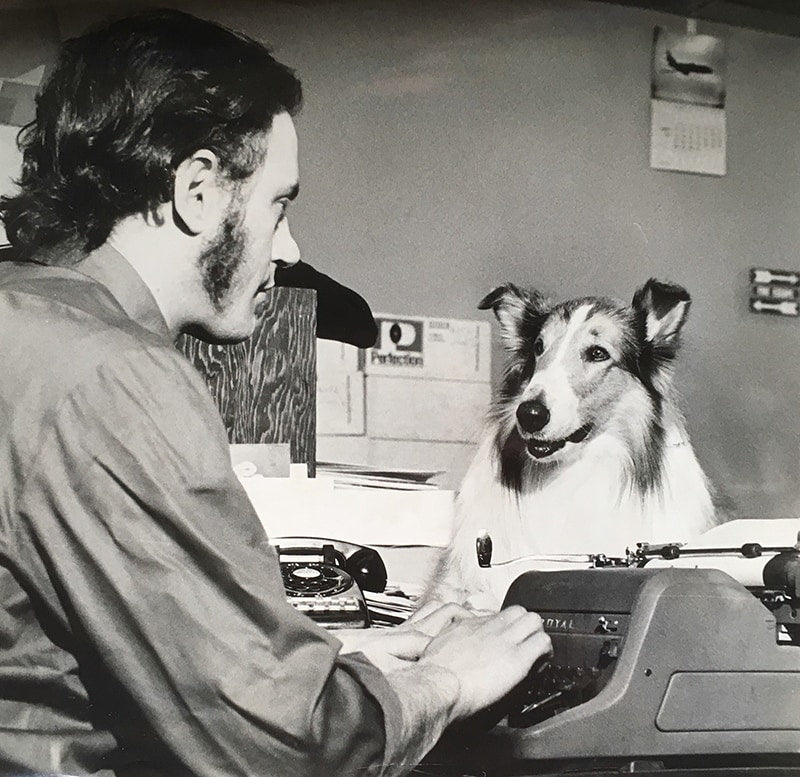
The book also features many photos from all stages of his life, the images helping to paint a more complete picture of the man. There’s even a shot from 1971 of John at his typewriter with Lassie looking on. He was writing about a promotional tour the dog was doing to tout a new dog food. His resulting column began with disillusionment – “She slunk into the Chronicle offices like the veteran television star she is – hair long and sleek, enormous brown eyes, petite 74-pound body drawing stares with every step. Then she barked. The spell was broken. And drooled on my typewriter. The final blow – Rudd Weatherwax, her sexagenarian sugar daddy, confessed that she is actually a boy. A transvestite, if you will, a female impersonator. Lassie bowed his head forlornly and dribbled on my telephone. Nothing, it would appear, is sacred.”
John Wasserman interviewing Lassie, 1971.

John had many friends in the entertainment world. A lover of jazz, he knew Cal Tjader, Oscar Peterson, Bill Evans, and Toots Thielemans, all of whom had visited John and played in his living room. He even sat in on conga drums with Benny Goodman at a 60th birthday party for San Francisco icon Herb Caen.
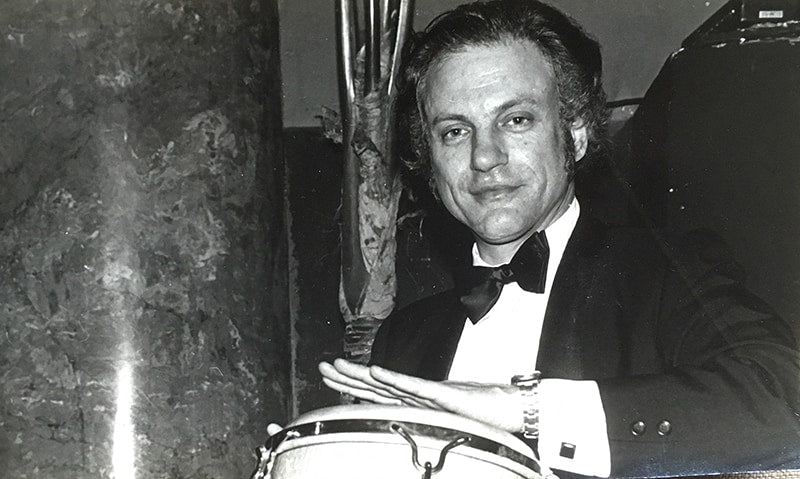
 

Wasserman playing the conga drum at Herb Caen's birthday bash. Courtesy of Lani Mein.

To be expected along the way, he picked up a few enemies. His reviews rankled Jerry Lewis, Wayne Newton, Miles Davis, Chita Rivera, and Mel Tormé, among others. Ms. Rivera wrote and chastised him for using the term “ghastly” to describe the “immensely gifted” young men (her words) with whom she was performing, and implored him to look up the definition, as she felt that it more appropriately applied to his manners. His response was to write: “Look up ‘ghastly’ in the dictionary and it all becomes clear – a simple misunderstanding. Miss Rivera obviously thinks I was referring to this definition of ghastly: ‘Ghostlike; pale; haggard.’ Not at all. Her immensely gifted young men are, in fact, rosy-cheeked and well-rested in appearance. No wonder she took offense. But, in fact, the definition I was referring to was ‘Horrible; frightful.’” Ouch!

John’s columns often dealt with cultural events far afield of musical concerts. In 1976, he wrote about a bodybuilding competition featuring, among others, a young Arnold Schwarzenegger. This was well before Arnold’s film career would take off. John predicted great things for Arnold, and described the event as follows: “What he and the rest did on Saturday night was both bizarre and breathtaking. In individual performances that lasted no more than 90 seconds, each man contrived to exhibit, to a capacity house of 2,000 or so (at no less than $10 a person), every major muscle group in their body in a sculptured relief that has about as much in common with the average man’s body as does Michelangelo’s ‘David’ with Porky Pig.”

He reviewed adult films and comedy performances with the same humor and outrageousness. In writing about a live performance by porn star Marilyn Chambers, John said after she had become famous, she “hooked up with legendary sexologist Chuck Traynor (once Linda Lovelace’s favorite lozenge) and went on to conquer new worlds.”

I will explore further the life and writing of John Wasserman in Issue 157, but I’ll leave you with my favorite column of his (I actually saved the original newspaper clipping), a review of a concert by The Osmonds at the Oakland Coliseum Arena.

Suffer – The Little Osmond Brothers
February 9, 1972
Now that such show biz luminaries as Bob Dylan and John Lennon are over 30, those whining sycophants who once adopted the slogan “Never Trust Anyone Over 30” as some sort of in-group Pig Latin are in trouble.
A whining sycophant without a slogan is like an eye-makeup kit without mascara.
Fortunately, I have just discovered a fine replacement: “Never trust anyone under 15, especially if he is a singer.” Let us all chant that for five minutes.
The inspiration for this catchy new slogan is, needless to say, the Osmond Brothers, who appeared here in concert on Sunday night. The Osmonds originally tried to make it in show business as singers and musicians. When it finally became clear that this was an impossibility, they formed their current act. This involves appearing en masse on stage (there are between five and 27 of them…no one has ever been able to make an accurate count as they are constantly in motion) in white, plunging-neckline jumpsuits, screeching at a volume that precludes intelligibility, pretending to play musical instruments and jostling about in what might be described as pre-1955 bad Motown unison show-and-tell.
The star of this spectacle is one Donny Osmond, a 14-year-old crypto-midget who need only simulate picking his nose to bring forth brain-shattering shrieks from countless thousands of horny 13-year-old girls. The show also features at least five other Osmond Brothers, but many are so old – some even as old as 23 – that the capacity audience of Sunday night could not even remotely relate to them. One of them – Patti, Maxine, or Laverne: I always get them mixed up – even had dark splotches visible on his chest where his shirt V’d. This was either hair or charcoal smudges. I asked several nearby girls to identify this substance. They thought it was a two-tone shirt.
The show opened with Bo Donaldson and the Heywoods, the worst rock and roll group in history. There were seven of them in yellow jumpsuits and sequins, playing what sounded like prerecorded Gary Puckett at the wrong speed and carrying on like a bunch of dancing bananas.
Then, they appeared. Bedlam, hysteria, a lung-breaking performance by that new, 10,000-voice singing group the Decibelles, Kodak stock up six points. I haven’t seen that many flashbulbs since the Monkees at the Cow Palace in 1967. Hair-tearing, knee pounding, eyes blurring, tiny bosoms heaving against training bras, hand-lettered signs thrusting out of the mass mess like toadstools.
They started with a song which sounded like “Bite Him Down” and one thing was immediately apparent. The Osmond Brothers were painfully, literally painfully, loud. Combined with their own ham-fisted playing (drums, guitars, bass, electric piano) was an eight-piece back-up band and a crazy person at the volume controls. By comparison, The Who’s Civic Auditorium concert sounded like two moths locked in mortal combat.
Surely, I said to myself, this cornucopia of riches cannot continue to expand. Wrong again. Out came another Osmond – Muhammad, I believe – who is eight years old and as cute as a Presto log. Muhammad, a regular pee-wee Wayne Newton, stands approximately two feet seven. He immediately launched into “I Got a Woman” and “I’m Evil” all the whilst bumping and grinding from one end of the stage to the other and producing pelvic thrusts Lamaze never even thought of.
Finally, Donny sang “Your Song,” “Go Away Little Girl,” and – prepare yourself – “Sometimes I Feel Like a Motherless Child.” That, of course, was the real humor of the program. “Sometimes I Feel Like a Motherless Child” is a kid’s song like “Animal Farm” is a kid’s book. Donny, on the other hand, thinks that “Hold On, I’m Comin’!” is the theme song of St. Bernard dogs in the Swiss Alps.


That review elicited a flood of hate mail, and some 50 adolescent girls picketed the Chronicle offices, wearing “I Love Donny” T-shirts and holding signs that said “I Hate John Wasserman.” As an aside, I was at that Who concert he mentioned and it was the first time I had ever thought a rock band was too loud – if I hadn’t been familiar with the songs, I would have lost my place in the aural hash that assaulted my ears.

All photos and excerpts reprinted by kind permission of Abby Wasserman. Header image photo by Sydney Goldstein.

More from Issue 155

View All Articles in Issue 155

Search Copper Magazine

#228 Serita’s Black Rose Duo Shakes Your Soul With a Blend of Funk, Rock, Blues and a Whole Lot More by Frank Doris Mar 02, 2026 #228 Vinyl, A Love Story by Wayne Robins Mar 02, 2026 #228 Thrill Seeker by B. Jan Montana Mar 02, 2026 #228 The Vinyl Beat: Donald Byrd, Bill Evans, Wes Montgomery, Eddie Palmieri and Frank Sinatra by Rudy Radelic Mar 02, 2026 #228 Listening to Prestige: The History of a Vitally Important Jazz Record Label by Frank Doris Mar 02, 2026 #228 How to Play in a Rock Band, 21: Touring With James Lee Stanley by Frank Doris Mar 02, 2026 #228 The NAMM 2026 Show: The Music Industry’s Premier Event by John Volanski Mar 02, 2026 #228 The Earliest Stars of Country Music, Part Two by Jeff Weiner Mar 02, 2026 #228 From The Audiophile's Guide: A Brief History of Stereophonic Sound by Paul McGowan Mar 02, 2026 #228 A Bone to Pick With Streaming Audio by Frank Doris Mar 02, 2026 #228 Blast Off With Bluesman Duke Robillard by Ray Chelstowski Mar 02, 2026 #228 A Visit to the Marten Loudspeaker Factory in Göteborg, Sweden by Ingo Schulz and Sebastian Polcyn Mar 02, 2026 #228 Pure Distortion by Peter Xeni Mar 02, 2026 #228 A Nagra Factory Tour by Markus "Marsu" Manthey Mar 02, 2026 #228 Back to My Reel-to-Reel Roots, Part 27: Noodge and Ye Shall Receive, Part Two by Ken Kessler Mar 02, 2026 #228 PS Audio in the News by PS Audio Staff Mar 02, 2026 #228 90-Degree Stereo by Frank Doris Mar 02, 2026 #228 The Keys to Art by Rich Isaacs Mar 02, 2026 #227 Seth Lewis Gets in the Groove With Take a Look Around: a Tribute to the Meters by Frank Doris Feb 02, 2026 #227 Passport to Sound: May Anwar’s Audio Learning Experience for Young People by Frank Doris Feb 02, 2026 #227 Conjectures on Cosmic Consciousness by B. Jan Montana Feb 02, 2026 #227 The Big Takeover Turns 45 by Wayne Robins Feb 02, 2026 #227 Music and Chocolate: On the Sensory Connection by Joe Caplan Feb 02, 2026 #227 Singer/Songwriter Chris Berardo: Getting Wilder All the Time by Ray Chelstowski Feb 02, 2026 #227 The Earliest Stars of Country Music, Part One by Jeff Weiner Feb 02, 2026 #227 The Vinyl Beat Goes Down to Tijuana (By Way of Los Angeles), Part Two by Rudy Radelic Feb 02, 2026 #227 How to Play in a Rock Band, 20: On the Road With Blood, Sweat & Tears’ Guitarist Gabe Cummins by Frank Doris Feb 02, 2026 #227 From The Audiophile’s Guide: Audio Specs and Measuring by Paul McGowan Feb 02, 2026 #227 Our Brain is Always Listening by Peter Trübner Feb 02, 2026 #227 PS Audio in the News by PS Audio Staff Feb 02, 2026 #227 The Listening Chair: Sleek Style and Sound From the Luxman L3 by Howard Kneller Feb 02, 2026 #227 The Los Angeles and Orange County Audio Society Celebrates Its 32nd Anniversary, Honoring David and Sheryl Lee Wilson and Bernie Grundman by Harris Fogel Feb 02, 2026 #227 Back to My Reel-to-Reel Roots, Part 26: Half Full – Not Half Empty, Redux by Ken Kessler Feb 02, 2026 #227 That's What Puzzles Us... by Frank Doris Feb 02, 2026 #227 Record-Breaking by Peter Xeni Feb 02, 2026 #227 The Long and Winding Road by B. Jan Montana Feb 02, 2026 #226 JJ Murphy’s Sleep Paralysis is a Genre-Bending Musical Journey Through Jazz, Fusion and More by Frank Doris Jan 05, 2026 #226 Stewardship by Consent by B. Jan Montana Jan 05, 2026 #226 Food, Music, and Sensory Experience: An Interview With Professor Jonathan Zearfoss of the Culinary Institute of America by Joe Caplan Jan 05, 2026 #226 Studio Confidential: A Who’s Who of Recording Engineers Tell Their Stories by Frank Doris Jan 05, 2026 #226 Pilot Radio is Reborn, 50 Years Later: Talking With CEO Barak Epstein by Frank Doris Jan 05, 2026 #226 The Vinyl Beat Goes Down to Tijuana (By Way of Los Angeles), Part One by Rudy Radelic Jan 05, 2026 #226 Capital Audiofest 2025: Must-See Stereo, Part Two by Frank Doris Jan 05, 2026 #226 My Morning Jacket’s Carl Broemel and Tyler Ramsey Collaborate on Their Acoustic Guitar Album, Celestun by Ray Chelstowski Jan 05, 2026 #226 The People Who Make Audio Happen: CanJam SoCal 2025, Part Two by Harris Fogel Jan 05, 2026 #226 How to Play in a Rock Band, 19: Touring Can Make You Crazy, Part One by Frank Doris Jan 05, 2026 #226 Linda Ronstadt Goes Bigger by Wayne Robins Jan 05, 2026

John Wasserman, Critic – Part One

John Wasserman, Critic – Part One

Critics and reviewers, in general, are an oft-maligned bunch, and, some would say, rightfully so. The old saying, “Those who can, do, but those who can’t, teach” sometimes gets paraphrased to demean those arbiters of taste with whom we, or the subject of the criticism, disagree. Criticism of the arts, it must be remembered, merely reflects the opinion of the critic – too often it is received (or perceived) as the Gospel. I have long thought that all reviews, whether they be of artists or items, should be preceded by the disclaimer: “The following is the subjective opinion of one person and should not be taken as a reflection of objective reality.”

Rare is the critic who entertains, edifies, and doesn’t take him or herself too seriously. The late John Wasserman was such a writer. He reported on musical performances and other cultural events with a healthy dash of humorous cynicism and irreverence. For too short a career, Wasserman regaled those of us in the Bay Area with his wit and sharp opinions that were published in the San Francisco Chronicle.

John was the kind of critic who could make you laugh even while he was skewering one of your favorite artists, something that cannot be said about his successor at the paper. (I have no love for that guy.) A now out-of-print paperback compilation of many of John’s columns for the paper, entitled Praise, Vilification, and Sexual Innuendo, was lovingly produced by his sister, Abby, after his death at the age of 40 in 1979. Abby is herself a journalist, author, and interviewer, and she elicited wonderful stories from the many musicians, comics, writers, and local celebrities whose lives intersected with John’s. The introduction is preceded by laudatory quotes about him from Jay Leno, Clint Eastwood, Herb Caen, and others. The poet Michael McClure wrote a special tribute.

Praise, Vilification, and Sexual Innuendo, book cover. Praise, Vilification, and Sexual Innuendo, book cover.
The book also features many photos from all stages of his life, the images helping to paint a more complete picture of the man. There’s even a shot from 1971 of John at his typewriter with Lassie looking on. He was writing about a promotional tour the dog was doing to tout a new dog food. His resulting column began with disillusionment – “She slunk into the Chronicle offices like the veteran television star she is – hair long and sleek, enormous brown eyes, petite 74-pound body drawing stares with every step. Then she barked. The spell was broken. And drooled on my typewriter. The final blow – Rudd Weatherwax, her sexagenarian sugar daddy, confessed that she is actually a boy. A transvestite, if you will, a female impersonator. Lassie bowed his head forlornly and dribbled on my telephone. Nothing, it would appear, is sacred.”
John Wasserman interviewing Lassie, 1971.

John had many friends in the entertainment world. A lover of jazz, he knew Cal Tjader, Oscar Peterson, Bill Evans, and Toots Thielemans, all of whom had visited John and played in his living room. He even sat in on conga drums with Benny Goodman at a 60th birthday party for San Francisco icon Herb Caen.


Wasserman playing the conga drum at Herb Caen's birthday bash. Courtesy of Lani Mein.

To be expected along the way, he picked up a few enemies. His reviews rankled Jerry Lewis, Wayne Newton, Miles Davis, Chita Rivera, and Mel Tormé, among others. Ms. Rivera wrote and chastised him for using the term “ghastly” to describe the “immensely gifted” young men (her words) with whom she was performing, and implored him to look up the definition, as she felt that it more appropriately applied to his manners. His response was to write: “Look up ‘ghastly’ in the dictionary and it all becomes clear – a simple misunderstanding. Miss Rivera obviously thinks I was referring to this definition of ghastly: ‘Ghostlike; pale; haggard.’ Not at all. Her immensely gifted young men are, in fact, rosy-cheeked and well-rested in appearance. No wonder she took offense. But, in fact, the definition I was referring to was ‘Horrible; frightful.’” Ouch!

John’s columns often dealt with cultural events far afield of musical concerts. In 1976, he wrote about a bodybuilding competition featuring, among others, a young Arnold Schwarzenegger. This was well before Arnold’s film career would take off. John predicted great things for Arnold, and described the event as follows: “What he and the rest did on Saturday night was both bizarre and breathtaking. In individual performances that lasted no more than 90 seconds, each man contrived to exhibit, to a capacity house of 2,000 or so (at no less than $10 a person), every major muscle group in their body in a sculptured relief that has about as much in common with the average man’s body as does Michelangelo’s ‘David’ with Porky Pig.”

He reviewed adult films and comedy performances with the same humor and outrageousness. In writing about a live performance by porn star Marilyn Chambers, John said after she had become famous, she “hooked up with legendary sexologist Chuck Traynor (once Linda Lovelace’s favorite lozenge) and went on to conquer new worlds.”

I will explore further the life and writing of John Wasserman in Issue 157, but I’ll leave you with my favorite column of his (I actually saved the original newspaper clipping), a review of a concert by The Osmonds at the Oakland Coliseum Arena.

Suffer – The Little Osmond Brothers
February 9, 1972
Now that such show biz luminaries as Bob Dylan and John Lennon are over 30, those whining sycophants who once adopted the slogan “Never Trust Anyone Over 30” as some sort of in-group Pig Latin are in trouble.
A whining sycophant without a slogan is like an eye-makeup kit without mascara.
Fortunately, I have just discovered a fine replacement: “Never trust anyone under 15, especially if he is a singer.” Let us all chant that for five minutes.
The inspiration for this catchy new slogan is, needless to say, the Osmond Brothers, who appeared here in concert on Sunday night. The Osmonds originally tried to make it in show business as singers and musicians. When it finally became clear that this was an impossibility, they formed their current act. This involves appearing en masse on stage (there are between five and 27 of them…no one has ever been able to make an accurate count as they are constantly in motion) in white, plunging-neckline jumpsuits, screeching at a volume that precludes intelligibility, pretending to play musical instruments and jostling about in what might be described as pre-1955 bad Motown unison show-and-tell.
The star of this spectacle is one Donny Osmond, a 14-year-old crypto-midget who need only simulate picking his nose to bring forth brain-shattering shrieks from countless thousands of horny 13-year-old girls. The show also features at least five other Osmond Brothers, but many are so old – some even as old as 23 – that the capacity audience of Sunday night could not even remotely relate to them. One of them – Patti, Maxine, or Laverne: I always get them mixed up – even had dark splotches visible on his chest where his shirt V’d. This was either hair or charcoal smudges. I asked several nearby girls to identify this substance. They thought it was a two-tone shirt.
The show opened with Bo Donaldson and the Heywoods, the worst rock and roll group in history. There were seven of them in yellow jumpsuits and sequins, playing what sounded like prerecorded Gary Puckett at the wrong speed and carrying on like a bunch of dancing bananas.
Then, they appeared. Bedlam, hysteria, a lung-breaking performance by that new, 10,000-voice singing group the Decibelles, Kodak stock up six points. I haven’t seen that many flashbulbs since the Monkees at the Cow Palace in 1967. Hair-tearing, knee pounding, eyes blurring, tiny bosoms heaving against training bras, hand-lettered signs thrusting out of the mass mess like toadstools.
They started with a song which sounded like “Bite Him Down” and one thing was immediately apparent. The Osmond Brothers were painfully, literally painfully, loud. Combined with their own ham-fisted playing (drums, guitars, bass, electric piano) was an eight-piece back-up band and a crazy person at the volume controls. By comparison, The Who’s Civic Auditorium concert sounded like two moths locked in mortal combat.
Surely, I said to myself, this cornucopia of riches cannot continue to expand. Wrong again. Out came another Osmond – Muhammad, I believe – who is eight years old and as cute as a Presto log. Muhammad, a regular pee-wee Wayne Newton, stands approximately two feet seven. He immediately launched into “I Got a Woman” and “I’m Evil” all the whilst bumping and grinding from one end of the stage to the other and producing pelvic thrusts Lamaze never even thought of.
Finally, Donny sang “Your Song,” “Go Away Little Girl,” and – prepare yourself – “Sometimes I Feel Like a Motherless Child.” That, of course, was the real humor of the program. “Sometimes I Feel Like a Motherless Child” is a kid’s song like “Animal Farm” is a kid’s book. Donny, on the other hand, thinks that “Hold On, I’m Comin’!” is the theme song of St. Bernard dogs in the Swiss Alps.


That review elicited a flood of hate mail, and some 50 adolescent girls picketed the Chronicle offices, wearing “I Love Donny” T-shirts and holding signs that said “I Hate John Wasserman.” As an aside, I was at that Who concert he mentioned and it was the first time I had ever thought a rock band was too loud – if I hadn’t been familiar with the songs, I would have lost my place in the aural hash that assaulted my ears.

All photos and excerpts reprinted by kind permission of Abby Wasserman. Header image photo by Sydney Goldstein.

0 comments

Leave a comment

0 Comments

Your avatar

Loading comments...

🗑️ Delete Comment

Enter moderator password to delete this comment:

✏️ Edit Comment

Enter your email to verify ownership: