COPPER

A PS Audio Publication

Issue 155 • Free Online Magazine

Issue 155 Disciples of Sound

Gideon King & City Blog: Fusing Rock, Jazz, Creative Diversity and More

Gideon King & City Blog: Fusing Rock, Jazz, Creative Diversity and More

Rock’s great guitarists have often been renaissance men; artists who allow their creative spirit to be expressed across a variety of platforms and endeavors. Jeff Beck and the late Danny Gatton made refurbishing hot rods their life’s other passion. AC/DC’s Angus Young spends time offstage in front of a canvas, painting with oil. The commitment these artists have to all that they do outside of music is as inspiring as the body of work they have assembled with their guitars. And, some might say that with real artists, every creative expression informs another. That is unquestionably the case with New York City-based guitar virtuoso Gideon King. When he isn’t fronting his band, City Blog, he can be found in his shop pursuing his love of fine woodworking and carpentry. It’s that endless quest for discovery that has made his musical journey so compelling, and the darling of so many critical eyes and ears.

He began playing guitar at age nine, and was quickly attracted to music that was sophisticated but also accessible. Artists like Bob Dylan, Steely Dan, and guitarists including John Scofield and Pat Metheny would help shape his sound, technique, and approach to music, through college and into life as an adult. There he forged a remarkable career in the business world. As his firms grew, King was afforded the freedom to more deeply pursue music, and he founded Gideon King & City Blog, a varied and virile pop-fusion outlet that would begin to explore funk, balladry, R&B, jazz, and soul. To date, the eight-piece band has released two albums, one EP and 15 singles, and they maintain a commitment to releasing a new single every two months. It’s a cadence that’s dizzying to most musicians but also reflects City Blog’s openness to experimentation and their aversion to being typecast.
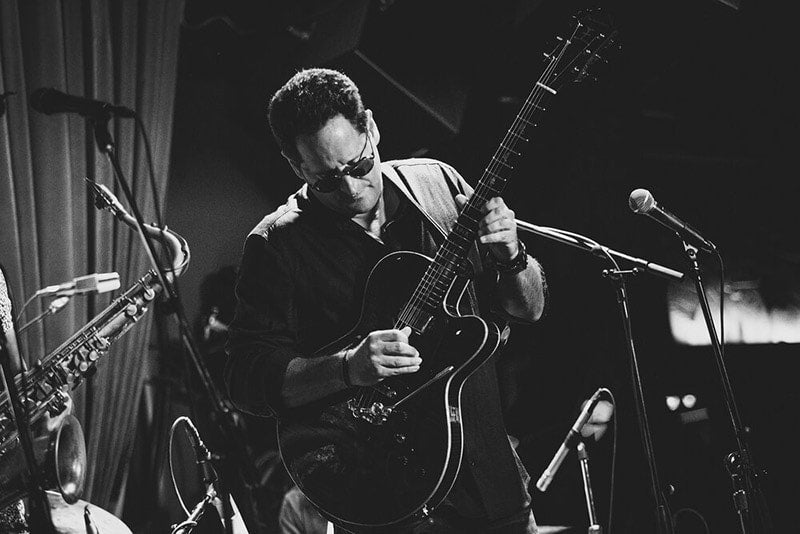
Gideon King. Gideon King.

HuffPost has called King “a musical genius…playing some of the most complex and satisfying music you may ever hear.” This kind of attention has helped the band build a following that finds them regularly selling out New York City venues like City Winery, Joe’s Pub, and the Blue Note. It also has prompted musicians like Scofield, sax legend Donny McCaslin (David Bowie, Bobby McFerrin), renowned Bayou-soul singer-songwriter Marc Broussard, and Saturday Night Live bassist James Genus (Herbie Hancock, Chick Corea), among others to join them on stage.

The band is set to release their latest three song EP, Whatchya Gonna Do, and advance praise is already mounting. Copper had the opportunity to speak with King as he was wiring up his new guitar rig, learn more about how the band Steely Dan continues to help guide his creative process, ask about how he listens to the music he makes, and inquire as to when we might just see him perform outside the five boroughs. It was an electric exchange that is only partially captured here. It was also a reflection of the energy and intensity King brings to the music he makes, and a metaphor for how he attacks his guitar and makes such singular music.


Ray Chelstowski: You began playing guitar at the age of nine but pursued a successful career in business. When did you decide that your avocation could become your vocation?

Gideon King: I am a freak when it comes to pursuing things that I have a passion for. For example, I’m an avid, obsessed woodworker and carpenter and have a shop where I spend hours and hours. I have a lot of different things that I am passionate about and not everything that I do is great. But I am fascinated by all of these different places in the world you can go intellectually and in most every other way.

I have always had the inclination to pursue many things at once and my brother is the same way. He is a killer jazz piano player and toured with Joshua Redman. He’s also a partner at a law firm. It’s a DNA thing we share, [and] I don’t think that anything I pursue is necessarily my main thing. In fact, I think that a lot of great businesspeople could be considered artists, and a lot of artists have a strong business side to them. Don’t think that Pat Metheny doesn’t have a business side to him. He is a pioneer sonically and his playing is ridiculous. But he is a businessman too. He is very serious about what he is building. So is Coldplay and so is Sting.

RC: Steely Dan is noted as one of your earliest and most lasting influences. What is it about that band that has made their impact so important?

GK: The Steely Dan thing for me was inspirational for a few different reasons. It’s kind of like when you play pick-up basketball. You look around the court and you want to pick the best athletes. That’s what Walter Becker and Donald Fagen did with Steely Dan. They said, “we want Steve Khan, we want Larry Carlton, we want Steve Gadd, and Wayne Shorter, and Randy Brecker, etc. The thing that’s beautiful is that if you write decent songs and bring them to great musical athletes, things happen. So that’s what I try to do. I write songs with a lot of jazz influences.

Steely Dan was a reconciliation of all of the different musical influences that I grew up with. A lot of people have done “rock/jazz.” But how they did it was amazing, especially when you layer on their ridiculous lyrics that are abstract, beautiful, and poetic. This made them the real deal. Also, it was just so cool to have those kinds of extended solos appear in a rock song. Just think of that classic solo in “Kid Charlemagne.” Even today on Instagram you find all of these kids still trying to figure it out, trying to determine what’s being played over what.


RC: Are you as exacting as Donald Fagen and Walter Becker were known to be in the studio?

GK: In the beginning I wasn’t because I didn’t know how to be. Now I think we have gotten there and the process is really collaborative. We are constantly shaping the sound and there is so much technology available now to musicians to help that along. For example, the Pigments [virtual synthesizer] software amazes me with its endless capabilities. You turn Pro Tools on, load Pigments in and you can get this incredible panoply of sounds; from a mellotron to a Wurlitzer [electric piano] all the way up to this crazy sequencer stuff that you can’t quite define. Over time this has helped us become really exacting and the studio is simply the place where you can get the most perfection.

RC: The new EP has a Brand New Heavies R&B sound when compared to some of your earlier work, where the approach is more like progressive rock. Do you ever say, “on this record or song I want to sound like Mike Stern?”


GK: Yes. On a new song we are recording called “Savannah Song,” I wanted to be The Wood Brothers. On “Whatchya Gonna Do?” I wanted it to be Anderson .Paak. On “Fake it on Facebook” I wanted to be a funked-out Steely Dan. We did a song called “Splinters” which I think may the best song we’ve ever done. It’s got a “Pat Metheny” intro followed by a “Jackson Browne” vibe. Making music at times is like playing dress up as a little kid. You want to try on a bunch of different things.

RC: The kind of music that you make is something every audiophile looks to in an effort to test the limits of their set up. What kind of system do you listen to your music through most?

GK: If I listen critically, meaning when I want to get a piece of music ready for your ears, I go from like gourmet food to pizza. Meaning we will pump it through Focal speakers in the studio and then listen to it on our iPhones to see how these frequencies sound. Then I’ll listen to it in a Jeep Cherokee. The truth is that music is consumed in a very different way than it used to be, and you should make sure it’s relatable and makes sense across all of the modern modalities of transmission. Now in terms of me and what I like to listen to it’s all about headphones, in particular, Audeze. Also, some of the AKG [headphones] can be really good. But when I really want to listen and hear “through” the music, it’s Audeze headphones. In terms of speakers, it’s more about the treatment of the room. You can have incredible speakers but if they are blasting their way into bass traps then it’s like driving a Porsche down Second Avenue in New York City – you’re never going to be able to test its real capabilities.

RC: When it comes to live gigs, you tend to perform exclusively within New York City. Have you considered taking your show on the road?

GK: It’s funny. We have been thinking more and more about that because we’ve been getting more invitations to do that. But I think that it’s been the right move to pass for the last year and a half because things keep getting rerouted and re-toured. With eight people in the band, it’s like [turning around] a battleship. So, we’ve been saying no to traveling outside of Manhattan because we are worried that once we set it all up it might be cancelled. To be honest, that’s been the right call so far. When all of the smoke has cleared then we will do it for sure.


Header image: Gideon King & City Blog. Photos courtesy of Gideon King.

More from Issue 155

View All Articles in Issue 155

Search Copper Magazine

#226 JJ Murphy’s Sleep Paralysis is a Genre-Bending Musical Journey Through Jazz, Fusion and More by Frank Doris Jan 05, 2026 #226 Stewardship by Consent by B. Jan Montana Jan 05, 2026 #226 Food, Music, and Sensory Experience: An Interview With Professor Jonathan Zearfoss of the Culinary Institute of America by Joe Caplan Jan 05, 2026 #226 Studio Confidential: A Who’s Who of Recording Engineers Tell Their Stories by Frank Doris Jan 05, 2026 #226 Pilot Radio is Reborn, 50 Years Later: Talking With CEO Barak Epstein by Frank Doris Jan 05, 2026 #226 The Vinyl Beat Goes Down to Tijuana (By Way of Los Angeles), Part One by Rudy Radelic Jan 05, 2026 #226 Capital Audiofest 2025: Must-See Stereo, Part Two by Frank Doris Jan 05, 2026 #226 My Morning Jacket’s Carl Broemel and Tyler Ramsey Collaborate on Their Acoustic Guitar Album, Celestun by Ray Chelstowski Jan 05, 2026 #226 The People Who Make Audio Happen: CanJam SoCal 2025, Part Two by Harris Fogel Jan 05, 2026 #226 How to Play in a Rock Band, 19: Touring Can Make You Crazy, Part One by Frank Doris Jan 05, 2026 #226 Linda Ronstadt Goes Bigger by Wayne Robins Jan 05, 2026 #226 From The Audiophile’s Guide: Active Room Correction and Digital Signal Processing by Paul McGowan Jan 05, 2026 #226 PS Audio in the News by Frank Doris Jan 05, 2026 #226 Back to My Reel-to-Reel Roots, Part 25: Half-Full, Not Empty by Ken Kessler Jan 05, 2026 #226 Happy New Year! by Frank Doris Jan 05, 2026 #226 Turn It Down! by Peter Xeni Jan 05, 2026 #226 Ghost Riders by James Schrimpf Jan 05, 2026 #226 A Factory Tour of Audio Manufacturer German Physiks by Markus "Marsu" Manthey Jan 04, 2026 #225 Capital Audiofest 2025: Must-See Stereo, Part One by Frank Doris Dec 01, 2025 #225 Otis Taylor and the Electrics Delivers a Powerful Set of Hypnotic Modern Blues by Frank Doris Dec 01, 2025 #225 A Christmas Miracle by B. Jan Montana Dec 01, 2025 #225 T.H.E. Show New York 2025, Part Two: Plenty to See, Hear, and Enjoy by Frank Doris Dec 01, 2025 #225 Underappreciated Artists, Part One: Martin Briley by Rich Isaacs Dec 01, 2025 #225 Rock and Roll is Here to Stay by Wayne Robins Dec 01, 2025 #225 A Lifetime of Holiday Record (and CD) Listening by Rudy Radelic Dec 01, 2025 #225 Little Feat: Not Saying Goodbye, Not Yet by Ray Chelstowski Dec 01, 2025 #225 How to Play in a Rock Band, Part 18: Dealing With Burnout by Frank Doris Dec 01, 2025 #225 The People Who Make Audio Happen: CanJam SoCal 2025 by Harris Fogel Dec 01, 2025 #225 Chicago’s Sonic Sanctuaries: Four Hi‑Fi Listening Bars Channeling the Jazz‑Kissa Spirit by Olivier Meunier-Plante Dec 01, 2025 #225 From The Audiophile’s Guide: Controlling Bass Frequencies Through Membrane Absorbers (and How to Build Your Own) by Paul McGowan Dec 01, 2025 #225 Your Editor’s Tips for Attending Audio Shows by Frank Doris Dec 01, 2025 #225 PS Audio in the News by Frank Doris Dec 01, 2025 #225 Back to My Reel-to-Reel Roots, Part 24 by Ken Kessler Dec 01, 2025 #225 Holiday Music by Frank Doris Dec 01, 2025 #225 Puppy Prognostication by Peter Xeni Dec 01, 2025 #225 How to Post Comments on Copper by Frank Doris Dec 01, 2025 #225 Living Color by Rudy Radelic Dec 01, 2025 #224 T.H.E. Show New York 2025, Part One: A New Beginning by Frank Doris Nov 03, 2025 #224 Fool’s Leap of Faith is the Extraordinary Octave Records Debut from Singer/Songwriter Tyler Burba and Visit by Frank Doris Nov 03, 2025 #224 The Beatles’ “Aeolian Cadences.” What? by Wayne Robins Nov 03, 2025 #224 Persona Non Grata by B. Jan Montana Nov 03, 2025 #224 Talking With Recording Engineer Barry Diament of Soundkeeper Recordings, Part Two by Frank Doris Nov 03, 2025 #224 B Sides, B Movies, and Beware of Zombies by Rudy Radelic Nov 03, 2025 #224 The Burn-In Chronicles: 1,000 Hours to Sonic Salvation by Olivier Meunier-Plante Nov 03, 2025 #224 A Conversation With Mat Weisfeld of VPI Industries by Joe Caplan Nov 03, 2025 #224 Blues-Rocker Kenny Wayne Shepherd Celebrates 30 Years of Ledbetter Heights by Ray Chelstowski Nov 03, 2025 #224 Playing in a Rock Band, 17: When Good Gigs Go Bad, Part Two by Frank Doris Nov 03, 2025

Gideon King & City Blog: Fusing Rock, Jazz, Creative Diversity and More

Gideon King & City Blog: Fusing Rock, Jazz, Creative Diversity and More

Rock’s great guitarists have often been renaissance men; artists who allow their creative spirit to be expressed across a variety of platforms and endeavors. Jeff Beck and the late Danny Gatton made refurbishing hot rods their life’s other passion. AC/DC’s Angus Young spends time offstage in front of a canvas, painting with oil. The commitment these artists have to all that they do outside of music is as inspiring as the body of work they have assembled with their guitars. And, some might say that with real artists, every creative expression informs another. That is unquestionably the case with New York City-based guitar virtuoso Gideon King. When he isn’t fronting his band, City Blog, he can be found in his shop pursuing his love of fine woodworking and carpentry. It’s that endless quest for discovery that has made his musical journey so compelling, and the darling of so many critical eyes and ears.

He began playing guitar at age nine, and was quickly attracted to music that was sophisticated but also accessible. Artists like Bob Dylan, Steely Dan, and guitarists including John Scofield and Pat Metheny would help shape his sound, technique, and approach to music, through college and into life as an adult. There he forged a remarkable career in the business world. As his firms grew, King was afforded the freedom to more deeply pursue music, and he founded Gideon King & City Blog, a varied and virile pop-fusion outlet that would begin to explore funk, balladry, R&B, jazz, and soul. To date, the eight-piece band has released two albums, one EP and 15 singles, and they maintain a commitment to releasing a new single every two months. It’s a cadence that’s dizzying to most musicians but also reflects City Blog’s openness to experimentation and their aversion to being typecast.

Gideon King. Gideon King.

HuffPost has called King “a musical genius…playing some of the most complex and satisfying music you may ever hear.” This kind of attention has helped the band build a following that finds them regularly selling out New York City venues like City Winery, Joe’s Pub, and the Blue Note. It also has prompted musicians like Scofield, sax legend Donny McCaslin (David Bowie, Bobby McFerrin), renowned Bayou-soul singer-songwriter Marc Broussard, and Saturday Night Live bassist James Genus (Herbie Hancock, Chick Corea), among others to join them on stage.

The band is set to release their latest three song EP, Whatchya Gonna Do, and advance praise is already mounting. Copper had the opportunity to speak with King as he was wiring up his new guitar rig, learn more about how the band Steely Dan continues to help guide his creative process, ask about how he listens to the music he makes, and inquire as to when we might just see him perform outside the five boroughs. It was an electric exchange that is only partially captured here. It was also a reflection of the energy and intensity King brings to the music he makes, and a metaphor for how he attacks his guitar and makes such singular music.


Ray Chelstowski: You began playing guitar at the age of nine but pursued a successful career in business. When did you decide that your avocation could become your vocation?

Gideon King: I am a freak when it comes to pursuing things that I have a passion for. For example, I’m an avid, obsessed woodworker and carpenter and have a shop where I spend hours and hours. I have a lot of different things that I am passionate about and not everything that I do is great. But I am fascinated by all of these different places in the world you can go intellectually and in most every other way.

I have always had the inclination to pursue many things at once and my brother is the same way. He is a killer jazz piano player and toured with Joshua Redman. He’s also a partner at a law firm. It’s a DNA thing we share, [and] I don’t think that anything I pursue is necessarily my main thing. In fact, I think that a lot of great businesspeople could be considered artists, and a lot of artists have a strong business side to them. Don’t think that Pat Metheny doesn’t have a business side to him. He is a pioneer sonically and his playing is ridiculous. But he is a businessman too. He is very serious about what he is building. So is Coldplay and so is Sting.

RC: Steely Dan is noted as one of your earliest and most lasting influences. What is it about that band that has made their impact so important?

GK: The Steely Dan thing for me was inspirational for a few different reasons. It’s kind of like when you play pick-up basketball. You look around the court and you want to pick the best athletes. That’s what Walter Becker and Donald Fagen did with Steely Dan. They said, “we want Steve Khan, we want Larry Carlton, we want Steve Gadd, and Wayne Shorter, and Randy Brecker, etc. The thing that’s beautiful is that if you write decent songs and bring them to great musical athletes, things happen. So that’s what I try to do. I write songs with a lot of jazz influences.

Steely Dan was a reconciliation of all of the different musical influences that I grew up with. A lot of people have done “rock/jazz.” But how they did it was amazing, especially when you layer on their ridiculous lyrics that are abstract, beautiful, and poetic. This made them the real deal. Also, it was just so cool to have those kinds of extended solos appear in a rock song. Just think of that classic solo in “Kid Charlemagne.” Even today on Instagram you find all of these kids still trying to figure it out, trying to determine what’s being played over what.


RC: Are you as exacting as Donald Fagen and Walter Becker were known to be in the studio?

GK: In the beginning I wasn’t because I didn’t know how to be. Now I think we have gotten there and the process is really collaborative. We are constantly shaping the sound and there is so much technology available now to musicians to help that along. For example, the Pigments [virtual synthesizer] software amazes me with its endless capabilities. You turn Pro Tools on, load Pigments in and you can get this incredible panoply of sounds; from a mellotron to a Wurlitzer [electric piano] all the way up to this crazy sequencer stuff that you can’t quite define. Over time this has helped us become really exacting and the studio is simply the place where you can get the most perfection.

RC: The new EP has a Brand New Heavies R&B sound when compared to some of your earlier work, where the approach is more like progressive rock. Do you ever say, “on this record or song I want to sound like Mike Stern?”


GK: Yes. On a new song we are recording called “Savannah Song,” I wanted to be The Wood Brothers. On “Whatchya Gonna Do?” I wanted it to be Anderson .Paak. On “Fake it on Facebook” I wanted to be a funked-out Steely Dan. We did a song called “Splinters” which I think may the best song we’ve ever done. It’s got a “Pat Metheny” intro followed by a “Jackson Browne” vibe. Making music at times is like playing dress up as a little kid. You want to try on a bunch of different things.

RC: The kind of music that you make is something every audiophile looks to in an effort to test the limits of their set up. What kind of system do you listen to your music through most?

GK: If I listen critically, meaning when I want to get a piece of music ready for your ears, I go from like gourmet food to pizza. Meaning we will pump it through Focal speakers in the studio and then listen to it on our iPhones to see how these frequencies sound. Then I’ll listen to it in a Jeep Cherokee. The truth is that music is consumed in a very different way than it used to be, and you should make sure it’s relatable and makes sense across all of the modern modalities of transmission. Now in terms of me and what I like to listen to it’s all about headphones, in particular, Audeze. Also, some of the AKG [headphones] can be really good. But when I really want to listen and hear “through” the music, it’s Audeze headphones. In terms of speakers, it’s more about the treatment of the room. You can have incredible speakers but if they are blasting their way into bass traps then it’s like driving a Porsche down Second Avenue in New York City – you’re never going to be able to test its real capabilities.

RC: When it comes to live gigs, you tend to perform exclusively within New York City. Have you considered taking your show on the road?

GK: It’s funny. We have been thinking more and more about that because we’ve been getting more invitations to do that. But I think that it’s been the right move to pass for the last year and a half because things keep getting rerouted and re-toured. With eight people in the band, it’s like [turning around] a battleship. So, we’ve been saying no to traveling outside of Manhattan because we are worried that once we set it all up it might be cancelled. To be honest, that’s been the right call so far. When all of the smoke has cleared then we will do it for sure.


Header image: Gideon King & City Blog. Photos courtesy of Gideon King.

0 comments

Leave a comment

0 Comments

Your avatar

Loading comments...

🗑️ Delete Comment

Enter moderator password to delete this comment: